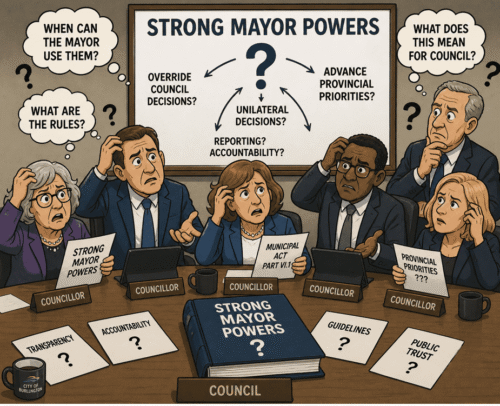
At Burlington’s upcoming Committee of the Whole meeting on May 11, Council will consider Agenda Item 8.3 – adopting “Guidelines for the Use of Strong Mayor Powers.” On its face, this looks like a responsible step toward accountability. I have submitted a letter to the City Clerk for the public record, raising concerns about the proposal. But the bigger issue isn’t the policy itself – it’s what it reveals about how little clarity we still have around Strong Mayor Powers.
Strong Mayors, created through the Building Homes Act, 2022 and embedded in the Municipal Act, 2002 – represent a fundamental shift in municipal governance. They are not a minor adjustment. They moved cities toward an executive model, where the mayor can act unilaterally in certain cases to advance provincial priorities, particularly around housing.
Burlington Response – Adopt a Non-binding Guideline.
The staff report is straightforward: the guidelines cannot limit the mayor’s authority, cannot be enforced, and do not need to be followed for decisions to be valid. In other words, the policy sets out how the mayor should act – while confirming there is no requirement as to how they must act.
What Problem are They Trying to Solve?
Not everything in the report is symbolic. The proposed amendments to the Council – Staff Relations Policy are meaningful. Requiring that directions to staff be formally authorized – and, in the mayor’s case, issued in writing in accordance with Ontario Regulation 530/22 – is a practical improvement. It protects staff, clarifies accountability, and ensures decisions are traceable.
But the centrepiece of Agenda Item 8.3 – the Strong Mayor Powers guideline – does not do the same. It encourages the mayor to consider past Council decisions, staff advice, and whether more inclusive processes are available. These are reasonable principles. They also describe how municipal governance functioned before Strong Mayor Powers existed.
Collaboration or Unilateral Decision-making
Council will try to preserve a collaborative culture inside a system that now allows for unilateral decision-making. The result may be a “comfort policy”: something that reassures without materially changing outcomes. It signals good intentions but leaves the underlying power structure untouched.
What the Policy is Missing
Strong Mayor Powers were introduced to advance provincial priorities. Yet the proposed guidelines do not require the mayor to identify which priority is being advanced, nor to demonstrate how a decision aligns with it. If these powers are justified on that basis, then transparency around that justification should be a minimum standard.
There is also no requirement for public reporting, no obligation to provide a meaningful rationale beyond the technical direction, and no mechanism for Council or the public to evaluate how often – or how appropriately – these powers are used.
Absence of Policy Points to a Broader Issue
Either municipalities do not fully understand how to integrate Strong Mayor Powers into their governance frameworks, or the province has not provided sufficient clarity on how they are meant to function beyond their legal authority.
In reality, it is both.
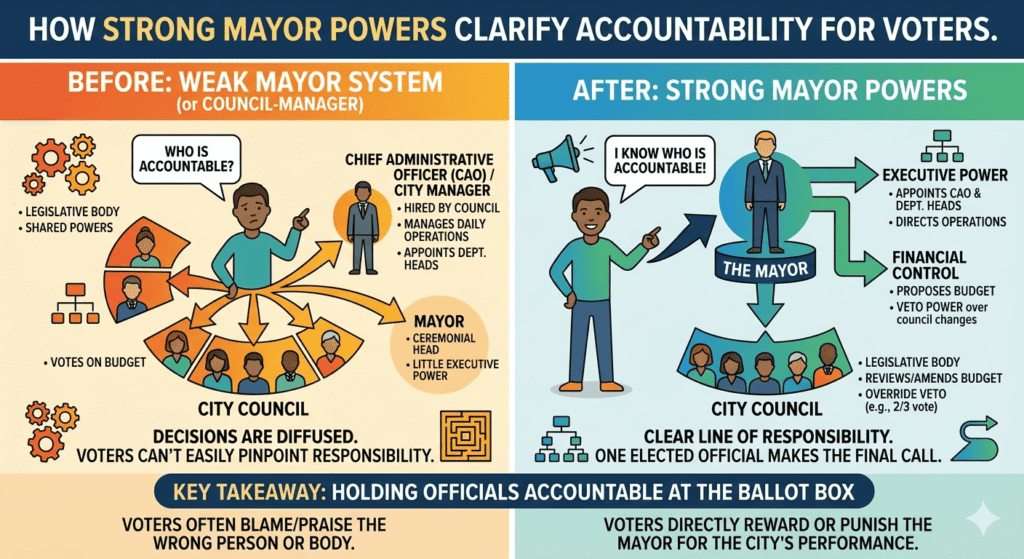
Municipal councils are now operating in a hybrid system – one that retains the language of collaborative governance while introducing executive authority that can bypass it. Without clear standards for transparency and accountability, the system risks becoming inconsistent, personality-driven, and difficult for the public to follow.
Trail Blazing or Navel Gazing?
According to the report, the City’s Integrity Commissioner was also consulted in the creation of this policy. Their comments are reflective of what was recommended to Council: “This would be a unique policy for a municipal Council in Ontario to enact. Staff could not locate another example of a policy or other document designed to guide the Mayor in their use of Strong Mayor Powers. The likely reason for that is because a municipal policy cannot limit or otherwise remove the statutory powers that are assigned to the Mayor in the Municipal Act, 2001”
Are SMP’s Here to Stay?
Probably. But at a minimum, council should include publicly stated rationales, explicit alignment with provincial priorities, and regular reporting on their use. If council doesn’t fully understand how these powers are meant to work, how can they expect the public to understand them.
Finally
Why is Council being asked to adopt a non-binding policy on Strong Mayor Powers now – just five months before an election, when the current mayor has not confirmed their candidacy and a newly elected mayor and council with new players may reasonably take a different approach to how these powers are used?
Read more about Strong Mayor Powers here:
Discover more from Focus Burlington
Subscribe to get the latest posts sent to your email.