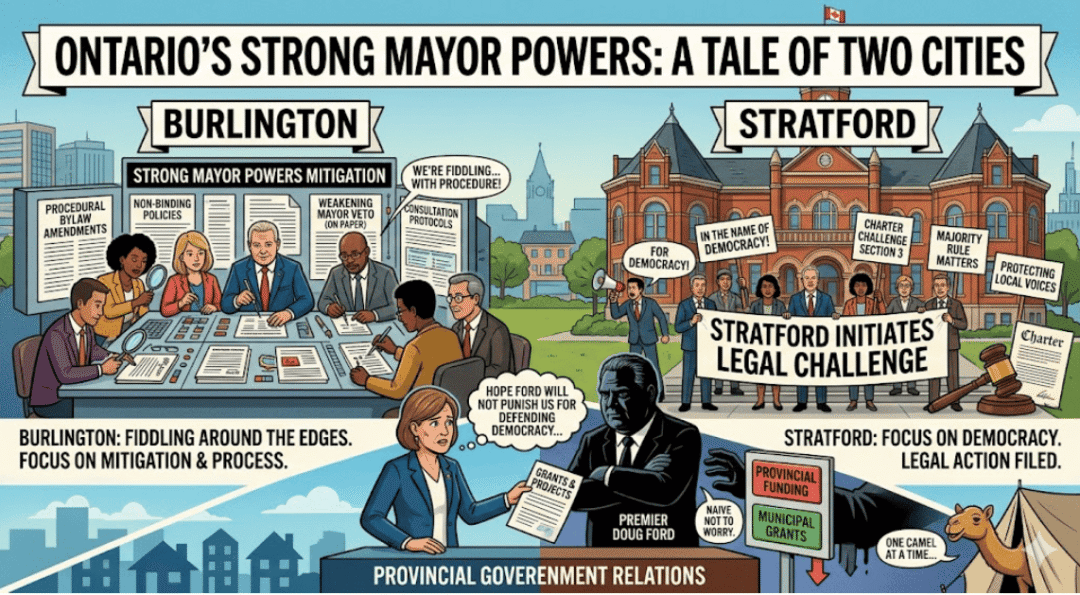
Democracy is not a spectator sport, but in Ontario, it has increasingly become a target for executive overreach. While some municipalities like Burlington have spent their energy fiddling around the edges with non-binding policies to mitigate the impact of the Strong Mayors, Building Homes Act, the City of Stratford has chosen a more courageous, albeit risky, path. Stratford is no longer just talking about democracy; it is fighting for it in the halls of justice.
A Legal Challenge Rooted in Principle
Mayor Martin Ritsma has been unusually direct about Stratford’s intent: this lawsuit is about “sending a message” -democracy matters.
Stratford has filed a legal challenge seeking a declaration that the province’s Strong Mayor legislation has “no force and effect,” arguing it is inconsistent with Section 3 of the Canadian Charter of Rights and Freedoms. That section guarantees the right to meaningful participation in the democratic process. Whether the courts ultimately agree remains to be seen. But the act of asking the question – of putting the issue before a judge – is itself significant.
The Risk Stratford Knows It’s Taking
Mayor Ritsma acknowledged what many in municipal politics understand but rarely say out loud – challenging the province carries risk. There is the practical concern about relationships with Queen’s Park. Stratford relies, like every municipality, on provincial funding for infrastructure, housing, and community projects. No mayor can ignore the possibility that a legal challenge could strain those relationships.
Then There is the Financial Cost
Litigation is expensive. Stratford has committed to funding the case through its operating budget, with council agreeing to publicly disclose the final cost once proceedings conclude. That transparency is commendable – but it does not eliminate the burden on taxpayers. This raises a fair question: if this case is about defending democracy, should the cost rest solely with Stratford residents?
Or is there a broader community- across Ontario – that believes strongly enough in this challenge to help carry it? A public fundraising effort, perhaps even a modest one, would test that proposition. It would also send a second message: that this is not just Stratford’s fight.
Burlington’s Approach
Meanwhile, in Burlington, council is engaged in a different exercise. There, the response to Strong Mayor Powers has been to explore policies – a tepid attempt to shape how those powers might be used. But they are, at the end of the day, non-binding. They do not change the legislation. They do not constrain a future mayor who may choose to exercise those powers more aggressively. And they do not answer the fundamental question Stratford is now asking: should these powers exist at all in their current form?
Democracy: Process or Principle
At the heart of this debate is a deeper question about what democracy means at the municipal level. Is it primarily about process – how councils operate, how decisions are made, how procedures are followed?
Or is it about principle – the distribution of power, the balance between elected representatives, and the ability of voters to hold decision-makers accountable? Strong Mayor Powers shift that balance. They concentrate authority in a single office, justified by the province as a way to accelerate housing and align municipal decisions with provincial priorities.
A Moment That May Define Others
Stratford is currently alone in its legal action, though Ritsma hinted at “soft conversations with other municipalities”. Legal challenges often begin with a single applicant willing to take the first step—and the first risk. If Stratford’s case gains traction, it could become a rallying point for other councils wrestling with the same concerns but hesitant to act. Or it could remain an outlier, a principled stand that others quietly admire but decline to join.
The Cost of Standing Still
Non-binding policies, however thoughtful, do not resolve constitutional questions. They do not limit legislative authority. And they do not prevent the future use – perhaps the aggressive use – of Strong Mayor Powers by those less inclined to restraint. Stratford has decided that the issue is too important to leave unsettled. That decision comes with financial cost, political risk, and uncertain outcomes. But it also comes with clarity.
The Question Now
Stratford has asked the courts to weigh in on the future of municipal democracy in Ontario. The question for other municipalities – including Burlington- is whether they are content to watch from the sidelines, continue refining process, or step onto the same field of principle.
Because in the end, democracy is not only shaped by those who challenge it.
It is also shaped by those who choose not to.
Discover more from Focus Burlington
Subscribe to get the latest posts sent to your email.
A legal challenge with little chance of success is only useful if it is used as an organizing tool to rally citizens around a cause. Expecting judges to win your political battle for you is a poor substitute for actual political organizing. The Burlington strategy could be effective for that city if the non binding guidelines become an issue in the mayor’s race this fall. Each mayoral candidate could be forced to take a position on those guidelines which could result in a mayor who commits not to use strong mayor powers. This would cancel out the effect of strong mayor powers for the city. I believe this strategy is more likely to succeed than relying on a judge.
A very interesting article. Thank you, Joe.
Bill, you seem a bit defeatist as to the legal challenge. Are you a constitutional lawyer?
Should we not take heart from the successful challenge to the AB Provincial government and the separatist (scumbags) in relation to a potential independence referendum. Sure it will be appealed. Legal pundits on CTV & CBC all seemed to think the decision will be upheld upon appeal.
Would it not be a good idea for Stratford and its lawyers to seek other municipalities enjoining the litigation or to convert to a class action lawsuit?
Maybe as a high profile vocal opponent of strong mayor powers, mayoral candidate Lisa Kearns, could gain support at Council for a motion to have Burlington join Stratford in the legal process. This would send a very strong message to Burlington voters that she is committed to delegate mayoral strong powers if she were elected mayor in October.