Our Question:
Creating a budget often involves balancing competing needs and interests with financial limitations. What principles would guide your budget decisions? How would you determine which programs or projects should receive priority when funding is limited?
Opinion – Background:
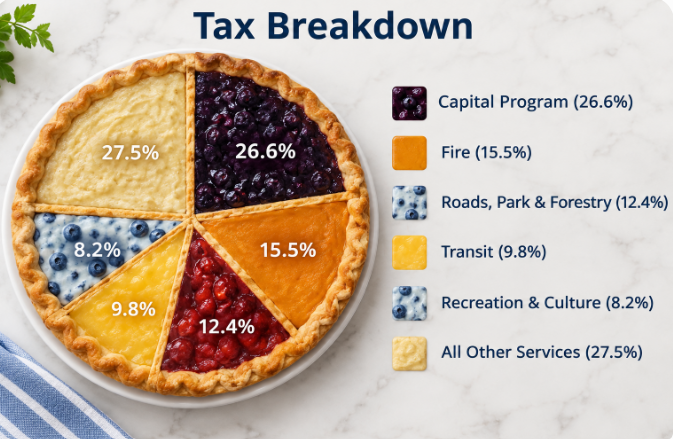
Every community has needs and wants. A primary role of government is to pay for needs and prioritize wants, within the limits of what taxpayers can afford. Think of a pie to represent the dollars the council has. The council’s job is to slice up that pie to meet the community’s needs.
In many communities, making the pie bigger is a challenge because property tax increases are unpopular. The total amount of property taxes, the net city tax levy, collected and used by Burlington is up over 47% over the last four years. Debt is also up 104% to over $150 million.
Our current council appears to have no issues with making the pie bigger. The number of collection letters the city issued for past-due property taxes is up 21% in just one year. That’s 674 property owners. Is our council finding the limit of what taxpayers can afford?
What the candidates said:
Mayoral candidate responses are listed alphabetically by first name (replying candidates only). Ward candidate responses follow.
Lisa Kearns:
My approach is to set clear priorities, protect Burlington’s long-term financial position and require spending to demonstrate value. Our reserves need to be rebuilt to safe levels so they are available for emergencies, infrastructure and long-term stability rather than becoming a substitute for disciplined budgeting. The professional background I hold in corporate organizations positions me as an accomplished leader that has delivered verified savings across industries and teams to drive down operating costs while implementing practical solutions.
That means reviewing discretionary projects, looking for opportunities to share services, using technology where it can improve efficiency, and establishing performance targets with clear accountability. I also want residents involved earlier through a Community Budget process that provides more time and information before major financial decisions are made. We must also look at the budget with the community more than once a year, I seek to launch a Tax Payer Advisory Committee.
Burlington should also look beyond taxation for revenue opportunities. My platform includes a municipal sponsorship program, growing the non-residential tax base and making better use of City assets. Protect core services, plan for the future and make every dollar work harder.
Marianne Meed Ward:
Three principles guide me. First, protect the core services residents depend on—community services, policing, fire, roads and transit—the largest items on the tax bill. Second, maintain what we own: a dollar wisely invested today saves 10 down the road. Third, be honest about trade-offs. When funding is tight, I prioritize what protects health, safety, and the long-term financial health of the city. Our reserves are at record highs, our debt levels below target and going down. We have a strong financial foundation at the city and Halton Region, where all council members also have a vote on budgets, maintaining our AAA credit rating..
Rory Nisan
My guiding principle is simple: government should live within the means of the people who fund it. As Chair of two budget committees, I’ve pushed staff and council to justify spending against outcomes, not against what was spent last year. When funding is limited, I prioritize services that touch the most residents’ daily lives, such as safety, transit, parks and infrastructure in a state of good repair, over new initiatives that sound good but haven’t proven their value. I ask whether a program is core to what a municipality should deliver, whether it duplicates something Halton Region or a community partner already does, and whether deferring it creates a bigger cost down the road. Capital and operating decisions need to be weighed together, since deferring maintenance today becomes a much larger bill for future taxpayers. Inflation-anchored budgeting is the backbone of that approach.
Click your Ward to view your candidates’ responses.
Cheryl Hurst
Forecasting for future spending, when done with knowledge of the needs, past spending, current impacts, future projections can assist with making informed decisions. Knowing the current fixed or essential variable costs will guide priorities. Also understanding our community is changing and along with the needs of the community some of the historical costs and spending need review. Also looking at streamlining processes to remove excess waste within our city’s assets. Partnerships and utilizing organizations that bring knowledge and expertise can assist with funding challenges.
Gary Carr
Under my leadership as Halton Region Chair we have maintained an AAA credit rating which is the highest and best rate. As Chair Halton Region ranks as a top municipal government with strong municipal finances and value for tax dollars. I will bring that experience to the City of Burlington.
Jeremy Gaetan
My priorities would be public safety, reliable core services, maintenance of existing assets and legally required work. New projects should compete for the money left after those obligations are funded. Each proposal should show its full life-cycle cost, funding source, measurable benefit and effect on future taxes and debt. A good idea is not automatically an affordable idea. I would scrutinize major capital commitments before they become difficult to reverse. The Robert Bateman school purchase and land exchange illustrate why I want complete, public costing and realistic contingencies before Council commits taxpayers to a project. When funding is limited, I am prepared to say no, scale a project down or defer it. Continually raising taxes to avoid those decisions penalizes homeowners, renters, and businesses.
Sean Campbell
My guiding principle would be simple – every taxpayer dollar should deliver value to Burlington residents.
When funding is limited, I would prioritize essential services, public safety, maintaining existing infrastructure and projects that address demonstrated community needs. I would also consider the long term financial impact of every decision, not just the upfront cost.
Before reducing an important service or asking taxpayers for more, I would analyze every line of the budget for efficiencies, duplication and opportunities to deliver services differently or at lower cost.
Projects would have to demonstrate a clear benefit to residents, a sound business case and a sustainable financial plan. I believe Council’s job is not to fund everything that is requested, but to make disciplined choices about what Burlington needs most and what provides the greatest value for taxpayers.
Katy Moore
I have 3 points on this
#1 new spending must be matched by new revenue. As council we need to be looking for ways to drive business investment into the city. There is no way that the property taxes can provide the money required to match our infastructure needs.
#2 Transparancy: residents need to know wat their tax dollars are paying for. If an increase is necesarry then an explaination for the cause is required.
#3 Service discipline: every dollar of spending should be tied to a measurable outcome with regular revies to ensure that the program is delivering value.
Kyle Hutton
As Councillor, I would adopt a ‘People First’ approach to the budget. Very simply, this means looking at city services and line items based not just on the obligation we have to provide them, but the actual usefulness of each. For example, its clear Burlington Transit is a necessity for many Burlingtonians, even with its flaws it remains a lifeline for people to travel, get to work or school, be with their families, etc. Meanwhile, funding for art installations or trips abroad to Europe may be nice, but they’re not necessities to help people get along in their daily lives. Its clear to me which of these needs to be cut when we’re aiming to keep the books balanced.
Tony Brecknock
Priorities should align with organizational strategic goals, evidence of impact, cost per pupil, and political support. Funding decisions rely on cost-benefit analysis and true program costs rather than historical spending. Limited resources require prioritizing initiatives that deliver the highest value to the community while eliminating lower-value services.
Chris Carter
My budget decisions would be guided by four principles: protect essential services, maintain what we already own, demand measurable value for new spending, and respect the taxpayer’s ability to pay. When funding is limited, I would prioritize public safety, infrastructure and state-of-good-repair, legislated responsibilities, and services residents rely on every day. New programs should have a clearly defined problem, cost, expected outcome and method of measuring success. I would also look at the full lifecycle cost of projects, not simply the initial price tag. Programs should not become permanent simply because they existed in last year’s budget. Council should regularly review whether they are still needed, whether another organization can deliver them better, and whether technology or process changes can reduce cost. Good budgeting requires choices, and Council should be prepared to explain those choices clearly.
Olivia Duke
Municipal government cannot fund every good idea, so setting priorities matters. My approach would begin with protecting core services, maintaining critical infrastructure and meeting the City’s legal and financial obligations.
From there, I would evaluate spending based on evidence: Who benefits? What problem are we solving? What outcomes are we achieving? Is there a more efficient way to deliver it? And what are the long-term costs of proceeding, delaying or saying no?
I would also distinguish between needs and wants. New initiatives should not automatically be layered onto existing spending without examining what we already fund and whether it continues to deliver value.
My business and public policy experience has taught me that responsible budgeting requires choices. When funding is limited, I would prioritize investments that protect essential services, address demonstrated community needs and provide measurable value for Burlington residents, while being prepared to defer lower-priority spending.
Paul Sharman
Municipal budgeting should start with strategy, not last year’s budget plus an increase. I ask four questions: What are we trying to accomplish? What services and investments are necessary? Are we delivering them efficiently? What can taxpayers reasonably afford? Essential services, public safety, infrastructure maintenance and legislated responsibilities must come first. Other projects should be evaluated against demonstrated community need, long-term benefit, affordability and measurable results. Burlington’s rolling five-year financial outlook helps Council understand the future consequences of today’s decisions and avoids pushing difficult choices into later years. We must also challenge major structural costs. Transit is a clear example. Rather than accepting a large annual operating deficit indefinitely, I want to redesign service to make it more useful and attract substantially more riders while improving efficiency. Sound budgeting protects today’s services without creating unaffordable obligations for tomorrow’s taxpayers.
Bianca Bielski
My budget decisions would be guided by a simple principle: taxpayers should receive the best possible value for every dollar spent. We need to protect the services residents rely on while making sure spending is responsible necessary. When funding is limited, I would prioritize projects and programs based on a few key questions: Is it essential? What benefit does it provide to residents? Is it addressing an immediate need or a long-term priority? What will happen if we delay it? And are there more cost-effective ways to achieve the same result?
I would give priority to core municipal responsibilities such as infrastructure, roads, public safety, parks and essential services, while carefully evaluating new initiatives and discretionary spending. I would also look for opportunities to improve efficiency and make better use of existing resources before asking taxpayers for more.
Having worked in the public sector throughout my career, I understand the importance of making difficult choices when resources are limited. Not every worthwhile project can be funded at the same time. Council’s responsibility is to set clear priorities, be transparent about those choices, and ensure that today’s decisions don’t create bigger financial pressures for taxpayers tomorrow.
Chris Bouchard
All councillors have a responsibility for the betterment to all wards not just their own, so there will always be competing interests with those financial limitations. The principles of collaboration and cooperation are crucial in determining which projects and programs will receive priority. Discussing the needs and wants of residents with other ward councillors should help establish common thread priorities that affect majority of residents and start creating a vision and budget that is indicative that truly addresses our citizen’s needs. We should start to see common thread issues that are lower priority and we can then determine if this is something the city should even be providing at no charge. The city has been stretched out thin taking on too many endeavors. We need to get back to having a united and comprehensive vision.
Frank Domenic
Burlington offers many programs which residents in Ward 6 and North Burlington don’t receive. When it comes to balancing a budget, the focus should be on fairness. If Ward 6 is paying for something, but not seeing the benefit of that, it should be considered for a cut or reduction before we look at programs and services that the entire city benefits from. A large portion of Ward 6 pays for leaf collection but doesn’t receive it. This is an expensive program. Do we expand it to every resident? Or do we consider the removal for budgeting purposes? These are the hard conversations we need to have.
Osob Adus
A municipal budget is a plan for spending residents’ money, and Council has a responsibility to make difficult choices when resources are limited.
My priorities would be essential services, public safety, infrastructure and obligations that protect Burlington’s long-term financial health. I would also consider urgency, community benefit, lifecycle costs and the consequences of delaying a project.
Before supporting significant spending, I would want clear answers: What problem are we solving?
What are the alternatives? What will it cost over the life of the project? What outcome will residents receive?
I also believe the Council should evaluate whether programs and projects are achieving the results they were intended to deliver.
Responsible financial management is not about saying “no” to everything. It is about knowing the facts, understanding the long-term consequences and ensuring every dollar delivers meaningful value for residents.
Rowen Fraser
Discussing exact criteria will be different for each decision. But the primary theme across all my decision-making in this process will be to ask a few basic questions. Firstly, what is the cost? Secondly, what utility or service is gained by spending this money? Thirdly, would the money be better spent paying down the debt?
We have been absolutely foolhardy in our deployment of financial resources here in Burlington. We need a responsible and fiscally minded council with a firm grasp on new technologies to help repair our reserves and get taxes out of the stratosphere.
You can read all the answers we received here: https://www.focusburlington.ca/#2026surveys
This is the second post in this series. Read the first post on affordability and taxes here: https://www.focusburlington.ca/survey2026taxes/
Discover more from Focus Burlington
Subscribe to get the latest posts sent to your email.