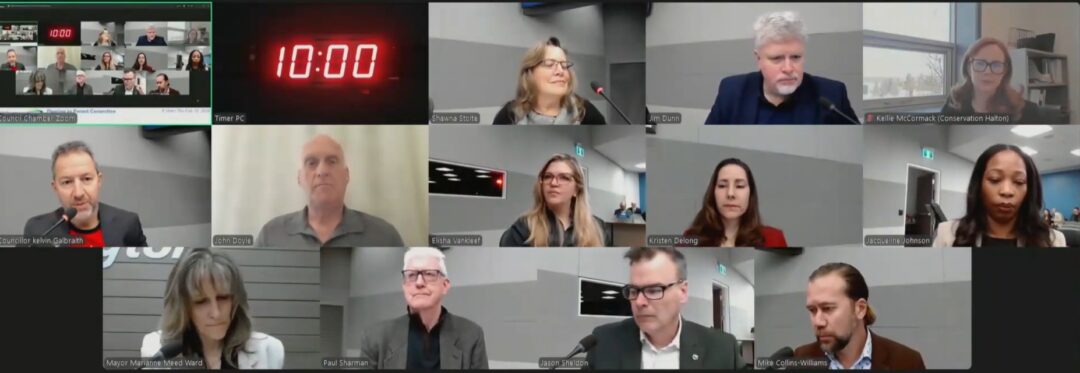
This is a computer-generated transcript of the meeting and may contain inaccuracies. You can view the agenda and verify the accuracy of any statement using the timestamp information and the city’s video on the city’s website.
This transcript is provided as a service to the community. Hearing-impaired individuals who are unable to watch the meeting in real time can read the proceedings here. Anyone can search the transcript for specific keywords and then watch the relevant section of the video linked above using the timestamp information.
Pipeline to Permit – February 12th, 2026 – YouTube
Transcripts:
(03:15) Good morning everyone. My name is
(19:07) Maryanne me Ward, mayor of the city of Burlington and co-chair of the pipeline to permit committee along with councelor Shauna Stolty, our deputy mayor for housing. And I’d like to call this meeting to order for the pipeline department to permit committee for Thursday, February 12, 2026. First, I will read a land acknowledgement.
(19:28) Burlington as we know it today is rich in history and modern traditions of many First Nations and the Matei. From the Anesnabek to the Houdinos and the Matei, our land spanning from Lake Ontario to the Niagara Escarment are steeped in indigenous history. The territory is mutually covered by the dish with one spoon wampam belt covenant, an agreement between the arkqua confederacy, the Ojiway and other allied nations to peaceibly share and care for the resources around the Great Lakes.
(19:58) We would like to acknowledge that the land on which we gather is part of the treaty land and territory of the Missosagas of the Credit. I’ll now read a safety notice for those present in council chambers. In the event of an emergency, please evacuate the chambers by the nearest exit staircase, which is located through the doorway marked with the exit symbol.
(20:18) Once you’ve evacuated the building, please gather in Civic Square outside of City Hall. All City of Burlington committee and council meetings are live webcast and archived on the city’s website. And today’s meeting is being captioned digitally, so uh make sure your words can be are clear and can be captured by the software. We do have rules of engagement.
(20:40) We ask everyone to please be respectful of each other and adhere to the rules of procedure. We’re not making decisions at this meeting, only recommendations that will go to city council for final consideration on Tuesday, February 17, and the public is welcome to join us once again for that meeting. By way of introduction of our members, our first order of business for today’s meeting is to conduct a roll call, and I’ll turn it to the clerk to take attendance and confirm quorum. Go ahead.
(21:08) Councelor Galbrath >> present. >> Councelor Charman >> here. >> Councelor Stoalty >> present. >> Kelly McCormack >> present. >> Mike Collins Williams >> present. >> Jason Sheldon >> present. >> Jackie Assada sends her regrets. Alicia Van Clee >> present. >> Jim Dunn >> present. >> Bianca Steer sends her regrets.
(21:31) John Doyle. John, I see John on the screen. Okay. Uh Kristen Dong >> present. >> Mayor me Ward present. Chair we have quum. >> Excellent. I would like to take a moment to acknowledge uh an additional council who is councelor who is here. Angelo Bentania, thank you for joining this morning.
(21:57) Angelo, as you always do, staff joining today are our acting chief administrative officer, Jacqueline Johnson, our committee clerk, Joanne Rudy, and other staff will be announced uh as their agenda items are discussed. So, first, are there any requests for changes for the agenda? Okay, seeing none, I will ask if Jim will move approval of the agenda.
(22:20) >> So moved. >> Thank you. Any questions or comments before I call the vote? Okay, seeing none, all those in favor? Any opposed? Seeing none, that does carry. Are there any declarations of pecuniary interest? Seeing none, we do have two presentations this morning and we will start with Monica Carneelli, excuse me, from Carriage Gate Homes regarding the Hamilton Roxboro case study.
(22:49) Monica, come on up. You have 10 minutes. There may be questions and feel free to adjust the podium uh to a height that is comfortable for you. >> No problem. >> Button on the right. >> Great. >> Excellent. Can everyone hear me? Okay. Good morning um committee. My name is Monica Carnichelli. I’m the director of operations at Carriage Gate Homes and I’m thrilled to be here this morning to present to you a very special project that we’re uh part of called the Roxboro Park Development. Next slide, please.
(23:22) I have a quick presentation here for you this morning and I also have Nick Carneachelli with me here today to help answer questions should there be any. Next slide, please. So, this is Roxboro Park. It’s a groundbreaking public private partnership with the city of Hamilton which has delivered over 750 mixed use mixed tenor and mixed affordability uh units including um you know a mix of market and below market home home ownership units as well as the largest affordable rental apartment project west of the GTA. So, the project uh is
(23:55) situated at uh Queenston Road in the Red Hill Red Hill Valley in East Hamilton. Uh and it was a catalyst for revitalizing the neighborhood which formerly had um a vacant uh school site as well as 8 acres of city housing Hamilton lands which housed only 107 uh affordable units. So, in total, as I mentioned, 754 units across this project.
(24:25) um and it’s been um a catalyst uh for the redevelopment of the city. Next slide please. So there are various phases of the development. Uh we have built 615 units to date. Starting with the bottom right corner uh is a 10story uh deeply affordable passive house inspired apartment building which replaced the uh city housing Hamilton units which were formerly on the site.
(24:48) It is owned by the city of Hamilton. We have 348 unit rental apartment building with affordability, sustainability, and accessibility criteria under the federal um CHC funding. First occupancies began on that building in July of this year. And we also have over 300 town homes across various phases.
(25:09) We’ve built 164 to date with 139 coming forward. As you can see, it’s a truly mixed uh mixed community with a variety of different products which we’ll get into further. But none of this could have been possible without the community improvement plan and partnership with the city of Hamilton. Next slide, please. So, the goal of the Roxboro Park community improvement plan was to provide financial incentives, minimize financial barriers, and stimulate private sector investment in a broad spectrum of housing options for Hamiltonians. Next slide, please.
(25:45) With this goal in mind, the city um aligned public policy incentives with the community improvement plan requirements. Um and in order to achieve two specific goals um specifically, they wanted to enable access to greater home ownership um with units at below market prices. They wanted to incent new rental apartment units and ensure that those units were affordable for at least 10 years.
(26:17) And for um builders or constituents who were able to satisfy these criteria in in addition to a slew of others, which we’ll get into, they could be eligible for a municipal development charge or parkland dedication waiverss. And I’ll just note in Hamilton um it is a one tier uh development charge. So it’s all bundled into one, not like Burlington where it’s two tiers. Next slide, please.
(26:40) So with this um goal in mind, the city strategically aligned public policy objectives with eligibility criteria to ensure the CIP objectives were met before any DC waiverss were unlocked. So some examples of criteria include housing type. They needed to be for family style units, two to three bedrooms. Units needed to be affordable.
(27:02) So on the rental apartment project, there were affordability caps for 10 years. And for the town homes, uh there was a maximum sale price for those units. To ensure we weren’t selling town homes to um investors, people buying the town homes needed to commit to live there for a one year. Otherwise, they needed to um you know, repay the lesser of the gain on their sale or the DC and parkland waiver that we as the developer received.
(27:30) And finally, the city wanted to ensure that these um these incentives were brought on market at scale. So we were required to build a minimum of 150 town homes under this eligibility criteria. Instead, we doubled it and built over 300 town homes. We were required to build a minimum of 200 rental apartment buildings. And instead, we provided 348. Next slide, please.
(27:53) If we go back in time, this is how the site looked before the Roxboro Park community improvement plan. As I mentioned, it was a vacant school site which was being sold by the school board. Roxboro Park won the bid on on that site. And as we were planning uh planning out the development of the site, we saw the under underutilized lands uh owned by the city.
(28:16) as I mentioned 8 acres with only 107 um city housing Hamilton units which were actually near the end of their life quite dilapidated and needed quite a lot of investment in order to bring them to uh accessible standards and that’s when discussion started with the city um about the broad incredible master plan community that we could build together next slide please so we replaced those groundoriented um city house in Hamilton units with this incredibly energyefficient and affordable 10-story building.
(28:48) Um, you know, the large familysized units, three and four beds with deeply affordable rent gear to income. Roxboro Park, Inc. built this building for a fixed price and handed it over to the city um during CO during a period of incredible cost escalation. Um we we turned over no extras and it was um you know very um economical and efficient building for the for the city. Next slide please.
(29:17) As I mentioned we we’ve built 164 town homes to date which were subject to CIP requirements such as maximum sale price um minimum one year of living in the unit. Uh we wanted to ensure that um and target first-time home buyers. So purchasers could not own any other real estate and there was also a maximum income threshold to ensure we were targeting a very specific part of the market. Next slide please.
(29:45) Roxy Rental Apartments is the you know heartbeat of the uh of the redevelopment. It’s a 348 unit rental apartment building with CHC financing. Um we have maximum rents. Uh we have two affordability thresholds, one through CHC and one through the city of Hamilton CIP. It’s an incredibly energyefficient building with um passive house inspired design and geothermal heating and cooling.
(30:10) Condo style amenities as you can see and occupancy is going uh very well. We have almost fully leased up the first building, 200 units, and recently just released the second building. Next slide, please. As I mentioned, we have uh one more phase of town homes, another 139 requirements. We have uh just received approval for an incremental 46 units because of the success of the project.
(30:36) And all the CIP requirements apply except for um we’ve increased the tenor from one year to three years at the request of the city. Next slide, please. As you can see, this is a landmark development. It’s delivered over 750 truly mixed tenor uh community units. The CIP was successful in unlocking private investment, provided the certainty we needed to secure CHC financing.
(31:00) It was flexible during these unprecedented market conditions of CO and it secured long-term affordability, which is the most important thing. And the bottom line is this project would not have been possible with the community improvement plan. Next slide, please. It really took a partnership uh from everyone at the city of Hamilton.
(31:19) It was critical uh right from the ward counselors to the mayor was actually a passion project for uh former mayor Fred Eisenberger who actually um lived in some of these city housing Hamilton units as a child. Um the city manager, senior planning staff, our very own Mr. Roashau who was very uh involved in this project as well.
(31:37) Um you know the city, the developer, everyone sort of did their part uh to to come together and make this possible. Next slide please. Now we come over the bridge to Burlington which we also know quite well as you know better than I do. Uh Burlington faces increasing pressure to meet our half targets uh specifically affordable and missing middle housing which is what you know the Roxboro Park uh development brought to light and so luckily the Burlington has a CIP which is the critical tool that can be leveraged to strategically unlock uh
(32:09) delivery in priority areas. Next slide please. So, this presentation was put together before uh council reviewed uh the possible DC elimination. So, I want to take a second to uh commend that and say that is, you know, absolutely the most critical and imminent thing that council can do to unlock housing.
(32:28) But aside from that, you know, we encourage um the city to look at their CIP and implementing mid and high-rise um eligibility criteria into the Burlington’s community improvement plan. take comfort in uh CHC and federal restrictions as I’ve mentioned in other discussions. They are extremely um restrictive is not the right word but strong willed and the city can take comfort in that and um predictability and flexibility are key.
(33:01) I’m running out of time but my closing thoughts are as you can see this is an incredible project that really portrays that municipal collaboration can truly translate policy into results. We’ve built 700 750 units here. We’ve welcomed thousands of families and we look forward to continuing to do so in Hamilton and um in Burlington as well.
(33:22) Thank you very much. I’ll open the floor to questions. >> You have quite a few. Thank you so much for that and congratulations on this incredible project. Your first question is from Councelor Stalty. >> Great. >> Thank you, Mayor. This is very exciting. I’m kind of jumping out of my seat over here. Um, I have I was madly scribbling a whole bunch of questions as you were going through your presentation and your presentation was so good.
(33:49) I was crossing off my questions as you were answering them. >> Great. >> So, I did have questions about the affordability and you answered a lot of those. Thank you. I think the one that I was curious about um that you did touch on is that when you talked about initially with the town homes, there was a one-year ownership requirement and then the city asked to change that to three.
(34:08) >> Did did was there an experience of those town homes still turning over at one year plus a day? Is that why the city moved it to three to ensure that that affordability remained? >> There was uh some experience of that. Is it okay if I ask Nick to come up and help me answer some questions? Monica missed the initial part of the pro.
(34:26) There was a very small amount of that. Um but it was something that was flagged very early in the process that was negotiated away and unfortunately this the initial phases were delayed by co so we delivered the homes later. There was a storm infrastructure issue. So it was um not something we easily came for but it it’s a good idea because um just to set that in customers minds right from the beginning to know it’s a longer term horizon. We actually didn’t have that.
(34:53) there was a component of them that did not require that the pro program was mixed but uh we didn’t see a lot of that um and unfortunately with interest rates going up people were under pressure so the ones that we did see were because there was affordability issues with people all of a sudden you know co delayed homes and then the interest rates went up too so generally speaking I that was another factor as well um yeah >> okay thank you that’s actually a really good point and I think I’d loved the idea of it moving up to three years but
(35:21) you’re right there needs to be something built in there where if someone can demonstrate financial duress that’s absolutely something that needs to be taken into consideration. So this is a amazing program and I the last note I wrote was set up a meeting please. So thank you. Yeah, on the just I’ll speak to the the homeowner aspect to it, right? There was requirements built in um you know, can’t be an investor, can’t own previous real estate, and then we got amendments to that to say, well, what if you get divorced? What if you
(35:50) lost your home or what, you know, so there’s flexibility around that has to be the principal can’t have other people. Well, when interest rates went up, a lot of people couldn’t get financing. So, we proposed some amendments to say, well, my mother needs to sign so I can get a mortgage. So it was a really fluid kind of process and we kept having to go back to amend it uh for those kind of reasons and that that um you know the the firsttime buyer um especially in that type of product is a very um unsophisticated is not really a
(36:20) fair word. New to the process don’t understand the complexities around financing and all those kind of things. And it’s it’s a lot different process to try to sell those people a home and it has to be more patient and accommodating. An investor will come, they realize that it’s a good value, they’ll write a check, they’ll get fine, they don’t worry about it.
(36:38) So, it’s a totally different thing once you separate and make it that it’s to that segment. It’s a whole different way to sell and manage that. >> And that’s where that lived experience of what you’ve gone through is hugely valuable as we move forward to hopefully creating something like this in Burlington. Thank you, >> Councelor Charman.
(36:57) >> Wow, I didn’t know you did this project. >> You’ve been keeping that a secret. It might have helped us for years if we’d known about it. >> Um, I do have a couple of questions. The first one is with this the 10-year affordable rent. Why only 10? What happens after 10? >> Well, the 10 years really there’s there’s two requirements.
(37:22) City of Hamilton actually asked for that as well. Their DC deferral document um is actually a mortgage that goes on title. Okay. And you have to guarantee the affordability for a 10-year period, right? And with each year after the first. So that’s part of it. CHC also asks for that as well. And um it’s not in this.
(37:40) We actually that’s a negotiating point with CHC. You look at your points, right? When you’re trying to get the financing and you can offer longer affordability, you can offer more accessibility. So it’s a factor. I think actually in that project we agreed to 15 years >> under under CHC it’s 15 years >> which when you think about it and you think lots can change in 10 years.
(37:59) So they’re very prescriptive. You have to be within those rates and you know you could have costs in 15 years you know 12 years down the road that created that you need to maybe raise rents or something. that 10 year is really only for the the rental apartment projects for rentals because on the home ownership you there’s only so many levers that you can do to control >> um thing. Yeah.
(38:20) >> Yeah. I guess what I was wondering is follow up that that that could means that they could be outside of the affordable rental band following the 10 years and I know in Simon Fraser University they have a very different model that continues in perpetuity. >> Yeah. But >> it’s also bundled under because within from one year to another you cannot raise rents more than an amount anyway.
(38:41) So in year 11 you can only do so much like you can’t raise the rents 30%. You can only go whatever the the percentage rate is is allowed at that time. >> Okay. So that clarifies. Thank you. My second question was about the CIP details. We talk about CIPs but I have no idea what that is worth in terms of the degree of support it provides the project and and the funding.
(39:03) Well, it would really be the the value of the development charges in parkland. >> Yes. Uh right now it with current rates it’d be like a with park and DC’s is 80 touches 80. At the time when we did the program it was around 50,000. Um uh you know it it was a um it was the you know on the the market rental side that’s one but on the rental apartment side uh in that at that time in that part of Hamilton um there wasn’t a rental apartment built in that part of Hamilton in 50 years. Okay.
(39:38) The requirement the city of Hamilton wanted rental housing to say to us to build rental housing. We wouldn’t have done it in that location in that market um without the CIP and also the preferential financing that we did with CHC. >> So the CIP deferred the >> the deferral the the waiver of DC’s. >> Right. >> Right. Um and park dedication.
(40:00) We were still required to pay and park dedication. We were still required to pay um the community education development charges. There was two or three other charges that we still had to pay. So, it was it was a material thing. >> Great. Thank you very much. >> Uh Mike, go ahead. >> Thank you for the presentation and um I had the opportunity actually to tour the site about three or four weeks ago and really really impressive site built quality.
(40:27) I mean, you wouldn’t know that it’s a below market affordable housing. Um and it’s it’s a fantastic community. Um you know when we look at the variety of different incentives that attracted carriagegate uh and gave you confidence to make the investment you know there’s a lot of moving parts there’s a lot of different agencies uh and from a developer perspective it’s often about managing risk so was it was it one thing or a variety of things like what gave you the confidence as a company to make that investment >> question >> um you know we’ve been working in
(40:58) Hamilton my whole career right I’m from Hamilton Hamilton that we’ve been working in Hamilton for 30 and 40 years now almost 40 years a crazy to say that um but what gave us the confidence you know um I believed in the community people that are from Heler know the community was there was a lot of um uh affordable housing in that neighborhood the neighborhood was not the how do you say it uh had a little bit of edge to it right to be politically correct so it was a little bit of a challenge but the ward counselor who I actually went to
(41:32) high school with right at the time was really passionate about doing something there and he was very excited when we won the the the the school site component of it. Um he was very excited that we won that part of it. That was the first four acres that’s familiar to us. We’ve done that would be our third school site in Hamilton.
(41:53) These you know when they they send them out and there was a public process. When we won that bid then we started rolling up our sleeves and looking at it. So we were always confident but the road to get you know you say we never heard about it I Monica did these timelines but you know we started in 2016 we started talking about it 2014 right so it was a long road ahead um yeah we were bullish on it um because the the components that were there yeah not sure if I answered that question >> follow up succinctly enough >> obviously CHC plays a major role in
(42:25) terms of the the financing >> has the point system changed Is anything different today than how it was when you went through it? Or did anything change during process that made things challenging? >> I’d say it’s much more difficult today to secure CHC financing than it was uh three years ago when we built this project.
(42:48) Um it continues to get more and more difficult. >> Can you just speak into the mic so folks online can >> Sorry about that. I’d say it continues to get more and more difficult to qualify for CHC financing. Um there is incredible demand for the product. It’s very um compelling and I’m monitoring the scorecard. I’m seeing every three months uh you need an extra few points in order to qualify whether that be through affordability, through sustainability or ac accessibility.
(43:13) We have projects that, you know, we are ready to pull a building permit and we realize we need more points and we’re redesigning the building to meet other accessibility requirements um and putting things on hold in order to qualify because >> the project doesn’t pencil without that that financing.
(43:30) So, it’s really make or break. >> Yeah, it’s you know, you get a developer saying it’s very challenging to bring a project forward. Okay. It actually the CHC formula um um it is constantly evolving like Monica said we have a a project that we’re doing in St. Cathine’s that we pulled we’re trying to pull the uh foundation permit before the end of 2025 because of you know thing programs that were expiring and now we’re redesigning not in a great way because we’re trying to meet this uh new requirement for 100% uh visibility in the suite. So it’s constantly evolving
(44:05) but um uh it’s a great program and uh well Monica made the point about make taking comfort and the affordability like just to meet all the requirements that are there right uh energy efficiency accessibility and then the um uh the financial requirements um you know are pretty compelling right so if somebody brings a CHC project forward like that um it’s pretty you know the due diligence the underwriting is very strong that’s one and second point I want to make about the CHC marketing program is the actual units that are
(44:38) delivered although they have affordability requirements are they’re comparable to a condo and amenity and lifestyle and the kind of people that are there right so there’s a little bit of a stigma attached to that that I I personally don’t like right um you know you go to Roxboro and there’s firefighters in there’s policemen in there’s teachers in there then you get some so it’s truly the community okay there’s nothing untoward about And um it’s you know there’s a reason why rental apartments the boom in rental
(45:09) apartments occurred in the late 60s early 70s. Okay. And you take it there’s been almost a 50-year lag. Okay. Um and the only people that were building up rental apartments were pension funds and REITs and super strongly well capitalized entities. So now we have a little time where maybe we can you know guys are pivoting and doing rental.
(45:28) Um so there’s a chance to move these projects forward. >> Yeah. Thank you, >> Councelor Gre. >> Thank you, Mayor. And uh exciting project and I think I do remember Nick you telling me about this and how excited you were about it um 3 four years ago. So, but I didn’t get the complexity and the size of it. So, um congratulations on getting this far through this.
(45:52) Um you kind of answered my question about how long it took. Um so, you made the deal in 2016 and when did the first person move in? What like how long was that? We had uh town homes. They moved in in 2022. >> Yeah. First ones were 2022. >> 2022. >> Yeah. >> Okay. And it’s not finished yet. >> No, we have our last phase that we just actually serviced the lots just before uh Christmas.
(46:17) Uh they’re not registered yet, but we’re looking to launch town home sales in the uh um in the spring. >> Okay. >> We’ve built 615 of the 750 units. >> Yeah. >> Okay. Thank you. And then a second question. Um, sounds like a fairly complex financial deal between multiple agencies. Did the municipality and and you guys have a third party consultant that set up the financial deal to encourage you to sign or how did how did you work that out with the municipality? >> That’s a good that’s um good question.
(46:50) They actually engaged Altus on the uh the underwriting of the I’m just going to step back a little bit to talk about the complexity of it. The total site was 12 acres. We originally bought the 4 acre school site that was a third party totally independent process. Then there was 8 acres of land that the city of Hamilton actually owned.
(47:08) So the process around that to acquire a city-owned asset was very complex. Okay. There was multiple we had to get multiple appraisals. Uh Steve’s nodding his head. I I probably had 100 meetings with Steve Robo. City legal, right? It was very very um it was very yeah it’s a very difficult thing to buy an asset off the city you know there’s a lot of eyes on it right um so that was there was you know m third party appraisals that were involved in that further complexity is those 107 units were occupied so we actually had to negotiate a transition
(47:39) plan okay with city of Hamilton Housing which is a separate entity of the city of Hamilton to figure out a way to phase the project and dis displace is not a great word um move or relocate and make it a you know compassionate way. Um so that was part of the complexity as well. And then on the the replacement of the homes, we built a 10-story building uh turnkey to the city of Hamilton.
(48:08) Altus was involved in vetting our numbers. Okay. And we delivered it turnkey for a fixed price four years before. Okay. It’s the if you compare what we built and what it cost them, it’s 60% of what they were delivering units for at the time. So they got a huge benefit in um you know, city of city Hamilton is building other units. Okay.
(48:33) Um so they they got certainty in that they made a deal with the developer. It’s it was $29 million, okay, to build the building for 107 units. Okay. Um and it was fixed. All right. And like Monica said, um, it was just during COVID times, okay, and cost overruns were all over the place. We delivered it on time and without one penny of extra cost to the city of Hamilton.
(48:56) >> Wow. >> Every time I see the, you know, this the politicians aren’t the same. I keep saying like, you know, I should have charged you more. I should have charged you more, you know, like and we toiled with that. But anyway, that’s what they, that was the delivery on their side of it. And um, >> yeah. >> Yeah. Very interesting.
(49:13) Thank you, >> Jason. Go ahead. >> Thank you, Mayor. Uh Monica and Nick, congratulations. Great project. >> Um something that comes up with uh high density uh applications is obviously the the unit mix >> and I noted, and correct me if I’m wrong, 27% of the units are three bed, 19% of the units are four bed. >> Incredible numbers.
(49:37) >> These are truly familyoriented units. Yeah. >> Is that Could you walk through the Sorry, you can hear me. Could you walk through the process? Is that a You’re working with the with the city on that. Was that a prescribed target or was this a you market driven or a combination of both? How did those are great numbers? >> Yeah, great question.
(49:58) It the part first part was prescribed because we were the first building that we did for the city of Hamilton, we were replacing the existing, right? So, what we replaced was groundoriented town homes. It’s impossible to create, you know, you know, replace that. So we tried to do that and the city of Hamilton actually had the requirements.
(50:13) So we had four bedroomedroom we had some fourbedroom units in that building. Okay. Uh which you never never have. Maybe they did in 1962. I nobody builds fourbedroom units and they were very wellreceived and often times you have multiple people you know two families or whatever. So it was that there is um and then our our market building or the the benthal we still skewed it um larger.
(50:37) we had a combination because there’s a real strong demand for as affordable as as possible. So those units are, you know, people are happy to have a home and a bedroom and a kitchen and one bathroom. So those are smaller, but then the two bedrooms and three bedrooms are more family style. So yeah, that’s um um uh you know, it’s it’s more than family style.
(50:58) It’s also people combining, you know, like my daughter lives uh Monica’s sister lives in a three-bedroom condo in Toronto with three girls, right? So, it’s a family style home, but they’re that’s how they can afford it, right? That they have that. So, the bigger units play that way. I’m But I’m going to say on the there are challenges around that and the mix is something that we really struggle with um uh to try to figure out what’s right.
(51:21) One thing one thing I’ll add is that um the family style units are are in high demand but also the we find the smallest units are most in demand are actually the most in demand because they are the cheapest and people are very price sensitive. Uh this product is some of the you know most affordable new construction uh rental apartment in the in the city and those units go first.
(51:47) >> Yeah. Uh I’m going to jump in with some questions as well and I’m I want to you talked about um the school site and the and winning the bid. Can you talk about the process by which you acquired that and did you have to pay I know school sites have their own set of regulations around they have to be market rate and that like land is one of the biggest costs obviously when you’re doing things.
(52:15) So how did how did that process work? How did you win the bid? How did that uh site become available for you? >> The school site actually was a sealed bid tender process. Right. Okay. >> That was state straight sealed bid. U they actually have a process. I think it’s similar. It’s a provincial mandate where they have to first offer it, you know, when they deem it excess, they have to wait a certain period of time.
(52:34) Then they have to offer it to certain organizations. The municipalities get a chance. So once it goes through that whole process, then they do a formal um bid process where it’s sealed and you win based on uh there’s rigid requirements on deposit and your financial ability. And then once you’re qualified, you submit a sealed bid, they open the envelope and >> the winner is right.
(52:55) That’s that’s how the the process is. And that was our third that we did in Hamilton. >> Okay. >> On the schools, >> they they’ve changed all that now. They don’t they don’t let us bid first unfortunately. But anyway, so you it was just a straight up you won the Okay. >> Right. >> Um and then my my next question is >> how is it determined who gets to be in those units, especially the more deeply affordable? Is is it the weight list for social services? Is it first come first serve for some of those other units like the firefighters and the teachers and so
(53:26) forth? Like who who gets to be lucky and get one of those units? >> Right. Well, again, the first building was a city of Hamilton housing own building that they have their own criteria. They they >> subsidize I think in that building 30% of the units are deeply affordable. Okay. Um right.
(53:43) So they have and they mix a little bit of market on our the Roxy project. The two tower 348 unit is um um traditional marketing. Okay. And uh pricing in accordance with um the CHC guidelines that we agreed to in the city of Hamilton guidelines. Right. So, but I’m going to say, you know, we all know what numbers are in that market there.
(54:04) We have one bedroom starting from $1,588. >> Wow. >> Okay. Um, a one-bedroom across the street if you try to rent the condo there’s $2,700, right? So, we are, you know, more way more affordable than they would find. So, it’s a traditional marketing process that’s there, right? And it’s open to everyone.
(54:23) So, there’s no preferential at all. >> Okay. And just a followup, were you uh overs subscribed? I mean, were people uh lining up to get these units and they were gone quickly or >> you know, it was a process. It took the first building was 200 units. Uh we started marketing last summer and it took six months to fill it, right? So, it’s it’s um uh I wouldn’t say it was we weren’t over subscribed and now we just recently launched the second building.
(54:47) So, it does take a little bit of time to fill the units up. Um you know, even in this malaise that we have, even rentals are slower, right? And um uh it does, you know, and it costs people money to move, right? So if they’re looking to improve their circumstances, they they’re not that fluid that can do it in in, you know, in 30 days or 60 days.
(55:08) So everybody’s kind of moving at a slower pace, right? So >> Okay. Yeah. >> Thank you. Very helpful. Uh councelor Stoalty, back to you. >> Thank you. Sorry, very quick question. I was actually trying to find on the map where the Roxboro project was. What What is the address that I could look for to see where you are? >> Uh 16. Yeah. 16 Rock Sand Drive.
(55:25) >> Yeah. Rock. >> So, it’s actually backs on you can see it from the Red Hill Parkway that that the thing that goes up the mountain. Okay. It’s um on Queenston Road and the Red Hill. >> Okay. Perfect. Thank you. I look forward to meeting with you too in the very near future. >> We can show you. >> Yes, we would. Yeah.
(55:44) And we maybe we can arrange when the weather’s nicer, we can arrange a tour of the site. That would be great. We’d be very open to that. >> Perfect. >> Yeah. >> Thank you. Field trip. Awesome. I love them. Uh Alicia, you’re next. Thank you. Uh thanks for the presentation, Monica. It was great. Um I had the chance to actually watch this project grow uh from the ground up and it’s very impressive and um I think it’s revolutionary for the city of Hamilton and I think they should continue with this.
(56:12) Um so congrats to you guys and your partners on this. Um I know the climate has completely changed since this proposal started. So, you know, as of uh today, what do you think would be over and above needed in terms of a partnership or um from the city to get a project like this off the ground? Cuz obviously today we can’t get projects off the ground in general.
(56:39) So adding this deeply affordable level, it’s it’s almost an over and above, right? So, it’s a heavy loaded question, but just wondering your thoughts on, >> you know, I think every tool in the tool belt, right? Everything from making the approvals a little easier. Um, you know, DC waiverss are great, the deferrals are great. Like we we’re in St.
(57:01) Cathine’s, uh, they have a DC deferral program. Okay. Um, there’s also the what’s that other thing that we just got there in St. >> Housing Accelerator Money? >> Um, I’m not sure. It’s it’s you know people are pivoting to rental and trying to figure out how to move things forward. It’s very very challenging right now.
(57:18) Um any and all things that we can do um to help us you know I’m stuttering here because there’s no clear answer. Um you know the market is such that um there’s challenges in the in bringing a project forward, right? things like what happened yesterday or is hopefully going to happen at at um council where you’re giving a two-year break um uh on DC’s and I was brief conversation with the mayor before two years is not a lot of time right so for a developer waking up the day after you get that approved say okay is this going to make my project go
(57:54) he’d really have to hustle in that first 3 to six months of that process to make it happen within the two years right so there’s you know it’s hard to go from the idea or a or a new policy to actually implement and get the thing done, right? So, anything that that helps um everybody decide, well, let’s go forward and how do we do it as quickly as possible? >> That that’s >> Yeah.
(58:16) >> Yeah. >> And I will note just from our experience too and listening and and feeling the same same pain, um CMHC is continually moving the goalpost. So, there’s been more recent changes where uh that have, I believe, come into effect. Um, and again, the point systems forever changing and you could be actually out of the ground and and under construction and they’ll change it and you’re required to to make these changes.
(58:43) So, um, it is a a bit painful. Um, >> a lot painful. >> We’re at the mercy. Exactly. So, I think um, you know, on that level, there’s >> there’s some uh, >> work to do for sure. Thanks, Councelor Stolty. >> Thanks. Sorry. Uh I will shut up soon. Keeps bringing up more questions. So to Alicia’s point, and I’m not sure if this is something you can answer, but maybe just comment on >> when you talk about anything will help getting a project like this going off the ground now when it’s more difficult to do. So if Burlington, if the Halt
(59:21) School Board were to suddenly decide that they had properties that they were going to declare redundant, we never know when that’s going to happen, but if it were to, if the city were to be the one to invest in the property rather than the developer, do you see the potential for that working in a partnership if the city owned the property and therefore the developer didn’t need to factor in the cost of the land to the to the build? Uh you’re saying like city-owned property existing and trying to make that into some sort of development.
(59:50) Yeah. Um possibly. Um um that is a possibility. A partnership is more what I’m thinking. You know, for I made the example of of the building that we built for the city of Hamilton. All right. Um the one that they did at the bottom of James Street was uh 70 60 or 70% higher in cost per door. Right.
(1:00:11) So, um I think you can le pardon >> the retrofit >> ret. Yeah. But even the new ones that they’ve done, right? Even the new ones they’ve done are much more um a a collaboration is a great is a great way. Partnering with developers to use their expertise on bringing the projects forward is a great way to do it. And if the city can help with the land, the land is the um is a hard circumstance especially when you’re in a waiting period, right? So, and if you have asked, you know, go ahead.
(1:00:38) Uh, one thing I’d add is the ownership once if it’s a rental apartment building is ownership once it’s stabilized. You know, one of our partners is uh, um, property management company, Effort Trust, who’s a, you know, um, prolific company in the area. Um, so, you know, it depends on the city’s appetite to, you know, hold the asset into into perpetuity.
(1:00:57) you know, city uh Hamilton has a unique um entity of city housing Hamilton where they own the assets themselves, manage them, and they have a portfolio. Um >> you know, I again I don’t want to be critical. City of Hamilton Housing is a very dynamic, really sincere people that run that organization. Okay. Um I personally think it’s somewhat flawed when we go back to the very beginning when the ward counselor when we showed the ward counselor Google image right of their units that the city of Hamilton owned with a blue tarp on top of the
(1:01:29) roof you know he brought that forward everybody right and saying wow how can we have assets like this right so um you know partnerships and collaboration is a great straight up municipal ownership like building owning and managing I’m Not sure that’s something that should be a long-term thing for municipalities.
(1:01:51) I think you can give the tools to create the these assets and have some controls in place that get you your outcome that you need. >> Okay. Thanks, Councelor Sherman. >> Thank you very much. I I didn’t see in the presentation the number of acres of the >> 12. The original school site was four and the city of Hamilton owned 8 acres with 107 town home units on 8 acres.
(1:02:16) Okay. Um, so thank you for that. Um, I just thinking about what I’ve been hearing recently about the CH um, brain got dead CHC uh, funding that they give us low interest rates, but then they charge us fees that obliterate any opportunity to get any funding out of it. >> Is that is that a am I just hearing nonsense or is that true? It’s a like on you know honestly I think actually the programs are really good.
(1:02:46) Um you know when you go to RBC and try to get financing it all financing is financing is difficult to get that first you know everybody that’s ever tried to do it even a homeowner today trying to get financing is difficult. Um yes it is but as a whole package there’s basically two kind there’s um uh not two kinds I would say the vast majority of financing that’s happening if not all of it in rental apartments is some sort of CHC product um the fees are there you know ours for example one program is geared to the 10-year
(1:03:19) bond rate okay which helps because the rates are are much lower um their fee structure is higher and their due diligence is very very difficult um and sometimes and not very attentive, right? That combination is is really hard to deal with. Um but overall, it’s it’s a good program that needs, you know, uh how do you say it? It’s pretty sophisticated because they’ve been around for a long time, right? So, you know, unfortunately, I think a lot of the requirements and the changes that happen uh are I don’t know what
(1:03:52) motivates them, but like Alicia says, right? all of a sudden like Monica constantly monitors that thing and you know we are active and we’re redesigning a project right those are the kind of things that make it go forward or not so >> just to follow up you know I’m just thinking about a pro from a proformer point of view you got to figure out how to make money in a high cost low low price environment um but I’m hearing numbers like millions of dollars of fees going to cate like we did a project in Dundas we built it we we’re have no
(1:04:22) ownership stake in it and then the owner added up all the fees he’s at after it’s all the CMHC stuff and all the consultant reports required for that. It was quite a daunting thing, but he got it built. The building’s sitting there. It’s in, you know, it’s an is 80 unit project in downtown Dundas apartment.
(1:04:36) Hasn’t been built in Dundas for I don’t know when. I can’t I don’t even know when the last rental apartment was built in Dundas, but it existed. And um they were lucky enough that they were building on something that was remnant land, an existing apartment that had a parking lot, right, with zero land cost.
(1:04:52) And they made it work, right? So, it’s uh it was a challenge, but without that program, they wouldn’t they wouldn’t go traditional banking financing there. >> Despite everything, we love them. >> Yeah. >> Thank you. >> All right. She’s already on the on her way to the field trip. That’s awesome. Uh I see no further questions.
(1:05:12) Thank you so much. Congratulations. This is uh this is actually a model of how to do partnerships. So, thank you for sharing that with us. It’s uh given us a lot to think about. >> We applaud. We can applaud. Please, please applaud. Thank you. Anthony is amazing. >> So, uh, our next speaker, Anthony Pasarelli from the Canada Mortgage and Housing Corporation.
(1:05:36) You, speaking of which, uh, you you may get a number of questions. Uh, but welcome. We’re delighted to have you here and, uh, share with us your observations about what is happening in the housing sector. So, the floor is yours and go ahead. >> Thank you. Thank you. Yeah, it’s great to be here. Um, what I’ll do is short presentation.
(1:05:58) I’ll get into some of the just the latest data. CAC obviously collects the data on the new home market, right? The new home starts is our most commonly cited statistic. Uh, get into something the trends in the market and also kind of where we see the market in the next year or so as well. And then obviously I’ll leave time for questions from everyone.
(1:06:17) If we can go to the next slide please. Okay. So, uh when we talk about housing starts, you know, there’s actually two categories, most of the presentation I’ll focus on the blue, which is the new construction market, but I’m quickly going to touch on the red. And the red is the um we call them up conversions and you know, mostly in Burlington those are ARUs, right? So, I wanted to bring this up because you could see that in the last uh last year actually, you had noticeable increase in the ARU permits issued. You know, you changed uh you had
(1:06:55) a CIP put in place around I think it was the springtime. And if you look at the permit activity, it kind of started to really trend up around the second half of the year. So, you’re seeing some momentum behind that, which is a good thing. Um the blue is the new construction part of the market which makes up most of the new homes.
(1:07:13) Uh I included our um outlook for this year a high and low scenario. You know the numbers are you know not great I would say in terms of the new construction part the ARU I’m factoring in continued momentum right because it’s still a fairly new development putting in those uh incentives. But on the new construction side, you know, we don’t expect it to be that strong of a year this year.
(1:07:39) A lot of that 300 to 500 I’m saying is is in this purpose-built rental segment of the market, right? There’s a couple projects, obviously the one across the street is the biggest one that, you know, we would factor into this year’s numbers um because I could see the sightes cleared and all that. Um there isn’t much else out there right now in terms of you know shovel ready types of projects.
(1:08:04) Uh potentially one more uh on the high-rise side and then you know you always have some of that ground oriented stuff but that’s a very slow market. I’m going to go into some of these trends in terms of what’s happening in the different market segments. Next slide please. Okay new construction.
(1:08:21) So the new this is just a new construction component which makes up most of the new housing. You could see historically, you know, a lot of that is coming from condominium apartments, right? And that is not going to continue to be the case over the next couple years. The little red sliver on the top of the screen there is purpose-built rental apartments.
(1:08:41) So, this is city of Burlington. So, you added 11 units last year. New, these are new construction projects, right? Groundup building, not the arus. This is obviously where most of the growth is going to happen and it’s already starting over the last couple years in a lot of cities in Ontario. Not as much so far this or so far in Burlington, but again that’s making up most of the construction going forward.
(1:09:08) That groundoriented navy blue uh you can see it’s been quite sort of weak for a long time. Some of that is due to land availability and some of it is just due to the market being very slow for that type of housing given the price. Next slide please. Okay, so these are GTA numbers. So this is kind of illustrating the trend in the new construction market towards the purpose-built rental apartments.
(1:09:29) So these are GTA housing starts over the last 5 years. You can see that you know starting on the left that ground oriented type of housing has been trending down steadily. The condo one you could see really dropped down a lot last year, right? The red there compared to the gray 24 to 25, you know, extreme decrease in that type of construction.
(1:09:49) And then in that right hand column is the purpose-built rentals where you know you’re actually growing and also uh Ontario wide if you just look at Ontario numbers that actually exceeded the other categories in the GTA was a little bit less growth but we think that’s going to change this year.
(1:10:12) Uh if I looked at our CHC uh insured or financed projects the ones that have not broken ground but are approved. So these are like shovel ready permitted finance approved you know just in the GTA the numbers are round similar to last year’s number if you then factor in that we generally our estimates that we’re we’re financing like about 80 to 90% of the rentals right so if you factor in that you know this year should be around similar to a little higher in the GTA that number will be potentially hitting the 10,000 mark I would on purpose-built rentals. Those other two
(1:10:49) categories though, they are due for more declines, I would say, particularly the condominium apartment. Next slide. This is new home sales. So, I’m using the same sort of colors and years, and these are just the sales. So, right, cuz the sales turn into the starts. The sales happen first pre-construction, you get your financing, and you start your your your projects.
(1:11:14) Um, and with the condo apartments, obviously that takes quite a while, right? So, you could see how the sales activity on the condominium apartment category has really just tapered off to to to almost nothing, right? Um, so that’s kind of what’s behind the forecast is this idea that you’re not going to get those condo projects.
(1:11:33) You’re going to rely on the purpose-built rentals. You got a couple of them that are kind of ready. you know, looking further ahead. You know, we’re a little bit concerned about after this year because, you know, we know about all these projects that have been financed in the last half of 2025 that have yet to break ground.
(1:11:52) Developers generally saying to us that they are going to proceed. Even though the markets kind of soften for rentals, they’re not going to give up that kind of those kind of financing terms. Plus, you’re going to be building and completing and selling or renting this unit the units in about three years time, let’s say, right? Especially if it’s a high-rise.
(1:12:13) So, the market will be a little bit could be different then too, right? So, most of those projects that are like rubber stamped will go ahead. It’s the next wave that we’re a little bit more worried about because it’s become harder to finance projects like mentioned. Some of that is due to just the market conditions, right? like when an application comes in for um for us to look at, right? The rent that is needed to make the the whole deal work has to be justified through the what the market’s doing.
(1:12:41) And right now, rents are declining uh especi especially at the higher end of the market, right? And sort of pushing down the the average rents. Uh next slide, please. Just getting into this home ownership just a little bit more. So, this is City of Burlington prices, new homes, and resales by the different dwelling types. So you can see there’s a huge gap and you know the gap always exists between new and resale but one thing to note is in the resale market the prices are falling right and they’re falling quite fast whereas the new home prices are not
(1:13:11) falling at the same rate right so sort of the gap between the new home price of each of these dwelling types and the resale it’s getting wider generally so that’s making the new the resale product more appealing also it’s because of the fact that it’s a lot cheaper and there’s affordability issues. Next slide.
(1:13:32) This is the last slide I had. This is just translating those prices I just showed you into like an income qualification number. I’m using the scenario of putting the minimum down payment. So, this is like a CHC mortgage. It’s generally used to illustrate what like a firsttime buyer would be facing out there, which is important because the firsttime buyer market really drives the sales activity, right? A lot of people right now, you know, you talk about people, they’re sort of locked into their home because they can’t sell the house to move up to
(1:13:59) the next house. A lot of the new homes in Burlington, most of the uh GTA in Ontario, I would say, are a product for move up buyers. So, those new homes are not going to get sold until the person sells their existing home and uses the equity to buy the new home. So, the first time buyer dynamic is important.
(1:14:17) So you could see here even with the resale product that’s the navy blue dots there you know the income you need to put the minimum down is still quite high. Even with the prices coming down for you know it’s about 3 years straight of price declines you’re still at a very high income. Uh just to put in perspective we estimate about 20% of the renters in Burlington are like in the 80,000 plus I think it’s about a quarter 20% are like at 80,000 plus income.
(1:14:47) So it’s not even hitting that, you know, uh top end of the renters who could buy if they wanted to, right? So we think the prices have to come down a little bit more to be to see a meaningful sort of bump in the sales activity. Uh next slide. Oh, it’s just my Okay, so that that was the last slide. Uh my contact info is there.
(1:15:10) Uh as always, I’ll I’ll send out the slide deck and you know, Steve can distribute it. Um, I know I send our our monthly housing starts information out to some of the people in this room like home builders association. I send it to uh the you the mayor as well uh every month. Um, happy to take some time to answer some questions now. >> Thank you so much.
(1:15:31) Uh, you have one coming from Mike. Go ahead. >> Thank you, Anthony. And also appreciate you sending me those numbers every month. Um, appreciate that your presentation also contains the some sales numbers. Um, I’ve often said that the housing starts aren’t necessarily the number that we should be looking at.
(1:15:49) Like those are the numbers in terms of the economic activity that actually generate the on-site jobs, but they’re not necessarily indicative of where the market sentiment is in terms of actual future investment decisions. Um, and it’s really the sales numbers that sort of show us where we’re at when we put rental aside.
(1:16:05) if we’re focused on >> right >> on the ownership and you know you had some pretty bleak numbers there. Um Urban Nation which tracks the condo market across the GTA um I believe their year-end release said that it was the worst sales numbers they’d ever recorded and they’ve been recording since the 1980s.
(1:16:24) Um and then um WHBA had reached out to Zonda, a different firm that uh looks at sales numbers and they had a grand total of four condominium sales in the whole city of Burlington in all of 2025. So in terms of looking forward to future activity um I am coming to a question here. um you had showed that you’d forecasted uh 300 housing starts I think in the the high-rise or the condo section uh sector for Burlington um in 2026.
(1:16:53) Now in terms of the housing starts CHC you measure it not when the ground breaks but when the foundations actually poured. So >> right >> in terms of your detective work in building that forecast >> when you have that 300 number are those units in some cases that are already >> there’s no housing start but they’re under construction somebody’s excavating they’re digging down and you know like okay there’s going to be 300 housing starts or is that sort of a forecast on future activity on where you see some of these sales translating into somebody
(1:17:25) pulling the trigger getting the financing and actually starting a Right. Okay. No, that that’s a great question. So, yeah, the the the forecast for this year, like we’re looking at projects that basically are through city council and they have like the permit or they’re going to get the permit very soon because to get to that, like you said, the stage of the housing start where, you know, the construction’s basically at grade, right? Speaking more about the high-rise projects, um it takes time, right? depending on how much
(1:17:58) um under how much you got to dig, right? Pretty much the excavation process. So that’s a reflection of what’s already sort of I would say that the low sales activity that you’re seeing plays into that, but also I would say into maybe a next year’s number too, right? I think going like I I kind of mentioned this beyond this year, you know, we said 300 to 500 total new construction.
(1:18:23) I’m actually factor in the ground too, which is a very small component in 2027. You know, our concern is that that rental depending on incentives out there, right? I’m basing it on current incentives in the market that the rental could slow down and that would really dry up construction even more because the condo uh and the other groundoriented stuff doesn’t seem like it’s going to come back that quickly like the recovery won’t start next year.
(1:18:49) So with the rental slowing down it’s a um very alarming. >> Then you had one other slide that really drew my attention >> microphone. Yeah, >> you had one other slide that really drew my attention in terms of some of the challenges that the industry is facing in actually moving anything forward and that’s was the slide showing the benchmark pricing difference between resale and new.
(1:19:13) And this is one of our challenges when we’re sort of coming to to government for help whether it’s locally on DCs or looking provinially or federally on HST GST. there there’s a huge gap that exists between the resale which is not paying DCS or HST or GST and and the new um the cost of actually building and delivering that unit to a consumer.
(1:19:39) That gap is what is killing us because it’s impossible for Carriage Gate Homes or or New Horizon or Remington to sell a new home or condo when there is a building directly across the street that was built a couple years ago with very similar quality and amenities that that unit is available for $100,000 less, not in five years, but today.
(1:20:01) Um, and that’s really sort of the wall that we’re hitting in terms of consumer confidence and getting people back to investing in in new housing. >> Definitely definitely the case. And because the market is what it is right now where prices are de declining in that resale market quite quickly, like I said, it’s uh that situation is getting worse.
(1:20:22) So, um, DC changes to fees to bring the new home price helps. And honestly what else is going to help is the recovery in the resale market because once that actually you know say the prices start to stabilize there demand comes back you know generally home new home building occurs at a faster rate when there’s sort of shortages in the resale market right right now we’re in sort of the opposite environment where it’s uh overs supplied right in a lot of cases.
(1:20:50) So, new home prices coming down plus resale prices actually kind of so that so that gap gets smaller and there’s sort of a a reason to go into the new product. The price isn’t that much different. It’s new. It’s got new technology, new materials, um amenities and stuff like that. Yeah. >> Thank you, Councelor Stoalty. >> Thank you, Mayor.
(1:21:13) Um could you bring up the slide deck again, please, Richard? It was the last slide that I had a question on. Yes, that one. Thank you. It’s like you read my mind. Um, can you help me to understand this? So, when I was looking at the bottom of these three lines, single detach, townhouse, and apartment, when you say the word apartment, is that condo purchase or is that rental? >> This is for purchase, right? These are only purchase. So, it’s condo apartment.
(1:21:38) Sorry, I should have mentioned that. Another thing that I actually failed to mention is you can see on the single detached, there’s no new home income number there. It’s no, there’s no red dot. The reason for that is you can’t buy a new home with the minimum down payment because it exceeds there’s a $ 1.
(1:21:56) 5 million threshold to get like a less than 20% down mortgage, right? And the new home price is 1.8, I believe it was, right? So, you can’t uh not that many people would anyways, but just to illustrate the idea that like that price is just way off >> a first time buyer uh off the charts, literally. Yeah, it’s not possible. even the resale one 235,000 to put like the minimum down, right? That’s a very small percentage of first-time buyer households, right? So, they’re they’re more in the market for like the town homes and apartments and even those are
(1:22:26) even in the resale market, you know, like I said, 135,000 for a resale town home. That’s it’s that number has come down because the prices have come down. So, this income number has come down, but it’s still not uh like I said close to like what renters incomes are like, >> right? What would be that number for a new home single detached >> income threshold? >> Oh, just out of curiosity, >> I couldn’t do it because you’d have to put 20% down.
(1:22:54) So, this math would be totally different. These are all doing like say 5 to 10% down mortgages, right? Cuz the down payment is a big thing for a first time buyer, >> they have to um >> to get the 20% down, that’s more like getting a gift from your family or something like that, right? This is the slide that hit home for me just because I’m so focused on the next generation.
(1:23:14) This speaks volumes >> and it’s it speaks to again to what Mike said why the market is so slow on the on this home ownership side, right? Um even the resale market like I said the prices we think have to come down more to bring these income numbers down so that more people can get into the market. Um you know that could happen soon.
(1:23:36) I think you know we are predicting that the sales activity will probably bottom out soon and start to tick up. A lot of it is you know obviously people waiting on the sidelines too because of the economic uncertainty that exists right now. Um but some of it is what I’m showing on the screen which is just the prices have to be lower.
(1:23:52) >> Okay. Thank you councelor Charman. >> Thanks for coming here today. This great answer. Um, despite my comments, I I was thinking about slide five where you’ve got the new home sales in GTA. So, it’s it’s just >> Thanks for that one. Nope. Down. >> No, the next one. Yeah, next one. >> Uh, no. A forward. Thanks.
(1:24:18) >> There you go. >> That one. >> Yeah. I was just thinking about, you know, the genesis of all our troubles was the bubble of condominiums in Toronto where the city went crazy. We got condos everywhere and then everybody else across the province decide we were going to have condos and you know 40 of our 45 44,000 units are in our pipeline are condos and and we also know at the same time that that that you know this this number of7 sales that’s pre-sales I’m assuming.
(1:24:51) >> Yes. for the GTA and and that doesn’t really make a bit of a dent in in condos like if that’s probably 10% of like 10, >> right? Yeah. The inventory that’s not sold is is extremely high and it’s it what it’s doing it’s also causing you know fewer launches, right? So what like the developers see this and they’re some of those projects in your pipeline like you’re referring to some of them are kind of you know they’re not close to maybe launching.
(1:25:18) They’re just going to delay, right? they might get they want to get through the approvals process but they’re not going to start selling because the environment’s not uh uh there for that. Some of them uh also are trying to convert it into a rental project and come to CMHC to see if the financing works which you know there’s been some movement on that front but I would say you know I look at this a lot cuz I hear a lot of anecdotal evidence of this uh when I go to events and do these speak engagements but generally a lot of the condo projects that come and
(1:25:52) want to convert to rental they’re looking for these really higher rents to make their proformer work that are not really justified by the market because they were building like a luxury product, right? So, so it’s not really working for them. There there are some examples of where it has occurred where it was originally launched as a condo, they weren’t selling, they said, “We’re going to take it off the market, change it to a rental, come to CHC, and they’ve been approved and they started building.
(1:26:17) ” >> Yeah. And I thank you for that, and I appreciate the information. My I WHBA is not thinking there’s going to be any increase in condominium activity for 10 years, not two. I know our planning department is hopeful. Um that but that’s a bit of a challenge. My my my question was is going back to the uh the fees CHC fees, >> right? >> Um now I’m assuming that there’s fees that one would a developer and applicant would have to pay to a bank in order to get funding.
(1:26:45) Um so are your fees competitive with the banks? >> Okay. So I’ll because I heard this comment when I was listening to the previous presentation, so I wanted to uh address it. So if you were to come to CMHC for the rental financing, there’s two sort of groups you’re in. The first group is most commonly known as MLI, MLI select.
(1:27:07) That’s where you go to a bank to get a mortgage and the mortgage sends it to CHC to ensure the mortgage. So the bank wouldn’t lend on the terms that they’re offering without the insurance from CHC, which is the same product we have for residential mortgages, right? or someone puts the 5% down, they go to a bank, the bank has us underwrite it, and we’re just saying we’re insuring it in case of default.
(1:27:30) That’s where a lot of that rental activity happens. The fee you’re referring to is an insurance premium. Sorry. It’s like the we wouldn’t be able to offer those rates and terms without the insurance premium. So, I don’t know if I would call it a fee the same as like a tax because you wouldn’t be financing without the insurance, right? The bank would have offered you a low a worse rate.
(1:27:55) They would have asked for more equity. The project may never have, you know, worked on the proform without the insurance. Um, the second group is it’s called ACL. Um, so this is a product, a product where CAC is actually lending the money. We’re the bank, but the money comes from the federal government.
(1:28:16) The federal government gives us a certain amount of money and we have to lend it out to rental developers across the country and a little bit more ownorous because it is the government’s money. They have like different standards, right? They just dictate to us what the standards are. Uh, and that’s kind of some of the examples I think provided by our friends here.
(1:28:38) uh that did the first presentation they were giving about some of the the hoops they have to go through but for that because you’re the government is lending the money for the project they want to make sure that the project is you know has the affordable component like you’re going to cross more te’s and dot more eyes with something like that because the money is coming directly from the government versus the other product where the bank’s lending you the money CAC is just assessing the building and saying you know yeah these rents are reasonable we don’t think there’s a high
(1:29:06) risk a default, go ahead with your project. And with those ones, it could be total market rent, a mix of affordable market, right? With with the one where we’re lending the money, ACL, you know, you have to have, like they said, minimum 10 years of um affordable on a certain percentage of units. It’s it’s just a different set of criteria.
(1:29:29) >> Well, thank you for that. It seemed a little counterintuitive that government money would be more cheaper and would be more expensive because of those kind of considerations. I think we should be making it a lot cheaper. But I I appreciate the explanation. Thank you. >> Thank you.
(1:29:46) I I do have one question and it is related um to I think it’s slide three, but it’s the total housing starts and just what your assumptions are in there. And you you touched on it, but I just wanted to be clear. So for 2026, um you’ve got low and high there. So 2026 you’re saying, uh sorry, the uh one >> just the one prior to that >> before that.
(1:30:09) Yeah, that one >> uh 300 units. Um and you’re saying the 100 is the ARUS, >> right? >> Projecting the 100 is is Yeah, it’s almost all AR like we call it up conversions. You could be um instead of it Yeah. An aut would be a basement. It could be on top of that, you know, like duplex, anything like that. Yeah. >> Okay.
(1:30:34) Uh yeah, and this this will be relevant to our later conversation, the verbal update on the the DC uh credit that uh council dealt with on um at committee the whole earlier this week. So, we don’t pay DCS at all, I don’t think, on ARUS. So, we’re talking about the third 300 there. And is did did I hear you right in saying that you think that most or all of that is going to be the purpose-built rental across the street >> in that in the low scenario? Yes. Right.
(1:30:58) I’m fac I’m always factoring in a certain amount of again that ground oriented because even though you >> don’t have many of these subdivision projects anymore in Burlington, there’s still, >> you know, I would say uh >> 50 to 100 that just happen, right? >> There’s tear downs there, you know, like stuff like that.
(1:31:16) like there those things >> but small so multiple part of the pie for sure. >> Okay. >> And then on the on the high end the optimistic side is 500 and that’s uh is that do you have a sense of what the mix is there? Is it purpose-built rental mostly there as well? >> It would be mostly purpose-built. Uh it could be again another project thrown in there plus a little bit more optimism around the ground.
(1:31:42) Again, like these are forecasts, so we have to give ourselves some kind of wiggle room. That’s why we give a range. So, a little bit more in the ground. The the low scenario is very like pessimistic about the ground. The other one’s a little bit more optimistic, but it’s mostly >> a little bit more on the on this apartment side, right? Um >> that that could factor into that.
(1:32:02) Um because you know we’re working off of what we know right now in terms of permits and approvals, but like >> we’re only in beginning of the year, right? So you by June, >> especially if you say you have the the DC um go through count the DC exemption, >> you know, >> let’s say there’s a faster than expected response to that, right? It could be more towards this high scenario or even above it, right? because we didn’t know about this when we uh >> put this together.
(1:32:32) >> Yep. Okay. Well, it gives us an order of magnitude. Uh and then you you mentioned 2027 might be where we start to see the real impacts of that housing decline. Are you do you think those numbers are going to be even worse in 2027? >> I fear that they could be because like I said, a lot of the activity is in the rental space, >> right? And like we’re pretty confident about this year beyond Burlington.
(1:33:01) This is just provincewide. Uh because of like I said, we finance a lot of these projects and we I see that there’s a lot of them that we did in the second half of the year that didn’t break ground yet. But what I’m concerned about is it’s become harder to qualify because the rental market conditions have have sort of deteriorated from the investor standpoint, not from the tenant standpoint.
(1:33:23) Um, but there’s always the wild card of I don’t know what governments are going to do from this point forward in terms of incentivizing the market like you’re doing, but also I would say even the federal government side, right? Like we’re reporting the federal government, but we don’t know within the next budget. they see this very low activity across the country, let’s say, and say, you know, we need to ramp up um build Canada homes more projects or uh let’s let’s let’s do something on the DC front, right, which was kind of rumored last year, but
(1:33:55) didn’t happen. So those sorts of things I think are more on the table given the current climate where you know the numbers have been dropping in the province but I think there would be very more stark numbers this year and next year which could lead to you know what I mean just like a a response from governments like city of Toronto.
(1:34:15) I know they’re they’re really trying to uh ramp up like their own construction, right? >> Uh some of it’s brought by that housing accelerator fund money, but it’s >> it’s it’s that’s bit of a new development, right? That’s that’s harder to predict. >> Okay, that’s great. Thank you so much. Not seeing any other questions.
(1:34:33) We always enjoy having you here and thanks for the data. We like to work with data. >> Thank you. >> Thanks a lot. All right. Uh moving now to uh the pipeline to permit report and we do have a presentation. It’s our 2025 year in review. So I’d like to invite who is it? Jenna, are you coming up? Okay, awesome.
(1:34:56) Uh come on up and just introduce yourself and your title for everyone. Uh and then get started. Go ahead. >> Thank you. Uh so my name is Jenna PTO. I’m the manager of planning implementation in our community planning department here at the city of Burlington. So, good morning to everybody this morning. Um, I’m pleased to present our 2025 year in review on behalf of the community planning department.
(1:35:21) So, this is a bit of a look at how we’re supporting the delivery of housing in Burlington for residents of today and tomorrow and to ensure that everyone has access to housing that meets their needs. I do want to note this presentation was prepared for January’s P2P. Um, and so the data has not changed and we have specifically left it to reflect the 2025 year.
(1:35:40) Um, so I just wanted to make a note this data was prepared in January. Uh, January 6th I believe was the date. So it might look a little bit different from what you see on the dashboard today. Next slide. Okay. So before we get into the numbers, I just wanted to take a moment to set the stage because the data that we have on the following slides doesn’t it actually captures our major development applications, but it doesn’t necessarily reflect the full scope um of the transformation happening in the community planning department or the
(1:36:08) full scope of the type of applications that we manage in community planning. So as Anthony just illustrated, the market conditions have shifted significantly. Um, in 2025 was a year where our department took the opportunity to build on the foundation for what’s going to come next. In 2025, the department adapted and responded to provincial planning reform through bill 17 and bill 60, operationalizing as of right variances um, and new ARU permissions.
(1:36:36) We absorbed new policy and review responsibilities from the region related specifically to archaeology, land use compatibility, and natural heritage. We also made major strides in modernizing how we deliver our services. We launched the streamlining development application project which we’ll speak to a little bit later.
(1:36:51) We enhanced our pre-conultation process, deployed AI tools like Archestar and we moved the committee of adjustment to a hybrid model fully integrated into escribe. We invested significant time in the creation of a new zoning bylaw to better support residential housing options and modernize our regulations related to lowdensity residential.
(1:37:10) In 2025, we saw OPA2 approved by the province, moving us closer to a community planning permit system for our protected MTSAs. In 2025, community planning received 960 zoning clearance certificate applications, 106 committee of adjustment applications, and commented on over 20 Niagara Escarment Commission development permit applications.
(1:37:31) In addition, we received and responded to nearly 4,000 inquiries at the building renovating and licensing counter. While this work often doesn’t generate net new units, it supports current residents in achieving their goals and represents our highest volume of work. So when we dig into the numbers on the next slides, know that they sit on top of a department that is simultaneously transforming its processes, absorbing new mandates, and helping our residents and businesses every day. Next slide.
(1:37:57) So let’s look a little bit at the big picture. So, as of January 6, as I mentioned, Burlington’s total housing pipeline stood at 21,529 units. Over the course of 2025, the units under review through a development application process, like an official plan amendment or zoning bylaw amendment, were reduced by 54%.
(1:38:17) This established the land use permissions and regulations for nearly 3500 units waiting for site plan um sorry reduced um this established um the land use and regulation for nearly 3500 units and advanced them to the site plan status. The waiting for site plan approval status increased to 8,866 units which is a growth of 65% over 2025.
(1:38:43) In 2025, we increased the number of planning uh sorry, we increased the number of planning approved units by 8% with 510 new units receiving their full planning approvals. And then lastly, the number of units that are appealed to the OOLT remained relatively flat. I think we changed by about four units in 2025.
(1:39:01) But here’s the number I want to leave you with. Over 16,000 units were either planning approved or waiting to submit their site plan application. That provides us with a really large pool of units ready to move to permit quickly when the conditions are right. Next slide. So I want to take a quick look at where some of these units are located across the city.
(1:39:24) So wards one and two account for 72% of our pipeline which is about 15,500 units combined. Wards 3 to six represent smaller but important shares reflecting the different development capacity and context of those communities. But the real story here is the pattern. And you can see that a lot of the dots up on the screen, albeit it’s a little bit small, they’re congregating along some key lines and in some key areas.
(1:39:47) And this this type of development activity is telling us that our planning framework is doing what it’s intended to do. We’re concentrating growth in our major transit station areas and along our corridors like Fairview Street and Plains Road. This is strategic growth that links housing to mobility. Next slide. Now I want to quickly focus on the types of housing that we saw in our pipeline in 2025.
(1:40:10) So the split here is significant with 80% or 86 or sorry 86% or 18,000 units being apartment units of apartments and buildings of 10 units or more. That remaining 14% which is about 3,000 units are groundoriented housing. As Anthony shared the apartment market has slowed significantly across the region.
(1:40:30) that makes the groundoriented share of our pipeline and our focus on enabling more of it more relevant. Tools like our new zoning bylaw are designed to help us enable exactly that type of development. Next slide. One of the key insights from 2025 was the concentration of units in our pipeline into several large projects. So when we consider large projects with 500 units or more, 11 projects are accounting for nearly half of our pipeline.
(1:41:01) Of those units, three projects represented about 2600 units. They all have they have all of their planning approvals and are positioned to move to a building permit. Six projects are awaiting a site plan submission or in an appeal status and two remain under review. Although I do want to note they are legacy projects.
(1:41:17) So Anony’s forecast projects 400 to 650 starts in Burlington for 2026 and our pipeline holds over 16,000 units with some form of planning approval which could contribute to helping us achieve that number. The gap between the pipeline and the mark and what the market can absorb is significant and it underscores why our focus on process efficiency matters.
(1:41:36) When conditions shift, we need these projects to be ready to move without planning delays in the way. Next step, sorry, next slide. Looking ahead to 2026, the community planning department is continuing to take advantage of the shift in the market to solidify our foundation. Earlier this week, we brought the new zoning bylaw forward for lowdensity residential zones, unlocking options for things like duplexes, triplexes, and garden suites in our established neighborhoods.
(1:42:04) This will have the effect of allowing additional supply without drastically changing our neighborhood’s character and and is the type of housing that is potentially viable in today’s market. We’re also working on increasing predictability and speed in our processes. And I noted that there are more than 8,800 units waiting for site plan submission.
(1:42:20) We’re improving our processes to move them quickly to permit efficiently and predictably. And we’ll talk more about that this morning. We’re also nearing the completion of a fee review that will ensure our fees reflect all of these improvements that we’ve been making. As a department, we’re proactively working with our development partners to bring more groundoriented units into the system with approximately 800 new units anticipated for submission in 2026.
(1:42:42) This is no doubt a challenging market for housing delivery. But our job is to make sure that the planning system is not the bottleneck and that’s what 2025 was about and what 2026 will continue to build on. Thank you. Excellent presentation and great work to everyone uh here. I know you have a bunch of team members in the audience and we just want to say our thanks to all of you for the work that you do.
(1:43:07) Uh it is noticeable for sure. So we’re we’re trying to do our part and the market market conditions are conspiring against us but well done. Um I’m not seeing any questions. >> Oh uh councelor Charman go ahead. >> Just get my brain around um 1989 amp be lying. um which as you know they they’ve sent back their money but is it it’s still on our website on our our pipeline? >> Uh are you referring to the data on the slider presently? >> Well, so it’s still on our pipeline to permit dashboard as as being in the system.
(1:43:47) >> Yeah, we’ll we will update that. No, I I I know. But that was actually a broader question than I was getting at in terms of of of you know, as I look at the slide deck, I’m I’m thinking that um I have to go back and find the slide deck. So, pardon me for a minute because you got me in data data drive mode.
(1:44:05) Yeah, I was no longer thinking about that one. I was just just thinking about you know the the slide number three where you’ve got waiting for site plan application and approved whereas you know I yeah but if there’s no market they are not they’re never going to be built and and so so when we do statistics and we think about what’s going to happen in the next two years what assumptions are we making about how many of those units are actually going to we’re going to see any light of day in the next five years
(1:44:38) And I’m steering that towards Steve. Thank you. >> They they don’t have a crystal. I think that was Anony’s presentation. 3 to 500 is probably >> Well, I don’t I I I have questions about Anony’s number as well. I actually would like an answer. >> Uh thank you to the counselor. um represent you know gener the numbers presented here represent the universe of supply versus what your question is what gets built and obviously information such as what CHC is providing helps us when we’re having the conversations internally between planning staff and
(1:45:09) finance staff as they’re making those forecasts what do we think is moving through the pipeline have they how quickly are they advancing their site plan how quickly are they advancing to a building permit and then having the conversations with the industry whether it’s the particular applicant or the industry in general but from uh planning perspective, it’s usually, you know, filtering both the CMHC information around housing starts combined with other information from whether it’s some of the other major economic firms to
(1:45:34) really come back and say what do we think is going to be a realistic number and that range that was presented earlier from the CHC number that’s probably a number that generally I have a fair amount of confidence in. So when someone is asking me what do I anticipate will be the housing starts in Burlington probably the floor is 400 units you know and then the ceiling will be that 650 units recognizing that the other factor that wasn’t mentioned is you know with the accessory apartments some of that is not necessarily new
(1:46:00) units being created as opposed to units being legalized as we work through in terms of whether it’s on the um with the grant program and other considerations. So, but it is a it’s not a positive number. I mean, we have an aspirational target of 1,250 units is what we should be building at to reach our growth forecast.
(1:46:20) We know that won’t be happening this year, and that’s what’s reflected in the DC background report. But the numbers that were presented earlier today from CHC, I think it would be the number if you asked me, I would say it would be that 4 to 600 unit range is what we might see in 2026, assuming that the applicants are advancing their projects.
(1:46:38) You know, there’s one or two that obviously will be a significant marker in meeting that number, but it’s in terms of some of the other projects that seem to be stalled. What we really didn’t say or didn’t come clear is we are probably in year five of a sales recession. When you look at the new sales activity, building permits remained strong for the last couple of years and then they just fell off the cliff.
(1:47:00) But when I there was some historical data I was trying to look for that CHC provided last year and it showed probably about five years ago new sales peaked and then every year after that they slow they dropped dropped and dropped to where they are today and what we are seeing today was the failure or inability to sell the unit 3 to four years ago whether it was in for whatever reason and until that sort of sales activity turns around I think we will continue to be in this very very soft market conditions because of all the headwinds that the IND industry is
(1:47:28) facing. You know, the province, the federal government immigration changes, you know, the province or and the feds when they make announcements around GST, when I talk to builders, they’re saying is that sort of gums up the system because they don’t know how to price a unit. So, when there’s public policy announcements, but they’re not executed, then that that becomes people pulling back and waiting.
(1:47:49) As a home buyer, first-time home buyer, I would be waiting for that GST certainty before making the decision. Sorry, Michael’s nodding his head. It’s a series of these other announcements that you hear and that is the you know the change and then as indicated the pivot towards rental not all projects will pencil in at that rental or the rates have to be so high that then they aren’t affordable.
(1:48:10) So I become very pessimistic in the starts and say yeah it’s probably 400 which is you know a fifth to a tenth of our universe of unit supply of which of those units will advance. Sorry, hopefully I answered your question. Certainly, it’s a long answer. >> If I might just add a followup because you’re talking to a guy who’s done 30 years of simulation modeling and making assumptions.
(1:48:32) Um, do we actually talk to the owners of these properties to find out what they think they’re going to do? Short answer is yes. Have that ongoing dialogue just saying what are your plans? Is there what can we do? Is there something that you need? Do we is there an issue to help clear get clearing the conditions? Is it market conditions? But having that ongoing in discussion with both the industry representatives as well as the actual property owners just to check in to see where are they what what does it look like and what can we do to help facilitate them at least
(1:49:01) getting their application or their building permit in so that you know in a normal slowdown. Everybody wants to be first out the door but we’re not actually even seeing that sometimes right now. People are holding off and spending the money and the soft costs because they’re just trying to read the tea leaves.
(1:49:17) I think the industry could probably speak better to some of those uncertainties. >> So, so it begs another question, but I’ll let it go. >> Councelor Stoalty. >> Thank you, Mayor. Um, I’m going to go in reverse here. I just want to pick up on what you were saying, Stephen. I think that that is so true. I mean, that’s human nature.
(1:49:34) It comes down to trust and trust in the market, both from the developers perspective and from consumer’s perspective. When we have upper level governments who are putting out lots of fancy words, but we’re not seeing actions, that’s what people don’t trust. and we need to see those actions before people are going to be able to feel comfortable moving forward.
(1:49:49) So, thank you for bringing that up. What I wanted to comment before uh initially was just to thank staff so much. It’s been so exciting when I think about having sat in this seat now for going on 8 years. The level of creativity and the willingness to be proactive and thinking outside the box and using whatever tools we can come up with to try to stimulate growth and development in housing in Burlington. I just think it’s amazing.
(1:50:13) It’s to see the one year in review is one thing, but to think back about over the last six or seven years is quite remarkable and I just want to thank you for your willingness to step up. Thanks. >> Well said. Uh go ahead, Jason. >> Thank you, Mayor. It’s a an observation and a comment. Thank you, Jenna.
(1:50:30) Great presentation, excellent summary. Um again, the the the the role of this committee. Um I can’t say enough about it. It’s open, transparent, and it puts the issues on the table. the dashboard is in real time. And my my comment would be um this uh committee, this municipality because of this great work understands in real time what’s happening in the market.
(1:50:59) And if we are uh looking to move lands forward expeditiously as possible, part of that conversation typically with a municipality is trying to explain perhaps to that municipality why we’re making changes to our application. It’s it’s can be a long process. It can be exhaustive and it can be expensive. But what I’m what I’m seeing here and I’ve seen it for a long time and we’re in a market that no one has ever seen before that gap or that or sorry that process has in essence been eliminated because of the work that your team is doing. I
(1:51:36) could show up to your counter and say we have a problem and your team because of all of this work and all of this real information can say we know we get it. What can we do? So, I I applaud the work because it it we we need to figure this out. It’s all hands on deck. But the idea that you’ve you’ve we’ve eliminated that that process where I need to explain or one of our members needs to explain why we’re coming in to look at change. It’s gone.
(1:52:07) It’s it’s sitting right here. The dashboard, you can pull it up. You said it. We’ve all said it. The high-rise market is on a cliff. Can we look at modifying our plans to bring in some grade related product at a price point that we can deliver to get the project moving? Yes, based on every all of this information. Yeah, let’s take a look.
(1:52:27) So, thank you for that. Again, it’s a comment. There’s no questions, but uh again, just I I applaud the work that’s being done. Thank you. >> Also well said. I think we all feel that way around this table. Uh Councelor Stoalty, go ahead. >> I just want to thank Jason for his words.
(1:52:45) That’s so encouraging for us to keep doing what we’re doing. Thank you very much, >> Councelor Charman. uh and sincerely I I realize that the uh the work we’re going to hear more about in terms of the processes being redesigned and all the rest of it and the effort we’re making to become more interested or more sensitive to the the changing needs of the applicants I think is really valuable.
(1:53:19) So so thank you sincerely. >> Thank you. Uh well done. All right. Uh we are at a couple of minutes after 11. Is every we do have two more presentations. Is everyone okay to stick around for another uh little while or Okay. Uh we will charge right ahead. So our next is uh actually a verbal update regarding the options for temporary elimination of development charges that uh committee dealt with at committee of the whole on Tuesday and will be going to council on Tuesday, next Tuesday. So Allison, come on up.
(1:53:57) The floor is yours. Hello. Thank you to the chair. I’ll just provide a very quick sort of entry point into the discussion that happened at committee on Tuesday. So on Tuesday, committee considered the staff report uh related to uh the temporary exemption of development charges. I’ll just highlight some of the key elements of the discussion.
(1:54:25) a lot of discussion focused on that really compelling case made by delegates either through written or actual verbal delegations about the compelling case to support the development industry. Uh there were a number of discussions about cost assumptions and related to those cost assumptions the underlying assumptions about what kind of growth might happen.
(1:54:49) um and you know checking in on the market conditions given the the commentary we heard from the development industry there was a significant element of discussion about funding concerns so whether it was for a full DC exemption or through a CIP there aren’t funds dedicated to this endeavor at this moment so a lot of the discussion centered around how might we be paying for that is one of the risks.
(1:55:19) There were a number of other risks that were highlighted through the discussion and uh you know I won’t do it justice of course in trying to say it in two minutes but um I think some of the discussion also spoke to what might it look like if we did nothing and is that an option as well. Um, all this kind of circles back around to the bigger point about the action that might be required by other levels of government.
(1:55:49) That sort of connection to what might be the action that the region potentially the province or the federal government could all come together to make a difference that makes a difference. Um, and with that, so I might actually turn it back to uh the co-chair of the committee to speak to actually what the recommendations looked like at the end of that very good discussion.
(1:56:15) >> I’m happy to provide that color commentary. You did a fantastic job though of outlining the key considerations that were part of that discussion. I’m sure others will want to uh uh to comment who were there. Um, four of us on council were in that meeting as well. So, uh, but I’ll pause to see if anyone wants to ask Allison a question before I let her sit down.
(1:56:37) Okay, Councelor Charman, go ahead. >> Thank you. Thank you. And I I I I’m sorry I missed the back end of that meeting on on Tuesday because I had a an engagement that I had set up six months earlier. Listen, what I hear in the language is cost, but what I actually think you’re talking about is revenue. And we have staff that can do the work.
(1:56:58) So the cost of doing the work is not the many millions and millions of dollars. It’s the cost. So we’re talking about foregone revenue, which we would forego anyway if those applications don’t come in. So I think we really need to be very careful about language. Do you agree? Go ahead, Craig.
(1:57:21) Our chief financial officer. Jump in. >> Um, thank you for the question uh through the chair. I’m I’m not going to say I’m going to say it’s complicated and I just I don’t want to get into the debate. Um, I don’t want to get in the weeds too much. Um, but I’m glad this group’s here. um in that municipalities under the DCX still have to fund exemptions if we’re charging for DCS.
(1:57:48) So the challenge is what’s the cost going to be? So finance, we have to be prudent. We have a capital plan we’re trying to fund. So we’re trying to realistically inform council and others the best information available. What could it cost? So we have a range and the range is pretty big. But the one key element to kind of remember is the the development charge act and the planning act are very prescribed.
(1:58:13) And while the intent is to incent development for the next two years, which is great um and hopefully beyond, the reality is um when site plan those developments that require a site plan, when that site plan is approved, that’s when the development charge rate is locked in. So the challenge becomes towards the end of this two-year cycle, they have 18 months to pull a permit to get that rate.
(1:58:44) Then from there it goes on to occupy. So actually construction may happen many years out. Well, I know the intent is to try and build over the next two years. So that’s why some of the you have such a large range as as the previous presentation identified there there are some applications praying and hoping come in.
(1:59:04) Um once they come in and get approved they’re locked in. So if there’s an exemption during this time they’re going to benefit down the road. They won’t have to pay the DCs at occupancy. But the municipality under current legislation, we have to put the loss money to the D in the DC reserve from another source.
(1:59:25) So that’s really the complexity of it. I I I totally agree. Um when we had these conversations putting that report together, there’s there’s there’s not a lot happening in Burlington this year and next year. Um but again, we wanted to inform that the potential costs could be that giant range. Thank you for that clarification because what you’ve just convinced me that we have to reserve create a funds in a reserve that is still on our books from our books and so it’s internal accounting.
(1:59:51) What what what liability does having that reserve create for us other than it just moving money being money moved from one reserve to another? >> So great question. I I do want to remind you the recommendation in the report was the CIP and the community improvement plan under the legislation gives the municipality a lot of flexibility as was done in Hamilton.
(2:00:15) And as part of that exercise from a finance standpoint, you can kind of control your costs. So you could say, I’m going to take X dollars from this reserve. I’m going to put in a community improvement plan. And you know, okay, that’s what it’s going to cost us. So, it’s kind of a fixed number that then can help support targeted developments.
(2:00:36) Um, so to answer your question, it’s it’s it’s not so much a liability, it’s it’s you do have to fund those DC when when they’re due. You’re moving into another reserve. Um, it’s not a liability on the books per se, but it it is a requirement to fund it. Like when development charges are collected cash, they’re a liability.
(2:01:00) They don’t become a revenue until we actually use the funds to build a project. >> No, I get it. But we’re moving money across our balance sheet. >> Correct. At the expense of existing um assets. We’re going to have we have we have a $350 million deficit in our existing asset management plan. Right. So, we’re we’re going to have to we’re funding a lot.
(2:01:18) >> Oh my. It gets bigger after that. Thank you. >> All right. I’m not seeing any more questions for you, Allison. Um I’ll just add a couple of things including things that have happened since the committee meeting. So uh the staff report I think you’ve all seen or had an opportunity to look at it was for a CIP targeted to affordable rental housing.
(2:01:41) uh committee chose to go um in the direction of a wide no restrictions essentially a two-year uh freeze on development charges for projects that achieved um permit and construction within the 2-year period. So, we don’t want people sitting on permits. We don’t want people uh coming forward uh and uh and then, you know, 10 years from now when they get shovel on the ground taking advantage of this.
(2:02:07) We we want this to stimulate uh what we clearly have seen from CMHC to be a uh a catastrophic uh decline in the multi-res market and the condo market and a uh and a similar decline in all other housing units. So this is really a housing emergency and crisis. And so um so uh committee went to a two-year freeze with some conditions.
(2:02:34) Uh since that time um I have issued and you’ll see it this morning a mayor’s direction to get some additional information. So uh as I thought about it overnight there might be additional data that we would benefit from before we make that final decision. So uh just testing some of the assumptions of the range that we were originally um uh presented that 16 to 42 million.
(2:02:56) if the CMHC numbers are more uh relevant of what might actually happen, you’re in the 6 to 8 million. So quite a significant difference when when I know cost considerations are a concern for committee as they should be. Uh so we’ll get those uh get those numbers asking staff to uh look at is there instead of reopening our DC bylaw which has those very prescriptive elements um could we just develop a grant program? So here’s a grant and uh if you achieve the conditions of the grant which is substantial uh well construction and permit then you get the
(2:03:35) uh you get the funding and we don’t have to touch our DC bylaw come under those restrictive uh covenants. So uh staff are going to look into that. Uh and there were some other items as well uh from just when I was listening to the conversation and some of the questions and concerns that were raised by committee members that we might benefit from getting some additional information.
(2:03:55) So uh staff are diligently working on that in the two days since uh since you got uh well you you got all the questions from me and others I think yesterday and we’ve formalized it now into a mayor’s direction. Uh council also recognizes and this was touched on earlier that other levels of government have a critical role to play.
(2:04:18) We cannot do this alone and at the top end Burlington’s DCs are $20,000. That will probably help some units but it won’t be enough without HST, GST or other measures by government. Uh the CHC obviously uh they’ve played a key role in making the math work. we can’t do this alone. And so there’s a significant advocacy um that we’ve been doing to support those initiatives.
(2:04:47) But also uh governments have said that if municipalities take the step of trying to uh adjust or reduce our DCs that they would keep us whole. The province has said it many times. The federal government in their most recent election campaign said they would fund DC reductions by 50%. So, we need them at the table.
(2:05:08) And, you know, there’s always a question of who goes first. Uh, if we’re waiting for others to act, we’re going to wait. So, this is a way to go first and to, uh, uh, I hope nudge them gently along, but drag them if we have to, uh, to to be true to their words. So, uh, what you all have, it’s really an information item.
(2:05:27) there’s nothing for you to do with it, but I wanted everyone to have a copy of um and I want to thank our GR staff for for helping uh with this. So, there’s an advocacy letter that uh I will bring to council on Tuesday and ask for their endorsement of it. Um but the draft is here and there may be some other items that we want to tuck in there.
(2:05:48) So, you have that that copy. So, so those are the things that have happened in short order since um since committee. And I I understand that this feels like we’re moving super quick, but if we all remember the first direction from this table to review DC’s was September. So we’re 6 months out already and uh we’re in an emergency.
(2:06:08) We’re in a crisis. We can’t ignore the numbers that we are seeing. There is a catastrophic decline in housing starts. And I just uh just to close off uh I I wanted to uh to read if I can find it here what a a resident um saw the news art the the CHCH uh television show interview with me uh about this and wrote in. So just give me a second.
(2:06:58) Sorry, I can’t find it. I’m going to go from memory here. Um she saw the she saw the interview and she said uh her exact words is it breaks my heart to see that the residential housing uh market has gone away and I have four boys living together in an apartment and they would love to be in the in the housing market and they can’t.
(2:07:22) And she said I’m just praying to win the lottery because that is the only way without help that this is going to change. That’s who we’re doing it for. That woman and her four adult children who simply can’t get into the housing market without significant effort, not just from us but from every table. So, uh I will stop there.
(2:07:42) Uh that is the update on what we have done and this will come to council. You can turn tune in 9:30. Uh we we won’t deal with it right at 9:30. It’ll be somewhere in the in the uh council agenda probably in the middle of the council agenda where we’ll have the final vote. All right, Mike. Go ahead. >> Uh just a general comment and thanks for the leadership on this.
(2:08:05) Uh and the comments that you just made. I I really want to appreciate and emphasize the uh you said if we are waiting for others to act, we will wait. Um we have been discussing this for nearly 6 months at this table and things are getting worse in the sector and by all accounts sort of looking forward and talking to our members and in talking to folks at build.
(2:08:28) Um we’re expecting things are likely going to continue to deteriorate in the months ahead. So we appreciate the leadership but we’re asking for quick and decisive action. Um I very much appreciate um sharing the draft letter to uh Minister Robertson and Minister Flack uh beyond the work of the city of Burlington. You have partners in the development industry be it WHBA and our neighbors and friends at build um that have our own connections and contacts um with the provincial and federal government.
(2:09:00) I was actually in Ottawa on Parliament Hill on Tuesday. I had the opportunity to speak to Minister Gregor Robertson directly. Um, and um, I wanted to share with him a good news story because I think he often hears only bad news stories when he’s talking to folks from the sector right now. So the one and only thing I spoke to him about was that an hour or two before our conversation, there was a vote at Burlington from the committee of the whole um to move forward with um what I think is the first municipality in the entire country not to tinker around the
(2:09:30) edges, not to have a gazillion conditions, not to talk about 5 10 20%, but to have a potential for 100% um elimination. So that is certainly on his radar screen. I’ll be at an event next Tuesday after the council meeting with Minister Rob Flack and we’ll certainly be um emphasizing what Burlington’s done and I think that there is potentially an opportunity with the building faster fund. They’ve got money there.
(2:09:56) I don’t think they’re going to be handing out any checks this year. So, if there’s an existing allocation of money from the provincial government, um what the city of Burlington’s doing and what a few of your other colleagues are doing with development charges is where the provincial government should be turning their attention with that fund.
(2:10:11) Thank you. >> Thank you, Councelor Greath. >> Thank you, Mayor. And I just want to indicate why I supported the uh the DC reduction and and thank you, Mike, for all your input and advocacy work. Um something that you also said was that uh it’s not just the building industry. This industry has a massive supply chain and you know if building stops in our city it affects hundreds and hundreds of employees uh our retailers, our home depots, our ronas, our restaurants, our lumber stores and all the employees that that work there as well. Uh so it is a
(2:10:47) massive industry. Um, one developer again I I I said uh he works in my ward. They are on the verge of letting 800 people go because they don’t have a second project for them to go to. So um I you know the DC reduction is one incentive. There’s still a lot of other fees that are involved in building. I realize that really hoping the provincial and federal government step in to for one make us whole and two offer their own incentives.
(2:11:15) And I think we took leadership in doing what we did and uh hopefully others will follow. So that’s why I supported it. Thank you, >> Jason. >> Thank you, Mayor. Um I certainly really appreciate Council Gra’s uh comments. Um yes, it’s about housing, but it’s about jobs, and it’s so important to that the two go hand inand part of the discussion. Um this decision was bold.
(2:11:44) Um, build was here on Monday to make a deputation. And if I could, I’d like to read just so your uh this committee’s understands where build’s position is. Um, we just got to find my Yeah, the build is and this was uh this was uh part of our deputation on Monday. Build is actively advocating at the federal level and are engaged in critical discussions at the provincial level to address the challenges facing this sector.
(2:12:13) So we can assure you through our our our association that we’re working with you. We’re we’re sending the same messages to the province and to the federal government that that it’s time to act. Uh the comment was made who goes first. Clearly the city has gone first uh which again has to be applauded. It’s a bold step forward and now we’re going to work with you to get the province and the federal government on board. Thank you.
(2:12:41) >> We’re going to need your help. Thank you, Councelor Stoalty. >> Thanks. I just want to take a second to provide just a tiny bit of balance to round out the very wholesome conversation that we had at committee. Um, I was absolutely in support of DC reductions, no doubt about it. And I think that the the delegations we had here today, especially hearing about the Roxboro project and hearing about the partnerships that can happen with the development industry and talking about CIPs and development charges and how all
(2:13:09) that wraps in together to create some really amazing projects. That’s the direction that I and and at least one other were kind of heading to in the conversation as far as taking the opportunity to literally all of us, all levels of government, the development community, council, um doing every bit we can to get our hands on land and to get things built.
(2:13:30) And I think the Roxboro project is a great example of a huge project that did create and sustain a lot of jobs for a number of years. And I just wanted to provide that balance to say that there’s different ways of getting things done. I was not in support of the blanket DC charge reduction, but I certainly I think I would have gone a lot further myself and if we had tied it to projects like the Roxboro one, I could have seen going to 5 years.
(2:13:54) So I just wanted to round out that conversation. >> Thank you very much uh counselor. And I want to say that we uh respect that view and I think the the conversation was very uh wholesome. It was it was very complete and there’s lots of ways to look at it and uh certainly the concerns that you and others raise are very valid. So I want to thank you for that.
(2:14:16) Uh all right we are concluded with this item. We are at 11:30. I do need to go. I don’t know how you folks are. We have two presentations. One seems to be to be more timesensitive than the other. Although you have the information in your package. So I’m just going to see how you’d like to proceed. if we’re going to stay.
(2:14:36) I will probably have to pass the gavvel to uh my co-chair. Um so I’m just going to sort of canvas to see where we’re at if we and and a question to our staff is do you think this can wait until uh the next meeting the the site plan one could even though it’s a fantastic good news story and we love you for it.
(2:14:58) Uh can we hold on the residential zoning? I know that’s going to council for a vote. Uh, and I know you’re not asking for a decision of this group. Um, so maybe I’ll just turn to the committee to see if you have any questions on that. Uh, okay. So, it is in your package what we have been working on and and that’s been um sort of a long time coming. So, all right.
(2:15:20) So, it looks like uh I I think it would be helpful for us to get the presentations, but maybe we can wait till the next committee cycle and I apologize for that. Um, we had a we had quite a full meeting this time. Um, okay. So, if everyone is good with that, uh, we will we will bump those two. Do we need a motion to do that? Okay.
(2:15:41) So, uh, Mike, we we are going to refer item PP426 and item PP 626 to the next pipeline to permit committee meeting. Questions or comments? Seeing none, all in favor? Any opposed? Seeing none, that does carry. Uh, we have some information items. Do I need to move? Okay. Um, Kristen, would you like to move receipt of the information items? >> Yes. So, moved.
(2:16:08) >> Thank you. Uh, all those in Oh, uh, councelor Stolty. >> No, you’re you’re She’s already voted. She’s She’s actually out at the Roxboro. One one foot out the door already. Okay. Uh, all those in favor of the information items, any opposed? Uh, seeing none staff remarks. Any final thoughts? Seeing none. Okay. Committee remarks.
(2:16:37) >> One- nothing Canada. >> Oh, yay. All right. Thanks for repping the team there. Uh, Calvin, good. Well done. Uh, no further committee. Well, I I just want to say um I was speaking on a panel at Civic Action yesterday in Toronto. Jim Dunn was there and I had the opportunity to brag about this committee and I just want to echo what was said earlier by many that this is an incredible uh group of folks to be able to bring uh bring your lived experience your wisdom to us but also building relationships and you know you talked
(2:17:10) about it earlier Shauna trust the fact that we’ve sat around the table for so many years I think allows us to trust each other as we start to make these really difficult decisions and work together in a way that uh we really didn’t do as much uh previously. So uh I think that is is great and and uh lots of interest in the room I can tell you about this committee.
(2:17:34) So bragging rights uh 100% here at the city of Burlington. That’s because all of you. So I will now call for adjournment. Mike, all those in favor? Any opposed? Seeing none, that carries. Thanks everyone. Have a great rest of your day.
The Pipeline to Permit (P2P) committee meeting on February 12th, 2026, co-chaired by Mayor Meed Ward and Councillor Stolty, focused on strategies to address the significant decline in housing starts in Burlington.+2
Key Discussion Points
- Case Study: Roxboro Park Development (Hamilton): Monica and Nick Carneachelli from Carriage Gate Homes presented on a public-private partnership in Hamilton that delivered 754 mixed-use, affordable units. They credited the project’s success to Hamilton’s Community Improvement Plan (CIP), which waived approximately $50,000 to $80,000 per unit in development charges (DCs) and parkland dedication fees.+4
- Market Forecast (CMHC): Anthony Passarelli from CMHC provided a sobering outlook, noting that high interest rates and construction costs have led to a near-total standstill in new condominium apartment sales, which will likely result in even lower housing starts in 2027.+3
- Burlington 2025 Year in Review: Staff highlighted that while major development applications were processed, many were for single units (ARUs) or zoning clearances, and high-volume inquiry levels reflected a department in “transformation” amidst provincial planning reforms.+3
Significant Actions and Directives
- Development Charge (DC) Freeze Proposal: The committee discussed a proposed two-year freeze on city development charges for projects that achieve permits and begin construction within that window.
- Mayor’s Direction: Mayor Meed Ward issued a formal direction to staff to obtain more precise financial data, noting a discrepancy between staff’s estimated revenue loss ($16–$42 million) and projections based on CMHC data ($6–$8 million).+2
- Advocacy for Funding: The Mayor introduced a draft advocacy letter for Council’s endorsement, requesting that provincial and federal governments “keep the city whole” by funding the DC reductions.+1
Voting Record
| Item / Motion | Action / Outcome | Mover |
| Approval of Agenda | Carried (Unanimous) +2 | Jim Dunn |
| P2P Report and Data | Information Item (No vote required) | N/A |
| Information Items (Receiving) | Carried (Unanimous) | Mike Collins Williams |
| Adjournment | Carried (Unanimous) | Mike Collins Williams |
Note: As this is a committee meeting, many items were presented for information and discussion to form recommendations for the full City Council meeting on February 17, 2026.
Discussion Timestamps
| Discussion Item | Start Timestamp |
| Meeting Call to Order & Land Acknowledgement | (19:07) |
| Roll Call & Attendance | (21:08) |
| Presentation: Hamilton Roxboro Case Study | (22:49) |
| Questions from Committee on Roxboro Case Study | (33:22) |
| Presentation: CMHC Market Outlook (Anthony Passarelli) | (1:05:36) |
| Presentation: 2025 Year in Review (Jenna PTO) | (1:34:56) |
| Update: Options for Temporary DC Elimination | (1:53:57) |
Discover more from Focus Burlington
Subscribe to get the latest posts sent to your email.