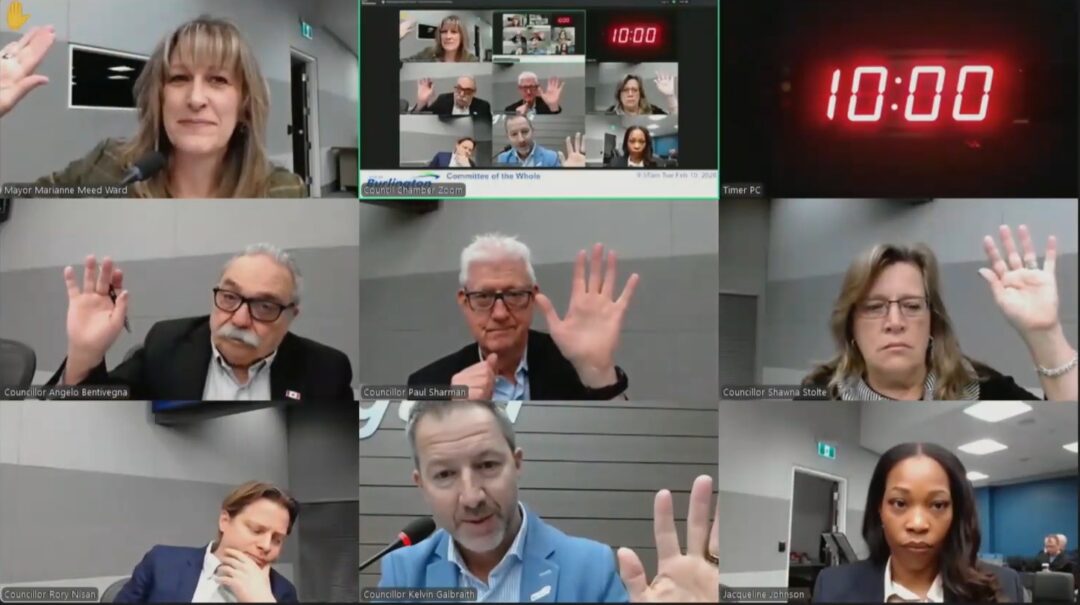
This is a computer-generated transcript of the meeting and may contain inaccuracies. You can check the accuracy of any statement by using the timestamp information and watching the video of the meeting from the city’s website.
This transcript is provided as a service to the community. Hearing-impaired individuals who are unable to watch the meeting in real time can read the proceedings here. Anyone can search the transcript for specific keywords and then watch the relevant section of the video linked above using the timestamp information.
Committee of the Whole: Votes here are recommendations. When the committee votes “yes,” they are technically voting to recommend that the City Council approve a specific action at a future date.
Council Meeting: Votes here are final and legally binding. This is the stage where the recommendations from the Committee of the Whole are officially “ratified” or passed into law (by-laws).
Transcripts:
(24:21) Good morning everybody. >> My name is Calvin Galbrath, counselor for Ward One, and I will be chairing the committee of the whole meeting today, which is a continuation of the meeting that began at 9:30 a.m. yesterday, Monday, February the 9th. I will now read a safety notice for those present in council chambers.
(24:38) In the event of an emergency, please evacuate the council chambers by the nearest exit staircase, which is located through the doorway marked with an exit symbol. Once you have evacuated the building, please gather in civic square outside of city hall. All city of Burlington committee and council meetings are live webcasted on and archived on the city’s website.
(24:58) Today’s meeting is being captioned digitally through our agenda management software. I will remind everyone to slow down and speak clearly so your words can be captured by the software. I would also ask everyone attending virtually to please use appropriate microphones so your words can be captured accurately by the software.
(25:17) We do have rules of engagement in committee meetings. We ask everyone to please be respectful while others are speaking and listen as you would want to be listened to. A reminder to committee members to adhere to the procedure bylaw and limit your questions to two at a time. Further, a member may ask a question only for the purpose of obtaining facts relevant to the matter under discussion and necessary for a clear understanding.
(25:41) All questions will be stated succinctly and will not be used as a means of making statements or assertions. We are not making decisions at this meeting. Only recommendations that will go to city council for final consideration on February the 17th, 2026. The public is welcome to see when sorry when the final decision-m happens by attending the meeting either in person or watching the live stream.
(26:08) Delegates are welcome to register to speak at the council meeting. I’d like to make some introductions today. I would uh introduce the members of committee. Uh councelor Lisa Karns, w 2 sends regrets. Councelor Rory Nissan, w three. Councelor Shauna Stolty, ward four. Councelor Paul Charman, Ward 5, Councelor Angelo Bentovenia, Ward Six, and Mayor Maryanne Meid Ward.
(26:33) We are also joined by acting chief administrative officer Jacqueline Johnson and committee clerk Joanne Rudy. Other staff in attendance will be introduced as each agenda item is discussed. Uh so schedule for today’s meeting, we will take short breaks midm morning and afternoon. Um and then we’re going to have uh a just a slight change to our schedule.
(26:56) May Ward, did you want to table something at this time? >> Uh, yes, please. Thank you, chair. Uh, due to a hard stop of one of our members, I would request that we move item uh 12.3, which is the options for the elimination of DC’s to immediately after item 8.4, which is the motion memo regarding amendments to the code of good governance, which will be the first item we discuss after the stat public.
(27:23) Anyway, uh both of those are relevant to uh the member who has to uh exit and uh would also request that we consider going to 1230 today >> before we break for lunch. >> Okay. >> Is that okay? >> Motion to wave the rules. >> Okay. >> Okay. >> So, you’ve made a motion to to wave the rules and we need to vote on that.
(27:52) >> Okay. Can I have uh all in favor? Any opposed? And that carries. Okay. So, we’ll go straight to 12:30 today and then we’ll take a lunch break. Then we’ll still do a midm morning break uh around 11ish. >> 11. >> 11 on the dot. Okay. Rory. Um so, we’re going to do the statutory public meeting first.
(28:18) This the purpose of the statutory public meeting today is to present this report in a public form as required by the planning act. The report before committee today will go to city council for final consideration on February the 17th, 2026. During the course of the statutory public meeting today, a ticker tape with delegation registration information will be scrolling along the bottom of the webcast cast which provides details on how to submit a delegation request.
(28:44) If there are requests during the course of the meeting, new delegates will be communicated to to the committee clerk who will advise the chair. After all registered delegations are complete, I will make a last call for delegations and indicate the deadline time. A recess will be called to ensure that all requests made in advance of the deadline can be provided with all applicable access codes and instructions.
(29:07) When all requests have been dealt with to the satisfaction of the chair and the committee clerk, we will reconvene and the remainder of the delegates will be heard by committee. It is important to note that only the minister, the applicant, specified person and public bodies as defined by the planning act and registered owners of lands to which the bylaw will apply and who made submissions at the public meeting or who have made written submissions to the city before the bylaw is passed will be able to appeal the decision of the city
(29:36) of Burlington to the Ontario Land Tribunal. So item 13.1 is the new residential zoning bylaw DGM-05-26. Before we proceed to delegations, I will pass it over to Steve Roban, our commissioner of devel development and growth management to make some brief introductory remarks and then Todd Evershed, supervisor, special projects and urban design will provide a presentation.
(30:07) Over to you, Steve. >> Thank you. A new zoning bylaw will directly or indirectly affect everything that will get built in the city of Burlington’s residential areas for the next 25 years. The new bylaw is designed to streamline and simplify the city’s requirements and to be easier to use and understand for residents and developers and builders alike.
(30:27) Increasing housing choices, sustainability, and context sensitivity are principles embedded in the new zoning bylaw. Equally important has been community and stakeholder engagement. In February, staff presented the draft zoning bylaw to seek public input. Since February, the team has responded to public inquiries and met with land owners to review and discuss the proposed bylaw changes and to explain how the zoning bylaw regulations affected an an individual’s property.
(30:52) Zoning bylaws are living and dynamic documents and as we move forward with the next phases of the zoning bylaw relating to medium and highdensity residential areas, commercial, institutional and industrial areas, we will make any adjustments that required as we work with the zoning bylaw and learn what is working and what isn’t working.
(31:10) What is very important is the efforts of the team. I would like to acknowledge the team and especially Victoria and Rebecca for their public engagement efforts, creative problem solving, and creating a best-in-class streamline zoning bylaw that will guide development in the city of Burlington for the next 25 years. Thank you.
(31:26) And now I turn it over to the team. Thank you. Just going to wait for the presentation to load up. >> Perfect. So, good morning, chair and members of the committee. It is a pleasure to be here today to present phase one of the new zoning bylaw project, the proposed residential zoning bylaws for your consideration and approval.
(32:03) These bylaws are the result of deliberate multi-year process that begins with council direction. Includes extensive technical work and is informed by broad public and stakeholder engagement. We heard consistent themes throughout the process and the bylaws before you reflect changes made directly in response to that feedback.
(32:21) This morning, I’ll briefly outline what council is being asked to approve, the key changes from the previous draft, and why staff are confident these bylaws are ready for adoption. Next slide, please. I’ll start with a quick overview of how we got here. So, this work flows from council’s approval of the official plan in 2020.
(32:47) In December 2023, council approved a phase work plan in response to ongoing appeals and changes to provincial legislation. Residential zones are prioritized as phase one to support the city’s goal of building more homes faster. The project launched in early 2024. Engagement began with a discussion paper and stakeholder workshops in July 2024.
(33:11) The first draft was released in July 2025, followed by a public openhouse, a statutory public meeting, and a joint workshop with industry and interested parties in the fall. The final draft was released January 30th of this year. We are here today at committee of the whole with council enactment scheduled for February 17th. Next slide, please.
(33:40) The current bylaw is more than 25 years old and needs to be updated to implement the new official plan. The planning act requires that alignment. The proposed residential zoning bylaws conform to the Burlington official plan, the regional official plan, and aligned with key city strategies, including the housing strategy, and the climate action plan.
(34:01) These bylaws are foundational to expanding housing choice and improving affordability in Burlington. Next slide, please. Phase one focuses on residential zones because those official plan policies are already in force. This phase delivers two new zoning bylaws for residential zones and related sections, establishing the framework for future phases.
(34:28) The approach supports increased housing options within and at the edges of established neighborhoods while enabling gentle ground oriented intensification. The guiding objectives are straightforward. Enable low-rise housing, improve usability, modernize the bylaw, and reduce unnecessary process and red tape.
(34:51) Next slide, please. The new bylaws introduce several important changes. They permit new built forms, including broader permissions for demi semi- detached dwellings and low-rise apartment buildings at select neighborhood edges along major streets. They expand permissions for additional residential units, including up to two units in a detached ARU with standards in place to protect for privacy on neighboring properties.
(35:22) They simplify the bylaw by reducing residential zones from 31 to 9. They introduce a two bylaw approach with holding provisions near rail lines to address land use compatibility. They also add flexibility through contextual front yard standards, more adaptable gross floor area regulations, modernized parking standards, and clearer, more user-friendly language.
(35:49) Next slide, please. So engagement has been extensive and ongoing throughout the project building on years of consultation tied to the new official plan. This slide shows highlights and act highlights this pardon me. This slide highlights the activities and events that the team and the supporting teams have been busy with over the course of the project.
(36:14) Next slide please. Feedback focused on clarity, additional residential units, neighborhood impacts, parking transition, and built form regulations. In response, staff made meaningful revisions to improve clarity, flexibility, and usability of the bylaw. As feedback continues to come in, staff will bring forward minor refinements to the final draft, including technical corrections and clarifications ahead of council’s decision. Next slide, please.
(36:51) So, uh, council consideration and enactment are scheduled for February 17th, a week from today. Following enactment, the appeal period begins and is expected to conclude in mid-March. During that time, staff will prepare guidance materials, update the city’s website, train staff, and support residents and stakeholders through the transition.
(37:15) Until the new bylaws come into force, the current zoning bylaw 2020 will remain in effect. Staff also commit to reviewing sight specific exceptions and holding provisions and to monitor implementation to ensure the bylaw continues to support housing delivery and aligns with the new official plan. Next slide, please.
(37:39) The recommended bylaws reflect staff’s professional planning judgment and a balanced approach. They carefully consider public input while advancing council’s housing objectives. While not every suggestion is adopted, every submission is reviewed on its merits. Staff recommend that council approve the report and enact the proposed residential zoning bylaws to enable new housing options across the city.
(38:03) Next slide, please. So, I’d like to thank the residents, stakeholders, and industry partners for their engagement throughout this process. And that concludes my presentation. Thank you. Thank you, Todd. I will now request delegations to provide comments to committee. As a reminder, during the course of the statutory public meeting, a ticker tape with delegation registration information will be scrolling along the bottom of the webcast which provides details on how to submit a request.
(38:40) We have six pre-registered delegates. So, the first I would like to invite Sandra Loggen Longen from Cornerstone Association Realators who will be joining us in person to speak. Welcome, Sandra. Uh, you have 10 minutes. Uh, the mic is on. Uh, begin when you’re ready. >> Great. Thank you. Good morning, Mayor Maidward and members of council.
(39:06) My name is Sandra Longden, and I’m appearing on behalf of Cornerstone Association of Realtors and our 7,500 members across our various regions, including the city of Burlington. Our members support individuals and families looking to buy, sell, and rent across Ontario. I would like to thank you all for the opportunity to share our perspective on the proposed citywide residential zoning bylaws.
(39:33) It is of no surprise to us all that home ownership is posing a challenge to many. The housing crisis is a multi-layered problem that becomes further challenged by red tape, delays, cost to build, and a widespread stance against denser development. Our members believe that municipalities should impact progrowth housing policies in their planning.
(39:56) The proposed changes to modernize and streamline the zoning process to make it easier to interpret and apply is an important step in the right direction. We have continuously advocated for a more streamlined process to mitigate the cost of development and unlock more housing supply in high demand cities like Burlington. Addressing housing needs is a monumental task and the proposed changes today are a step in the right direction to fulfill the city’s vision set out in your housing strategy plan.
(40:27) It is worth mentioning that the variety of housing options such as the additional residential units, new permissions for allowing semi- detached and low-rise apartment buildings are bringing forward more diverse and affordable housing options needed to address the missing middle. We hear from our members and their clients that they are looking for options that allow them to get into home ownership sooner and are open to being more realistic when starting out.
(40:54) Stacked town houses, mid-rise buildings, and semi- detached homes are some of the options that research show are desirable options for first-time buyers, especially we understand that this is part of a multi-phase strategy for the city. There are many opportunities that the city can continue to build upon with changes to this bylaw.
(41:15) This includes increasing density along transit corridors, four units as of right across the city, and aligning incentives to ensure that homes are being built that match the needs that individuals and families want to have in the city of Burlington, particularly when it comes to the size of the units. Last but not least, I would like to mention our support for option A of the development charges item to temporarily remove development charges as outlined in our letter to this committee.
(41:43) Removing extra costs to housing is an important step to help support affordability. Cornerstone is open to continuing to work with the city of Burlington to implement these changes and help inform future plans. We look forward to continuing to work with you and make home ownership an affordable reality for the residents across Burlington.
(42:02) Thank you for your time today. >> Thank you, Sandra. I do not see any questions for you. So, thanks for your presentation today. Uh, next I’d like to invite Steven Barrow from Community Development Halton who will be joining us in person to speak. Welcome, Stephen. You’ll have 10 minutes whenever you’re ready. >> Very good. Thank you.
(42:33) Um, and I do have a PowerPoint that may or may not be connected, but it’s okay if not. >> Uh, give us a second. Uh, we’re going to pull it up and just let us know when you want the slide to be changed. >> Oh, okay. Sure thing. >> And you can raise the podium. There’s a button on your right hand side that that raises that up a bit.
(42:56) >> There you go. >> That’s much better. Thank you. >> No problem. >> Okay. Um, Mayor Meid Ward, esteemed members of council, um, everyone in the audience, thank you for for having me. Um, my name is Dr. Steven Barrow and I’m a social planner uh, with Community Development Halton. Um, and I’m here um, to delegate in support of the zoning proposed zoning changes.
(43:20) Um, next slide, please. So, um, a brief look at who we are. Um so we’re the region’s social planning council and volunteer center. Uh we do community based research, community development planning, uh promoting volunteerism, um to identify community needs, uh to um collaborate members of the community and promote civic engagement.
(43:44) Um and we facilitate coordinated planning um to address uh key issues in the community um in addition to advocating for change. Next slide, please. So the last year and a bit um CDH has been quite involved in promoting housing advocacy. Um we uh we do this through a combination of um convening folks uh in uh annual right to housing forums uh which involve bringing the community together um and having open dialogue about you know some of the housing challenges people are experiencing at all levels of the housing uh continuum uh including those experiencing
(44:27) homelessness. And this also includes public education events uh such as um what you see on the screen there um an upcoming film on affordable housing builds across Canada. Um and uh you know we I’m also joined today by um a team of of folks who uh support me in going out into shelter spaces into encampments and we have dialogue with folks experiencing homelessness or at risk of homelessness um to you know hear about what are some of the causes of of homelessness and and how is it changing in our uh in our world today. Um and so you know in in
(45:02) our support of this uh resoning um we really see this as a an opportunity to um address the needs of folks at all ends of the housing spectrum. Next slide please. So a little bit of data because we are data folks. Uh we like our data. Um you know uh the the situation uh with housing in Burlington um you know reflects that of a lot of communities across our country.
(45:29) um you know, and and looking at um you know, currently the average price of a one-bedroom apartment um is over 1,700 a month. Um and uh a rental wage that would be needed to afford market housing uh would be approximately just under $38 per hour or 78,000 a year in order to comfortably afford a one-bedroom apartment in our communities.
(45:52) Um and with a lower vacancy rate, uh this makes it much more challenging and competitive to obtain um any any sort of affordable housing stock. Um and you know, when we when we contrast that to uh the average wage of um of of wage earners across Burlington, uh who which is around 54,750 um as of 2020, it falls significantly below the comfortable threshold of affordability.
(46:20) Um and even more critically when we look at um uh the incomes of folks on on fixed incomes like OW, ODSP or pensions um the um the the the contrast is is even more stark. And so something that we’ve been really involved in is trying to explore what affordable solutions could look like. Um and I think you know we’re in a time where um you know things are are dramatically shifting under our feet and uh um and sometimes can feel uncertain.
(46:48) And so um you know how can we get creative to uh to explore some solutions going forward? Uh next slide please. Um and you know part of this conversation is thinking about who’s the most uh I mean we’re all impacted um and some of us are quite deeply impacted by this unaffordability crisis. Um, you know, um, according to Statistics Canada, um, and, um, and other organizations, uh, renters are more than twice as likely to spend, uh, more than a third of their income on housing, which is considered the affordability
(47:20) threshold. Um, and, uh, although this also impacts homeowners, um, 16% of them in fact. So, so this really is an issue that affects a lot of our neighbors. Um but when we look at folks that are already uh marginalized or vulnerable in society, um indigenous and racialized populations, um single mothers in particular who often bear the brunt of child care, um people living on lower incomes or on fixed incomes, um and also considering uh the idea of affordable rental units that get lost to the market um at a higher rate than than what we’re
(47:54) able to build. Um, and so there’s a lot stacked up um to to address and um it’ll it’ll require um it’ll take a village, I guess, is the best way to put it. Um, next slide, please. Um, and I I kind of did a little bit of a dive into um, you know, what existing housing stock looks like in Burlington and and I’m not sure if this reflects other communities across Ontario um, but I imagine it might.
(48:24) Um, so just looking at half the housing stock is is single detached housing. Um, that’s the type of housing I grew up in. Um, and you know, where my family had lived for several generations. Um, and uh, you know, increasingly we see the the inclusion of row houses. Um, not a lot of semi- detached or apartments over five stories.
(48:46) And so I I think with this resoning um, it might sort of diversify that housing landscape a bit um, towards affordability. um given the the challenge of affording single detached homes uh in 2026. Next slide. Um so, uh Todd had already gone over the the proposed zoning changes, so um I won’t uh focus too much on that. um you spoke much better to it than I could, but um you know, just looking a little bit at uh what the diversifi diversification means in terms of more semi- detached dwellings, uh town houses, backto-back units, um low-rise
(49:23) apartments, and uh very significantly uh additional rental units or ARUs. Um we’ve uh we’ve really been engaging with um folks in the developer community um and advoc advocates across Burlington who um feel quite strongly about promoting ARUS as a as a creative solution um to I guess the missing middle as we sometimes say um what’s missing in housing and so um yeah how can we creatively build on existing housing stock through ARUS is a a key question um and you know thinking about how this all applies to advancing
(49:59) Burlington’s housing strategy um building a healthier rental housing stock uh with a broad variety of housing um and really you know through events like this being able to build advocacy and partnerships and taking action to address the needs of our neighbors. Uh next slide please. Um so I I borrowed this from the city of Burlington website but because I really like the illustration of um just as a visual of of what ARUS can look like.
(50:28) Um and so we’re we’re saying yes to additional residential units um of all types. And you know here we see uh with the 50% um single detached housing stock uh this is what you know ARU construction could look like. Um and something that CDH has been doing among other community partners is um you know connecting with folks that are doing just that.
(50:50) And um it’s been a great learning experience to see, you know, how that process looks and um we’re we’d like to lend our support to it. Uh next slide. Um yeah, so you know, what can this mean um in our community? So, you know, we we have a chance to uh through diversifying our housing um in more affordable ways, we can help reduce poverty uh particularly child poverty.
(51:14) um reducing vulnerability for folks of for folks living on lower incomes. Um increased choice. I mean, you know, on the positive end of the spectrum, um how great is it for folks to have more choice in the type of housing and and where they live and um you know, being able to find housing that meets their needs? Um in a tight market, it’s very challenging right now everywhere.
(51:36) So, um so we very much support that. um and building community and a sense of belonging where people belong in our community. Um people uh aren’t excluded because of affordability. They they can have a home and uh build their lives here. Um and last but not least, but building a more resilient future.
(51:56) Um, you know, coming in here today, uh, I had a conversation with, um, a good friend and community partner who, um, you know, we we spoke about the shifting times we’re in and and how, um, you know, our economy is in flux and we don’t always know, you know, what the next few years are going to bring and so this is a significant step towards building up our our community resilience.
(52:17) Uh, next slide. >> You got about 40 seconds left, Stephen. >> Oh. Oh, perfect. I’m on the last slide. Um, so I leave you with this question. If our goal is to create a community where everyone is welcome, where all current and future residents have access to housing options that meet their needs at all stages of life at all income levels, uh, what zoning decisions today can bring us closest to that future? Thank you.
(52:42) >> Thank you, Stephen. Uh, you do have a question coming from councelor Stolty. >> Thank you. Thank you, chair. Hello, Stephen. I’m really excited to see you and your crew here today. Thank you. It actually makes my eyes water a little bit because eight years ago I sat where you are sitting, not necessarily doing research, but at community development Halton volunteering on looking at creative housing options for Burlington to make sure that everyone at all income levels were welcome here.
(53:08) And it was actually the group I was volunteering with who encouraged me to run for this seat. So talk about making taking a village. It takes all of us at different levels to make things happen. So my question to you is next steps. What do you see as far as partnership with community development Halton and other community organizations along with council and stakeholders in the community to continue this process moving forward to make sure that we achieve and I was going to quote our value statement of our housing strategy?
(53:36) But I’m glad you did. Thank you. What do you think we can do to make more happen? >> Oh, thank you. Thank you uh councelor Stoaltce and and um I I appreciate the sentiment. I uh I didn’t realize you you had started with uh with CDH that so anyway that brings me a lot of joy. Um, yeah. So, next steps.
(53:54) I mean, um, I’m I I certainly wouldn’t be the, uh, the authority on, you know, exactly what that looks like, but but I could tell you that, um, you know, with with increased housing options, I think we have a real opportunity to come together as a community in um, you know, increasingly creative ways. So, I mean, the housing forums are one such example.
(54:13) Um, but you know, our role really is convening the community to be able to have these conversations. And, you know, folks have a lot of very valid concerns about resoning. And, um, you know, it’s it’s where they live that, um, it’s the spaces they live in that we’re speaking about.
(54:31) And so, um, I think really, um, I I see our role at CDH as being about bringing people together to hear each other out, to to hear each other’s stories and concerns and, um, you know, and to sort of find our way through it together. Um, so it’s very generative and it it’s not uh, you know, super clear and it’s a bit messy, but I think um, you know, but but in our two housing forums we’ve had so far, we’ve had some great dialogue from all kinds of stakeholders and um, I would say, you know, we should keep doing that.
(54:57) It’s it’s a practice and and not an end point. So um, yeah, anything we can do to be a part of that, we’d we’d be grateful. >> Excellent. So keeping the conversation going and listening. >> That’s right. actively listening and that includes folks especially folks that are most deeply impacted by the housing crisis.
(55:14) >> Awesome. Thanks. Thank you. >> Thank you, Stephen. I see no further questions. Thank you for your delegation today. >> Yep. >> Okay. Next, I’d like to invite Albert Faca from Coral Gable’s Homes uh who is joining us in person to speak. Welcome, Albert. Uh, you have 10 minutes whenever you’re ready.
(55:43) You know the drill, right? >> Good morning all. >> Congratulations to the planners, consultants, and council for initiating this new bylaw or these bylaws that are designed to increase housing supply and improve affordability, more homes faster and quicker. I’m going to be discussing two things generally. this bylaw and these bylaws meet my ideas.
(56:06) So, I’m I’m quite happy. So, the first one is uh I we sent an email in. Could we get that kicked up on the screen if we can? All right. Um, can you skip back? Well, that that’s a picture of a swimming pool that takes up almost half the backyard. I’ll refer to this after, but can we flip through the please? All right.
(56:34) So, what we have is a situation where we’re going to be measuring lot areas uh two different ways. This is a deck at the back of a house. If that deck is filled in with dirt, then it’s not covered under the lot area um and not included. If we were to put a basement, a bedroom under there, can we flip keep flipping please to the bedroom position? >> Just say next slide and then they’ll they’ll change the slide for you.
(57:00) >> Yes. Okay. So, that what is what a bedroom would look like underneath that deck. So, I’m having trouble understanding the logic of having that area filled back in with dirt. When I can get a basement under there, the sightelines from the neighbors doesn’t change. In other words, the deck doesn’t look any bigger.
(57:21) They’re no wiser as to what is underneath. And that room can be finished for $40 a foot as opposed to $300 a foot. Now, imagine having a home. You’re having a mortgage payment. You can get $700 from a rental of that bedroom. It’s cheap accommodation for whoever’s looking for a bedroom, and it’s already generally paid for, and that’s going to take a big chunk out of your mortgage.
(57:44) And yet, it’s the same size as a deck that’s going to be in place anyway. The deck can’t have trees planted on it. We’ve seen the picture. Can’t have sod planted on it. So, that deck is going to have a foundation around it, same depth as the basement. So, it makes absolutely no sense not to permit that area below the basement or the patio to be filled.
(58:06) So, we shouldn’t include that in the lot coverage when you can get this out of that and it makes no difference to the neighbors nor to flooding, any other problems that you see with some of these iceberg homes. Th this doesn’t apply at all. Um, and that’s as far as that goes. Um, we have lot coverages in the city that go from 50 to 35%.
(58:30) So if arguing that 35% lot coverage by increasing is going to cause problems, then we’re definitely going to have problems in the 50% lot coverage areas. In apartment buildings, this doesn’t apply at all. You can put six stories underground. So any of the issues that would be created, flooding, anything else would certainly apply there, too.
(58:46) So those are really non-existent when you do a project of this size. And like I said, that’s a gorgeous bedroom to have in addition to We’re the only ARUs that are being done now in Burlington are being built in Burlington are all basements being finished. But generally any basement in a house under 1995 wasn’t designed to be finished.
(59:12) You’ve got no fire protection. You’ve got mold. You’ve got wet basements. They didn’t have weeping tiles at the time and those areas were never intended to be finished. We’re doing it because we have a shortage of rental accommodations. But these would in no way come close to meeting the standards that we have today for new units.
(59:30) In other words, fire protection, everything else. We’re doing it because we have no other choice. Here we are prepared to build units that are up to date in terms of building code, everything else. So, we would ask for some concessions here to allow those to be built under. Sadly, the three-unit buildings, fourunit buildings, the ARUS with four units, uh, forplexes and triplexes, they haven’t been a big hit.
(59:53) From my understanding, none have been built and they’ve been allowed for some three years now. So, we have to kickstart something because there’s nothing in the bylaws that I can see that’s going to change that situation. One of my suggestions, and if I may suggest, tenure. In other words, if you’re allowed to build your four ARUS or four units or whatever you want to call them, it’s quite confusing, but you’re allowed to uh consider them as condos.
(1:00:19) In other words, you can sell the units off individually. One, it creates the missing middle housing. It creates a very affordable form of housing in the low density areas. And uh these units will be rented and can still be rented. So, it’s nothing different than a 50unit condo. It’s just a 4-unit condo. And I think that would give incentive kickstart the desire uh fill in the building plan which would justify building these units because to date um none have been built and with what I see and all the changes allowed if the
(1:00:53) building plan doesn’t work it it’s it’s not going to work. So, what we want is new residential zoning bylaws. Use clear, easier to understand rules and use modern zoning ideas to help make it faster and easier to build and make it worthwhile for developers to build. And if those laws permit that, they will be built. I assure you.
(1:01:14) And the region is also partnering with developers to permit these types of units uh to be built. So, it’s an exciting time. Thank you. >> Thanks, Albert. Uh, you do have a question coming from councelor Stolty. >> Thanks, chair. Thanks, Albert. You covered a lot of ground. Some of which I agree with, some of which I struggle with.
(1:01:36) So, my question, I do agree with the four-unit condos. I’m interested in having that conversation. Um, I’m glad the picture is still up as it is right now, cuz I am curious about your thought process around bedrooms under a deck such as that and your comment about how it doesn’t impact neighbors and it doesn’t impact flooding and so on.
(1:01:54) Mike, my the word that comes to mind is permeable. If you fill that with dirt, that’s permeable land that water will run through. Are you suggesting that a bedroom underneath a patio such as this one in the picture would be built out of permeable materials in order to equate it to dirt? >> No.
(1:02:14) If you if you put a patio in, that’s not permeable anymore. So, in other words, whether the patio’s in or not, whether there’s room underneath it doesn’t affect that. Once a patio goes in or a swimming pool, that’s not permeable. Those patios that you’ve seen have foundations 8 ft deep and they sit on footing. So, they’re excavated just like the basement.
(1:02:34) So, at the end of the day, that room or those decks will be excavated just like the patios. The only thing they’re asking us for is that this area be refilled with dirt and not be occupiable. But to me, what’s the difference if if it’s not permeable anyway? Do you understand the decks? You can’t plant a tree on it.
(1:02:53) You can’t put sod on it. It doesn’t It’s become a lost area. So, you might as well put a room underneath because the deck is permitting water from being absorbed into the ground because it’s encased in concrete. >> Encased. Fully encased. >> Fully encased. Well, that’s the only proper way to do it. If you just lay a slab on the ground, uh the frost is going to heave it. It’s going to break.
(1:03:13) to do it properly, you have to put in a 4 inch a four an 8 foot foundation wall on top of the exact same footings that follow the rest of the house. So, you’ve got a void there. So, you can do two things. Fill it with dirt or put a room there and it accomplishes the same thing.
(1:03:31) Nor does it have any detrimental values more or less if you put a room in there. People think that that slab on top is just dropped on the ground. It’s not. It’s encased in a foundation just like a room. And that’s why you can put a room in there because it’s there’s a void. So filling it up with dirt accomplishes nothing. >> Okay.
(1:03:48) I’ll have more questions for staff around why we’re allowing that because leapage and seepage of groundwater and flow of groundwater is a huge issue. >> And I agree with you, but because there’s walls and everything else, but also remember you’re allowing 50% lot coverages in the uh L1, L2, L3 areas. So um you’re allowing 50% there.
(1:04:08) You’re only allowing 35% in these neighborhoods. the laws of physics shouldn’t change from one neighborhood to another. If you’re allowing 50% uh lot coverage, clearly that would be should be a problem, but it’s not. So, doing this makes absolutely no difference at all except creating affordable housing that the other delegates uh made presentations on.
(1:04:32) And this is very, very cheap housing. You can’t do that this often. This is $40 a foot as opposed to $300 a foot to finish it off. uh you have an older child, a grandmother or something. Those are beautiful bedrooms. >> Okay, I’m going to ask more questions of staff. Thank you. >> Thank you. >> Thanks, Albert. I do not see any further questions for you.
(1:04:50) Thanks for your delegation. >> Next, I’d like to invite Lloyd Rapini from Coral Gables Homes joining us also in person today. >> Welcome, Lloyd. >> Morning. 10 minutes whenever whenever you’re ready. >> Thank you. Good morning, staff, council, and mayor. Um, I’ve been building single family homes in the Burlington and Hamilton area since uh 1986.
(1:05:23) Over these years, we spent a great deal of time learning and working with the city uh zoning staff. First, I’d like to begin by saying that the proposed increase in lock coverage for single family homes from 25% to 35% and 45% for ARUS is in my view a positive and necessary step moving forward. Where I hope to add more constructive input is around the calculation of lot coverage and rear yard setbacks based specifically on how it applies to covered porches and whether those areas are going to be backfilled or not.
(1:06:00) I want to note that my comments are based on my interpretation of the draft and follow-up conversations with city staff to ensure I’m being as accurate as possible. What I believe could be optimized here is allowing the rear yard setbacks and lot coverages to be measured from the main basement of the house and not inclusive of a porch that has an excavated area underneath.
(1:06:27) The reason is simple. Once the foundation is in place, it is far more cost-effective and more logical to use that underground space of the porch than to backfill it unnecessarily. This ties directly into the shared goal I believe we all support increasing the availability of additional residential units. Using this space underneath a excavated porch, it would allow somewhere between 250 to 350 square ft more of belowgrade living space under a porch can make meaningful difference without changing the above grade appearance of the home.
(1:07:05) Practically speaking, we’re adding 300 ft in a basement can transform a unit from 700 ft to 1,000 ft². That additional space can mean an extra bedroom or more functional living, opening the unit to smaller families, single parents, or aging parents who require close family support. Would also note that a covered porch, whether excavated or unexavated, have the exact same visual impact above grade.
(1:07:32) For that reason, I struggle to see the benefit of adjusting setbacks or lot coverage based solely on whether the space below is excavated. In the concern that I heard from the counselor regarding permeability, if that covered porch has a roof over it and or a concrete deck, water is not going to penetrate it, be it excavated or unexavated.
(1:07:55) So the uh w the permeability of that section has would have no impact in either in either way. And the streetscape utilizing the streetscape um it the existing streetscape while making better use of the limited land available. You’re not going to for for neighboring properties they wouldn’t know the difference if that’s just a covered porch with or without some living space underneath it.
(1:08:24) I do understand the concern that this flexibility could be misused. To address that, I would respectfully suggest placing clear limits on the allowable size of an excavated porch outside of the main foundation, such as restricting it to the width of the house and defi and maybe a defined depth, whether that be 10, 12, 14t, or even a percentage of the home’s depth.
(1:08:47) This would provide clarity and prevent overuse while still allowing the intended benefit. I would also like to highlight a practical challenge related to lot coverage calculations in the LN5 zone particularly where an additional residential unit or ARUS are permitted while the draft bylaw allows for 45% lot coverage in LN5 where an L where the ARU is going to be included using a typical Burlington lot as an example and I’m talking about existing lots because I understand that the LN5 is an 18 meter lot width, but that’s only if we are
(1:09:25) creating an uh creating a new lot in the LN5 zone. The lot coverage of 45% on that 50×120 lot is 6,000 square ft. The 45% would give us a footprint on the ground of 2700 square ft. However, due to the current zoning bylaw setbacks, the footprint cannot be achieved in practice. The ma the maximum building envelope is 38 feet x 65 ft or 2470 square ft representing an immediate reduction of approximately 230 ft or 4% over two stories.
(1:10:07) This results in a loss of 460 ft of abovegrade living space. This reduction becomes more pronounced when a covered or excavated porch is introduced. For example, a 12 I’m just using a 12×30 deck porch only because I’ve built a number of these which totals 360 ft would further reduce the allowable building footprint from 2470 ft to 2110.
(1:10:36) At this point, effective lock coverage is now to 35.2%. We’ve lost the 45% that we want to do for ARUS. The cumulative impact is over a thousand square feet of livable space. Additionally, in the LN5 and LN6 zones, there is a maximum structural depth restriction of 20 m or approximately 65 1/2 ft.
(1:11:02) So on deeper lots, we wouldn’t be able to recover the larger size of a footprint. Our goal where appropriate is to build homes that can accommodate one principal dwelling and up to three ARUs. I understand that a lot of the conversations around the ARUS are on existing stock. Our company is considering and looking seriously at building new stock of single family homes with three ARUS and an individual unit for the owner.
(1:11:38) Larger set or larger coverages lot coverages of 45% will hopefully help achieve this. The not taking into consideration the lot coverage under a deck or under a porch will also make the units bigger because we’re we’re hoping to build units that could accommodate 1,100 square ft per unit. That’s the missing middle that we’re hoping to do.
(1:12:07) We will discuss tenure upon this at a later time. I hope that these comments received in the spirit that they’re offered as practical, experience-based feedback intended to help refine the bylaw that will shape our neighborhoods. Uh I just going to point out that uh we spoke to Rebecca Friday on February 6. She mentioned that there are still some edits being made to the bylaw that will not be public by the meeting today and would be re and we request that uh we are able to review some of these edits before the voting happens on the 17th.
(1:12:43) Uh thanks for your consideration. I still got two minutes. So I’m just going to mention something about this tenure. When I was reading all of the information that was sent uh by the by the uh housing strategy, the city of B I’m just going to read this excerpt that I found. The city of Burlington housing strategy, the planning analysis on the Burlington’s official plan on 8.7.2 ARUS.
(1:13:10) is to support creation in ground orientated form to increase the supply of affordable housing options that meet the needs of all residents current and future. This strategy is to address the missing middle from both the perspective of having housing options that are affordable, attainable for middle inome households and for the opportunity to diversify the spectrum of housing types and tenurs.
(1:13:35) So when I read that, I’m hoping that the city of Burlington would consider because we have made a number of inquiries with the planning staff. Maybe because it’s early, we’re getting some we’re not getting a very clear answer. If we were to build these particular structures with three arus in an individual residential unit as it’s described or in your definitions, we feel that we could really cover the missing middle by offering these units up for sale as a condominium.
(1:14:06) Now buyers, investors could buy them. They could be rented out, but the option of actually selling them could be quite viable. You’re now making much more. It’s not affordable housing by any stretch of the imagination, but it’s certainly much more affordable. Thank you. >> Thank you, Lloyd. Thanks for the presentation.
(1:14:29) I don’t see any questions for you, so um thanks for your delegation today. >> Thank you. Next, I would like to invite Gar Napier and Jill Randall from the Burlington Accessible Advisory Committee who are joining us remotely to speak. Hey G. Hey Jill. Uh, is Jill there too? >> Okay. >> Uh, you guys have 10 minutes whenever you’re ready.
(1:15:02) >> Okay. Thank you. >> Awesome. I’ll start. Uh my name is Jill Randall. I’m the chair of the Burlington Accessibility Advisory Committee and I wanted to introduce my esteemed colleague Gh Napier who’ll be providing a delegation on behalf of our committee. >> Good morning, Mayor U. members of council, city officials, and other interested parties.
(1:15:25) On behalf of the committee, thank you for the opportunity to delegate today. BAC is a committee of dedicated volunteers with legislated mandate under the AODDA to advise council on the identification, removal, and prevention of barriers for people with disabilities. as well. According to the city’s engagement charter, when city officials engage with advisory committees, they promise to partner on each aspect of the decision, including the development of alternatives and identification of preferred solutions.
(1:16:03) This commitment was not adhered to, and we’re here today to provide advice on the new zoning bylaw project. BAC is recommending that council defer approval of phase one of the new zoning bylaw. This deferral would allow bylaws to undergo a comprehensive review through an accessibility and aging in place lens before they’re finalized.
(1:16:32) Appendix E, page 138 in your package, uh, prepared by city officials, states that a jurisdictional scan of best practices for zoning did not include a specific accessibility impact assessment, nor include a scan of leading municipalities regarding accessibility best practices. A comprehensive review of accessibility and aging in place has not occurred.
(1:16:56) As a result, the bylaw does not meaningfully reflect leading best practices from an accessibility focused municipalities. We believe this step is essential if the bylaw is to meet its stated goal of serving residents at all stages of life and ability. BAC supports the goal to modernize zoning and increase housing diversity.
(1:17:22) We believe the bylaws could be strengthened to better facilitate accessibility by reducing unnecessary red tape and regulatory burdens for developers who build accessible units. Other municipalities have successfully introduced accessible housing unit goals. They fasttracked approvals and innovative incentives for projects that prioritize accessibility while still meeting planning objectives.
(1:17:51) These approaches both support developers and builders and help the city advance its accessibility and housing goals by recognizing and addressing realworld development barriers. This project represents a once- in agenerational opportunity to embed accessibility and inclusiveness directly into Burlington’s regulatory framework.
(1:18:14) Now, here are some key facts for you to ponder. Almost 30% of Ontario residents have a disability and 40% of seniors live with a disability. Burlington has a higher than average population of residents aged 65 and older. And this group is growing faster than any other. And finally, nearly 90% of this demographic want to age in place.
(1:18:41) Without intentional accessibility standards, new housing options will not meet the needs of residents with disabilities or those wishing to age in place. Recent studies show that designing or accessible or accessibility right from the outset is far more cost effective than retrofitting later. I would like to spend a moment and touch on the engagement with city officials.
(1:19:07) Engagement with BAC during phase one was limited to a single presentation on October 2025 despite the project beginning much earlier than that. Materials were provided without advanced circulation limiting meaningful review and we were not and the materials were not provided to the committee until several weeks after the meeting as mentioned early this fall short of the city’s AP2 commitment.
(1:19:35) Questions asked during another meeting and included in a letter sent to the team regarding our concerns have not been thoroughly answered. You can see appendix three of the delegation we provided you for those questions as only partial responses to these questions have been provided. Early and ongoing engagement is not only optional, it’s essential to good decisionmaking.
(1:19:58) BAC recommends that council defer approval until staff report back on the following actions. Completion of a formal accessibility impact assessment with the findings being used to revise and strengthen the bylaw. A transparent jurisdictional scan of accessibility best practices and incorporate those best practices into the draft bylaw.
(1:20:23) Exploration of incentives for developers to create accessible housing. Develop performance measures for council and senior management to track accessibility and aging and place outcomes over time. Identification of the risks to the city if accessibility is not explicitly embedded as an interpretive planning objective supported by evidence and validated by thirdparty expertise.
(1:20:49) Ensure that accessibility expertise is required and accountable in future consultation procurements. Clear identification of site plan approval guidelines that will support accessible housing starts and reestablish early and ongoing collaboration with BAC and the city’s accessibility coordinator in future in future phases.
(1:21:12) In closing, BAC supports growth housing diversity and modernization. We’re simply asking that accessibility be treated as a foundational, not optional. A short deferral now to prevent systemic barriers for will prevent systemic barriers from decades to come. We look forward to working collaboratively with council and staff to strengthen this important project.
(1:21:38) I’d like to thank you for your time and consideration. >> Thank you, G. Um you got a couple questions coming. Uh the first one from councelor Charman. >> Thank you chair. Thank you very much GT. It’s appreciate I appreciate the uh presentation. U especially as I’m the council leazison on the BAC committee. Um my first question is with respect to your comment about aging population.
(1:22:02) Um what factors um specifically in a general fashion would be influential um in anticipation of what age older adults might need in their later later stage. in their lives to make their homes prepare them for uh being more accessible. >> Um yeah, I think that there’s a couple of things when you look at the 40% of seniors that live with disability that can also be broken down into other percentages of those types of disabilities.
(1:22:33) But in general, it’s creating more access creating more accessible housing includes wider doorways mostly. Um more accessible washrooms which can include um um showers that are don’t have a lip on them that you know you can you can access them right through. Um sometimes with the glass u the glass that that that would allow let’s say a wheelchair or some other type of assisted device to get into those particular areas.
(1:22:59) So the actual changes that are required from a initial build perspective as I said as I said earlier are um much cheaper in fact uh a recent study from the London School of Economics states that it’s 20 times cheaper to do this at the get-go rather than retrofitting later on. >> Thank you for that. >> That answers your question.
(1:23:21) >> Yeah. No, that that’s very good. Thank you very much. Um I guess my next question is with respect to the what we have before us. I I know that there’s an enormous support from everybody for implementing the new residential zoning bylaw. Um, if it were possible to uh work with staff to uh review a potential amendment to this uh at at another time, so undertake to review the accessibility factors and then have that brought back to council.
(1:23:50) So rather than hold this up right now um that we actually uh ask them to do the work that you’ve asked them to do uh and have them bring it back as an amendment at some sort of point in time. Would that work for you? >> Well, um I I’ll just say this part. You’re the elected officials. You get to make those decisions.
(1:24:10) I think that the thing you might want to reflect on though is that accessibility shouldn’t be an afterthought. And I think in this case it is I think accessibility has to be front and center when we are developing public policy. So um yeah uh would it make sense? I can’t speak for the whole committee. If my personal opinion is is that if we get accessible standards built into the bylaws that’s that’s the goal.
(1:24:39) Uh but I think that there’s also uh something to council may want to reflect on why is this not being done initially and how can we ensure that as a go forward this is something that is uh taken seriously from the get-go because at this point it has not been put into the bylaws and it relatively easily could be. >> Understood. Thank you.
(1:25:05) Uh your next question is from councelor Stoalty. >> Thank you chair. Thank you G and Jill for being here. I really am glad that you decided to delegate today. It’s been a very good conversation. So my question actually is very similar to councelor Charman’s. um you spoke at the very tail end of your delegation about a a short deferral and that’s where my question lay that’s an extension of what councelor Charman was getting at was a short deferral which is I’m not sure would fly at council today but even if it were to that would only involve a
(1:25:36) limited study of the issues that you’re bringing up would it not be more wholesome to perhaps consider and I take full um I take to heart what you said about how in future we need to be doing this differently. But moving forward today, if we were to approve this residential zoning bylaw with a promise that council was going to take it back to staff to do a proper better study and come back with revisions and perhaps incentives and so on to make sure that these accessibility issues are incorporated.
(1:26:13) >> Um, yeah, I’m not sure what the question was. Sorry. My question is it better not to do a to maybe pass it through today and do a wholesome study and bring back revision as opposed to defer it today and just do a short look quick look at it. >> Um well well again as I said that this is a council decision.
(1:26:36) I I uh it it it’s still there is a a piece to this that um and I agree with you that we do have to start thinking about accessibility uh uh as as part of our our our thinking right from the get-go. Um I believe if we would have when we were hiring I think there were two consultants hire consulting firms hired if they would have put in their RFP that that they also the consulting firms needed to have an accessibility expert that would have been done uh right from the beginning.
(1:27:05) I understand the city and know the city did have a accessibility coordinator, but when I read the the comments, uh we’ve looked at two years of uh of uh a report back from from that that individual and there was nothing mentioned about this bylaw. Uh nor uh when we looked at what the comments were, we didn’t really uh get our our response back as to what did this individual provide that wasn’t included.
(1:27:29) But the types of things that should be included is is trying to create um you know as I said the the the goals uh for for the number of accessible housing and and other supports that we can give developers but also ensure that when we talk about affordability that affordability for all means for all and that includes the 30% of persons with disabilities. So so I I take your point.
(1:27:51) Thank you. >> Thank you. May I have a second question? >> Would rather it be more wholesome. >> Thank you. Second question chair. >> Yeah. Thank you. So my second question to you is back in 2020 when we started the process of looking to explore a housing strategy. One of the strategies we used for our housing strategy was that alongside staff input which is hugely valuable as experts and consulting input which is hugely valuable as experts.
(1:28:21) We also hosted a working group of uh stakeholders in the community and we tried to find a variety and cover as many bases as we could to make sure that that lived experience was being incorporated into the housing strategy. There was conversation at one point about implementing that same style moving forward for this zoning bylaw review.
(1:28:42) Do you think in hindsight that that would have maybe captured what your concerns are about making sure that accessibility, someone representing the accessibility community was present on a working group and that perhaps the city and council needs to look at that model moving forward to make sure that we more often incorporate working groups to make sure that the stakeholder and lived experience is incorporated right from the start.
(1:29:03) >> Well, well, thank you for that question. I Yes, I do. I think that that’s a great idea. I also think um just just to to further answer that question um what I did notice in the IP2 um guidelines for this particular piece on on bylaws they included and and I’m going to get the language wrong because I I read this a while ago but I know there there’s five different uh uh levels for IAP2 uh they they’ve just done the first two and I think that if we we really want to be uh inclusive and uh and uh collaborative um
(1:29:40) we should be uh really reflecting on on when we’re when we’re developing certain policies what level of um engagement do we want and as I said in my uh when I was speaking that uh that the the team did come out to us albeit late um uh but when they they do engage with uh with uh advisory committees it should be the collaborate which is level four and uh that that I think if that would have occurred uh early and ongoing.
(1:30:11) I think that yeah, this definitely would have been mitigated and you all would have had to listen to me for 10 minutes, could have given you a longer lunch break or something, but sadly that didn’t happen. >> Thanks. Thank you, G and Joe. >> You’re welcome. >> Uh councelor Bentoven is next. >> Thank you, Chair.
(1:30:34) And uh thank you for uh being here, G. you brought up uh some uh very interesting points. Um I guess the first question um I’m going to ask um the delegate from um Halton community left had a question at the very end and it said and I’m going to paraphrase it. What decisions do we need to make, meaning us, to improve living for all? And um I guess my question to you is from an accessibility standpoint, what are the key factors? Because you know sometimes people look at accessibility is you maybe someone in a wheelchair or a walker. I mean it’s
(1:31:21) quite diverse. What do you believe we need to do and work with planning including accessibility committee um to get to what you’d like to see? >> Well, thank you for that question. I really think there there’s two things is one is to conduct a wholesome accessibility review of the bylaws and really there are organizations that do this work.
(1:31:53) Um Rick Hansen Foundation uh does this kind of work. The CHC has a number of um uh pieces on on how you should build accessible units. But I also want to state I’m not a planner. I’m just a resident who is uh interested in accessibility from personal lived experiences and also have some um some expertise in the area. But but I really would look towards um um you know some others who have th that that type of expertise.
(1:32:28) And I would always encourage city officials and council to um ask at the beginning of these projects that accessibility be put front and center and put in mechanisms as I mentioned when you’re hiring a consultant. um add on that an accessibility expert needs to be included uh from that consulting company so that Burlington and others can start you know doing their part as you do but but you know continue to do their part on accessibility.
(1:33:01) So so that would be my um my um um advice. That’s yeah thank you. >> Thank you for that. Um my second question and you you brought we touched on it earlier. Uh we have an accessibility coordinator um in the city um and I just found out recently that she has retired. So my question to you is has the coordinator brought anything to your advisory committee with respect to the zoning bylaw and being part of the staff obviously.
(1:33:40) Um, has she done any of that in the past? >> Well, I’ve only been on the committee for for two and a half years, but what I did do was go through the the the two and a half years of um of reports from the the individual and and uh the the bylaw piece was not mentioned. Now, yeah, the this bylaw project was not mentioned.
(1:34:04) And as I said that the first time that we kind of became aware of it was um in October of this year when we had a presentation that was walked in and then received the materials several weeks later. And I’ll just say that that you know um you can imagine as council if you got your materials just walked in it’s sometimes diffic well it would be all my for me it’s always difficult because I like to read things and and know but uh it would be difficult to make a decision so and provide advice so uh once we we found this out we started going through the materials and uh I
(1:34:39) came up with this notion of um let’s defer and let’s do it right and let’s put accessibility in to give and as I go forward, let’s really make this a commitment um because Burlington’s a great place and let’s, you know, let let’s continue that legacy and and continue to make it such an an awesome place. >> Thank you. Thank you for that.
(1:35:04) And um I will uh ask staff some questions because as you know the coordinator accessibility looks at every application that comes in. So the information is important for the advisory committee to know. So thank you. >> I appreciate that. Thank you very much. Thank you for your questions. >> And uh final question coming from Mayor Meard.
(1:35:27) >> Thank you chair. Thank you so much G and Jill and uh the entire committee. I know you have a bunch of residents standing with you today uh giving us this advice. My my question for you is around um the the different uh ways that the city addresses accessibility and uh and I’m just looking at your outstanding uh document that you sent us with some of the uh considerations to strengthen accessibility the five points there and as I as I read that and this will be a question I also ask of staff it seems to me that some of
(1:36:03) the uh things that you’re asking for there and some of the opportunities are actually um building code matters or um uh site plan matters which are actually outside the scope of the zoning bylaw. Uh the zoning uh bylaw really only sets what use is allowed on a property. Can you have one unit, two unit, three unit? Uh so that’s all we’re dealing with today really is and then how much lock coverage can you get and so forth.
(1:36:33) But it it seems to me, and this is my question for you, that some of the very good um um suggestions that you’re making are actually uh related to different uh bylaws, not this one. So, if we could and I think the suggestion earlier from my colleagues around uh having you huddle with our staff and I know you give us such good advice on on everything, how we can make our facilities and our transit and everything more accessible.
(1:37:00) Uh th this might be another opportunity. So, I’m wondering if that um if it strikes you that way and if that um if that is in fact true that that most of what you might want to uh have us think about regarding accessible housing is related to different bylaws that we focus our attention there and not hold up the use piece uh which is which is really all we’re dealing with uh today.
(1:37:26) Well, I’m not an expert, but I do understand or thought that the bylaws do have things such as grades, grading uh when you’re entering uh buildings, etc. And so, um if you required that those grades uh were accessible um so that it wasn’t uh um that the the steepness of them was accessible, let’s say, for a um assisted device, then then that’s one piece.
(1:37:56) Again, I think there’s, you know, I’m not an expert, but I think there’s many things inside the bylaws that could be done to make it more accessible um or some units more accessible so that um so that again this goal um you know of of of housing for all um it it that that that could actually be achieved. So, I I think that um that that that there are pieces in the bylaw, but um again, there’s much smarter people than I am sure of looking at that could look at this.
(1:38:30) So, um I would really uh defer to them, but would would uh I think our committee would always love to be part of the conversation. But, um >> and there’s people on the committee much smarter than I. So, >> as you should, we want you to be part of the committee. We want you to be part of the conversation. and and there are definitely people smarter than me.
(1:38:46) So I I will ask um uh what uh what they have thought about with respect to those accessibility pieces that relate directly to the zoning bylaw. Um and and if that uh so stick around and I hope that will be uh provides some answers around what they’ve thought of already and where the opportunities might lie. So uh thank you G.
(1:39:09) No further questions for me chair. Thank you. Thank you, mayor, and uh thank you, G and Jill. I don’t see any further questions, so thanks for your delegations today. >> Thank you. >> Okay, next I would like to invite Daintry Klein from Milcraftoft Greenspace Alliance uh joining us in person today to speak with us. >> Welcome, Daintry.
(1:39:34) >> Good morning. >> 10 minutes whenever you’re ready. >> I’m just going to lower this if that’s all right. I’m not quite as tall as some of my friends. Thank you, mayor, council, staff, and fellow residents. My name is Dry Klene, and I represent the not for-p profofit Milcraftoft Greenspace Alliance Group, which advocates for livable, sustainable communities and responsible development.
(1:39:59) The zoning bylaws we are reviewing and discussing are the details to implement the city of Burlington official plan of 2020 which is currently being finalized through the Ontario land tribunal process. Two members of our organization attended the first engagement session held by planning staff to provide community input on the issues that should be considered in the zoning bylaws.
(1:40:25) We are speaking today to continue to raise our concerns. We note that the city of Burlington declared a climate emergency in April of 2019 and has many related plans that have been enacted since that declaration. Our city is impacted by flooding, heat, wind, fires, and earthquakes and sometimes resulting power outages. All risks to human life.
(1:40:51) This council is well informed through its association on regional council and conservation halton of the flooding impacts of overdevelopment in the town of Oakville which was recently the subject of a class action lawsuit. Our group has been advocating to the city, the region, the province and the federal government through an informal organization and more formally as Milcraft Greenspace Alliance since May of 2020.
(1:41:18) This work predates the official plan of 2020 passed by the city and region and was prior to the formal application of Milcraftoft Greens for the proposed development on the Milcraftoft Engineered storm water management lands which operate as a facade of the Milcraftoft Golf Course. At the time, our city boasted of being a greener city, a highly debatable topic today.
(1:41:41) Consistent with our organization’s focus, we would like to highlight, considering our time constraints, a few of our organization’s concerns as they relate to the livability and sustainability of the city and the proposed two new zoning bylaws, including the very new information on the bylaw near rail. Livability factors in our city that are relevant to these draft bylaws include planned natural and built environment, outdoor spaces and buildings, transportation and infrastructure, economic environment, including housing
(1:42:13) affordability and safety. It is noteworthy that the economic situation today is drastically different than in 2020 when the official plan was implemented. And perhaps this should be an opportunity for the city to reset some priorities as they relate to climate resiliency. Currently, the true intrinsic value of housing is beginning to evolve from the speculative investment housing market that prevailed at the time of the 2020 official plan.
(1:42:43) We are witnessing the realities of changing consumer demand as proposed developments are being cancelled and the province of Ontario is experiencing net immigration. The past imbalance of profit-driven developer priorities should now be reconsidered with community needs. Let us not lose sight of the fact that eliminating development charges will require an increase to property taxes, a housing affordability issue as well.
(1:43:12) The council direction to implement four units as of right feels like an unplanned city. How do we economically deal with the infrastructure requirements of such an unpredictable approach to development and population? We hear of repeated power outages in areas of the city that have insufficient infrastructure to handle current development.
(1:43:36) How are residents of the city expected to cope with lost time as they try to work from home? the lack of lighting, heating from heat pumps, sump pumps that may not have adequate battery life, and proper refrigeration of food during these interruptions, particularly if they occur during periods of flooding, extreme heat, or sub-zero temperatures? And should the residents of Burlington have to pay increased hydro rates to build infrastructure just in case a forplex is built on any lot? How do water and sewage sewage infrastructure operate with such unpredictability?
(1:44:14) Is Burlington headed in the direction of Cairo and Jakarta that are so unlivable the entire cities are being moved to new locations? Who in the city is keeping track of the weight of the high-rise buildings relative to the city’s geotechnical ability to support this weight? Cities such as Jakarta and Houston, Texas are known to be sinking.
(1:44:37) and who is managing the wind impacts of the number and location of highrises. We note that the city is currently trying to address transportation gridlock. If we are experiencing this today, how will we cope with the increase in transportation needs including service vehicles of the additional housing units within the current boundary and existing road network.
(1:44:59) Milcraftoft Greenspace Alliance is particularly interested in the new zone zoning bylaw near rail. Our organization has raised the issue of mitigation factors for noise and air quality through the protection of green space and forestry in the vicinity vicinity of the rail line. Two of the multiple benefits of stopping development on the Milcraftoft Golf Course lands.
(1:45:23) Hardened surfaces are known to reflect and magnify sounds compared to the ability of trees to buffer and absorb them as nature’s baffles. Protection of the natural environment is critical to the rapidly evolving threats of climate change and Milcraftoft Greenspace Alliance continues to highlight the disconnect between the realities of development in this city and the city’s climate resilient plan.
(1:45:49) Other cities have recognized that flooding can best be addressed through a spongy spongy city approach. This does include dirt. It is interesting that conservation Halton suggests extending downpipes from roofs away from foundations. Yet the city continues to reduce setbacks and some lots contain 100% hardscape.
(1:46:11) green space in the form of the green belt, major parks and open space, lot size and coverage, setbacks and boulevards, and the ability of these spaces to grow trees can all contribute to this flood mitigation concept. The city’s forestry plan highlights the heat impacts of large areas of concentrated smaller lot sizes combined with higher hardened surface lot coverage ratios due to the lack of green space and inability to grow trees.
(1:46:40) green spaces within communities through boulevards and front yard setbacks could also accommodate snow clearing in place rather than the city’s current practice of trucking snow from one neighborhood to another placing it in our recreational areas. The city of Burlington is currently considering iceberg or sorry the city of Toronto is currently considering iceberg houses.
(1:47:07) A concern raised in this city as we see belowgrade development unchecked by the city’s zoning. These factors should all be considered within the zoning framework. Burlington was a desirable city due to the options of housing and neighborhoods whose varying designs reflected preferences and community needs. Do the new simplified zoning bylaws protect the integrity of neighborhoods and desiraability of purchasing homes within them? To conclude, Milcraftoft Greenspace Alliance is requesting that the city continue to use all tools available to stop development on the Milcraftoft
(1:47:42) engineered storm water green infrastructure that appears as a golf course. the multiple benefits of preventing the proposed regra regrading hardening of the surfaces together with the removal of the weir that buffers the flow of the Apple Creek to South Burlington are significant to the livability of the residents of Burlington.
(1:48:02) Preservation of this green space is significant if the land is reforested and evaluated for further improvements of natural storm water management. Similar to our previous suggestions, the city is highlighting the adverse factors of noise and air quality through the rail bylaw and these can be mitigated through the benefits of additional trees.
(1:48:25) The economic realities of lower intrinsic value of housing should make the negotiation to preserve this green space achievable. Thank you. >> Thank you, Dantry. A question coming to you from councelor Stoalty. >> Thank you chair. Hi Dry. Good to see you today. Thank you for your very wholesome delegation. You covered a lot of areas. >> Thank you.
(1:48:48) >> Um the one that I particularly just wanted to touch base with you and get your perspective on is when you talk about density >> and whether or not our infrastructure could manage the gentle density that our this new zoning bylaw is promoting. I think so. My question to you is um can you see the possibility of blending the realities that our demographics of aging population in Burlington and the number of I know this is a sensitive term but it’s a technical term overhouse seniors who would like to age in place in four-bedroom homes that
(1:49:24) were built and the infrastructure was built for families of four to six people. And if there’s only one or two seniors who want to stay in that home, will that not create a balance to other gentle density opportunities where the infrastructure given the fact it’s not being utilized by a lot of large homes that are underused, it can be utilized by gentle density in other ways.
(1:49:50) Do do you understand my question? >> Yes, I see I see what you’re saying. I think the um the situation is when you’re talking about four units as of right on a property that’s quite different than what you know in in my experience in these larger homes uh was typically four people. Um you’d have to assume that in that case there’s only one person living in each of those four units to equate to that.
(1:50:18) And I’m not sure that’s a fair assumption because not everybody lives lives as a single. you know, we’re talking about we’re talking about trying to increase the housing stock for um you know, a single parent with a child or like what we’ve seen or what in my experience with the uh housing developments that have been approved over the last number of years are highrises with very small units, barely livable for one person, and not accessible.
(1:50:55) like the the washrooms are so small, the doorways are not wide enough. They’re they’re just not adequate for the needs that we were talking about here with accessibility. And I think that um we might be overlooking some critical factors here. And you know what I’m speaking about is is happening and is real in areas of our city where we keep blowing transformers because the usage is so high that the transformers can’t use it.
(1:51:26) And and power outages aren’t just for a half hour or an hour. Uh in some cases, you know, 12, 14 hours. I saw the hydro trucks on Lake Shore yesterday. I’m not sure what they were up to, but you know, we we are already experiencing the problem. So, if your point was true that, you know, we’re just replacing uh a senior who’s living in the house with four additional units and it wouldn’t be a problem, then we wouldn’t be experiencing these housing or these power outages that we’re currently experiencing.
(1:51:55) I I think is a fair comment. >> Okay. I think there’s a lot of variables that go into it, but I do get your point. The other question I was going to ask that’s related to my first one is that when we talk about aging in place, that’s not always just about living in the house that you’ve been living in for 30 years.
(1:52:10) It’s about living in the neighborhood where your friends and your doctor and your community support system is. Mhm. >> So by providing say um say there’s a single family residential home where the envelope of the home stays the same but inside it is three two or three smaller units for a single or a couple that want to stay in their neighborhood.
(1:52:30) Do you see that as a benefit with this gentle density of allowing seniors who want to stay in their communities the opportunity to do that without having to maintain a huge home and a lot? I totally agree with your point about having our seniors still in the community. I personally had my mom living at Tanley for a brief time and I loved the fact that I could walk over there and have coffee with her in the mornings.
(1:52:57) It nothing upset me more than to see uh a long-term care unit placed in an employment area where that just doesn’t exist. So in in the area of North Burlington, we have, you know, um we have a a planned community where we have uh seniors housing which is mostly um uh one story so it’s accessible. Um we we have Tanley Woods um seniors home which includes long-term care and various housing options there.
(1:53:33) My understanding is you can buy an apartment in that complex, you could rent a a unit in that complex, or you can live in uh an assisted care area even outside of the long-term care unit on a private basis. To me, that is brilliant because we have different areas that are planned that allow for different types of uses.
(1:54:01) And so we don’t have four kitchens in a single family dwelling. We don’t have, you know, um, four chair lifts or elevators. We, like, let’s be honest, a lot of accessibility is is being able to change grade and one level to the next. So there are all these things that I are considerations and I I think an integrated community is fabulous.
(1:54:25) Absolutely fabulous. But I think it needs to be done in a very specific and planned way. Not just a helter skelter um you know well we’re going to do four units here and like we never know where the four units are going to be. So how do we plan for infrastructure for that? And we still need ambulances to get to those units.
(1:54:50) We still need firet trucks to get to those units. We need snow plows to get there. We need um those people quite often uh need grocery deliveries or you know different they they need services as well and we have to consider these things within the road network within the the sewage all the all those services and infrastructure. Okay. Thank you.
(1:55:14) >> Thank you Dry. I don’t do not see any further questions for you. Thanks for your delegation today. Okay, we have no further pre-registered delegates for this public meeting. So I will now ask if there is anyone watching the live stream or present in council chambers who would like to delegate to development and growth management report DGM-05-26 regarding new residential zoning bylaw to please submit your request by uh 10 after 11 um to clerks at burlington.
(1:55:51) ca CA or 9053357777 extension 7481. As noted in the ticker tape that is scrolling at the bottom of the screen, we will now take a 7m minute recess to ensure that we have received all requests to delegate. This meeting is recessed until 12 after 11. Thank you. Yeah.
(2:07:55) Okay. Welcome back everybody. Uh I’ve been advised by the clerk that we have uh one additional delegate to speak on this item. So I would like to invite Tyler Rapini um in person. Welcome Tyler. You have 10 minutes. Whenever you’re ready to speak, you can raise the lectern by his button there. >> Oh, takes a while.
(2:08:22) All right. Good evening, mayor and members of council. My name is Tyler Penny. I’m Lloyd’s son, which hopefully that’s a good thing. And I appreciate the opportunity to speak with you today. I’d like to share a few concerns and ideas from the perspective of my generation of people trying to get out of their parents’ homes.
(2:08:38) Many of us are encountering the same challenges. increasingly high down payments which lead to big mortgages just due to the price of property and land. And to change that, I have a couple of ideas, just small tweaks that can help the missing middle. My goal is to help to make new builds significantly more affordable, thereby adding supply to the crucial segment of the market.
(2:09:00) I’d like to start by saying that with a few years of experience and observing local development, I believe the direction of the new bylaws is fundamentally sound. However, I also believe that we’re not aggressive enough in addressing land use and lot size limitations, particularly when considering the of amount of land that’s available to us.
(2:09:18) Specifically proposing reducing the minimum lot widths required for the semi- detached homes, specifically in LN3, LN4, and LN5 zones. Currently, we have 9 mters proposed. The average size land in these zones has a 50- foot frontage, which is a 20% ask for variance to be able to put a semi- detached home on the average size lot in these zones.
(2:09:45) So, I would like to take that down. My suggestions would be they’re quite drastic, but LN3 and LN4 zones from 9 m to 7 1/2 m and for the LN5 zones 9 1/2 m to 8 m. This adjustment could unlock substantial number of new properties for semi- detached construction. Additionally, implementing to sever exceptionally large lots which are clear outliers within the neighborhoods could effectively cut land costs in half which would allow more opportunities for new semi- detached homes that are complement existing neighborhood characters while
(2:10:18) providing attainable options for young families. By making these changes, I believe we could see new homes entering the market, which with far more attainable price points. I’d also like to comment briefly on the additional residential unit program. I think the ARU initiative is heading in the right direction, empowering homeowners to create additional housing options within their new homes.
(2:10:42) However, I believe there is a further opportunity to engage with developers in constructing new buildings designed specifically with ARUS in mind, lowering construction costs and in turn creating more affordable rental options. On that related note, I would like to make a small suggestion regarding building height allowances specifically for ARUS.
(2:11:01) Increased the permitted height specifically with ARUS slightly could allow for larger basement windows. Giving tenants a brighter and more livable space in the basement. I understand we have had conversations with Halton the region and they will not allow our us to build for them with a unit in the basement just due to the living whatever they think it’s dark or they don’t want to put people in there.
(2:11:29) So, I just believe a small change, raising the basement out with about a foot, two or two or 3 feet, will allow a lot more natural light, which will create a more livable space in the basement. I recognize that I’m still early in my career and I do not have the extensive experience of the city’s planners, but I hope these ideas resonate and contribute positively to the ongoing conversation about the housing affordability in Burlington.
(2:11:59) You have a question coming to you from councelor Stalty. >> Thank you, chair. Thank you, Tyler, for being Tyler, right? Yes. >> Yes. Thank you. Thank you for being here today. Um, I’m actually really glad to hear someone hear from someone of your generation because that’s important. That’s what we’re making these changes for is for the next generations.
(2:12:14) Well, people who are living in Burlington and those who we want to make sure have opportunities to live in Burlington. >> So, my first I have two questions. The first one’s directly related to what you were just talking about about creating opportunities for ARUS, especially basement arus that are more livable. >> Mhm.
(2:12:30) >> This is a bit of an extreme question, but do you think that if we were to require new builds under the zoning to create foundations, whether they’re a little bit higher or at least have accessible access and eress windows? Do you think that would help? a homeowner would not be compelled to have to use it as an ARU, but at least then therefore it would be set up to be an ARU.
(2:12:52) Do you think that would help? >> Yeah. Um, are you going to allow the height of the building to be taller or are you just moving the foundation out of the ground? >> Probably moving the foundation out of the ground. >> It could work, but the struggle will be then making sure that the foundation is deep enough on solid ground.
(2:13:09) >> Mhm. because I know some neighborhoods like we built a house on Henderson which was extremely soft all the way down and was very difficult and then if it becomes mandatory that they have to be out could create larger problems and very high financial problems to build said said basement out of there. >> Okay.
(2:13:29) So not so much from a building perspective but from a u younger generation living perspective do you think that would increase opportunities for people of your generation? >> Yes I I think so. I think I mean the way I would look at it is having a nicer ARU in the basement to rent could subsidize my mortgage significantly. Therefore, being okay to take a bigger risk, maybe spending more than I would have been comfortable with in a condo to be able to get a front yard and backyard.
(2:13:55) Knowing that I want to expand my family and the next five, six years, having space like that to me would be important. I don’t want to speak for everybody of what they like to do, but knowing that it’s more of a there’s a return on your investment that comes monthly rather than having to sit on it forever would make me much more comfortable purchasing something like that.
(2:14:15) >> Okay. Thank you. My second question is um a question that was brought up by a previous delegate who you may or may not know as far as tenure. >> Yes. >> And the opportunity for some of these additional units to be available for purchase rather than just rental. Is that something that your generation do you think I mean I’m asking a lot for you to represent your whole generation but do you think that’s something that your that the younger generation would be interested in? >> I think absolutely. I think there would
(2:14:41) as long as there’s choice as long as it’s not okay you can tenure but it has to be a basement unit. I know I’ve been doing a lot of thinking with my father about ch kind of moving into purpose-built arus where there would be four arus all above ground which I think tenure would be super important just not owning something that’s under the ground is a lot more enticing right with the front and back door and having your own yards and your own parking spaces I think tenure for that is super important because it’s you want you would like to
(2:15:13) own something like that I think owning a basement unit is a little bit tougher of a cell. >> Fair. Okay. Thank you. >> Thanks, Tyler. I don’t see any further questions. Um, okay. So, I now declare that the public meeting portion of this meeting uh to be closed. So, we’ll now move on to uh questions for staff.
(2:15:41) Let’s start with uh Mayor Me Ward. >> Thank you, Chair. Uh my first question is around this business of a deck um extending u with a box of 8 ft below and it’s a shell and all of that. Is that is that actually what happens? It it seemed odd to me. I know when we built a deck we had you know a couple of inches of screening and some patio slabs.
(2:16:05) So what help us out there? >> Yes. So through the chair to the mayor that that’s our understanding as well is that um you know it’s going to vary on a case by case basis. I think the the image that we saw um would would possibly be something that is um you know on grade. So it it varies um depending on what the infrastructure is.
(2:16:31) Um and I think the other thing I can add is that in some cases we do think that you know those foundations may not necessarily be as necessary as the delegate had had suggested. Um and that they could in some cases allow for infiltration infiltration um growth for trees and other vegetation on the site.
(2:16:53) So, it is something that we are we have taken back and we’re continuing to look at um to make refinements that I’d mentioned in the presentation and would bring those forward to council next week. >> Okay. Um they they were also quite concerned about if there is a patio that’s impermeable and a covering over top then you know what difference does it make if you put a unit underneath? And and my thought is that you know water kind of moves from one place to the next and if it’s uh able to move underneath the deck that that retains a permeability. Is
(2:17:30) that maybe this is a question for our public works over there? I don’t know. But uh isn’t there still some permeability notwithstanding what’s on the surface? if what’s underneath retain is still soil that that retains a a good degree of runoff and permeability and all of that. >> Maybe um I can assist the the mayor with >> Sure.
(2:17:51) >> The zoning bylaw does not preclude what was being proposed. That bedroom would form part of the principal dwelling. So access to that bedroom would be through the principal dwelling. That dwelling would have to be designed to be in conformity with the Ontario building code and that would deal with in issues of windows.
(2:18:10) So it would most likely have to be 18 or 24 in above grade in terms of to the roof of that deck structure in order to ensure that there’s adequate light to that bedroom. From a zoning bylaw perspective, the setbacks are measured to the foundation wall. So that d that bedroom would have to meet the minimum required side and rear yard setbacks.
(2:18:32) And if they were able to achieve those setbacks, they could as of right build a new house with an under with a bedroom uh projecting as proposed and then the roof how they treat the roof of that bedroom whether they use it as a deck or they do a salarium or a part of the principal structure would be up to the designer.
(2:18:50) So there is nothing in the definitions in the zoning bylaw that would prelude what they are proposing to do provided they can meet the regular setbacks in the zoning bylaw. Um as the other conversation is the mayor indicated most people when they build a deck it’s usually if it’s above grade they have gravel underneath it to deal with drainage issues and nothing will grow underneath that deck structure.
(2:19:12) or if it’s a non-grade deck, it’s usually patio stones or concrete which is then put on a bed of gravel or crushed stone and it’s then compacted to ensure it doesn’t shift. But you don’t need to put a footing below the frost line in order to construct a deck. You do need to ensure that if you’re doing an above grade deck, the footings go below grade to deal with frost heaving, but a full foundation wall on all three all four sides of a deck is not required under the OBC as my understanding.
(2:19:40) and speaking with the CBO, you know, there is some design flexibility. But the short answer came back to my original point is the picture that was illustrated, should an individual want to proceed with that and they meet the zoning bylaw regulations with respect to setbacks, there is nothing to prelude them from proceeding to build with that and obtaining a necessary building permit.
(2:19:59) If they can’t meet the side or rear yard setback, then they always have the option of going to the committee of adjustment and the committee can consider the merits of whether or not to reduce the side or rear yard setback in order to effectively accommodate that underground structure or the foundation walls which are encroaching into any required rear yards.
(2:20:17) But there is, like I said, it is permitted. It’s not prohibited by the zoning bylaw. Subject to compliance with the applicable performance standards in the zoning bylaw and the the applicant obtaining the necessary permits through the building division. Thank you. >> That’s what I thought. Thank you very much for clarifying that.
(2:20:34) And they’re still here, our delegates, and I’m sure that will be encouraging news to them. Thanks, Steve. >> Councelor Charman is next with a question. >> Thank you very much. Uh my question really is about the accessibility requests. No, I I appreciate they’d like us to defer it, but that would seem challenging when we’ve got some pretty important things to accomplish already.
(2:20:56) Um, but that doesn’t mean we could we need to ignore their request to have an accessibility review. Um, do we need the staff direction to undertake an accessibility review and perhaps come up with an amendment to uh to this at some point in the future? >> Good question. I think the best person to answer it is Kyle.
(2:21:16) So I’ll turn it over to >> Kyle. Um, one of the things that I would offer an acknowledgement is that by virtue of this project, we understand these documents are essentially living documents that need to reflect the needs of the community as needs evolve. And so I think we we recognize that and I and I think Todd had mentioned earlier that uh there is the need for us to kind of refine the bylaw as early as council next week already, right? And so there there isn’t this constant evolution of the document. So are we willing to take
(2:22:00) additional feedback and look at it, review that information and refine the bylaw moving forward? Absolutely. I think that’s part of the work plan moving at forward as we head into 2026. Um, I I think there’s also the the need potentially for us to kind of uh illustrate what a bylaw, a zoning bylaw is actually capable of as it relates to accessibility and what it is not capable of.
(2:22:23) And the mayor alluded to some of those things as part of her questions. Uh, and so I just want to touch on that quickly. I think a new zoning bylaw like this has an indirect um implications as it relates to accessibility, but some of the more direct tangible pieces of accessibility may be better suited for uh site plan guidelines as an example uh may be better suited to find their way into the Ontario building code which they’re actually requirements that uh need to be adhered to.
(2:22:50) So the zoning bylaw, what it does is it allows permissions to take place. We can’t compel someone to make sure that the what they’re building is actually accessible, but it allows for that should a property owner have those needs and and wish to construct in that manner. So, what it does in terms of allowing for accessible uh accessibility as well as aging in place, we’re we’re allowing for additional residential units and that’s big for for a lot of the reasons that we already touched on.
(2:23:16) Uh multiplexes is another uh building typology that can assist with uh accessibility. Uh, it can allow for supportive and assisted housing as well as accessible dwellings should a property owner wish to take advantage of some of those permissions. What a zoning bylaw cannot do, it cannot require specific accessibility features to be incorporated into a development, as an example. It can’t require an elevator.
(2:23:40) It can’t require an accessibility ramp to be included or tactile signage. It also cannot override the requirements of the Ontario building code or the accessibility for Ontarians with disabilities act AODDA. Uh it cannot require interior layouts to be designed in a certain fashion or barrierfree entrances to be included.
(2:24:02) A lot of these requirements do fall into subsequent stages, the Ontario building code as an example. Uh so there’s a number of other things that a bylaw cannot do. So essentially what we can do in zoning is we can enable certain outcomes uh but we may not necessarily be able to secure them at the zoning bylaw stage.
(2:24:19) Some of that may fall to subsequent stages in the process whether they be guidelines or the building code requirements uh moving forward. So I hope that’s helpful and just um >> if I may add counselor staff have made themselves available to meet with all of the city’s advisory committees and other stakeholders and we will continue to make ourselves available.
(2:24:38) So because as staff have indicated there’s still additional work to come. We have additional chapters of the zoning bylaw to write. We still have the opportunity to work with those advisory committees. We we’re prepared to go and meet with the advisory committees, you know, after the bylaw has been adopted by council because it is a living dynamic document and if there are areas that we identify that there’s necessary to make changes, we will come back to this committee with those recommended changes to a decision today to proceed does not stop the
(2:25:04) consultation or the engagement process with the stakeholders and we are committed to that ongoing engagement and consultation with the stakeholders. But as Kyle indicated, there are some limitations as to what a zoning bylaw can and cannot do. Um, and maybe that part of that will be a conversation with those stakeholders.
(2:25:22) Does it belong in the official plan? Does it belong in the zoning bylaw? Or does it belong in our development engineering guidelines or our site plan guidelines and or is it a matter that’s regulated under the building code? But that can be part of the conversation with those various stakeholders to say this is where this is being addressed or this is how it is being addressed.
(2:25:40) One of the approaches we did try to take in the zoning bylaw was not to have things in there that don’t necessarily translate into action. So, you know, by saying that all development will be subject to the OBA or the Ontario building code. That’s of course it has to comply with the building code. So, that’s why we didn’t put it in there.
(2:25:57) And it seems relates to some of the issues that we were talking about around accessibility. But notwithstanding that and staff will continue to have a follow-up dialogue and conversation with the accessibility committee and get their input and report back on any changes to the zoning bylaw that we identify are required or are better or the mechanism to address those through other action plans or council the doc documents. Thank you.
(2:26:19) >> So thank you for that. I I have a second question but I can I ask just to follow up just clarify what so I was asking if you needed a staff direction. So I gather you’re saying you will actually do it in a different way without a staff direction. >> That is correct sir. >> Perhaps we could include something in the report that comes the final report that talks about that.
(2:26:41) You think about it. My second question is I think about the comments we’ve been having here. um accessory. I I fully understand the implications in terms of the building code and and and you know the fact that people live in those homes for a long time, you know, and people are buying them want affordability and not having to pay for a lot of things they’re never they hope they never use.
(2:27:03) But it raises other questions around parking and transportation and and our roads being congested and the more density we have. At what point do we have a a more holistic conversation as that in our official plan amendments? I mean, I’m I I see no holistic view of the city, but I see us going a whole bunch of different rail tracks and they’re not necessarily going the same way.
(2:27:28) How do we address that? >> Uh through the chair to the counselor, you are correct. The official plan does set out council’s broad vision for how we grow and where we grow. Um, but that official plan also does reflect the underlying infrastructure master plans or other strategies that are adopted by council.
(2:27:47) Part of the official plan realignment exercises, we’re trying not to replicate or duplicate policies that may exist in a council adopted strategic plan document in the official plan, but making sure that it is embedded as a principle in the official plan. Whether it’s how we move in the city, how the city grows, where people work, how we play, etc.
(2:28:07) , etc. Those are official plan type policies and policy directions that also are implementing the broader council strategic plan which also sets out at the type of city that and how the what the city of Burlington will look like going forward for the next 20 to 50 years. Thank you. >> Thank you. So I guess we’ll deal with this in the next few months maybe.
(2:28:24) Thanks. >> Councelor Stoalty is next. Thanks chair. Um so my colleagues will be happy to know that that was one of my questions answered. Um my my next my first question actually then is a follow-up to what the mayor was bringing up and I just wanted some added clarity because if I I’m hope I’m hearing what I believe you two have said um Steve and that is when it comes to one clarification that it is not necessarily necessary under the building code nor general building practices to have to build a full structure
(2:28:57) underneath a deck of that sort. uh through the chair to the counselor. That is correct. The building code does not require that you build a full foundation. >> Yes. >> Underneath a deck. You do there are design parameters about how the load is, but that can be just the traditional methods with pylons and sauna tubes.
(2:29:16) Thank you. >> Thank you. And as a followup to that then, is that how the city of Burlington under this new zone zoning bylaw is dealing with that issue of iceberg homes? because I know it was a bit of the wild west a number of years ago when building practices started to dig foundations lot line to lot line because there was not zoning or Ontario building code regulations around what happened underneath the dirt.
(2:29:36) So this is a way for us to make sure that any build underneath the ground is incorporated into setbacks and the actual building envelope. Correct. >> Uh through the chair of the councelor that is correct. For the purposes of the zoning bylaw we measure the setbacks from the foundation wall. That is not to address the iceberg homes.
(2:29:53) that’s just being the way of normal practices. Uh and then also ensuring that we are dealing with proper setbacks, grading, drainage, etc., etc. Thank you. >> Okay. Thank you. Um so my second question then, I’m not sure who this is towards. Um what aspects of this new zoning bylaw have been determined or dictated, for lack of a better word, by changes in provincial legislation being imposed upon municipalities.
(2:30:19) So through the chair, to the councelor. Um those are primarily focused on the additional residential unit policies or pardon me the provisions for additional residential units. Um so through the province and their rig um there have been there’s a requirement to allow up to two additional residential units um on all residential service lots.
(2:30:49) And as you’ll recall, the city has approved that to go up as high as three additional residential units. So that’s kind of one example. Um I’d have to defer to the team to kind of bring forward any other examples that I can think of at this time. But that’s one example. And I >> if I may just in addition the provincial regulations uh direct around zoning stand parking standards for ARUs.
(2:31:11) The municipality cannot have a ARU parking standard that is higher than would be for a principal dwelling unit. In addition, the province has provided direction around the zoning regulations, how you can deal with issues such as angular plane relating to ARUS, etc. So, the province has come out with a suite of regulations to remove what they see as unnecessary zoning regulations in other jurisdictions that impede the ability of a homeowner or property owner to build an ARU, whether it’s within the principal dwelling or a detached ARU.
(2:31:39) That is probably the primary area of provincial direction impacting the zoning bylaw. As we move forward with other chapters in the zoning bylaw, there also be to ensure that it complies with the provincial policy statement, the planning act, which then flows through our official plan and ultimately implementation through the zoning bylaw.
(2:31:55) Thank you. >> Thank you. So for clarity, what we’re seeing today is a combination of what is we’re trying to achieve with our housing strategy as well as gentle density, our increased population as well as taking into account those provincial legislative policy changes that we are compelled to adhere to. That’s correct.
(2:32:15) >> Okay. Thank you. >> Councelor Bentoven is next. >> Thank you, Chair. And uh much of my questions have been answered. First of all, I want to say thank you to uh Kyle and Stephen for explaining um what this report is all about so that we can all understand and more importantly uh the advisory committee the the accessibility advisory committee now understands.
(2:32:44) I think the where the confusion comes in um is and you mentioned it um from an AODA standpoint uh the concern was building code compliance which is goes hand in hand when we zone something uh then the next steps take place and the concern was if they don’t bring it up now and explain their situation what they’re looking for the next time we we do the zoning bylaw, it could be another five or 10 years.
(2:33:19) They don’t want to miss that window >> to um help us all recognize their needs. We talk about parking um you know the level of parking for accessibility the type of parking for accessibility um when anyways you’re it’s that site plan and I get all that is there a way to get this information in in writing I guess and and sent it to the BAC group so they to see you.
(2:34:00) They can have their discussion ahead of time and then when you meet to discuss they can sort of massage what they want or what they’re looking for. Sorry. >> Yes. Through the chair to the counselor. Um there are a number of conduits to the Burlington accessibility advisory committee. Um, one is our accessibil accessibility specialist and the access accessibility specialist has been a member of our technical advisory committee from the start of the the project.
(2:34:33) And so we would continue to work through the accessible accessibility specialist um to provide information and update and seek feedback from the committee um together with direct lines. So we have been in contact with with um the delegates and and members of the committee who have reached out for um for questions and wanting to understand a little bit more about what is zoning bylaw can do, what’s in the current bylaw as proposed um and how that addresses a number of accessibility needs.
(2:35:04) So we’ll continue to have that dialogue and continue to engage in that committee as we move forward with this project. >> Thank you for that. I appreciate it. Okay, seeing no further questions, would somebody like to move the report? Uh, Mayor Me Ward, you have a question or >> I was going to move it. >> Move and comment. >> Okay, councelor Stalty.
(2:35:33) >> Thank you. I’ll be very brief. I just really appreciate all the work that’s been done, all the citizen engagement, all of the conversation. This has been a long time coming. It’s something that is needed in order to implement a lot of the strategies that we put forward in the Burlington housing strategy.
(2:35:48) Um 2022 is when we passed that. So I know things take time. They take time to get it right. I know this just the start and there’s going to be revisions along the way, but I just want to appreciate and thank staff for all the work they’ve put into this and I’m fully in support of this. >> Mayor me, >> thank you.
(2:36:06) uh ditto to what uh councelor Stoalty said and I recall when we passed our official plan in 2020 the sequencing is that you do the zoning bylaw next except um we were going to wait until the tribunal dealt with it uh which they still haven’t done which so I’ll put my plug in for the tribunal is irrelevant and should be abolished it is the definition of red tape cost and uh inefficiency but I’m glad that we haven’t waited until they finally got around to finishing who knows when they’re going to approve our 2020 plan.
(2:36:35) They’ve uh chipped away at it uh in pieces, but uh I’m glad this is here. And for the public who are um uh who are watching, I I I want to say thank you. Most of them are gone now, but if they’re watching from home, thank you for your uh input. It is really helpful, and it’s actually been really interesting to see over the years some of the feedback that uh we’ve received from various folks um residents as well as people in the construction industry incorporated into these zoning changes.
(2:37:03) So I think that actually is a reflection that you are listening very carefully and trying to adapt to new and changing realities. Uh I think it’s important to note that much of uh the zoning matters as uh Steven and others were alluding to um are dictated by the province. We have to adapt.
(2:37:23) So uh we are and we’re going to try and build a made in Burlington plan in light of those realities. Uh I also want to address some of the concerns that were raised uh by one of the delegate that that we actually uh have to consider hydro, water, wastewater, all of that. There have been detailed studies done at the regional level as well as with our partners at hydro uh to determine what uh what capacity exists in the system.
(2:37:47) Uh and there is capacity for all of the uh 29,000 units that we’ve been uh gifted by the province of which this is a small portion. And uh there are there are complexities in all of that. Uh but the bottom line is that all of those issues are considered before we move forward with the zoning bylaw.
(2:38:06) And I hope that provides some comfort for folks that we do this in a thoughtful and measured way and we put the right amount of growth in the right place. Uh and this is uh this is one piece of that puzzle. So thanks to uh everyone who has given us their feedback um and the accessibility advisory committee.
(2:38:24) I’m I’m very much looking forward to the continued conversations that our staff will have. I think they’ve got uh they’ve always got great advice for us and I think uh they’ve just shown uh once again how important their input is today. >> Just going to add my a couple of comments as well. I just like to thank staff for all this work.
(2:38:45) I know it’s been years in the making and um I I fully support uh the approval of it. I I think there’s uh as the deputy mayor for red tape reduction, I I I know a lot of people refer to this aging zoning bylaw as the thickest piece of red tape um that prohibits a lot of things that uh um are modern and should be should be promoted and encouraged in today’s building environment.
(2:39:11) So, um I’m in contact with several projects that are waiting for this to be passed so that uh um there are 11 variances on their project will be zero with this new zoning bylaw. So, um I think it’s uh it will promote some building in the city and provide some of that missing middle housing that we so desperately need and I’m looking forward to it.
(2:39:30) So, thanks again. Um so, the report has been moved. Um, before calling the vote, oh, we’ve those are all the comments. Uh, I will now call the vote on item 13.1, the new residential zoning bylaw, DGM-05-26. The motion is as follows. Improve and enact the new Burlington residential zoning bylaw in accordance with appendices A and B of development and growth management report DGM-05-26 and deem that the new Burlington residential zoning bylaws will conform to the 2020 official plan of the city of Burlington, the 1997 official plan of
(2:40:09) the city of Burlington and the 1995 Burlington regional official plan as applicable and state that in accordance with section 34 417 of the planning act. City council has determined that no further public notice is required related to the changes to the proposed zoning bylaws. All those in favor? Any opposed? And that carries.
(2:40:37) That completes the statutory public meeting portion of our agenda today. We will now proceed to our outstanding agenda items. Outstanding. >> Outstanding. So, we are going to start with 8. We’re starting with 8.4, right? >> We’re starting with 8.4, which is the motion memorandum regarding amendments to the council code of good governance and council staff relations policy COW-04-26.
(2:41:07) Councelor Charman, would you like to move the motion and speak to it? >> Certainly. Thank you very much. I uh just want to reflect back on all of the conversations we’ve had about strong mayor’s powers over the last two years. Is that it? And uh at times it gets a little off the rails and and gets quite energized.
(2:41:28) And and part of it is because I think that there there was some additional um language we could have used in our um in in in the kind of thing the documents that guide us and and so the notion is that we would make an amendment to uh council code of good governance. Um and and and you know there are other matters aspects we think need staff to look through.
(2:41:52) Um I I added a bulletin to the you know the the first two items the motion was written by staff uh after after looking at the integrity commissioner’s um email on the matter uh and the advice because this advice came from the integrity commissioner um and I added the last sentence on there final that staff may only seek to direct the staff of independent boards as formally directed by council because we have had an issue with that um in the last in the last little while um that we needed needed to clarify I’m not sure that that’s exactly the
(2:42:24) right language and I I welcome some suggestions on that. Um, but I know I know councelor Niss’s got some wants to get into some lengthy conversation and alternatives. Um, but I’m actually quite comfortable with everything other than that last sentence. Thank you. Over to to the mayor if she has some comments.
(2:42:44) >> Mayor Midwart, do you want to comment? Uh thank you very much and uh I want to thank councelor Sherman for really digging into this. This is about an effort to go above and beyond what the leg the minimal requirements in the legislation to ensure that we uh communicate with the public about what these uh powers mean, that everyone understands what they mean, including staff, including council, and most importantly that the uh the public is aware of the transparency requirements uh under the strong mayor power
(2:43:17) legislation. And uh there was also a um as we got into this conversation, we we discovered that there really wasn’t uh specific language around how council engage with staff of independent boards. Uh but really uh the staff should be aware that they don’t have to take direction from council and I don’t that wasn’t clearly understood.
(2:43:40) uh we we carry a big reputation when we walk in a room and uh they need to know that uh there’s a process for that and it needs to go through the boards and through uh through council. Uh but also that if uh a council member wishes staff to undertake um items, it’s in our code of conduct that they uh that they have to bring that to this table for a staff direction.
(2:44:05) Uh the legislation um that the province has set out under strong mayor powers has uh has been very specific that if the mayor chooses to direct staff that has to be papered uh in writing. Uh it’s not clearly understood that that’s the case. Um and uh we want to make sure that the public is aware that those provisions are there.
(2:44:25) Uh and and it’s important to put those in the uh in the staff policy so that staff know that if they get an extra exuberant council member wishing them to do some things that there’s a process uh that the the mayor has to be told uh to bring it through council uh or post it online and be accountable fully to the public for that and that uh if council wishes to do that they have to bring it to this table as well.
(2:44:50) So uh so this is really um uh and I also want to thank the integrity commissioner for uh suggesting some language around enhanced uh it’s really about enhanced transparency and accountability. This is legislation that the province has um imposed upon us uh and we now have to find a way to navigate in the best most collaborative most transparent way uh through this process and I think this is another step in that direction.
(2:45:18) So, uh, pleased to work on this. I have seen the, uh, the suggested language from councelor Nissan, uh, subject to staff comment. I don’t have any objection. I think it, it adds, uh, to what we’re trying to do. So, uh, always happy to work with everyone who has an interest in an item to to get the best outcome for the community. Thanks, Chair.
(2:45:41) >> Council Nissan. >> Uh, thank you. Uh I don’t see any hands other people wanted to ask questions on the main motion but um maybe it be just be the interest of time I’ll just bring up my uh proposed amendment um subject of uh good good discussion with the movers um with the councelor Charman uh in particular um and appreciate uh the mayor’s support as well.
(2:46:08) So, I guess I should start with a couple of concerns and I I welcome members to ask the other staff if they agree with these concerns. I have um one of the concerns is we can’t Well, first of all, I just want to add an aside. If we’re going to refer to an integrity commissioner um advice and bring it to council, I think we should actually bring that advice so that everyone has it.
(2:46:34) you know, maybe that’s something we need to amend in our rules of procedure. Regardless, um the code of good governance has has a lot of problems with it. Um it was done in a very particular time frame and it does need to be updated and I know people have been waiting uh for um for the pro province, but we can’t uh wait forever and it’s taking way too long and don’t know what what will even come out of that. There’s no act.
(2:47:02) There’s no bill. So the act I should say. So um uh so I think we should actually be reviewing the code of good governance in general including the items that are in particular the items that are noted here. Uh but an individual a member of council may only seek to direct staff and local boards committees through a motion memo adopted by council is frankly just not correct.
(2:47:26) So, um, a a member of council can never we we we already know this member of ca council calling direct staff through uh through a council decision, but we can amend things. So, motion memo isn’t quite right. We can’t uh we have no control over local boards and committees in the way that is sort of uh put here.
(2:47:46) So, that’s not accurate. We don’t have council can’t make a resolution to tell BPAC to do something. For example, it’s an independent board. we have a member on it, but it’s independent. Um, so I think we all know that and we should make sure that we don’t cross that line. Finally, it says here, “Finally, staff may only seek to direct the staff of independent boards as formally directed by council.
(2:48:08) ” Um, staff can’t direct independent boards, period. Um, that’s that’s boil that’s boiled in already. Um, uh, they are independent boards. It’s literally in the name. So, what I would uh prefer is uh the amendment that I have here. I see you didn’t start the clock, Joanne. Uh but I’ll wrap it up.
(2:48:28) Um let’s review let’s get a review from the city clerk of the staff council relations policy including consideration of this section and let’s also uh review the option of uh stipulating that staff are only to implement directions from the mayor delivered in writing. that was in the integrity commissioner report uh uh feedback that I saw.
(2:48:52) Second, um let’s review the code of good governance including the issue around clarity around the ability of members of council to make directions and also let’s see if we can align this with the regional code. We’re all regional counselors. Having two codes that are very different is uncomfortable and challenging to know which code you’re being governed under at a particular time.
(2:49:13) The region just undertook a lot of good work. We all approved it. As far as I can recall, that was unanimous. So, we might be able to just um harmonize, make our lives easier. Finally, uh directing the CEO to review staff policies to ensure clarity around the roles of staff with respect to local boards and committees.
(2:49:32) uh with that report back. Uh my final comment is um I believe this amendment uh fixes another issue which is that we should not be according to our procedure bylaw we do not uh we we need staff to review and report back on our motion memos before they are approved. So asking staff to bring forward a bylaw to me is one step too far according to our procedure bylaw just like my motion around X asked them to report back review and report back.
(2:50:02) That’s the exact language in our procedure bylaw. So, I think I may have I I hopefully have made that either given it more clarity or repaired that in this uh in these amendments and uh I hope that it actually achieves the same things that the uh mover was hoping to um albeit wrapped in a bit of a bow there. So, thank you.
(2:50:25) >> Uh councelor Charman is next. >> Thank you very much. You know, I I I was thinking when I we drafted this that staff would consider the items that you brought up, councelor Nissan. Um, but I’m quite happy that you’ve, you know, you’ve you’ve embellished this and you’ve given a little more clarity. I I wasn’t sure that we needed all of that in the in the motion, but I’m okay accepting what you’ve put in here.
(2:50:47) I I heard the mayor say she was okay with it as well. I I I think you’ve refined this quite nicely, so I’m completely willing to accept the the modifications as provided. Thank you. Uh Blake, do you want to speak to it now? >> I see other council hands on the board, so uh we can get to them, but I do have a few comments as well.
(2:51:10) >> Okay, we’ll go to councelor Stility first. >> It’s not a question, it’s a comment. >> Well, I had a question about the movers as far as whether they were on board with this. I’m glad to hear that they are. And a quick comment just to say that the outcomes sought of greater transparency, improved accountability, better decision-m, especially protection for staff, and enhanced public trust, I think are all great, and I’m fully in support.
(2:51:32) >> Thank you. And over to you, Blake. >> Uh thank you, chair. And just to confirm to uh committee that uh certainly staff are in agreement with the uh direction that there work does need to be done and an update does need to occur and we’re happy to take the direction. The one thing though uh that I would note with the proposed amendments from councelor Nissan uh that would suggest a an entire review of the code of good governance uh and two things with respect to that.
(2:52:05) staff has been monitoring and there’s been reference made at the committee this week of the uh work that the province had been doing and and quite frankly that staff has been waiting for that as well and it has uh led us to conclude to not update the council code of good governance uh to align with the region for example because we’re didn’t want to do it once and then have something come in uh right again.
(2:52:27) Looking at where we are in the calendar year, um we are heading towards an election later this year. And uh from staff’s perspective, uh this council may wish to consider pausing a complete overhaul of that until the new year when we get a new council around the table and they can have their input on it as opposed to staff trying to bring it back uh on a on a short turnaround for a complete review of the council uh code of good governance.
(2:52:57) I understand there’s one particular aspect that we were looking at through uh councelor Charman’s motion and staff’s happy to take a look at that, but I would recommend at this point that we do not uh attempt to try to do a complete overhaul or uh of the of the code at this time and rather wait for one of two things to happen.
(2:53:19) that the province uh im uh introduces uh its uh mandatory or aligned code, standardized code, or we get uh into the new uh term of council uh at the end of this year and bring that back early in the next year for new council to consider changes to the uh to the code. >> Thank you, Blake. Uh it’s inspired a few other questions starting with councelor Charman.
(2:53:47) Yeah, thank you very much. And I was just reading the sentence you’re referring to. It it is in the context of the local boards and committed. So I don’t see a request to do the whole thing for the complete review of the code of conduct. If you read the whole sentence, >> yeah, it’s it’s it’s alignment region code, but more importantly, clarity regarding the ability of members of council to make directions to local boards and committees.
(2:54:12) So I don’t see that as being a complete review. Certainly and and through the uh through the chair. If that is council’s understanding then and we’re not expecting a complete review and complete uh code to come back then uh staff is has no concerns with that and happy uh to accept the the and support the language uh introduced by councelor Nissan regarding the review.
(2:54:33) So when we do come back to uh committee and council, we’ll make clear uh around the points that the council Nissan has also raised about the ability of uh committee and council direct uh staff and local boards. We’ll will have a clear answer to that for you. Uh and some uh proposed changes uh as suggested. >> Thank you.
(2:54:52) Um and of course those were my comments, not council Nissan. So you may have a different view. >> Council Nissan is next. >> Yeah, I’m not not far off. Um I I’ll I’ll give my um my own opinion about this. Uh the reason it’s got the the A and the B there is that’s the scope um the review to A and B. So uh I know you can’t do the new code by May.
(2:55:16) No question. However, I do believe that it would be possible if staff recommended upon taking a look at the region’s code of conduct that we’ve all already approved and say how much would we actually have to change in order to have this approved by Burlington as an interim. Whether we then vote on that in May or we wait till the the new council to do it, we could decide that in May.
(2:55:41) I don’t believe that that review would take too long. um it was uh a long and a long process at the regional level. Um and it is very detailed. It’s many pages long. We may say no this is not suitable but it was good enough for us you know down the road. So it’s quite possible that you take a look at and you say oh we could take this until we get clarity from the province or we actually like this because I think having two separate codes is is um is uh tricky.
(2:56:10) I think it’s tricky for for us to try to keep track in our heads. Uh it should be the same ideally. >> You okay with that, Blake? Do you think you could do the A and B and and you don’t have to do the whole thing >> uh through the chair? Yes. Uh certainly staff’s uh willing and able to take a look at that uh the region’s code and the city’s code and find out to kind of look at where the differences are and see if any of those differences are substantive that we would make a make a recommendation to amend our code at this
(2:56:41) point or whether or not we’re looking at thinking uh from that review that you know what we would recommend doing this as a whole for the new council to to consider in early in the new year. Just one final comment. You may find that there are differences between the Burlington code and the Halton code, but that the Halton code treats it better and therefore the Burlington differences are are not necessary.
(2:57:05) So, time will tell. Thank you, >> Mayor Mewart is next. >> Thank you, and thank you for that guidance. Uh, all of this may be moot if the province brings in their code of conduct because that will eliminate all uh codes of conduct entirely. But I I do think this is an important uh even just passing this is an important signal that we are trying uh collectively as a council and staff to live under the provincial legislation and be uh as as councelor Stolty uh noted uh much more transparent, more accountable to the community. I think that’s an important
(2:57:41) message. Uh the piece around the local boards and committees um is is really important not just for council to know our role. We we should know already that we don’t direct staff anywhere without benefit of um uh of some kind of papering if it’s not at this table at the board uh table if we happen to sit on the independent board.
(2:58:04) Uh but it but the staff council relations piece was actually something that the integrity commissioner was very interested in that that there’s a message to be sent to staff uh not only in the city but of those independent boards so they understand that they are not to take direction from an individual council member.
(2:58:24) And while we may have an understanding in this building um because we you know staff uh staff are well aware of that and we have this process of staff directions. But I wonder uh if and this was a question that the integrity commissioner wondered uh as well um whether the staff of independent boards understand that they are not uh obligated and and in fact should not be taking direction from any individual council member regardless of whether that person sits on the board.
(2:58:51) Uh, and so that’s where the I I don’t know if staff council relations policy is the right piece, but I wanted to provide that extra color and clarity for staff. Um, and and maybe it’s simply a circular or some sort of message that we send to our indep independent boards to say just so you know, uh, council can’t direct you.
(2:59:12) Uh, just be advised, uh, ever we can’t direct you. And if you in are interested in what council thinks about a matter come to council and if the uh counselor appointee on a board uh wishes to direct staff that’s the proper table to do it through uh is through the board. So this is all in our uh quest to have good governance and make sure that um uh that that everything is properly uh first of all properly papered but that there’s a majority perspective before staff undertake work and that’s the municipal act for us. Uh individual counselors
(2:59:48) don’t direct anybody nor does the mayor including under strong mayor powers uh without benefit of something being in writing. Thanks >> councelor Stalty. Thanks. Just picking up on what the mayor was saying, that’s the most important part of this motion for me and that’s why I was saying when we’re going through the outcomes sought obviously they’re all great but it’s that protection for staff because there’s a fine line between we as the mayor stated and as councelor Charman stated we know that we don’t direct
(3:00:15) staff. We know that there’s a fine line between directing staff and strongly suggesting something. And I don’t like the feeling that staff may have that these that they need to act on verbal or unclear instructions for out of fear of repercussions because that fine line between direction and strong suggestion is is too fine.
(3:00:38) So I love this that it’s going to be much more clear to staff and I like the term properly papered. Thank you, >> Councelor Charman. >> Yeah, just a final word from me. I really appreciate all the dialogue. uh this was in fact what was motivating me and and is necessary for all of us uh because there have been things that we had doubts about and so let’s get it on the way get it done and then uh then we we don’t need to talk about this again.
(3:01:04) >> Thank you. Okay, seeing no further comments, uh I will now call the vote on the amendment um to the motion um the one on our screen right now. All those in favor? Any opposed? And that carries the And now to uh vote on the on the motion as amended. Uh all the councelor Nissan. Thank you. I wanted to ask um based on what we heard from the delegates uh what is the status of these uh staff um policies and could we hear back about that and get a u get a report showing us I I swear I saw one at one point actually um showing us that we had staff
(3:02:00) policies out of date might have been in a CIP or an email but um be good to get that uh updated and and from there we could give consideration to working on a plan to bring those uh up to date. >> Thank you through the chair. So that is um you’re correct. You have seen those policies uh come here in the past.
(3:02:25) there has been a lot of transition and it is something that XLT has recently discussed as well and it is uh planned to be presented um back to the back to council in the future >> and okay great and uh then you don’t need a direction it’s going to happen >> no we wouldn’t need a direction through your chair it is uh it is something that XLT has been discussing and um something that was flagged as in addition to yesterday’s comments >> so thank you the Second question is, do you need a staff direction for the staff
(3:02:58) direction? Outstanding staff directions >> through you chair. Uh, we do not need a staff direction for the outstanding staff directions. The quarterly reports will resume. That um has been confirmed that the it is actually being worked on currently. >> All right. Then all that’s left is to thank Jim for his uh delegation and uh it was a good delegation.
(3:03:20) I appreciate it. Thank you. Uh, Mayor Meard, >> thanks. Just a little quick PSA for folks who may be watching. Uh, the staff work on the quarterly reports is awesome. It brings everything together. However, you don’t need to wait for that. Everything is posted online. Every single decision uh by the mayor and I would say 99% of those are to approve the bylaws of council.
(3:03:46) So, go have a look. You can look at those in real time 247 uh whenever uh a decision is posted. Thanks. Okay. Um, so now back to the vote of the original motion as amended. All those in favor? Any opposed? And that carries. Um, >> sorry. >> Yep. Okay. We’re uh we’re going to move on to item 12.3, the options for the temporary elimination of development charges, DGM-03-26.
(3:04:34) Um looking for Allison NS. So >> we are just we just in her office, I believe. So, >> okay. >> But she is here. I saw her earlier, too. >> Sure. Thank you. >> Apologize. >> Uh, Mayor Me Ward, did you have a question? >> Well, I didn’t. I was going to move the amendment and then we could do questions and comments to uh to move our business along if committee wishes.
(3:05:05) >> Yeah. Allison has a brief presentation. So, uh right after that, we’ll do we can do that if we find her. >> Sure. Let’s uh let’s do a couple two or three minute recess and until we locate her. Thank you. Okay, back to the options for the
(3:07:29) temporary elimination of development charges. Welcome Allison Ends. Uh we’re looking forward to your presentation. >> Sorry, pull you out of lunch. >> Thank you through the chair. I just have one slide and it can just be up as I’m speaking and I’m going to speak briefly to that affforementioned report uh discussing uh options and recommendations related to a staff direction provided to staff.
(3:07:59) One of the most striking things about this discussion is how much has changed since the original motion memorandum was considered by pipeline to permit um in the fall. So to name a few, we’ve seen changes to the development charges act, changes to the planning act related to uh the legislation around community improvement plans and the how a a region an upper tier municipality without planning authority engages in that.
(3:08:29) And I’ll just note even after the completion of the report staff did receive um correspondence from the region elaborating that through regional council decision to pause or to actually pro probably the correct word is to discontinue the community improvement program at the regional level. The the assertion is that remains in effect.
(3:08:55) I think it doesn’t stop the need to continue conversations with the region, but that’s a a big change that happened since the fall. Um, and we’ve also seen changes uh through discussion of budgets at the provincial and federal level. And we heard more about that too, even active work that’s happening in Ottawa and other places to try and uh bring more awareness to this issue.
(3:09:26) So all of these changes and actions are in recognition that every level of government wants to support the development industry, wants to support the creation of new homes, and this is the desire of the city of Burlington as well. I think it’s equally important to note the things that haven’t changed. Most relevant is that there has to date been no commitment or action on making municipalities whole for development charge reductions.
(3:10:00) The table that’s uh before you just tries to provide a simplified view of the options presented in the staff report. The first three options are DC bylaw amendment options and the second two are related to amendments to the city’s existing affordable rental housing CIP. The table is fairly self-explanatory.
(3:10:26) It just goes through a range of considerations that were put before staff to bring back to committee uh related to um each of the options and their pros and cons. So it ranges from is public consultation required all the way to how much control would city council have over cost and budget impacts. So given the conditions that were established in the staff direction and consistent with the city’s own housing pledge, staff recommended amending the affordable rental housing CIP uh in order to establish a temporary program or a set of temporary programs to
(3:11:11) support the creation of new homes in this challenging time. This is for three reasons. The CIP can be tied to some degree of achieving policy objectives for housing for the city. The CIP secondly can also be structured and approved to only be be delivered on the basis of the reduction being supported by funding from the federal or provincial level of government or through a budget decision of council.
(3:11:42) And third, the CIP program can be established to to set out detailed criteria related to starts and completion. Another really critical element of the staff direction. An amendment to the CIP to create one or more temporary programs will put the power of decision-m in council’s hands. Flexibility and adaptability being the key strength of that.
(3:12:06) It presents an opportunity to work together to establish criteria for this temporary program whether it’s related to affordability tenure depth of incentive is it 1% or 100% of the DC the grant equivalent and to set gen those general eligibility criteria starts completions occupancy you know the list goes on and and you can adjust the dials staff recommend working closely with the development community in region to calibrate such a program or programs to maximize the benefit of the city of benefit to the city. Helping us meet
(3:12:43) other housing and policy objectives and make meaningful temporary change to support the development community during the the challenges they’re facing now and the challenges we understand that they will be facing in the coming years. Um, so the strength of this is that it will support the market to help not only deliver new housing but find ways to support city objectives like housing in the right places in accordance with the official plan and the integrated mobility plan with a variety of tenurs, types, and sizes of units to create more
(3:13:23) complete communities. All with the infrastructure required to support these new homes. people and businesses. I I return back to the city’s housing pledge and remind us of this. I think a really good element of it. At the core, we’re all committed to working toward the creation of more housing and more diverse, attainable, affordable housing options so that we can welcome more people to the city.
(3:13:51) Uh, and I am available to answer any questions. >> Thanks, Alison. You have your first question coming from councelor Nissan. >> Thank you Allison. Appreciate the presentation and the chart is really uh useful. Uh so and understand that there will be an amendment. Uh I would uh just like to ask some questions about your presentation in the chart first.
(3:14:18) The uh I know you answered it in some ways but and in the report but uh impact of future DC bylaw is unclear. I struggled a bit to really get to the bottom of that. So I’m hoping you could help uh help committee understand what the potential impact would be, what the risk is here >> through the chair.
(3:14:40) I’ll start, but I may need to defer to Craig. Um I think the the report tries to get at the essence of a development charges background study describes what development we expect to see and the cost of providing the infrastructure to support that development. the the nature of the lack of clarity is would an exemption today be cons a consideration that’s brought forward at the ne time of the next development charges background study it’s just an unknown and I don’t know if might want >> yeah through the chair just to jump on what Allison’s saying I think ultimately
(3:15:21) there’s a lot of variables that go into a background study timing of projects money in your reserves and I think the the the the comment is just really it as a result of any exemption we may have to defer some capital works that could be growth related. So we don’t know what that will look like in future DC rates whether it makes them higher or lower.
(3:15:41) So I think it’s just really identifying that there will be potentially some some impact on future uh background studies. So uh second question is and maybe others have questions as well about the total cost uh noted in your um chart here that column um the fullon um residential DC exemption showing 16.7 to 41.3.
(3:16:08) Could you tell us what that is anchored in? It certainly sounds like a lot. Um you know starting with how much this is over two years so how much DCS did we collect last year? Yeah, this is probably a CFO question >> uh through the chair. So, you had a couple of questions in there. So, there’s some related to the the planning, but last year we collected uh 6.5 million in cash.
(3:16:33) The legislation changed so that um now DCS are payable at occupancy. So, that changed in around November. So, November, December, we’ve recognized there’s 347,000 of deferred uh DCs that will be collected in the future. So, um in total, it’s about 6.8 million of recognized DCS. >> Sorry, did you say 6.8? >> Yes. >> Okay.
(3:16:55) Did you want to add something else? >> And then I’ll just return to the assumptions. I think the assumptions are uh worth having a quick discussion about. Um we maintained the assumptions that were in the previous report. uh report FIN4125 which was the discussion of the 2-year temporary uh development charge reduction um and stuck with the estimated I think in that report it was conveyed that we would look at the low uh the low assumption about the number of units that might be likely to pull a building permit in the coming two years.
(3:17:35) So with that as our base, we layered in just another assumption about how many two or more bedroom units and how many singular bachelor units would be and just teased that apart. So that’s pretty much the only assumption change from the two. >> Okay. >> But the range is important. >> Mhm. So the high range that I’m just going to make sure I said that right the high range of the 41.
(3:18:05) 3 million that relies on those assumptions. >> Mhm. The low range is and I can defer to my finance colleagues on this as well was a look at historical DC collections and sort of a reasonleness look at what might um might come in. So that’s a very grounded the low end is very very grounded in history uh whereas the high end is uh more forecast oriented but both of them are real numbers real possibilities okay thanks chair that’s two questions councelor stol is next thanks chair this chart is very helpful thank you it takes
(3:18:52) a very well done but somewhat complicated explanation in the report and really makes it much more clear. So, it’s that second column that I’m most intrigued by, the calibration to policy and housing objectives, primarily the housing strategy. And I can certainly see clearly that it it confirms what I thought I was understanding in the report and through conversations that the first two options, while they may help the building industry and literally create more housing, it doesn’t necessarily create the kind of housing that the housing
(3:19:20) strategy is trying to achieve. And it’s option three, four, or five. And am I correct in my understanding that staff who are supporting supportive of any kind of DC exemption in conjunction to calibrate with housing objectives would be more interested in the CIP amendment option four or five >> uh through the chair that that’s uh how the recommendation is >> yes structured. Yeah.
(3:19:47) >> Thank you councelor Bentovena. Thank you, chair. Um, thank you for the, uh, chair, Dallas. I appreciate it. And I, I know I asked some questions offline um, yesterday and day before, but the 6.8 million that we collected last year um, is quite a far cry from what we’re potentially looking in the for forward after hearing all the delegations.
(3:20:23) yesterday. Do you still feel strong about what we’ve put on there? Cuz I don’t >> through the chair. Just a question of clarity uh in terms of the range of costs. Is that what you mean? Or the recommendation itself? No, I’m I’m I’m more concerned about I don’t think we with the downside of housing and development, we’re looking like we’re not going to get close to $8.6 million.
(3:21:01) So through the chair, I think that in terms of how this uh recommendation and report in response to the staff direction is structured is to say uh recommending the CIP is not to say not supporting the development industry. It absolutely is and it is a sort of direction to say we can calibrate this in a way that works in the benefit of the city and the benefit of the developers.
(3:21:27) But in terms of development activity, I think there is a a line in the staff report that was quoted a couple of times either in written delegations or in um in inerson delegations acknowledging that if there if no action is taken, there will be consequences. And the consequences would be no activity or li lowered limit. I appreciate that.
(3:22:01) And the reason why I brought this this up in terms of our forecast, I received a call unlike what we heard yesterday from one of my wards potential build. And they said that they would be contributing if they built a million just over a million dollars in DC charges, but right now they just can’t build. So that would be one6th of what we all there must be a pile of those around.
(3:22:42) So um again um thanks for the the chart but I’m having difficulty understanding and realizing those numbers. Okay. >> Uh through the chair, if I if I just jump in and just uh again, the numbers are based on activity that’s from the past and some activity that’s in the hopper, but reality is, you know, building slowed.
(3:23:08) No one’s building at all. Um and it’s, you know, a rather simple concept. I guess if you you cut DCs, it will provide, you know, some incentive to help developers build. I I think that’s, you know, we’ll see. And hopefully that does happen. But I I think what is important to remember from for council the impact on the city of Barry the way the DC act’s written.
(3:23:32) So if you proceed with this exemption and if there is an uptake on development you’re looking to achieve that the municipality has to fund those grant those exemptions. So, while unlikely, I would say we’re going to collect $16 million or in DC’s this year, but if you did incent up to $16 million uh worth of new homes, which fantastic, um the way the act’s written now, we would actually have to keep the DCs whole.
(3:24:02) So, we would have to take money away from one reserve and put it in the DCs. So I think really it’s just trying to articulate without getting too far in the weeds is at this point in time hopefully things will change and the province and feds will will will give us money to keep DC’s whole but there is a cost to the municipality and that we will have to shift our capital priorities and I think that’s really kind of a takeaway that I’d like you to understand uh when you make your decision.
(3:24:30) >> Thank you. Um, second question. >> Um, Mr. Chairman, if I can also add, just following up on Craig’s comments, it’s the way the development charges act is structured now causes some of the how the number gets calculated, the opportunity cost. The development charge rate is set at the time you apply for your site plan.
(3:24:52) So, if council were to wave development charges effective March 1st, an application for site plan approval comes in on March 2nd. they then have two years or to uh it depends on the date that then the application gets approved sorry and it’s 18 months after it’s approved they’re locked in at that lower rate but then also DCs are collected at occupancy so although the they get site plan approval after and you know they take a while to get they drag the process out they come in get a building permit and then it takes another 24 months to construct the
(3:25:28) residential say it’s condominium building and then occupancy starts and the cash flow starts at the DCA’s payable at that point in time. So it could be 3 to four years from the date of council’s from the date of that site plan application before a DC payment actually comes in. Notwithstanding we still see building permit activity happening in the interim.
(3:25:50) So part of that concern is how does the city then cash flow in that situation if the applicants the developer takes the maximum length of time to from date of site plan approval to date of occupancy. Notwithstanding all of that you know that’s one issue you know we do have some new CMHC data coming forward to pipeline to permit committee on Thursday and it is showing that housing starts that are forecast for the city of Burlington for this year are not very good.
(3:26:18) they are going to be below our historical average at the low end of the forecast possibly as low as 400 units. Um so that obviously you know reinforces the message from the development industry and not only from the builders but the trades there simply is not work happening and you talk to some of the vendors they have staff are literally just sweeping the floor because there’s no product like there’s just nobody’s building at all.
(3:26:40) So the industry is in a crisis. It’s just the development charge act is such an inflexible tool in the way that it’s structured and from a legislative perspective. That was why staff said a community improvement plan gives a bit more flexibility. But either or would have the desired outcome of providing that relief to the development industry with the hope that they would then respond and start being able to advance their projects. Thank you.
(3:27:06) >> Okay. Uh, councelor Sherman is next. >> Thank you very much. Well, I I appreciate the way we’re looking at cost here. Um, there are other aspects as well, which is assessment growth that we will certainly not get if we don’t provide any development. Number one. Number two, at the same time, staff are not recovering costs and we know that we what is for 2025 that we didn’t recover of our our uh our planning department’s costs.
(3:27:32) It was like a million bucks or two million bucks and that was with $6.8 8 million of DCs coming in and some level of fees associated with those applications. Uh the probability of which we will see much less of for 2026. What might we expect that unreovery to be and how do we eliminate that or could we actually put the folks to work dealing with applications and then make use of the of that that uh that uh effort and available effort.
(3:28:01) >> Am I is that clear? Um I it’s I will try to answer the question. One is um of the staff that are allocated to the development approvals process, there are is some legacy files that they are working on, we are also managing vacancies based on activity levels. So should staff whether they leave on a paternity leave or decide to move to another part of the organization or exit the organization, we are taking a retirements for example, we are taking a hard look at those vacancies and not filling those vacancies. And then as like with the
(3:28:38) zoning team, we are redeploying staff to some of those other projects and doing that important work while we are waiting for the development industry to respond on the planning side. On the building side, what we are seeing is there is a shift. So the generally the volume in building permits is staying relatively the same, but it’s the nature of the building permits is what’s shifted dramatically.
(3:29:00) So it’s many small permits as opposed to one or two larger building permits. So the building folks are fairly busy, but it’s not they’re they’re doing, you know, single family homes as opposed to a 200 unit multi-res high-rise building. So I hope I answered your question. Um and but we are trying to manage the budget carefully and keeping a careful eye on that especially on the planning side because the you know the reserve is now depleted.
(3:29:26) So in terms of reallocating work and managing staffing levels and vacancies try trying to be financially responsible going forward and hopefully not getting into that situation where uh we have a real financial problem at the end of the year. Thank you. >> Well thank I appreciate the clarification.
(3:29:43) I guess the question in my mind is whether or not you can actually shift everybody onto important work um rather than um rather than pick up on work that would actually even be more important because we need the development. Uh and will there still be a deficit in terms of funding and my assumption is there will still be a deficit.
(3:30:03) Is that is that reasonable? I anticipate based on activity levels to date, yes, we probably will not. And that >> but to your first part of your question is yes, it’s not just assigning staff to busy work. It is important work that will lead to something whether that is helping to work with the applicants to get their applications in or to once those applications in to plow the road to make sure we get timely decisions so they can get to the building permit stage as quickly as possible.
(3:30:28) >> Yeah, I got that followup if I may. But what you’re saying though is if those applications were coming in, they wouldn’t be doing these other things. >> That is correct. Right. The development processing is the priority for that team. Thank you. >> And and thank you. And then there was the other issue of assessment growth that will be accelerated, will be advanced as a result of us having development that we would not otherwise have if we stimulate the market >> through the chair.
(3:30:55) Yes. But you’re upfronting the cost. You have to pay for the development charges. So it take a number of years to recover that through assessment. >> Thank you. >> Uh councelor Nissan. >> Um I would move that we take lunch. Thank you. >> Yeah. Um doesn’t look like we’re going to finish this in good time.
(3:31:22) Councelor Charman had to leave uh >> 10 minutes ago. I’m leaving in four minutes. >> In four minutes. Um, >> you want to fill that time? >> Sure. Questions? >> Okay, we’ll we’ll stop hard stop at quarter two then. >> No problem. I wasn’t hungry anyways. So the uh assessment growth, what does uh is a is assessment growth a win for a windfall for the municipality or does it go towards um um servicing the new members of our community? Where does it go? >> Uh through the chair.
(3:32:06) So the assessment growth once the building’s uh built um then it goes on to the tax role. So it it contributes to paying property taxes which are used to uh fund uh city services. Um development charges are to fund growth related capital works. >> Okay. The uh second point was actually that chart.
(3:32:31) Would it be okay to pull it up now? Okay. So, uh, what the chart is going to show is the, uh, on a on a house that retails at a million dollars, a new home, uh, and and Craig sent this to me some time ago, uh, how much, uh, goes into, uh, fees that are paid, HST versus DC’s at the three different levels. And, uh, so, uh, yeah, I don’t know if we can get a little zoom on that possibly. Sorry.
(3:33:09) um bar or I can read I can read it as well. So the bottom line is that we actually there’s more money going into HST than development charges. So my question was um are we maybe misfocused by zeroing in on development charges when uh more HST is collected and where does the HST goes? Does it go into into pipes and roads and community centers and fire stations or where does the HST actually go? Is it earmarked? So through the chair to to councelor Nissan.
(3:33:41) So as you know that’s provincial HST. It’s provincial revenue sources. I couldn’t really speak to where it gets distributed and and similarly federal HST as you do know and I can’t remember when this was sent. Federal government has done HST rebates for homes. I think it’s up to 450,000. Um so we’ll get on that. >> I think I think the report touches on HST.
(3:34:03) I mean there’s an advocacy role there to certainly try and reduce that. I think um you know we I can only really speak to the development charges that the city charges um which I think the table highlights. >> I guess the question would be is there enough HST collected on these new homes to cover our DCs and should we if they don’t if they’re not removing HST should we be asking them to cover our DCs with it then we don’t have to charge the DCs anymore >> uh through the chair. Yes.
(3:34:32) That would be great if the feds and the province could could u um fund our uh any DC exemptions we’re going to give. So to answer your question, yes. Okay. Thanks. >> Okay. I I think we’ll break for uh lunch. Uh okay. If we come back for 1:30. That work for everyone? All right. Okay. We are uh on recess until 1:30. Thank you everyone.
(4:22:01) Okay, welcome back everybody. Uh we are continuing uh with item 12.3 the options for temporary elimination of development charges DGM-03-26. Uh we will continue with uh questions of staff. Um, next in the queue is uh Mayor Me Ward. >> Thank you, chair. I wanted to ask uh since I know we’re all sensitive to cost uh risk for the city.
(4:22:33) I just want to um bring everyone to page 146 of the agenda, page 14 to 18 of the report at the top. Um because we have we have the staff recommended option which is the um doing the CIP for the assisted rental or affordable rental housing, sorry. Uh which is described on page 13. And uh and then there’s the amendment that I’ll bring later for the 2-year freeze, which um we know the cost of that is 16 to 42.
(4:23:07) My question is um it says in the report the estimated cost of the staff recommended option is less than or equal to the cost of the two-year freeze. So, I just wanted to clarify that regardless of whether we do your recommended or the potential motion, which is really just the two-year freeze, it’s it’s essentially this potentially the exact same cost through the chair. Uh, agreed.
(4:23:33) Especially if it was a 100% DC exemption, it would be the exact same impact, right? the the nuance comes in if we focus it geographically or if we reduce the percentage of DC exemption that would lower that cost >> but the potential is that we’re yeah it’s the same cost so we have to decide whether we want to go a CIP route which would take some time to set up and all of that versus a two-year freeze route which in theory and here’s my question based on how the vote goes and and after council a freeze option could be
(4:24:08) implemented mented immediately. Does that like take effect I don’t know March 1st versus a CIP would take longer? >> Yeah. Through through the chair we would we would um the CIP would be a longer process to implement and and we could do a bylaw update uh fairly fairly quickly. >> Okay.
(4:24:31) Um can I ask one more question? Um, so and it really was around the the cost estimates of uh I’m going to say the the two-year freeze option that’s 16 to 41. I did a quick calculation. Um, so our our DC for a single family home which is the most expensive and we know not everything would be that is 20 21,000 roughly according to our online documents.
(4:24:59) And if you look historically, uh, in a good year, 3 to 400 units, uh, but we’re off a cliff right now in a housing crisis, so it’ll probably be less than that, but let’s just assume it’s 400. Uh, just a quick calculation of that is closer to 9 million, which we didn’t even achieve last year. 6.8, and I’m assuming that’s just the residential, not the all-in because we had some. Okay, so that’s the So 6.
(4:25:26) 8 8 would be sort of a a a reasonable year, but now we’re in a housing crisis, Cliff. So, is that is that the more realistic potential impact or even far less than that? And that’s just assuming it’s all single family, which it wouldn’t be. I mean, other units are less than that. >> So, uh through the chair.
(4:25:48) So, yeah, we’re hitting on the challenge of trying to forecast DC revenues. It’s easier to do it over a 5 10 year period. So yeah, like the $16 million I think is more or less an average of where where we are. Yes, the economy is going down. So I think your your comments are applicable and that it uh most likely will be less particularly for this year.
(4:26:06) Um but just be aware, you know, the next year, who knows what what happens. So we’re really just trying to highlight >> there is a potential um and just it’s a big range we’ve given you, but just uh to be aware of that. So I I would agree with your comments. Thank you. >> Councelor Bentoven is next. >> Thank you, Chair.
(4:26:27) And I’m going to expand on that in a moment, but I want to ask a quick question. Um, I just got no notified and I know I spoke to some staff yesterday. Senior homes, senior developments, um, are they exempt or are they included into this? And I use the example of uh we have a project in my ward platium 4107 Platium way that hasn’t begun and it’s they want to get moving on it.
(4:27:03) Um again affordability. Would that be included into this whole package that we’re talking about or are seniors homes exempt? So through the chair, I’m just going to say long-term care I believe is exempt. Um seniors homes and residents um are not. So if currently today, they they would have to pay DC’s as as currently stands.
(4:27:32) >> Okay, let me clarify. The long-term care is a separate building already almost complete. The residential portion of it was a separate application that was approved strictly for seniors. Now what was we respond with that? So through the chair so devil’s always in the details. I don’t have all of the all of I know you just described them to me, but the nuances that are in there.
(4:28:05) Um, if it’s built as a long-term care facility for that purpose and they are doing long-term care, then the intent is when they come to the planning stage, that’s how it’s identified and and they wouldn’t pay um DCS if that was the intended purpose of long-term care. If it’s res residential uh seniors to live, it’s still DCS are still applicable.
(4:28:30) >> But just to clarify, if the motion went through, if if if council decided to um do the motion to accept exempt DCs, then yes, they would be exempt. Thank you. Uh my second question um has to do with what the mayor was getting to. Um and I know Craig, you talk about potential and the risk and and and I understand that totally.
(4:29:07) And the mayor brought up on sort of on the high end $9 million and we did 6.8 8. This past year, um, I did read on record that we in 2025 was the lowest on record of of housing since 1981, which is huge. And when we talk about risks, if I was a gambler, I’m not gambling on, you know, moving this forward.
(4:29:43) So having said all that, you because we always talk about who’s going to pay whatever whatever that number is, it is my understanding we have $51 million in reserves specifically for DCs. It is also my understanding that uh legislatively we’re capped for DCs and the reason why the government cap DCS for everyone is because they accumulate very quickly and you can go on forever in the old days I guess when things were good.
(4:30:21) So my question is if we have two two more bad years of eight or nine thousand eight or nine million dollars and we took that money out certainly with an uptake moving forward we would more than make up that that cap again. Would you agree >> through um the chair? So just to clarify, we have 35 million of uncommitted dollars in the DC reserve.
(4:30:50) So um they’re they’re uncommitted, but they are we have through the background study identified the projects that need to be built. So when we update the capital plan, we will be committing those dollars against projects that are needed for growth. So, I agree with everything you’re you’re saying, but the one nuance here that’s being missed is if you exempt DC’s under the act, council, the city of Burlington has to fund those DC exemptions.
(4:31:21) So, we have to actually keep their DCs whole. So, let’s say this year there were um six let’s say council decided to exempt DC’s and there was $6 million worth of applications came through. Well, we now have to fund we now have to take $6 million from one of our reserves or capital reserve and put it into the DC reserve to keep it whole.
(4:31:43) So, I just want you to understand whereas ideally if the feds or the province were to keep um municipalities and the DC reserves whole, they would they would pay us to put that money in there. That’s the way the DC is is is the DC act is written. So, I think that’s a nuance you have to keep in mind. So, totally agree.
(4:32:02) If you take away DC’s, what’s the cost of the city? There is a cost because we have less money now to fund not only growth projects but also our our renewal projects. So just keep that in mind as as we go through this exercise. >> I agree and I do understand that that it’s coming out of our reserves. Now again, just to follow up, I’m not a big person to take away from reserves.
(4:32:25) I I get that. But what I I mentioned specifically that is we’re in the worst situation since 1981. Reserves are for a real emergency. And I think that’s where we are now in terms of so um I just feel that I think we need to do this to better our city obviously uh moving forward. Um and the two years will certainly help the development industry and help us catch up in some whether it be through more taxes point of order >> from people and so on. Thank you.
(4:33:03) question >> your question. >> Is there a question there was a comment? >> Would you agree on that >> through the chair? I don’t I don’t know the comment about being the worst period since 1981, but I but I will take your word for it. And uh councelor Nissan is next. >> Okay. uh reserves are not only for emergencies.
(4:33:34) Why do we collect DC reserves not for emergencies? What is it for? So through the chair, so DC’s are uh required for growth related capital projects and can only be used for growth related capital projects. >> Not for emergency growth capital related projects. >> Not not for emergencies, not the DC reserves. >> Okay. Um hope that’s clear.
(4:33:59) Second question uh regarding the report um you were tasked to come back with options including CIP and uh DC forgiveness or uh freeze or elimination temporarily. What uh we the request didn’t say also give us the option of doing nothing. So I didn’t see that in the report a do nothing option. And uh what I’d like to know is uh is do nothing a viable option as well even possibly preferred and maybe there was some misunderstanding or you know because we can’t we weren’t supposed to direct through that uh direction to to
(4:34:38) narrow your options but to get your review. So what are your thoughts about us not doing something and uh might that be actually be the best option for the city? uh through the chair there is a small section called do nothing >> and it’s read again >> framed in sort of a theoretical sense in that staff are clear >> um it’s on page 16 of 18 clear that we don’t recommend doing nothing that’s not that so it simply frames out some of the other considerations like that would give more time for the federal government and the
(4:35:18) provincial government to sort out how they’re addressing the GST and PST discussion we had earlier in the report. Um I think we just highlight some of the concerns and I think that was the source of the comment that many um many people uh look to that to say that um without action it will likely mean development charges will not be collected given marking conditions.
(4:35:47) So that was referenced a few times in some delegations. >> So just one followup uh from a city perspective given that growth doesn’t pay for growth. Why is development charges not being collected against the interest of the city? Obviously it’s in our interest to uh add more homes and to do our part there.
(4:36:06) But specifically around development charges, what’s the problem? >> Can you repeat the question? >> Sure. Uh, and I’ll rephrase it. Um, it’s it’s positioned that by doing nothing, we will not receive development charges, but development charges go entirely to pay for the cost of growth and don’t even cover all of it.
(4:36:29) So, um, if the growth is not occurring, the I don’t I see a problem with the growth not occurring, but I don’t see a problem with not collecting DCS for growth that’s not happening. Uh so I just wanted to clarify whether that is the case that the real problem is we all have we all believe in growing the city and that won’t happen but as far as DC’s go there’s the fact that we’re not collecting DCS is actually not in and of itself important is that fair to say so through the chair so um it is it DC’s are important source of of revenue for
(4:37:00) municipalities the province uh dictates how we how we collect revenues and development charge ES are significant. So a lot of our our our capital plans uh are are are based around collecting DCS. The challenge is you have years as we have in the past where DCS are low. So you may not collect as much this year.
(4:37:24) Um but you still have to put the infrastructure in the ground. So so staff look at timing and the importance and cash flow and and they kind of spread things out. It’s the way we’ve sort of always worked. Um, so we need development charges under the current model that municipalities operate to fund like without some other funding sources.
(4:37:44) You know, it’ll be hard to do any growth if we don’t have a funding source to pay for the capital. So, um, they’re very important. Um in the short term um if economy is in a decline even without doing exemption if we don’t collect any DCs this year we’re still okay in terms that we have 35 billion uh development charge revenues to fund some of the works.
(4:38:12) Um if we get in a situation where things are stagnant and we’re not collecting any DCs for a long period of time that’ll be a problem for some. municipal you’ll have to drastically change your capital plan. Um so it’s a it’s a long-term game with development charges. The short terms up up uh ups and downs are are certainly a challenge.
(4:38:32) Um but that’s why we’re prudent in h and how we budget. So to answer your question, they’re very important in the framework that we work under today. >> I think it was a bit misunderstood, but I’ll get back in line. Mayor me, >> I was ready to move the amendment now. Uh, chair. So, unless >> follow up on the amendment. >> No, the uh Rich.
(4:38:59) Yeah, just >> councelor N has one more question. >> Yeah, sorry. I I uh I really appreciate that uh response uh and completely agree how important it is to have DCs to pay for growth. you know, I mean, I think, you know, that’s where I’m coming from. Uh, what I what I was trying to get at was that um that if we add a couple, you know, more units, I mean, we’re kind of going around in a circle because if we’re adding more units because we’re not uh because we’ve forgiven DCs, well, we’re not getting the DCs. So, uh a DC
(4:39:32) forgiveness, doing nothing actually preserves the DC system. DC elimination um doesn’t uh get us anywhere. So therefore uh the the issue of the do nothing option uh correct me if I’m wrong is not um is not that we won’t collect DCs because we wouldn’t be collecting them anyways because we’re forgiving them in order to get the homes built.
(4:39:57) >> I’ll just through the chair I’ll jump in just quickly and I think uh Steve might want to want to add something to it. I think what I what I would say and I think what you’re getting at is if we do nothing and we don’t collect any DCS for this year um the benefit of that is if you if we don’t exempt them and we don’t collect if if you don’t exempt them we don’t have to fund anything right so if we don’t collect these DCS this year um as per normal our bylaw is the same we’re okay in that for the short term from a
(4:40:28) capital financing standpoint so the financing we’re okay if you exempt them and there are some activ some units come forward we have to fund them so we have to take money out of one reserve to put into another so that’s from a finance lens I think the planners might have a different take uh thank you through Mr.
(4:40:46) chairman to the councelor. Uh there are the other a couple other elements at play. So the development will make its contribution towards parkland at the time of the issuance of a building permit or parkland dedication payment fees as well as the community benefit charge to pay for the items within the city’s community benefit charge bylaw.
(4:41:02) In additions depending on where the growth is and the type of growth there may be benefits acrew to it. So for example that growth may result in uh an improvement completion of missing sidewalk segments completion of road networks or other contributing factors to help complete help create complete communities within an area so that you currently when you don’t have growth you may have deadend roads or sidewalks that aren’t completed or pedestrian connections that aren’t done.
(4:41:27) as well as in terms of providing as previously discussed there is the long-term assessment growth that comes along with that growth and the question you know depending on the form of development and where that development is um and the type of development it may or may not have a net benefit in terms from an municipal tax base perspective.
(4:41:44) So, a mid-rise or a high-rise building generally has more positive tax implications and less service demands than an equivalent if it was a low density development in a green field area that ex required extensive service connections. Um but given that the per the main a lot of the development within the city is infill development.
(4:42:01) I think there are those positive aspects of that growth in terms of completing missing outstanding elements and completing missing road segments are all positive aspects associated with the growth that occurs as well as um you know as I indicated we are also seeing the people that build the units are suffering the most in this in terms of as a construction the labor is the one who are impacted by the no growth um you we’re seeing material prices sort of staying the same but labor prices are decreasing simply saying that there’s a
(4:42:31) surplus of labor out there. But the workers are impacted and that maybe we run into a situation also if there is no growth, people will have to look if they still have a preference for a new home. Where is that growth? New homes being created. And some of the information that’s coming out is saying it’s in the outlying areas where the construction costs are lower is where new construction is still occurring.
(4:42:51) So we will see continued pressures for out migration as people seek to purchase a new home or relocate elsewhere. So it’s not simply a simple benefit of question of will we or won’t we get DC revenue but it’s the entire package of everything associated with growth and being able to keep people within the community. Thank you.
(4:43:09) >> Okay. Uh it’s not my question but okay. Uh second question and last question. Uh when it comes to option three, it’s it’s to send you back to do work on the CIP that could lead up to that maximum amount. Do you will you be providing us with options then of different levels of reduction? So it doesn’t need to go up to that amount necessarily.
(4:43:39) I mean the consequences of doing so would be equivalent to the DC reduction. So I I think I heard that in your answer. So we could have a 20% option, a 10% option, 50%. So that’s why it’s not clear what that number will be because it would be determined. Do we know what staff would be recommending in terms of a percentage >> through the chair? No, not at this time.
(4:43:57) I think it would really require a lot of engagement with the development community and in order to determine, you know, what what might make things feasible, what might be the difference that makes a difference. >> Okay. Hope we could uh engage the taxpayers as well. Thank you, >> Councelor Stooly. >> Thank you, Chair.
(4:44:20) Um, I’m not sure who my question is to. I’m wanting to pick up on this conversation about option three and do nothing. And first, I want to thank staff for putting that in there. I think it’s really important and I like the way you worded it to say, well, it’s a theoretical option. Um, I’m curious, and this is whether this is to staff or perhaps over to Steven.
(4:44:39) Um, in an ideal world, would staff have been recommending option three? And how much of the fact that you were uh heading towards um amendments to the affordable rental housing CIP as a preference? How much of that was out of the reality that you recognized a significant amount of industry and political pressure that something was wanting to be put forward versus nothing? through the chair.
(4:45:05) I can speak to the recommendation in that we were addressing a staff direction that gave a number of criteria and the criteria were really clear about um having some control about influencing and reinforcing housing policy and objectives of the city as well as clear about being able to be really surgical about how um a DC exemption might apply.
(4:45:29) So that I think that drove the recommendation um significantly in my opinion. >> Thank you. >> Back to you, mayor. >> Thank you very much. I would like to bring an amendment up on the screen. It has been pre-irculated uh yesterday morning to council and to staff and um it does two things. Uh the first is uh two-year free um exemption on development charges and the second is to continue to do our uh significant advocacy to the province and to the federal government.
(4:46:17) uh federal government has promised to uh in their campaign to uh make whole 50% of DC credits. I think the provincial government could and should be uh at the table to make good for the rest. Uh they are currently um redesigning so to speak the building faster fund. It came to an end at the end of last year.
(4:46:39) There is a significant amount of money in the building faster fund simply because we are in a housing crisis and most people including Burlington did not meet the targets even though one year in there we had a 10-year high the thousand units of two years ago. Uh so we tried uh we did really well um and and then uh forces conspired against all of us.
(4:47:01) We are now in a housing crisis and off a cliff. And so this is really intended to uh kickstart some development. I don’t believe that there will be um a thousand units or 2,000 units or 3,000 units coming forward because the market still is very difficult. But if it means that some can advance um and and that this uh small amount it’s 20,000 on top on a on an overall unit.
(4:47:33) So, what we’ve heard from the delegates is two things. One, uh they’re in a they’re in a housing crisis and things are off a cliff and we’ve already seen a project uh canled here in Burlington and and and and so that’s that’s what’s really happening. That’s real time. Uh but they’ve also said that this needs to be able to be stacked, that it isn’t isn’t just as simple as the municipality doing our part.
(4:47:56) We do need the federal government to get rid of the HST and PST. the province could lift their own DCs for education which are about $10,000 right now in the city of Burlington. Uh and we need to do some advocacy at the regional level as well. But but even if you simply stacked uh province fed and city action that would be a significant uh amount over $100,000 on a unit uh and may make the difference for a builder between u it penciling and not penciling.
(4:48:29) And what we have heard from them is that the price of resale Sorry, I just noticed my clock wasn’t on. You should probably time me. Um that uh that it’s it’s cheaper for uh somebody to buy a resale for them than for them to build new. It it and it simply isn’t going to happen. And when I hear that the staff recommended option uh through ACIP and and um affordable rental could be uh the same amount as what this is being recommended.
(4:49:00) This you know the the fewer uh restrictions we can put at this moment of crisis the better chance that this will actually unlock some development. It keeps people working. It brings in building permit fees which right now um we are having to draw down from our reserves uh on that because we’re not getting enough building um uh fees coming in.
(4:49:25) We are not getting the assessment growth which though it goes into general revenues. It keeps the tax uh increase every year down by a half point to a point depending on what assessment growth we get. If we don’t get that, we have to fund those costs through the tax base. And as we just heard, we’re not getting parkland or community benefit fees.
(4:49:46) So if if development uh continues to stagnate, uh we lose more than the development charges, we lose a whole bunch of other revenue and uh and then we don’t have housing for our residents. I also appreciate the industry being uh um quite amanable to showing the flow through to the purchaser and the cost uh so that it’s not going into their pocket.
(4:50:13) It actually uh will be shown on closing and at the time they’re payable as a credit uh or as a discount for um uh for the purchaser. And the opposite if we keep them there, it’s it’s a cost uh to the purchaser when they close. so we can uh we can make that affordability decision for our residents now too. So that’s the um motion and happy to take questions. Thanks.
(4:50:38) >> Thank you, Mayor. You have a question coming from council Nissan. >> Yeah, thank you. Uh one for staff and then one for the mayor. Uh question for staff is uh would we be by doing this um temporary elimination? We know that there are although not a lot that there are that there are uh building permits coming in the next two years already despite not having any DC reduction.
(4:51:06) So will we be reducing those DCs for those that are coming as well? Like I’m thinking of the waterfront um hotel and apartment uh at least the apartment side. They said they were going to be building right away. So um pulling permits. So we have some in the pipeline now and admittedly not a ton, but uh could is that are they going to be included as well in this? We are we had 6.5 million in DC’s last year.
(4:51:37) So >> uh through you Mr. chairman to the councelor. My understanding based on the scenario you were describing, the short answer would be yes because DC a development charge is normally calculated at the time of issuance of a building permit but collection is deferred to the occupancy stage and the province amended the legislation to say that should the development charge drop during any throughout the process the applicant always benefits from the lowest development charge.
(4:52:06) So there is a potential even though if they came in and made their site plan application in DC’s today and then on m March 1st the bylaw is passed to remove the residential development charge they would take advantage of the lower of the two development charge rates. So that new bylaw that would be passed. So um new development uh regardless of where it is in the city, if it was residential development and the city waved any or removed any residential development charge, then that development would be el would not be required to pay any
(4:52:38) development charges uh on a go based on you know if they met the parameters of the act based on the day they site planned etc etc. But the short answer is yes. Under the scenario that you were describing that future development would be exempt from having to pay a development charge should council pass a bylaw to resin the residential development charge. Thank you.
(4:53:00) >> Okay. >> For the city portion only. Yes. Thank you. >> For the city portion. Yeah, exactly. Um so, uh my question for the mayor would be um it’s not First of all, I do want to thank the mayor for providing this in advance. Um, I think it helps us get to the to a better solution and it’s best for our business, especially a a big issue like this. So, thank you for that.
(4:53:22) Uh, my question is, what is the funding plan for this? I do not see anything in the amendments or the report to tell us exactly where this money is coming from and funding plan for 16 to $41 million to be clear. >> Yeah, thanks for the question. I don’t think it’ll be anywhere close to that. uh when you look at the realtime data from the city of Missaga uh they estimated their program would cost 487 million but because we are in a housing crisis and housing starts have gone off a cliff it was about 2% of that
(4:53:57) so it is um that that’s real time our neighbor uh the uh the quick math that uh that I did and shared with you earlier if we get 500 units which is a banner year uh and all of them are single family, which they won’t be, but that’s the most expensive DC. Uh the max there is 9 million. Uh we’re not going to get anywhere close to that.
(4:54:20) So, I recognize that there is a risk here. There is absolutely a risk to the city. It is a 2-year temporary freeze uh on DCs to get shovel in the ground and get some other revenues coming in which will help to uh which will help the city in different ways. uh and to continue our advocacy.
(4:54:39) Both federal and provincial levels of government have said that they will make municipalities whole. They haven’t acted on it uh yet, but uh sometimes you have to be the one to go first and keep their feet to the fire. So I think this is a manageable financial risk. It is a risk of uh we also have a risk of doing nothing. 100% of development charges in a market that has uh grown stagnant is uh you know 100% of zero is still zero.
(4:55:09) So this way we get assessment growth, we get building permit fees which keep our staff employed, uh we get parkland dedication, we get assessment growth which helps to keep uh the taxes down. So we also have uh enough in our uh capital plan that it will not materially impact that uh in the short term and this is short term.
(4:55:30) Uh 10 years ago we would not be having this conversation. It was a different market. It was a different universe. But this is us trying to be agile, trying to hold other levels of government’s feet to the fire to keep us whole to fund the things that they said that they would fund. uh and to also make some changes to the DC bylaw to help us manage our manage our plan uh so that we don’t have to um you know automatically um put put the uh exemption into a reserve when the reserve isn’t needed uh yet because as we know the the fees um uh the
(4:56:05) development charges are collected but they’re they’re not all spent excuse me in one year or two year or the next. So, the money is not going to be needed uh immediately. And so, um I’ll ra I would rather take the risk that we’ll get housing and and affordability to our community than do nothing.
(4:56:24) So, hope that helps. >> So, uh chair, that did not answer my question and did not most of those comments did not relate to my question. Um at least not specifically, although I I thank you for the added rationale. Um, my question is, and by the way, I’ll take staff’s numbers first, not something that happened in Missaga. Sorry, I’m not briefed on the Missaga program. So staffs have said 16 million.
(4:56:50) It was 6.5 million last year. 16 million over two years. That’s $8 million. That’s not out of the question, especially if we’re going to incentivize it. And we don’t know where the market’s going to go in the next two years. No one has that crystal ball. So my question again is what is the financing plan for 16 to $41 million or call it 9 million if you want whatever that number is. There’s no financing plan.
(4:57:13) This is a huge hole in our budget. It has to have a financing plan. >> Question. >> Uh and the second part of the amendment is to talk to the government about keeping us whole as they said they would. Thanks. Okay. I have a I just have a couple of questions. Um uh the first just curious I’ve because I’ve been asked um if this uh relates to any commercial development uh commercial building permits being pulled uh within two years or is this just residential? Yeah.
(4:57:53) >> Um this was just for the residential housing market. Uh, I’m I’m open to that conversation, but we don’t maybe we ask for a report back. I don’t have a line of sight on what that would look like for for commercial, but we we certainly know how uh the housing residential is in freef fall. >> Okay.
(4:58:13) Thank I I was I thought that was that I just I had been asked, so I thought I would ask. And then secondly, I know Peele did something like this recently. I I think it was Peele, not not Missaga. Was it at the um It was Peele. So it was at the upper tier level um not the single tier. Um but was it similar to this? Is this how you sort of crafted this by leading by that example? >> Yeah. So I have the report here.
(4:58:39) It is online and available uh for folks. But um it was at the region appeal but it was related specifically to the Missasaga piece of the program because it was Missaga. They were analyzing the impact of the Missaga credit. But it was appeal report and uh they estimated that if um a projected number came forward it would be $486 million in uh in impact uh but in actual fact uh because of what came forward uh because it’s still not the only thing that will unlock uh you know there need to be other incentives as well. Uh 2.9 was the cost from the
(4:59:16) previous year. So order of magnitude there. Thank you. Um, back to councelor Nissan. >> Okay. Thank you. Um, I’m going to make some comments now, chair, on the motion. So, um, first I want to note that average sale prices for houses and condos has increased 66.1% since 10 years ago. So, there are a lot of factors involved in these price changes.
(4:59:46) And I I and by the way, I agree with the developers that it’s it’s very hard. I also want to note that detached homes are up uh 4% uh month overmonth. The average detached home sale in January was $1.32 million. We have 10 to 20,000 20,000 foot homes that we’re going to forgive DC’s on. Those these are ultra luxury properties.
(5:00:08) We approved one of them. It’s going to get the DC it could potentially get the DCs uh off. That’s that’s not right. Um there’s clearly there’s no financing plan. Uh two opportunities to answer that. There is no financing plan. It’s to go to the province, which I agree. I just think we should go to the province first.
(5:00:29) We can’t trust the province to do this for us. We can’t just think that we’re going to advocate. How often does our advocacy actually work with the province? 10% of the time, maybe 5% of the time. They never made us whole on the DCs we we lowered last time. They owe us millions of dollars for every year through Halton Region in Burlington on their commitments and we remind them of that all the time and yet we see nothing.
(5:00:54) Instead, we have this building faster fund which is a disaster and completely unfair to municipalities like Burlington. We all know that uh they gave us the flexibility to reduce the DCs through an act and then they didn’t give us the funding with it. That was a choice that they made. They had every opportunity to do so. They’re failing to drop the PST.
(5:01:13) They’re not dropping the HST with the feds. And the HST is more than the DC’s in Burlington. The Feds said they’d make us whole through if we reduce DC’s by 50%, had a federal budget and didn’t do it. So, uh, they’ve had the options, but they haven’t done it. So, uh, what we need to do is, uh, ask the government to, uh, make us whole and not touch it until they until they do.
(5:01:40) Um, this cost could be in the hundreds of dollars for every property owner uh to make up for this. Uh, I don’t think DCS are the right way to pay for growth, but it’s all we have until other options are given to us. The other option is we blow a hole in our reserve fund like our DC reserve fund. these these reserves that we’ve been so careful about for so long are going to be absolutely uh torn apart uh potentially 16 to $41 million according to staff the staff that we pay and trust to give us the right information.
(5:02:15) Uh we passed our budget two months ago with the capital program. Uh maybe in my second round of comments I’ll tell you which projects rely on the DCs and they’re in every single person’s ward. So uh be careful what you wish for here. Thank you. >> Councelor Stoalty is next. >> Thanks chair.
(5:02:37) Um I’d like I’d like to thank the mayor for putting this forward. Um, but I tend to support 99.9% of what councelor Nissan’s concerns are uh regarding the lack of commitment from upper level governments and the lack of a financial plan. Um, I’m really struggling to support what’s put put before us by the mayor at this point in the form of a blanket two-year DC reductions.
(5:02:59) I do fully support and understand that we want and need more housing in Burlington and that we’ve heard loud and clear how this policy change will encourage the development community to be able to potentially get housing starts off the ground or in the ground and increase assessment growth. Um, but I do also believe that we’re missing a significant opportunity to implement this initiative through the amendment of programs within our affordable rental housing CIP to ensure that whatever support we give to the development industry is also focused on
(5:03:24) being supportive to the most pressing build forms of housing that’s needed in our community right now. Uh, I’ve learned to be more realistic. Um, that’s an idealistic plan. Realistically, I know there’s not the support for that around the horseshoe. Um, I do appreciate the mayor’s amendments promoting advocacy to the province and the federal government, but we have done that as councelor Nissan pointed out so eloquently.
(5:03:46) We’ve done that constantly to no avail. Um, so I’m, as I said, I’m struggling to support what’s before us right now. >> Councelor Bentovena. >> Thank you, Chair. Um, I guess this might be for the finance uh for Craig. Uh Craig, our uh through our budgets, our assessment values, we have them planned for the next whatever number of years and and they’re actually quite low.
(5:04:12) In your professional estimation, moving forward in our current situation, will those increase or decrease >> uh through the chair? So with the current economic situation it it they won’t be increasing too much. >> Thank you for that. And then my second question is maybe to Stephen. Um if this motion passes, do you believe or do you feel or what is your opinion? Do you think developers will jump on taking advantage of this which means they would have to put pay for a building permit and as the motion suggests they have two
(5:05:14) years to put shovels in the ground fast. Will our building pro permit increase because people will save x amount of dollars whatever that may be and in some cases what the example I gave you was a million dollars uh through you Mr. chairman to the councelor when you speak to the builders of the development industry they’re very clear they will build what they can sell so if this helps re u with consumer confidence and make their product more price competitive then they will build um in my previous life when the city
(5:05:55) municipality did do some fee relief that you could see the builders automatically adjusting their prices once that council had adopted that fee relief so they lowered their prices right Okay. And that did help, you know, some people decide to make the decision. I think as part of the broader conversation, as we indicated today, the GST will probably have a much more substantial impact.
(5:06:18) You know, it’s up to it’s 13% for a first-time home buyer, which could be up to $130,000 on a $1 million home. So, that is a fairly significant um reduction in the price. But if you add the city’s contribution as well as the message that it sends about the supporting the development industry, it’s a positive thing.
(5:06:40) The it would apply to either rental or ownership. So you may see that some of the rental projects coming forward as well that the builders have been sitting on the fence trying to figure out how to market their product. But in speaking with some of the larger landowner developers in the city, they are very keen to start advancing their projects provided the market conditions are there.
(5:07:00) And it seems to be, you know, the Royal Bank came out this morning saying that it looks like the housing market is starting to test the floor and we should start seeing a bit of price stability which may encourage then new development occurring. So I think it may help with some projects advancing. Some of the other projects may or may not depending on you know land costs or other var variable components but where they can make the project work the development community is keen to advance that project. So, it may not um be a 100%
(5:07:29) success. We may not hit a home run with this, but would it help to get something to a first base or second base? Most likely advancing some development that right now is on the fence and they’re trying to figure out how to make it work in terms of pricing and cost of construction. Not really an answer, but I think it helps.
(5:07:45) >> That’s very good. All I want to say is to simplify it >> by doing what we’re doing and then getting the building permit. That gives them a head start to get their their development accomplished or finished more so than waiting. >> Yes, I would agree with that statement. Thank you. >> I’m just going to jump in for first time comments here.
(5:08:15) Um, I’m I’m going to support this motion. I uh you know, I I I hear the industry and uh and and I’m seeing it on the ground in my ward and throughout the city. Um you know, there’s a number of projects that uh are are not going ahead or they’re just waiting for this decision um to start advancing their project.
(5:08:38) I have many sites sitting vacant, attracting garbage and um all kinds of stuff that uh that really they’ve been sitting on approvals for years and I know it’s a bad market, but uh this is our part to signal to them that we are are willing to help. Um the industry is in collapse. We heard some stats yesterday.
(5:09:04) It’s uh it employs a lot more people than the auto industry that was bailed out by upper level levels of government years ago. So I I mean I really do hope that the advocacy work to the upper levels of government works. Um I’ve heard them both say they will make us whole, but we haven’t seen the money yet.
(5:09:21) Uh maybe this is an indication to them that we’re doing our part and uh they should do theirs. Um there’s also the, you know, the other factors that uh that go into this, the employees, the workers. Um, I have a builder in my ward that uh is on the verge of laying off 800 people um in the GTA. And that is a a huge number um of people disappearing from our economy.
(5:09:48) Um you know, when the building industry is good, uh it it trickles down to our food operations, our retail stores. Um you know, there’s it’s a it’s a big chunk of our economy and our workforce. So, um I think we should be doing everything we can to um see that that is uh healthy and consistent and not leaving this province.
(5:10:11) So, um I’m going to support this for now. So, those are my comments. Um back to councelor Nissan second time. Uh rather than go a second time, I’d like to bring my amendment to the amendment forward. It’s about being made whole. Just as a preview, it’s not not shocking stuff. Did you circulate that type of thank you Joanne? So uh
(5:11:16) you know I agree with uh the comments uh chair that you just made and uh the industry is hurting. Um so uh this motion is uh is actually verbatim from the mayor’s motion back in the fall. Uh exactly what was being asked for back then. I think that was a far more reasonable approach that we can all we should all be able to agree on.
(5:11:43) We forgive these DCs conditional on being made whole for the reductions by the provincial andor federal governments. You know, the goal is to get these built. Uh so it we want more homes built. That means that there will be a major loss if we don’t get this recovered. We can’t have it both ways. you can’t say that we really want these homes to be built, but don’t worry, it’s not going to cost very much.
(5:12:08) So, if it goes the way that uh the intention is, then it is going to cost us a lot of money and it is going to uh harm a lot of our projects if we don’t get this money back. So, please let’s not minimize the consequences uh because the whole goal of this is to get homes built. So, let’s get back to the principle that uh existing taxpayers in our community through their property taxes shouldn’t have to pay for the growth of their own community, especially in places such as Alton Village, such as even Haden Forest, uh the Orchard that already paid big DCs
(5:12:46) for themselves. It should be paid out of growth in the income tax as more people come to our province and there’s been a significant increase in the number of people. The the premier said at RBG that they are flush with cash and he was proud of it and then they wrote a $300 check back to every person in this province, rich or poor.
(5:13:10) So it could also be paid out of the HST which is already being collected on these exact same homes and going into general revenue. It’s going into general revenue. It’s not going back to help these people get ahead. It they’re just taking it from them on homes. Why do homes have HST? At least ours goes into things that people actually uh people need and they’re getting the benefit back out of it because uh when they flush it works.
(5:13:37) Um they have a community center that’s not overrun. When they call 911 for the fire, the they they get a response. So, it shouldn’t come from Burlington taxpayers who are hurting. Uh, Burlington taxpayers are hurting right now. This was supposed to be an affordability budget two months ago. What happened? If we recover this on the outside estimate, on the outside estimate, okay, the high estimate from staff, but it’s a staff estimate, not our back of the napkin stuff, taxes would go up by 7% in one year.
(5:14:11) Think about how much we argue over a couple hundred,000 at budget time. So, I agree with all the points. Uh I agree with the problem, not the solution. The solution is to be made whole by the provincial and federal government as proposed by the mayor back in the fall. And then we go ahead. We go dollar for dollar.
(5:14:34) We drop this and we keep our taxpayers whole. Make sure they can keep buying groceries because otherwise this is going to be very expensive. Don’t do it. Thank you. Wait, do the amendment. Do the amendment. >> Councelor Stalty. >> Thank you, Chair. Um, thank you, Councelor Nissan. Thank you for bringing forward that amendment.
(5:14:57) Uh, I’m totally in support of that. Um, I agree with your comments that we do need to deal in some way, shape or form with DC, but this policy change, making a conditional and actual proven commitment by the province and the federal government and ask them to put their money where their mouth is is exactly what we need to be doing.
(5:15:16) Approving this stud today based on council Nissan’s amendment will give I believe added incentive to the development community to join us even more strongly to address this issue and advocate with the province and the federal government because they’ll also be able to say to those upper level governments that Burlington City Council is willing to be bold.
(5:15:33) We’re willing to go first to quote the mayor um and that the only thing holding up us being bold and making this happen is whether or not the province and federal government make good on their commitments to municipalities. So this shifts the conversation, the political pressure to where it truly needs to be. The pressure shouldn’t be on us. We are on board.
(5:15:49) We are on board to help. We’re on board to get things moving. We just need those upper level governments to also get on board and as I said, put their money where their mouth is. Thank you, >> Mary Ward. >> Thank you very much. Uh I I certainly um agree with and and empathize with the intent here.
(5:16:10) I think in actual fact it will keep us mired in the dirt. uh the the industry is looking for certainty and this adds uh conditionality and uncertainty and so they don’t know uh and they’ll continue to be in a a sort of a neverland but I did want to um just cast our our attention back to how the staff phrased this and this notion of a financing plan.
(5:16:33) So, we did hear in response to questions that uh the staff recommended option, which I know we’re we’re not going with, but there was a staff recommended option around the affordable rental housing uh program, and it’s estimated to be the same as what this would cost, that 16 to 42. uh there wasn’t a financing plan uh in in the staff recommended report on that and I imagine that’s because um you would do that once you knew what we were doing here.
(5:17:03) So, I guess that’s my first question is regardless of what we unless we do nothing. I mean, do nothing. I suppose you don’t need a financing plan for that. But in any event, you’re going to come back uh to us or you’ll you’ll figure that out and you would have uh so that that is my uh first question that uh the financing plan isn’t there even for the staff recommended option, but it’s the same order of magnitude.
(5:17:24) So, you’ll uh you’ll advise us um along the way. Okay. And nodding. And then um you also didn’t make your recommendation to us conditional on and and I just actually for my motion took the exact language of what staff recommended. It’s on page 133 and one of the report that we advocate for further federal and provincial support to offset uh lost DC.
(5:17:49) So, um, if staff wish to comment on why they didn’t make it conditional, they can, but the language, uh, that staff provided for us and the order of magnitude is the same. It’s just a different option that we’re going with. Uh, and it was an advocacy piece. Did you did you want to speak to that, Craig? >> Yeah, through through the chair to the mayor.
(5:18:10) Um, in regards to the question the CIP, I I think there would be a conversation if that was approved um, path forward as to what that financial plan would be. And I think that would inform where the city ends up, what type of plan, >> right? And and what I mean by that, we’d probably be asking for parameters whether it be this large or smaller.
(5:18:30) Um, and how we find that would be discussed if that was the chosen path. >> Okay. But, uh, we we we have to go first. we got to tell you what we’re doing first and then you uh then you bring us the um the balance of the plan based on what is real time not estimates. So, and I’ll just uh close out my comments since I I think this is my second time to speak. Clerk, yeah.
(5:18:51) Uh I do want to give actually a a giant shout out to our corporate affairs and government relations team who are still here. Yes, there they are. They’re still here. Uh our advocacy does work. uh we advocated for uh by Ontario strategy. Uh we got that at the f at the provincial and the federal level and it wasn’t just us.
(5:19:13) We were adding our voices to many others but we got that uh we advocated for additional funding for uh mental health addictions and homelessness. Uh we got that through the heart hubs uh writ large across the province. uh at the at the region, we advocated for additional uh hospital beds uh for the Oakville Trafalgar Hospital where Finley uh tragically died and that uh actually came through in short order after that.
(5:19:40) Uh, I could go on, uh, but we get roughly, I think, $16 million every year in funding from the province and much of that is due to our incredible team who advocate and ask for that funding based on a strategy that we set in resolutions that we that we bring forward. So, it does matter.
(5:20:02) Um and and I think uh by being taking a leadership role and saying we are going to do our part uh government meet us there that is a much stronger advocacy than making it conditional which keeps us trapped in whatever they’re going to do. I think we’re in a crisis and we need to be bold and we need to act and uh and I know that our staff are quite capable of uh helping us with the financial pieces.
(5:20:31) uh councelor Bentovenia first time. >> Thank you uh chair. Uh I’m not going to repeat everything that’s been said here. Um uh I will not be supporting this um for many of the same reasons, but you know we just need to remember we need to do something again just my opin. And you know, we talked about the, you know, the path of doing nothing at CIP.
(5:20:59) I don’t want to go through any more red tape and that would take time, more discussion, more more numbers, more whatever. Um, we we need to react. We need to react quickly so that we could rebound faster. Thank you. >> And I’ll just speak to this for the first time. Um, you know, I I I I obviously really hope that uh our advocacy work um is successful with the provincial and federal governments and they make us whole.
(5:21:34) I I really really want that to happen. But um committing to that today is is not responding to a crisis. It’s it’s to me it’s the same as doing nothing. Um we’re hearing from the industry it’s in crisis. It’s in collapse. um you know, as bad as it’s ever been. And uh if we want to take a leadership role and and help keep those jobs and keep that permit revenue coming in and uh keep our staff working, keep our staff busy.
(5:22:07) Um this, you know, reducing the DCs is one small part that may help a few projects. I don’t think it’s going to be drastic. uh really hope for the HST and GST reductions and them making us whole. I hope for that but uh obviously we can’t rely on those things. So the only thing we can rely on that we can control are the DCs.
(5:22:28) So I I will not be supporting this at this time. Uh back to you councelor Nissan second time. >> Yes, thank you. Uh well here staff have told us the consequences of this. They don’t have a financial plan for the non-recommended option. That that’s something that should have should have come with the amendment.
(5:22:53) We need to know where the 16 to 41 million is coming from. But I’ll give you an idea. It either comes out of increased taxes or less spent less spending to either out of expenses or revenue. So what’s going to happen is projects are not going to get done. Projects we approved projects in uh on King Road uh renewal is relying on 2.275 275 million in development charge reserves.
(5:23:15) We’re not going to have any reserves potentially potentially. So that’s a project that will be at risk. Cedar Springs Road in my ward Applebe line renewal lake shore to Fairview Street relies on 2.282 million in development charges. The integrated mobility plan relies on 50% on development charges for $125,000. Plains road renewal in 2029 is a $6.
(5:23:40) 6 6 million project that needs 1.5 million in development charges to happen. Main way G flying to Burllo renewal small percentage required of development charges. So I could go on. Um this is a partial list. If you want to know uh what other projects will be impacted, I would suggest asking staff that question. It’s going to uh it’s it’s you can’t money doesn’t come out of nowhere, guys.
(5:24:07) It’s going to come out of somewhere. So um why why do we support this industry? Why are we putting this industry on our backs responsibly on our side rather than getting the province to do it? It’s a provincial problem. It’s not a Burlington problem that there aren’t people a ton of people who it’s not just people who live and build homes in Burlington.
(5:24:32) There’s people who live in Burlington build homes in other municipalities. I think leadership would be putting pressure on the province. I’m okay with the second paragraph, by the way, and we’ll eventually ask for that to be split, but uh we need to do something. Where is this energy for our taxpayers? Where is this energy for people trying to put food on the table? We add a lot of that energy most of the time, but when we’re looking at a $16 million to $41 million gap, we’re not worried about it.
(5:25:02) And finally, please don’t worry about our staff headcount and creating jobs for our staff. It will be okay. We have to optimize our headcount sometimes. It will be okay. It’s our job to do that with. So, you know, we’re we are not in the job creating business as a municipal government. We are in the responsible disposition of taxpayer dollar business.
(5:25:29) So, I just urge to think twice about this. It could be a really big hole and really expensive and everyone’s going to pay for it. >> Mayor Midwart, >> I know we’re still on the amendment, so I’ll ask the clerk if I have a second time or not or the chair. I don’t know. >> Do it to to the amendment. Okay. Uh, thank you.
(5:25:56) So I I want to reassure folks that um the projects in our capital plan for the next year are fully funded. So those aren’t those aren’t coming out. Uh we don’t know the impact of this yet. We don’t know how many applications will come forward, but we do know the industry is off a cliff. Uh we also know that the revenue we get for parkland dedication, for assessment growth, and for building permit fees uh help to fund things that the taxpayer doesn’t have to.
(5:26:25) And I also know that if we can do a little bit to make housing more affordable and increase the supply of housing, that also supports and protects our taxpayers by making life a little bit more affordable so that they can uh direct that uh $20,000 not to us uh but to their grocery bill and to their transportation bill and and to uh programs for their kids.
(5:26:44) So, this is uh about affordability as much as it is about uh wanting to uh make sure that we continue to support uh development in our uh community and support all of the revenues that come in in in many different ways. This is just one of them uh to uh to the city and we need all of that revenue and we’re in a cliff.
(5:27:04) We’re off a cliff right now and we’ve seen projects canled because of it. So, we need to be responsible uh and recognize that uh in the short term, and this is a two-year program. Um we are fully funded. There’s no projects being cancelled. Uh and uh but but we can help our uh our taxpayers and our residents with a little bit more affordability.
(5:27:29) >> Councelor Stoalty, thank you. I can’t help but to comment just to clarify on that last comment of the mayors. I really struggle with the commentary around making housing more affordable and how this will achieve that. If we were looking at the option of our existing affordable rental housing CIP and we were looking at offering this for affordable housing, that would certainly make a difference.
(5:27:53) But this program to be a blanket DC reduction, these are going to be on market level housing opportunities. These are going to be on milliondoll town houses. So saving $20,000 on a million-doll townhouse, that’s not helping people to put food on their table. If people can afford I mean, it’s going to be a nice little bonus for someone who can afford a million-doll townhouse, but it’s not going to make a difference to literal affording.
(5:28:18) Is it going to be relatively affordable? Yes, it will be slightly less affordable than it would be without it. It’s not literally affordable. Okay. Um, seeing no further comments, I’m going to call the vote on the >> double amendment. Amendment to the amendment. >> Okay, I’m going to call the vote on the amendment to the mayor’s motion.
(5:28:54) All those in favor and opposed and that does not carry. So back to the main motion if we could get that on the screen. Okay. So, back to the main motion. Um, we’ve already commented on this, so I’ll just call the vote. >> Okay. It won’t take long, I promise. So comments, you you’ve only commented once, >> correct? >> Okay.
(5:29:53) So second time comment, councelor Nissan. >> Thanks. And I would like to split the two paragraphs because I support the second uh paragraph if that’s okay. Uh chair. >> Yep. >> Okay. Uh so comments that the housing market is off the cliff. Something else is going to go off the cliff. That’s our capital program. The uh the projects that I quoted are for 2027.
(5:30:16) Those are not funded and I don’t see how they will get funded if if our DC reserve balance goes down to zero through this program. Listen, that’s the high end, okay? But the money has got to come from somewhere. Don’t pretend like the money is not going to come from somewhere. It’s coming from taxpayers one way or the other.
(5:30:38) We have reserves for a reason. We have DC reserves for a reason. So, I was quoting 2027 projects which are not funded at this time. Uh, still no funding financing plan for a 16 to $41 million um motion. No financing plan for it. No clarity. Obviously, this should be deferred to get that clarity before we go ahead. Uh, will that be supported? I sincerely doubt it.
(5:31:15) Um, you know what? I’ll do it anyway. Let’s refer this back to staff for a financing plan. Thank you. >> Uh, so that’s a referral. It takes uh precedence. Okay. Uh we’re just going to take a fivem minute recess uh while we get that up on the uh on the board. Thank you. We’re back. Um, okay.
(5:38:36) Uh, so the referral, um, takes precedence and it’s up here on the board. refer development and growth management report DGM-03-26 back to staff to provide a financing strategy for a 2-year temporary DC elimination with a report back to the April 13th, 2026 cow meeting. Um, first speaker to that is uh you want to speak to it, counselor? >> All right, thanks since you asked.
(5:39:08) Uh listen um if this goes back by 2 months, not a lot’s going to change. It’ll still be a 2-year temporary reduction. So it’ll be two months added on to the back end of it. Um I really feel that it’s our responsibility as stewards of the taxpayer dollars to know exactly the consequences of the decisions we’re making and the risks before we do it.
(5:39:31) And it may end up coming out very favorable to those who want to see this go ahead. Um maybe uh I’ll be shown to be um uh too riskaverse, right? Maybe in 2 months our GR folks will actually get us to where we want to go. Maybe we’ll get better indications. As I uh as I saw, correct me if I’m wrong, GR team, but Peele had a letter in hand when they made their change.
(5:39:59) It was noted in their resolution. We have no letters, asurances that I’m aware from the province whatsoever. So, I really think uh two months could make all the difference and then we don’t have to worry about this going into the spring, the summer, and the fall of how we’re going to pay for this. Uh I think it’s really our responsibility to be aware of the consequences of the decision that we’re making and know if because it’s an open question.
(5:40:31) I think it’s it’s clear to me, but it’s it’s an open question to this council whether projects would have to be cancelled, capital projects in 2027 and beyond because of this cuz the money’s got to come from somewhere, folks. So, let’s find out where the money is going to come from. Make that decision. Maybe there’ll be seven of us at that point. Thank you.
(5:40:54) >> Uh, councelor Stoalty is next. >> Thanks, chair. Um, again, I want to thank councelor Nissan for his um, bold efforts to try to have this steer in the right direction. Um, as he brought up before, there were significant conversations during budget time less than 3 months ago regarding committing taxpayer dollars to housing initiatives and to help get housing starts going in the city of Burlington.
(5:41:19) And I’d like to remind my fellow members of committee that at that time there was a significant concern about how to finance that and how to not have it land squarely on the tax the backs of the taxpayers. And I would like for my members of committee to recall that and to not uh do it that do the complete opposite with this particular motion that’s being put forward.
(5:41:40) So thanks again councelor Nissan. Um, okay. I I do have a question. Um, maybe this is to to the mover. Why two months? Why why April 13th? Is have you consulted with staff? Is that how much time they need or why two months? >> You’re right. And I think we should throw it back to staff and ask them if they can think they can get the work done.
(5:42:10) I wanted this to move quickly, as quickly as possible. the uh the motion the memos for fee or for March have already been drafted. So I think it’s unreasonable to put undue pressure on them. I mean that in like the the you know to not put pressure on them to get it done. I want it to be a proper report, the best report it can be. And I I hope that with about a month to draft it that we could get that.
(5:42:33) You know they’re they are very busy people. So I think that’s the earliest reasonable time. But maybe I’ll just throw it to Craig to um confirm that that’s a reasonable or the right amount of time. If you think you could do it for March, please let me know. You know, we’ll do it >> through the chair. Excuse me.
(5:42:49) Yeah, we wouldn’t be able to do it for March and and um we’ll we’ll do our best to uh have something for for April that that would be more workable. >> Okay. Uh councelor Bentovenia Uh just a quick question for whoever wants to answer it. Uh are we going to learn any re revolutionary new things by waiting through the chair? Those are pretty high expectations.
(5:43:28) I don’t know if they’ll be revolutionary, but we’ll we’ll inform as best we can with with the information we have available. Uh, Mayor Mard is next. >> Yeah. Uh, thanks. I I certainly understand the uh the anxiety and the risk around the table and I think uh from for my part, we’re we’re simply in such a housing crisis that we we need to take uh pretty bold action.
(5:43:54) And I know that is uncomfortable uh from a risk standpoint. Um, you know, when staff put forward their report, uh, recommending a targeted, uh, uh, DC deferral, there was no financing plan. That was step two. Uh, and the challenge is we don’t know what we’re funding yet. Uh and and so we need to really um uh let the market respond and uh and then we can build a financing strategy based on real data, not estimates that uh are really bear no relation to our uh very recent situation and the projections.
(5:44:37) So uh so we don’t you know typically when we build a plan we know what the budget is. We don’t here because we don’t know what the uptake is going to be. And uh that is that is a risk. There is no question about that. And there is also a risk of doing nothing and and keeping uh keeping our um you know not getting the assessment growth, not getting uh you know 100% of no DC’s coming in the door because nobody’s building is still zero.
(5:45:04) Uh and that will have an impact as we heard on our capital plan. So this uh this at least gets some revenue and assessment growth in the door which has a direct impact on our taxes and our affordability. We don’t have to raise taxes for the amount of the assessment growth. So um I don’t want to delay taking action.
(5:45:24) I want to give uh staff clear indication of where this council sits. Are we on for this or not? Uh and that then they can start to um uh to plan. But we need to know how the industry is going to respond to this. So, uh the fewer uh delays and conditions that we put, the the more that we’ll be in a situation of dealing with real numbers.
(5:45:46) And as I said, uh when we looked to Missaga and their situation, it was 2% of the projected uh actually less than that, 2% of the projected impact. So, it’s always good for us to be aware of the potential risk um you know, the the uh the magnitude of the risk. Uh but in actual fact uh in a housing crisis it’s not going to be anywhere near that.
(5:46:10) >> Councelor Nissan. >> Yeah. >> Second time. >> Yeah. Thank you. I mean if it’s not going to have any impact I’m not sure why we spent so much time talking about it. So uh this the staff are the ones who are best judged to measure that impact between 16 million and $41 million. a question to uh to staff try to help with uh councelor Bentoven’s question here.
(5:46:35) So how would you treat this request? What issues would you look at? Uh you know yet no you won’t like will there be a risk based approach like a lower end and a higher end? Will you at least be able to put in writing for the community and for us the potential consequences at lower end and higher end of this decision? What would like what would what do you think would be in there? Not not like the every not word for word, but how would you treat this um report? uh through the chair to uh to councelor Nissan.
(5:47:14) Um in the timelines that were being given, I mean, we we would shake the tree, so to speak. We would go talk to Sarah Phillips and look at her uh housing initiative half funding, which I don’t think is an option. Um but then we would just take a look at, again, you’ve seen the forecasts on growth. We would probably give it a couple scenarios and identify really a funding source.
(5:47:39) So for um um funding the like basically to give the DC grants and then at a broad level we’d say okay uh as part of the 2027 plan we would look to reduce spending uh related to X type of projects. Um that would kind of be the approach. We’d also look at that levels might be an opportunity to instead of deferring projects we might be able to issue more debt to to to facilitate some some uh movement.
(5:48:07) So those that would be the approach we’d be looking at. >> Well, I would like to have that information before making a decision. I hope others would too. Thank you. Okay. Uh seeing no further commenters, I’ll now call the vote on the referral. All those in favor and any opposed and that does not carry. So back to the um where are we back to mayor’s back to the mayor’s motion.
(5:48:52) You got that on your screen? Okay. Uh, okay. Uh, Mary Dard with a question. >> Yeah. Thanks. uh because we’re heading into uh well depending on how the vote goes into uncharted territory. Is it possible for staff to uh report to us maybe at each committee cycle what the uptake has been so we have kind of a rolling tally of what the potential now we’ve we’ve scoped this to you have to actually get pull a permit and be in construction.
(5:49:43) So nothing is going to happen in the next month or two probably but nevertheless uh would and would we need to modify the motion to direct you to give us regular reports uh throughout this period of the two years so we we know we know what we’re dealing with step by step and and we know where the funding is coming from at each tunch because it’s not going to all happen at once.
(5:50:08) We know that it’ll it’ll it’ll be sort of a month at a time. uh through the chair. I mean, right now the we do quarterly reports on financial information. So, we could certainly if you’re uh comfortable with that, we could identify in those reports what the uptake has been and what the potential impact is. >> Okay, that’s great.
(5:50:26) Do you would you like us to put that in there, the the quarterly financial reporting on the on the uptake or >> I’ll defer to you? It’s not necessary. It is part of a financial report, I would say. It’s so I you know, we’ll put it in there, but it’s it’s up to you. Okay. I I I think I’d feel better if it was in there.
(5:50:50) So, uh that staff uh provide an update as part of the quarterly financials on the uptake of the program and the funding. uh finance staff provide a an uptake on the program as part of the quarterly financial reporting. Thank you. Uh question council Nissan uh could uh for council which is the final decision-making body would staff be uh be willing to provide whatever additional financial information could be provided before the financial decisions made around projects uh and the capital program.
(5:51:46) I know it won’t be a full report, but uh could you uh maybe it’s for our acting CEO actually. Could is that something that staff could do? They could provide a uh uh an update for before council on the consequences of this soon to be uh approved motion, financial impacts. >> Thanks for the question uh through the chair.
(5:52:11) I would want to check with the CFO to see if that would be something that’s feasible. Uh, thank you. Uh, so other than what we’ve provided, you mean for next week? Um, other than what we’ve provided, I don’t think we have time to go. You’re looking for specific projects. I I we would be able to identify that impact, but we could just sort of at a dollar base at a high level provide, you know, which reserve.
(5:52:33) Sure, we could uh but >> asking for you to provide an update to the extent possible for council. Understanding that it’s not the same thing as a full report, but it’d be a >> Sure. We could try for CIP based on the time that we have. It’ll be >> go to council fairly high level. >> Yeah. I’ll just add in like a supplemental memo for in time for council.
(5:52:53) >> Yeah. >> Yeah. >> Yeah. >> Yeah. Just an update. Okay. Thank you. >> So, does that need to go into this motion? >> No. No. It’s just an ask. So, uh, as long as it’s something that staff are okay with, I don’t think it needs to. And this motion doesn’t even get approved until council. So, >> yeah. >> Uh, councelor Benttovenia, >> I’d like I’m not sure what we’re asking for to be honest.
(5:53:32) So between now and council through this motion, what could possibly happen through the chair? My understanding is um you’re looking for some potential consequences or projects that could be impacted as a result of this. So, all I’m looking for is understanding that you’re not going to get two months to do it, but in time for council, I would just appreciate if staff could provide us with more detail on the financial impacts of this potential amendment likely to be recommended by committee to council. So, by the time of council, I
(5:54:15) would appreciate it if we could get a little more detail on the financial consequences of uh implications of uh of this motion that’s going forward. So, uh, you know, it doesn’t have to be a staff direction. I’m just asking if staff can provide some more detail since we’re going in a direction that was not staff recommended.
(5:54:39) >> I understand the 16 to 41 million is what you what is the consequences that we already have on the report. Anyways, it’s okay. You have we don’t need a motion. Come up with whatever you need to come up with. Uh, Mayor Mewart is next. >> Yeah. Uh, noting again that this recommendation is the same quantum as the staff recommended option which also doesn’t have the detailed financial plan in it.
(5:55:13) Um, is it responsible I will say to build a plan based on we have no idea what the uptake is. So what are we counting? I mean, we we see the order of magnitude that is known. So, people can vote in favor or not of that risk exposure, but um what would you build a plan for when you have no idea how many are going to get to building permit and active construction within two years? Can would it be better to wait as part of the quarterly program? you give us uh here’s the actual uptake and here’s how we’re funding the actual and we can
(5:55:51) understanding we can probably resend this any time if if it start if the economy turns around >> uh through the chair so I mean we’re basically going to say uh fund first from any year-end surpluses uh secondly fund from uh a capital reserve subject to no other funding sources pro provincial or federal at this point that’s more or less Well, we we’ll tell you next week.
(5:56:18) Um I think as if council approves this uh exemption, I think when we go into the 2027 budget process, that’s when we’ll have some more information and then I think we could give a more informed decision of where things are at in terms of the quantum for this year and perhaps identifying um which projects may have to move or what additional debt we’ll have to provide.
(5:56:43) at this time it’s this really high level of what I’ve just sort of summarized. But as time goes on this year >> through that budgeting process, I think that’s where um >> you’ll get better appreciation of where we’re at. But for now, just assume that um if the quantum that we’ve identified, it’s it’s coming from your your capital reserves most likely or any year end surpluses at this point in time.
(5:57:08) >> Okay. So is that’s the answer that you would put in a CIP. Basically, do we need to paper that? Everyone heard it. >> That’s what I’ll write. >> All right. Thank you. Thanks, Craig. That was helpful. Okay. Um I will now see no further comments or questions. I’ll Oh, uh councelor Nissan asked for it to be separated.
(5:57:38) So, we’ll go with the first paragraph. We’ll vote on first paragraph and then we’ll go with the last uh >> two paragraphs. >> Last two together. Okay. So, I’ll call the vote on the first paragraph. All those in favor and opposed. And that carries. And now we’ll go with the second two paragraphs. All those in favor.
(5:58:11) Any opposed? And that carries. Okay. Thank you. Okay. Now we are moving on to the uh public works regular items. Um, the item pulled from consent yesterday, item 7.3 was the Burlington Climate Action Plan, taking action to reduce community greenhouse gas emissions, PWS-1-26. It was pulled by councelor Charmin, who is not here.
(5:58:52) So, are there questions for staff from anybody else? I’m just wondering, uh, councelor Charman indicated he would be returning. Is there any ability to perhaps rearrange the agenda on the off chance that he’s back before we finish? >> Oh, okay. All right. Thanks. Okay. Um, seeing no questions, uh, are there any comments? I will now call the vote on the motion approve the climate action plan taking action to reduce community sorry oh sorry um need somebody to move the motion thank you councelor Nissan for the environment um I will now uh I’ll
(5:59:44) read out the the motion approve the Burlington climate action plan taking action to reduce community greenhouse gas emissions contained in appendix A to public works report PWS-01-26. All those in favor? Any opposed? That carries. Moving on to item 11.1, the escooter micromobility pilot program update PWS-04-26.
(6:00:17) Are there any questions of staff? Councelor Dissan. >> Yeah, thank you. I just uh mostly I wanted to pull this to highlight how effective the program has been and the uh really impressive uptake for being only along one trail, but I did want to ask staff if they could just come forward and provide their uh point of view on how the pilot’s gone so far and next steps.
(6:00:42) >> Thank you, Chair. Uh to you, councelor Nissan. Uh the program was really well it was used well. Um I’m really impressed with the number of rides also the number of unique rides. We did see some trends where riders were using it for you know close to daily purposes but we also saw a lot of uptake of uh new users people getting acquainted with the technology.
(6:01:05) Um we also saw that it had a pretty significant role in mobility during Ribfest. So, even seeing the spike and how that microobility did kind of fill that like last mile for folks coming down to Spencer Smith Park, which wearing my parking hat is is great. That frees up parking capacity for visitors to the city, right? So, it it was it definitely fulfilled its purpose in facilitating a different way to get to uh to the downtown. Absolutely.
(6:01:31) No, we have some challenges. Um what we did here through the program, it was interesting. It wasn’t wasn’t unexpected, but through food for feedback, through some of our surveying, what we did hear from from the general community was more of a concern with private scooter use. So, I think the city running the shared scooty program did raise awareness of e scooters in general.
(6:01:54) Then we did start to have some u some concerns, some people coming forward, some a lot of good feedback about just confusion with the rules, age limits, helmet use, all that good stuff. And I know I spoke to councel or sorry, committee back in December. So staff have been busy uh through Q1. Uh we’re working on an engagement education campaign.
(6:02:12) Uh our community stakeholders being the police, the school boards. We’re working with corporate comps, developing a program that’s going to be rolled out just before season two. So um we’re trying to get ahead of some of those questions, provide some more clarity around the rules and regulations and and safe use of all mobility devices before we go and we start season two.
(6:02:32) And uh when is the pilot uh complete? >> Um looking to wrap it up. I would expect by November of 2027. Oh, sorry, November 2026. We were able to pull the scooters off because we had a fairly uh mild fall. So fingers crossed we can keep them out again till November. We’ll be back before committee probably by January with a recommendation on how we want to proceed.
(6:02:58) and potentially that would uh that proceeding would allow us to take advantage of the next good season. >> Um actually my my intent is to come back with a an a recommendation that we would then start to look at permitting e- scooter use on our bike lanes as well. So you would see it expand from the trail where we’re piloting and testing on the trail system.
(6:03:18) We would then look to roll out that program to our on-road bike lanes as well. So, um really tapping in that that real mobility benefit of um using the e- scooters. >> Okay. Thank you. >> Uh councelor Bentoven is next. >> Thank you, Chair, and uh thanks for everything, Kaylin. Just I know you’ve done this a million times.
(6:03:41) I know we’ve all done it through our newsletters. uh is is there an opportunity to on a regular basis, maybe it’s quarterly or whatnot or maybe the peak seasons to to remind people what the rules are. Um because that the emails I get, you know, you respond to three and you get five more over there who uh so just somewhere on our website, we’re you know, send it to the counselors to continue to put it on when you put it on.
(6:04:13) Um so that is important. Uh the second thing is I don’t know if it’s on the same situation but enforcement if something Oh man if I just blew a tire so I’m I ask you then I’ll turn off. Um if in enforcement if something happens with enforcement wise who do they call and when do they call because sometimes it’s us and sometimes it’s by law sometimes I’ll see you later.
(6:04:48) >> Sure. Okay. So uh through through you chair I can give just quick little updates on that. So from the engagement piece we are working with corporate comms. Um the way that has been been described to me through our comm’s advisor is that this campaign is going to be similar to like um recycling. It’s not going to be a oneanddone.
(6:05:06) It’s going to be that behavior change. So it’s going to be a consistent ongoing long-term safety education enforcement campaign around all e- scooter use. And then in terms of enforcement, um we are expecting that the ministry is coming forward with uh some enforcement guidance expecting it by March or April of this year.
(6:05:24) That’s going to be provincial guidance on enforcement. So, uh, Dan, who unfortunately he had to step out, he’s working closely with our stakeholder and and our partners at HRPS and helping them get ready in anticipate in anticipation of the enforcement guidelines coming down through the region or sorry, through the province. So when we do have that provincial enforcement guidance, we will be working with the HRPS to ensure that they have it, they know how to enforce, what moving violations to enforce, and then we will be conveying those rules of the
(6:05:53) road through our social media and our education and safety campaign. >> Okay. Thank you, Kalin. I do not see any further questions. Uh, councelor Nissan, did you want to move the motion? >> Yeah, with pleasure. I’ll make a comment as well. >> Sure. Comment. >> Uh, I want to thank staff for great work so far.
(6:06:18) I think the interim report is really helpful. I’ll be honest, uh, I’m ready to approve today that we just move on to the next steps. I know it’s only been half a season, but, uh, it’s not like we’re breaking new ground. We’re not the first place to have e- scooters. Um, that being said, I’ll let the process play out and try to be patient.
(6:06:36) And uh I did try them myself. They’re they’re very safe actually. And uh what’s really cool about these ones is uh number one, you can’t take them off uh the path that they’re permitted to go on. Uh they start beeping at you and stop working. Um so they’re not people aren’t going to run on the roads with them.
(6:06:58) Um and second that they have speed limiters on them. So when you get to like the downtown core, it goes down to 15 kilometers an hour. So that’s um that’s thanks to this provider who I understand has been really good with our staff as well in meeting the needs and I think that’s what’s led to very few uh complaints uh specifically about the city’s program.
(6:07:18) So that’s uh just a lot of kudos to the provider and our staff and I wish we could move a little faster, but um I uh I hope to be able to someday approve this uh in much larger uh areas and uh do that do our part for not just for the environment but uh for quality of life for our residents. >> Thanks chair. >> Okay, I don’t see any further comments.
(6:07:44) So, I will now call the vote on the motion. Uh, receive for information public works memo PWS-04-26 regarding the escooter micromobility pilot program update. All in favor? And any opposed? That carries? Okay. Next, uh, we are in the growth management regular items now. So item 12.
(6:08:13) 1 is the final Burlington Avenue and Ontario Street Heritage Conservation District plan and guidelines DGM-04-26. I’d like to pass the uh pass it over to Steve Roashon who will uh the commissioner of development and growth management to provide some opening remarks. >> Thank you very much, Mr. Chairman. Um, a heritage conservation district is a fairly significant undertaking and it is uncommon in Ontario for a municipality to adopt a heritage conservation district.
(6:08:44) It may happen once in a decade in terms of municipalities and I cannot recall of too many other municipalities that have prepared heritage conservation districts. As you may recall, staff brought forward the draft heritage conservation district in December to see and for the statutory public meeting and to seek public input on the proposed draft heritage heritage conservation district and the guidelines to uh for the property owners to understand what they can and cannot do to their properties um and what a heritage conservation district means. Um, based
(6:09:12) on the work that uh staff have done, in particular Khloe, we have received no objections to the proposed heritage conservation district and the property owners are generally in agreement with what is being proposed and this is a reflection of staff’s dedication to advancing the district as well as the quality of the documents that have been prepared which very very clearly indicate what is an acceptable or sympathetic alteration to a property, what would require a permit and what we are trying to discourage by this
(6:09:39) heritage conservation district. So, I just wanted to recognize the work of Khloe and all of her efforts in bringing forward this district before she presents the final plan to committee for your consideration. Thank you. >> Welcome, Chloe. Thank you. Um, so I don’t have a formal presentation today. I’d like to thank uh Steve Robishau for his comments and I’m happy to take any questions from uh any members of council or mayor me board. Thank you.
(6:10:13) >> Uh you have a question coming from councelor Bentovena. >> But you weren’t expecting that one. No, I’m just kidding. Um first of all, thank you um for what I heard. um doing a great job with with getting the information out to the community. So, uh I just want to clarify the the the 10 addresses that you have here.
(6:10:40) We’ve had no objection to any of them. Um with regards to the this designation, is that correct? >> Uh through the chair, the 10 addresses are for the other report. So, we’re on the Heritage Conservation District um now. So, I think you’re looking at the other heritage report on the agenda. >> I’m sorry. I’m sorry. >> We’re on 12.1. >> Yeah.
(6:11:01) Well, >> but we still haven’t had any any objection to the to the heritage um district. >> No, not generally. Um we’ve had a number of public engagement sessions. The most recent one was the uh statutory public meeting uh that Steve had mentioned back in December. Um, there were a couple members in the audience that were in the HCD. Um, I spoke with them afterwards.
(6:11:27) You know, generally the residents have had some questions about additions, um, the process, that sort of thing, what they need a heritage permit for, what they won’t need a heritage permit for. Um, but I don’t have any documented, for example, letters of objections or that sort of thing for the HCD. >> Thank you very much.
(6:11:48) That’s important for me. Thank you. Mayor Mard is next. >> No questions. Happy to move it and speak to it. Chair, >> go ahead. >> Awesome work. This is incredible. Uh the first time this was attempted was in 2009 and here we are uh many many moons later uh finally actually landing it and uh somebody once described this to me as uh threading a camel through a needle at a 100 paces. So well done.
(6:12:17) This is incredible. uh achievement and it actually aligns with our requirements under municipal policy but our own act to uh preserve our built heritage in collaboration with uh homeowners. So thank you. >> Thank you. >> Okay, seeing no further comments, I will now call the vote on the motion. I’ll read it.
(6:12:41) Uh, approve a bylaw substantially in the form attached as appendix D to development and growth management report DGM-04-26 to designate the study area as a heritage conservation district under section 411 part five of the Ontario Heritage Act. uh and adopt the Burlington Avenue Ontario Street Heritage Conservation District Plan dated January 2026 under section 41 and subsection 41.
(6:13:12) 11 part five of the Ontario Heritage Act. All those in favor? Any opposed? And that carries. Okay, moving on to item 12.2. Um the heritage response to bill 23 phase 2 short list of designation candidates DGM-07-26. Are there any questions of same staff? Councelor Bentovena. >> Now I can ask that question.
(6:13:50) um of the uh 10 properties um were there any objections to the 10 >> through the chair to the councelor we haven’t started our consultation with this in terms of um a project kickoff so with the phase one we had an open house where all the members were able to attend at this point I had sent a notice noting that these properties are being recommended by staff uh to be studied by the consultant um that was more of an information piece regarding this meeting, not specifically a consultation piece. So, if these properties do move
(6:14:27) forward um for consideration, then the owners would have their objection uh their formal objection under the Ontario Heritage Act at a later point. So, I haven’t had the lengthy discussions with owners, you know, at this point regarding these properties because the funding was just uh approved in December.
(6:14:49) Um, so I haven’t started that piece yet, but it is coming once the list of properties is finalized today or at council next week rather. >> The only reason why I asked that question because I re I received an email recently and I’m not sure who was copied, who wasn’t copied, um, who had some concerns >> uh, through the chair to the counselor.
(6:15:11) Yes. So, I did receive an email late yesterday that uh one of the owners received a notice late. Um, so I did go back and forth with the owner and she is aware that it’s being discussed today and that uh committee of the whole makes a recommendation. The final decision is made by council.
(6:15:29) Um, so I had followed up with councelor Karns, her local counselor. Uh, just noting that the reticence seems satisfied with that response and will be tuning in and knows that the decisions being made next week. >> Thank you. Okay. Can someone uh move the motion please? Mayor meard. Thank you. And any comments? Seeing no comments, I will call the vote on the motion.
(6:16:03) uh direct the director of community planning to retain a consultant to assess the eligibility of the following properties for the potential heritage designation under part 1B of the Ontario Heritage Act. Consult the Heritage Burlington Advisory Committee and report back to council with statements explaining the cultural heritage value or interest of qualifying properties prior to the January 1st, 2027.
(6:16:30) Uh, number one, 2137 Lakeshore Road. Two, 1419 Ontario Street. 3 2464 Dundas Street. 41 1264 Lemonville Road. 55535 G Line. 61391 Ontario Street. 71454 Birch Avenue. 8566 Locust Street. 92187 Lakeshore Road. and 10524 Hagar Avenue. All those in favor? Any opposed? >> The mayor moved it. And that carries it. Say it.
(6:17:20) >> Wow. And that concludes our agenda for today. Uh, can I have a motion to receive and file information items? Mayor me Ward. Thank you. I will now call the vote on that. All those in favor? Any opposed? And that carries. Staff comments. Committee comments. Motion to adjurnn. Councelor Stoalty. I knew I’d get the need on that one.
(6:17:55) I’ll now call the vote. All those in favor? Any opposed? That carries. Meeting is journed. >> Good job, sir.
The Committee of the Whole meeting in Burlington, Ontario, held on February 10th, 2026, focused primarily on addressing the housing crisis through updated zoning by-laws and a controversial proposal to eliminate development charges.
Meeting Summary
- New Residential Zoning Bylaw: Staff presented phase one of a new zoning bylaw designed to streamline development and increase housing options over the next 25 years. Key changes include permitting “gentle intensification” like semi-detached dwellings and low-rise apartments on major streets, as well as broader permissions for Additional Residential Units (ARUs).
- Development Charges (DCs) Elimination Proposal: Mayor Meed Ward proposed a two-year temporary elimination of city development charges to incentivize “shovels in the ground” during a period where housing starts have significantly declined. This led to a heated debate regarding the financial risk to the city’s capital program.
- Infrastructure and Capacity: The Mayor addressed public concerns by stating that detailed studies with regional partners and Hydro confirmed there is existing capacity to support the 29,000 units mandated by the province.
- Heritage Designations: The committee moved to assess ten specific properties for potential heritage designation under the Ontario Heritage Act, with a report back due by January 2027.
Voting Record and Significant Motions
| Item / Motion | Action / Outcome | Details |
| Schedule Changes | Carried | Motion to waive rules to move item 12.3 and extend the morning session to 12:30 PM. |
| New Residential Zoning By-law | Carried | Motion to approve the report and enact the proposed residential zoning by-laws (to be finalized Feb 17).+1 |
| Code of Good Governance | Carried | Directing the CAO to review the code for clarity and potential harmonization with the regional code.+1 |
| Financing Strategy Referral | Carried | Motion by Councilor Nissan to refer the DC elimination proposal back to staff for a financing strategy, due April 13, 2026. |
| DC Elimination Amendment | Failed | An amendment to the Mayor’s DC elimination motion was defeated before the referral was passed. |
| Heritage Assessments | Carried | Directing the Director of Community Planning to hire a consultant to assess 10 properties for heritage value. |
Discover more from Focus Burlington
Subscribe to get the latest posts sent to your email.