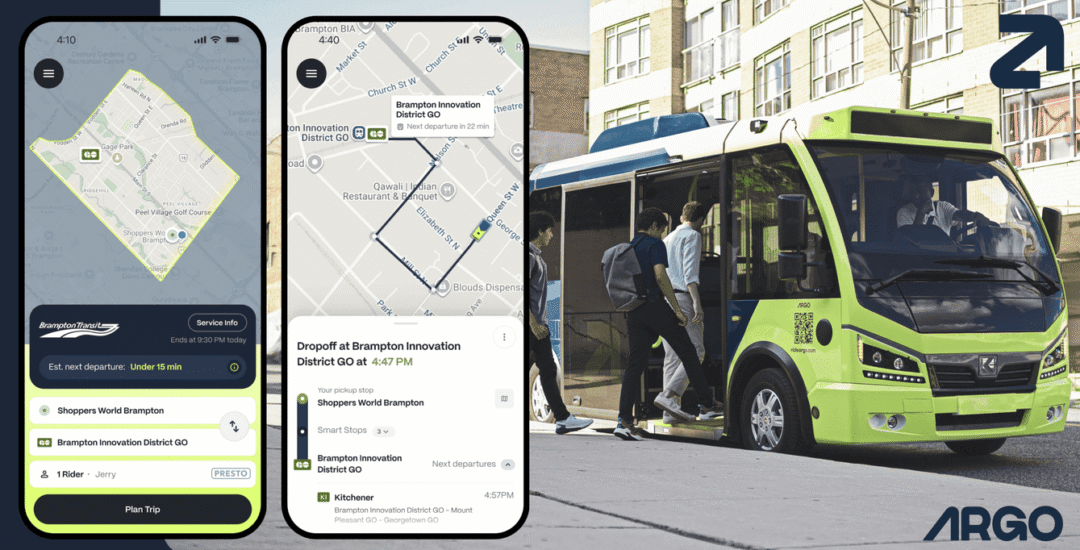
For decades, the taxi industry operated on its own terms—dispatch systems, regulated fares, and a belief that customers would adapt to the system. Then smartphones, GPS, and platforms like Uber quietly rewrote the rules. Riders no longer planned around taxis; taxis had to respond to riders. Many in the industry didn’t see it coming, or worse, dismissed it. By the time they reacted, the market had already moved on.
Free Rides – Zero Uptake
A few years ago, we made a decision that would have seemed unusual not long ago: we went from two vehicles to one. It wasn’t ideological – it was practical. Why tie up $40,000 or more in a second car, plus insurance and maintenance, when services like Uber or short-term rentals could fill the gap when needed?
Despite having access to Burlington Transit – and even being able to ride at no cost (actually paid for by all taxpayers) – we don’t use it more, and we won’t. Not because the system is broken, but because it doesn’t align with how we actually move. Even if buses came every five minutes, it would still take too long to get to the places we go most often. Burlington is not built around dense corridors; it’s built around fixed, point-to-point destinations. Fixed routes, by design, struggle in that environment.
No Tap Off – No Clue
As a senior rider, I tap my PRESTO card when I board – but not when I exit. That means the system knows where I get on, but not where I get off. In a time when every other mobility platform runs on precise trip data, Burlington Transit is operating without a full picture of rider behaviour. Meanwhile, demand-responsive systems capture every trip in detail – origins, destinations, timing, patterns – offering insights that traditional systems simply don’t have. As noted by the University of Toronto Transportation Research Institute, this level of data is exactly what allows modern transit systems to evolve.
BFAST – Burlington for Accessible, Sustainable Transit
Which brings us to the recent debate over the proposed on-demand pilot – and the role played by Burlington for Accessible, Sustainable Transit (BFAST).
BFAST describes itself as supporting “more and better public transit,” yet its delegation left more questions than answers. There was strong advocacy for improving Handi-Van service – important and worthwhile.
You can read BFAST’s position here: https://bfast.ca/wp-content/uploads/BFAST-ODT-pilot-Apr-2026.pdf
Curbing your Enthusiasm
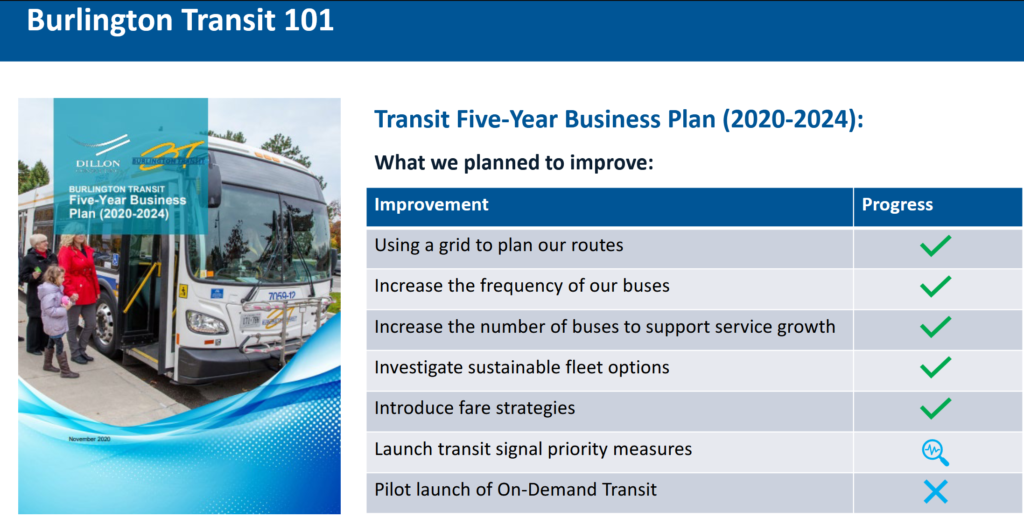
The proposal before Council was not a replacement for Burlington Transit, nor a substitute for Handi-Van. It may end up being a curb-to-node model, who knows. – one that has become the standard in on-demand transit. Instead of mimicking a taxi, the approach groups riders more efficiently, reducing detours, and filling gaps where fixed routes fall short. It is not about replacing the system; it is about making the system work better.
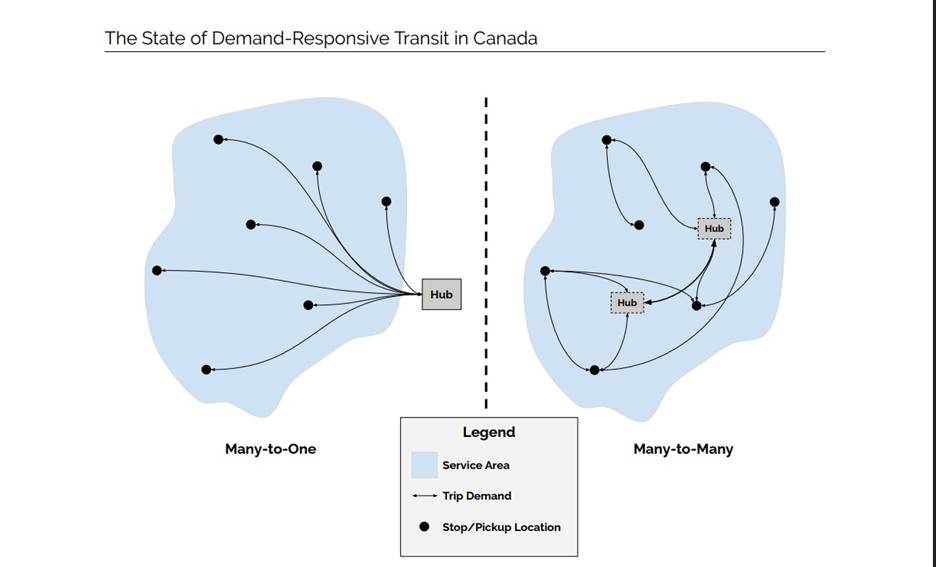
UTTI Research Final Report July 2020: Figure 2.3: Many-to-one and many-to-many DRT Service
Early Adopters Blazed the Trails
Burlington is hardly stepping into unknown territory. Since 2018, more than 20 municipalities across Canada have deployed demand-responsive transit (DRT) in some form. Burlington is not leading a risky experiment – it is joining a shift that is already underway.
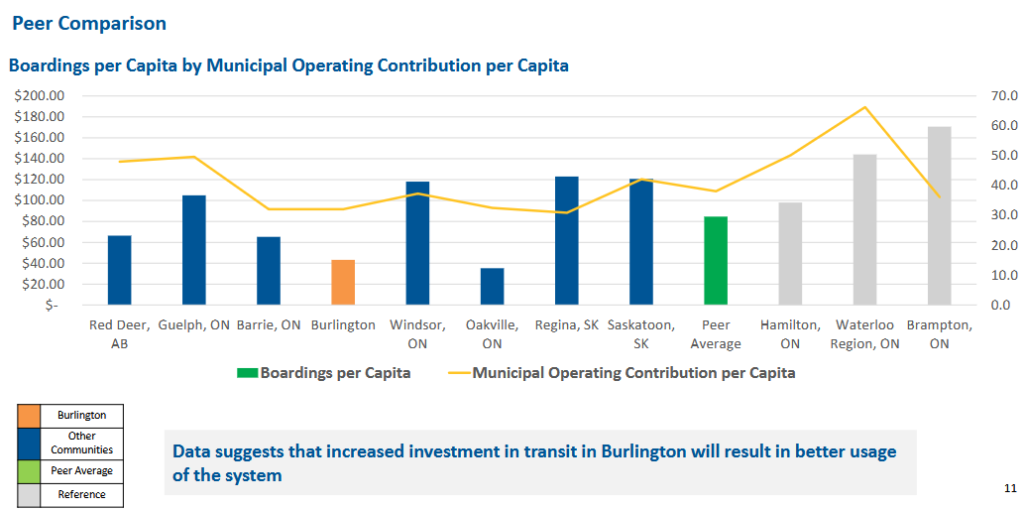
The underlying issue is one transit planners have wrestled with for decades: you can design a system for maximum coverage, or you can design it for maximum ridership, but doing both at once has always been a challenge. Traditional tools force a trade-off. Technology, for the first time, offers a way to manage that tension in real time. Demand-responsive transit may not be a magic bullet – but it is one of the few tools that directly addresses the problem.
None of this suggests the city should proceed blindly. Concerns about transparency, governance, and cost are valid and must be addressed. Any pilot must be measurable, accountable, and open to public scrutiny. But that is an argument for doing the pilot properly – not for avoiding it altogether as some suggest we should.
The real risk, may not be the trial, it could be what the Taxi industry did by missing the shift that was happening right under their hoods.
Transit isn’t just about moving people along routes anymore. It’s about – appointments, errands, service, multiple destinations – that reflects how people want to move on their own terms.
If Burlington gets this right, on-demand transit won’t replace buses. It will increase ridership and make Burlington Transit more effective and relevant.
You can read the motion approved by the council here: https://burlingtonpublishing.escribemeetings.com/filestream.ashx?DocumentId=95538
Discover more from Focus Burlington
Subscribe to get the latest posts sent to your email.
Nice piece.
Joe,
I think you’re being overly hard on the taxi industry and maybe not appreciating what it was up against.
Before Uber and others started operations here in Ontario taxi owners were required to own a medallion. The medallion was like a license to operate. There was a fixed number of medallions. So they became very valuable, tradeable assets. They were passed down from generation to generation or sold for considerable sums. If I recall correctly a Toronto taxi medallion was worth about $60,000. Taxi operations were also strictly regulated.
Along came Uber and others operating under the term rideshare rather than taxis. Rideshare implied that two or more people use the service, and share the cost of going to separate destinations. But soon Uber and others became unregulated taxi operators competing with the traditional regulated taxis. Municipalities seeing the benefit to their communities embraced Uber. Seeing the writing on the wall, medallions lost their value and taxi owners lost their investments.
The traditional taxi industry was hung out to dry by municipalities.
Moving on from that, as with the transition from traditional taxis to the Uber model, the Burlington bus system needs to be more flexible and rider centric. Maybe the flexibility of the first mile last mile micro bus with increase ridership.
Maybe certain groups like retirees or those on social assistance should be provided access at no cost to them to an Uber (two and from ride) maybe twice a week. Obviously anti abuse protections would need to be developed.
Transit ridership will only increase substantially if and when vehicle users find it more convenient to use than driving their car.
I have a suggestion in that vein.
There are four very large parking lots at the Burlington Go, Appleby Go, Mapleview Mall, and Burlington Centre Mall.
People arriving in Burlington by train at either of the Go stations May well want to go to one of the malls or to the downtown area.
I suggest a no charge shuttle service be initiated connecting those large parking areas with the downtown core. Vehicle users would be able to park at any of those locations, hop on the shuttle for either of the two malls or downtown.
The frequency of the shuttle service could be increased when there is a festival (Ribfest, Lakefront Music etc.) in the downtown core.
Just a suggestion.
David, you make a fair point. The traditional taxi industry was operating within a tightly regulated, asset-based system, and when platforms like Uber entered under a different framework, municipalities absolutely played a role in how quickly the ground shifted beneath them. It’s a much bigger conversation than a single exchange can do justice to.
Where I think we’re aligned is on the underlying lesson: technology changed expectations, and both industry and regulators were forced to react—some faster than others.
On transit, that same dynamic is now in play. The move toward more flexible, rider-centric service—whether through first-mile/last-mile or microtransit—makes sense, particularly in a city like Burlington. I also agree there’s likely still a place for curb-to-curb in certain situations, especially for accessibility or targeted groups, but “blue skying” it a bit, it may ultimately evolve into a 3P-style model where the city coordinates service while leveraging third-party capacity in a controlled, accountable way.
Your shuttle idea is also interesting—especially as a way to connect key nodes like GO stations, malls, and downtown. At its core, it speaks to the same principle: make it easier and more convenient than driving, or people simply won’t switch.