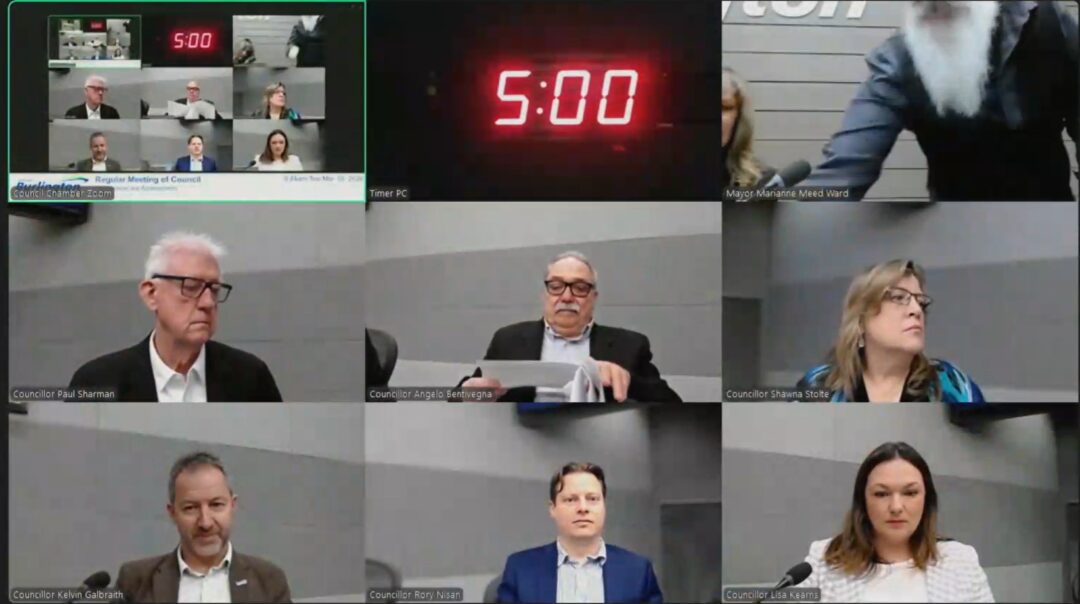
This meeting is a continuation of the April 13, 2026 meeting.
This is a computer-generated transcript of the meeting and may contain inaccuracies. You can check the accuracy of any statement by using the timestamp information and watching the video of the meeting from the city’s website.
This transcript is provided as a service to the community. Hearing-impaired individuals who are unable to watch the meeting in real time can read the proceedings here. Anyone can search the transcript for specific keywords and then watch the relevant section of the video linked above using the timestamp information.
Committee of the Whole: Votes here are recommendations. When the committee votes “yes,” they are technically voting to recommend that the City Council approve a specific action at a future date.
Council Meeting: Votes here are final and legally binding. This is the stage where the recommendations from the Committee of the Whole are officially “ratified” or passed into law (by-laws).
00:02:18
Number three, Good morning everyone. My name is Rory
00:23:25
Nissan, counselor for W 3. I’ll be chairing the committee of the whole meeting today. A continuation of the meeting that began at 9:30 yesterday. I will now read a safety notice for those present in council chambers. In the event of an emergency, please evacuate the council chambers by the nearest exit staircase, which is located through the doorway marked with the exit symbol.
00:23:46
Once you have evacuated the building, please gather in Civic Square outside of city hall. All City of Burlington committee and council meetings are live, webcasted, and archived on the city’s website. Today’s meeting is being captioned digitally through our agenda management software. Please slow down and speak clearly so your words can be captured.
00:24:04
would also ask everyone attending virtually to use appropriate microphones. We have rules of engagement in committee meetings. We ask everyone to be respectful while others are speaking and listen as you would want to be listened to. Reminder to committee members to adhere to the procedure bylaw and limit your questions to two at a time.
00:24:22
A member may ask a question only to obtain facts relevant to the matter and necessary for a clear understanding. All questions will be stated succinctly and not be used as a means of making state statements or assertions. We are not making decisions at this meeting. Only recommendations that will go to city council for final consideration on April 21st, 2026.
00:24:49
The public is welcome to see you when the final decision-making happens by attending the meeting either in person or watching the live stream. Delegates are welcome to register to speak at the council meeting. I’ll now introduce members of council. Councelor Calvin Galbreth, councelor Lisa Karns, uh, ward one, w two, councelor Sean Stolty, ward four, and councelor Paul Charman, w five, councelor Angela Bento, w six, and mayor Maryanne Midwart.
00:25:16
We’re also joined by Chief Administrative Officer Kurt Benson, and our committee clerk Joanne Rudy. Other staff in attendance will be introduced as each agenda item is discussed. Uh we’ll take the usual breaks midm morning and lunch from 12 to 1:00 p.m. The purpose of the statutory public meetings today is to present these reports in a public forum as required by the planning act.
00:25:41
The reports before committee today will go to city council for final consideration on April 21st, 2026. During the course of the statutory public meetings today, a ticker tape with delegation registration information will be scrolling across the bottom of the webcast which provides details on how to submit a delegation request.
00:26:00
If there are requests during the course of the meetings, new delegates will be communicated to the committee clerk who will advise the chair. After all registered delegations are complete, I will then make a last call for delegations and indicate the deadline time. A recess will be called to ensure that all requests made in in advance of the deadline can be provided with all applicable access codes and instructions.
00:26:27
When all requests have been made uh have been dealt with to the satisfaction of the chair and the committee clerk, we will reconvene and the remainder of the delegates will be heard by committee. It is important to note that only the minister, the applicant, specified person and public bodies as defined in the planning act and registered owners of lands to which the bylaw will apply and who made submissions at the public meeting or who have made written submissions to the city before the bylaw is passed will be able to appeal the decision of the city of Burlington to the Ontario land tribunal. So, our first item is uh 13.1 official plan and zoning bylaw amendments for 1056 to 1060 Brandt Street DGM2626. And before we proceed to delegations, I will pass it over to Benjamin Kisner, senior planner, to provide a presentation.
00:27:25
We’ll get that up on the screen for you. All right. Good morning, council uh chair and members of the public. Uh my name is Ben Kner. I’ve been the planner who’s reviewed the file that um well that forms the presentation today. Uh so the application for official plan and zoning bylaw amendment was submitted by Bose Fields Incorporated and it applies to the addresses at 1056 and 1060 Branch Street.
00:28:00
Um next slide please. So, the subject lands are located to the west of Brandt Street and uh they’re situated between Leland to the south and the QEW 403 to the north. Now, the imagery does suggest that there are structures on site. However, as of today, the site is vacant. Next slide, please. So staff uh began working with the proponents in December of 2025 uh with the pre-conultation meeting um in I think I have my dates confused.
00:28:41
I apologize. So that should be December 18th, 2024 is when the pre-conultation meeting took place because as of May 6th, 2025, that’s when the pre-application community meeting happened. Uh that same day the applications or the proposal rather went before the Burlington Urban Design Panel and um applications were submitted uh January 9th of this year.
00:29:03
Um and the 100 day excuse me the 120day timeline takes us to May 9th of this year. Next slide please. So the proposal consists of uh the construction of an 11story residential building. Um now that is excluding the mechanical penthouse. The building is proposed to contain a total of 93 residential units.
00:29:29
Um a propo a proposed floor area ratio of 4.5 to1. Um the amenity area that’s proposed is approximately 14.2 m squared per unit and uh a total of 68 parking spaces are proposed um within the development. And in addition to the uh relief and the special provisions that would be required to support the rest of the building, there are reduced setbacks that are proposed as a result of this development.
00:30:01
Next slide, please. So the proposed amendments are for both an official plan amendment and a zoning bylaw amendment within the OP. Um the site would be redesated to mixeduse corridor general with a sightsp specific exception for the floor area ratio and height. And within the zoning um a special provision would result on the site um providing relief for those setbacks um the increased floor area ratio um reductions to landscape areas the building height parking rate and dimensions for the parking stackers and finally the amenity area. Next slide please. So the staff recommendation uh is to refuse the proposed official plan and zoning bylaw amendments. Um the the specifics and the reasons the policy analysis are all contained within the
00:30:58
report G DGM2626. Um but the recommendation is well is what it is and it’s on the screen. Thank you. >> All right. Thank you very much. So, we will now request delegations to provide comments to committee. As a reminder, during the course of this statutory public meeting, a ticker tape with delegation registration information will be scrolling along the bottom of the webcast which provides details on how to submit a request.
00:31:31
We have one pre-registered delegate. I would like to invite David Fleta from Boozefields, Inc. who’s joining us in person, I believe, to speak. There you are, David. David, you have 10 minutes uh once you’re ready, we’ll get that PowerPoint up for you. Great. Thank you. Good morning, chair, members of council, your worship, and staff, and the public.
00:31:54
My name is David Fleta, and I’m a registered professional planner with Bellfields. Um Jack did a uh an overview of the presentation. Um, so I’ll try not to review sort of what he’s discussed, but we’re here on behalf of um those three numbered companies that that are in the staff report and um they’re basically uh a development company called the ELAD group.
00:32:20
Um, next slide, please. Um, just wanted to highlight some additional information uh for your uh benefit that I think kind of supports where we come from. Uh, and then I I’ll end with sort of our request, which is to um to continue to work with staff. So that as you can see this the subject sites on the west side of Brand Street immediately north of your MTSA as well as your urban growth center.
00:32:48
Um, next slide, please. Some of the key highlights of the immediate surroundings uh that we want to highlight for you is the depth of the site. So the site’s approximately 45 m deep, which is about 150 ft. the width of Brand Street. So, we talk about mid-rise buildings responding to the width of the street in which they front.
00:33:08
Brand Street is a very wide street at 36 meters. Just identifying it as having the potential to grow and have uh buildings that are taller along it. And then the third item we wanted to highlight for you u is Rickman’s Commons Place. So, in terms of immediate surroundings, we know along the Brand Street corridor, it’s an intensification corridor and the lands to the north and south will intensify over time.
00:33:32
in terms of its relationship with the lands immediately west of the subject site. You can see on the screen that it’s not a backtoback relationship. It’s a backto-front relationship which kind of changes privacy and overlook and other issues. Uh next slide please. Uh this is just a view of the subject site acknowledging that it is currently vacant. Next slide please.
00:33:55
Wanted to highlight the regional urban structure. So there’s two components here. We’re immediately north of the urban growth center. Um and then also along a regional intensification corridor. Again, this is where growth and intensification is directed. Next slide, please. Um just to highlight in terms of the current land use, it’s already designated mixeduse corridor.
00:34:15
So, we’re not proposing to change that in any way. We’re just proposing to add some additional modifications to that. Also wanted to highlight those town houses immediately west of the subject site also form part of that corridor. Um so again this whole area is intended to intensify over time and transition up to your urban growth center.
00:34:32
Next slide please. Um in terms of transitioning you’ve gone through an MTSA process where you identify growth to your urban growth center. This map really illustrates where the subject site is immediately north of the urban growth center in the MTSA. And the area in green along the Burlington, sorry, the Brand Street corridor is intended for taller buildings of up to 19 stories.
00:34:56
Uh, and as we know as we get closer to the GO station, those those heights grow even more. So the 11 stories in our opinion provides that transition up to that urban growth center. Uh, next slide please. Just wanted to highlight the current zoning. You see the MXG zoning and again those lands immediately west.
00:35:13
Those town houses are in that MXG zoning which are allowed to redevelop up to six stories in height. We don’t anticipate that happening. Um and we think the way that we’ve designed the proposal that it does align um and appropriately respond to it. Next slide, please. Wanted to highlight some of the changes that we made to address some of the comments that we heard through uh the public consultation strategy uh and meetings.
00:35:37
We increased the outdoor amenity area. we provided. So the the plan on the left is the original proposal. The plan on the right just shows some of the changes. So obviously landscaping to the to the rear, providing that transition, adding some landscaping as well as outdoor amenity area that helps transition down. We’ve added some stepping into the building.
00:35:57
We increased the parking. We heard a lot about the the parking. Um the driveway was reconfigured and then we added some additional parking spaces. The big piece about the parking is, you know, within your MTSA, your parking standards have been reduced significantly, which in some circumstances requires zero parking.
00:36:12
And as we know, we’re immediately north of that uh MTSA. It’s with, you know, it’s at the Leland uh intersection, which is about uh 150 meters away. Uh next slide, please. wanted to just highlight, you know, the architectures identified that as it as an intensification corridor. We will see uh higher density buildings along this corridor.
00:36:34
We think the lands to the east of Brand Street will require a little bit more transition because of the afternoon sunlight that creates those additional uh sun impacts. Next slide, please. I just wanted to kind of show within context what the building looks like. We think that we framed it in a way that uh really does um reduce the overall impact. Uh next slide, please.
00:37:00
Just just showing some views. We’ve really put a lot of thought into the architecture. We think it’s a really well-designed building that really frames the street. And then next slide, please. um proposals for 11 stories, 93 units, uh you know, 1325 square meters of amenity space, which is a reduction from the 20, but it is in line with other approvals that this council has granted.
00:37:23
Um uh the overall GFA is 7,000 square meters, 68 parking spaces, and 52 bicycle parking. Next slide. Just wanted to touch uh this is the ground floor plan, which shows the orientation of the building. Uh it’s a relatively tight site. We recognize it. The underground parking will function uh through an elevator and stacker system.
00:37:44
Um one of the comments we heard from staff is they do want to see mixed use, so additional non-residential uses along the street. Um next slide, please. And then we just really wanted to illustrate the transition. We know that between the proposed building and the town houses to the west which uh you know we we recognize in the staff report that there is concerns there is approximately 26 m of uh distance.
00:38:09
Uh we also provided the angular plane which illustrates where that boundary is. Again the entire site as well as the town houses both fall within that mixeduse corridor designation. In our opinion this is a relationship that makes sense. Um yeah uh next slide please. Uh just illustrating the landscape plan and then next slide.
00:38:34
Really want to touch on some of the key things that we heard which are parking supply and the potential queuing on to to Brand Street. A lot of these concerns we only heard about about a week and a half ago from staff. We know tight line timelines are tight because of the planning act. Um, we’re asking you for a deferral so we can spend a little bit of time working with the city.
00:38:56
The applicant has been open to the owner has been open to making revisions. We’ve shown that between the pre uh application community meeting and where we got to today. I’ve spoken to the owner. He’s willing to work with staff to address some of these comments. We’ve met with um your planning staff and uh we’re just disappointed that we haven’t had a little bit more time to work through some of these issues.
00:39:17
It’s not the fault of your staff. It’s not our fault. It’s just these timelines that have been uh put on us by the planning act. But uh with that, we I think that there’s an opportunity to work with staff. I don’t think there’s a bit of a um I I don’t believe that there is a risk to the city of an appeal.
00:39:33
We think that these buildings are really difficult to build because they are very tight. Um and we’re willing to work with staff and give you the notice you require uh should this have to be bumped up to the Ontario Land Tribunal. So with that, I’d be happy to answer any questions. >> Thank you, David.
00:39:49
And we do have a question from councelor Galbrath. >> Thank you, chair, and thanks for the presentation, David. Um certainly appreciate some of your arguments with its proximity to the uh the uh Burlington Go MTSA. Um staff identify one of the issues is the height at 11 stories. Nothing else around clearly is uh close to that.
00:40:11
Are you is that one of the things you guys are willing to talk about with staff and potentially reduce? Yeah, through you chair to the counselor. Absolutely. I think our our owner does not want to go to to an appeal because we’ll be wasting a lot of money that could actually go into the development of this building.
00:40:28
Um, you know, the 11 stories in our opinion makes sense because of the width of the street. And you know, when you read your staff report, there’s nothing in the staff report that indicates that the height is creating any built form impacts to the surrounding land. So, no shadow impact, no wind impact, um, and no privacy or overlook impact in our opinion.
00:40:49
Uh, and none of that is in your staff report. So, the 11 stories in our opinion makes sense. However, we’ll we’re willing to work with staff to identify what that number is. And again, the buildings are stepping up to 17 and 19 uh stories within your MTSA along that corridor. >> Okay, thanks for that. Second question, uh, is it potential to be a rental building or is it a condo? >> Yeah, through you, chair to the council.
00:41:15
At at this point, it’s undecided. The owners are leaning towards rental at this point given the the condo market at the moment. >> Okay. Thank you, >> Councelor Krence. >> Thank you very much. So, one of the questions I’ve had for you is um why are you taking all of the benefits of the MTSA area, which is reduced parking, etc.
00:41:39
Um but not giving any of that back in terms of this building. This is a mixed use. There’s no additional uses like commercial. Uh the area is zoned for six stories. You’re asking for 11. You’ve shown an image here that presents 11 in a contiguous pattern on that side uh of Brandt Street, which is the west side, when all four of those images would be breaking our own zoning bylaws.
00:42:06
I’m not sure why that was illustrated that way. Um, and I’m just wondering, uh, why would you exercise the benefits of the MTSA permissions and yet not give any of the amenities or the enhancements to the community that are intended to be exercised through that particular zoning, which is the MTSA or the community um, permit planning system? So, it’s a lot of taking and no giving.
00:42:29
So, can you explain that? >> Yeah, through through your chair to to the council. All great questions. So, maybe I’ll start with the 11 stories. The reason why we illustrated it as 11 stories is one of the comments that was raised early on in the process is what happens if all of these buildings uh develop at that additional height.
00:42:45
And what we’ve demonstrated is that they still can function so long as you’re providing those uh the spaces in between. And that’s why we’re trying to illustrate that we don’t anticipate that the corridor will develop like that. What we’ve what we would prefer to see is a range of heights that go from six to uh 11, maybe even taller in some circumstances.
00:43:05
In terms of uh the MTSA uh uh question about providing the mix of uses, I I think that’s what you’re looking for. Um we haven’t heard that from staff uh throughout the process. We heard it about a week and a half ago and our client is willing to add it. The problem with adding it is this segment of Brad Street doesn’t really lend itself well to retail.
00:43:25
And the reason why it’s a very wide street um so you don’t get that pedestrian activity that you would get. you might get it closer to an intersection where you can get pedestrians crossing the street. Um the other element is that uh because it’s not a pedestrian um area um you would have to provide on-site parking and again we’re really restricted in how we can actually accommodate parking on site.
00:43:53
So those were the reasons why we didn’t include it but again we would like to take it back and look at the opportunity to add it and how we can address th this comment that’s been raised. Okay, thank you for that answer. On my second question, I just wanted to understand more from the urban design panel around the built form because it is identified in the staff report as uh overly intense for the site.
00:44:16
I find this really interesting because we don’t often have staff make those statements so boldly around calling a a proposal over intensification. So, um, is your owner, uh, willing to kind of bring that, uh, context of the built form in a little bit more to be in more alignment with staff’s vision and council’s vision and the community’s vision? >> Yeah.
00:44:44
Through through you, chair to to the counselor. Absolutely. Like, you know what’s what’s most disappointing is that we thought we nailed we thought we nailed it. Like, we we thought we we had it. We did not hear from staff that that the transition was inappropriate. I think that’s what we’re talking about is how we’re transitioning down to the town houses to the immediate west.
00:45:07
You know, there’s nothing in the staff report that talks about built form impacts, but we know that’s not the only piece. We know that we’re building a city and it has to be compatible with the surrounding uh context and maybe that means molding the building, adding some stepbacks, and even lowering the height.
00:45:21
And we’re willing to work with you on that. I think I think everybody loses is if this thing goes to the tribunal, but if there’s an opportunity to work with staff to mold this building to address some of the comments and concerns that we’ve heard, I think we got to give it a shot in my opinion and we’re willing to work with you.
00:45:36
Yeah, >> I have more questions. You want to go back into Q. >> Thank you, Mayor Meard. >> Thank you, Chair. Um I did want to talk about the um the transition and uh just get your feedback on on what would be required. This the staff report does uh discuss it on page six of the report 286 of the agenda.
00:46:01
It talks about the development as proposed presents challenges with transition to the existing town host houses to the west of the property. Opportunities to bring in transition measures such as setback screening plantings are impeded by the buildout. So the the whole thing so there are transition impacts. The way the building is designed doesn’t allow for the usual sorts of landscaping and other things.
00:46:26
Uh that that whole paragraph. So it they’re suggesting it’s kind of a a doover there. So I I wanted to get your feedback on how you would uh address the challenges. You’ve you’ve said you’re open to reducing the height. That would be a start, but um the setbacks are also a challenge in terms of implementing some of those transition measures.
00:46:49
So what are you thinking? >> Yeah, through through you chair to your worship. Um absolutely. Uh I I think one of the opportunities is in increasing that setback or adding stepbacks. And what that means is right now we’re basically going from uh property line 7 and 1/2 mters and then we’re going up six stories.
00:47:12
Uh and then we’re stepping back minor stepbacks at the ninth story and the 11th story. Um, and I I I think what we’re hearing from staff is either we increase that setback even more. Um, or we add additional stepbacks at lower heights to like really improve it. So going from uh six stories, maybe the setback becomes a six meter setback rather than a 1.5 m setback.
00:47:36
And I think we can look at that. One of the the comments we heard from staff because we we kind of scrambled and we we met with staff was maybe there’s an opportunity to rotate the building so that it’s uh it’s wider rather than longer. Uh these are things we’re going to have to look at with the architect who you know WZMH is a is a wellrespected architect in the industry and we we we are very confident that they’re going to come up with a solution and we’d like to just sit with staff and sketch out some opportunities and options. >> Okay. And uh my second question is around uh I’m just looking at the sort of the timeline here and it doesn’t um I can’t see where the precon meeting was but I’m sure you had one uh with staff. So during the review of this which officially started in January, did staff raise concerns that we see now in the report around the scale, around the height, around the parking, around the queuing, the the stacked parking, all of that. Were those flagged for you uh
00:48:34
prior to you seeing them in this report? >> Yeah, through through you uh chair to to to your worship to the mayor. Um yeah, through we did a pre-conultation in 2024 was December 2024. The the slide was wrong. Um and through that process, the precon minutes did identify that we would have to rationalize the increase and really uh address the transition to the surrounding areas.
00:48:56
didn’t get into the details in terms of what is the most appropriate. Um, and you know, unfortunately, we we should have, you know, I’m going to take the blame as ourselves. We should have reached out to staff a little bit earlier to work with them to really uh sculpt this building. You know, I’ve got a pretty good relationship with your staff.
00:49:13
I think they’re great. Um, and you know, in this one, I I think we were just rushed because uh things moved relatively quickly January after the holidays. So, uh, the things just moved a little bit too quickly and usually we would get in a meeting like we did with Trinity Point, which you’re all familiar with.
00:49:32
You know, we work through some of the issues with the road widening and some of the sculpting issues that you wanted to and I think this is another opportunity to do to do that. Yeah. >> Okay. >> Okay. Thank you. I just have a first time question for you, David. It’s about the parking. Um, you started at 20 odd spaces.
00:49:48
Um, and uh you you bumped it up to looks like to one one space per unit if I if I’m reading that correctly. You’re very close to it. Close with visitors. Okay. >> Um I I can’t find the a parking report here on the on the website. So what did your parking analysis show uh was actually the market driven parking you know interest in parking? >> What does the market want in your team? Thank you, chair.
00:50:22
Um, so so Lee Consulting is the uh transportation um consult transportation engineer that’s on this file. They’ve they’ve completed a transportation study. As part of the transportation study, there was a parking component to it. They’re the ones that really informed um the original precon at 22 spaces, which is a very reduced number, and part of it is because you’re you’re so close to an MTSA where, you know, the parking standards have been uh quite lower.
00:50:49
So, they were applying those same standards to our site. They rationalized the 68 parking spaces. I think um your transportation staff uh when you look at what their comments actually said, they they recommended that if it does get approved that a holding provision be put on because the big concern that they have is because it’s parking elevators that there’s a potential for queuing back onto Brandt and nobody wants that.
00:51:13
So, they really wanted to understand how it would function so that we don’t have that backup and queuing occurring. Um, and we think we can work through it. We’ve we’ve uh we followed up with our transportation consultant and your transportation team is great and we think that there is a solution in there.
00:51:30
But the uh just to clarify the the market analysis or your your belief was that you could the market could handle 22 parking spaces here. >> Yeah. Yes. Chair. Yeah. >> Okay. uh in terms of the stacked uh spacing and the queuing. So, you’re talking about having a a potential hold provision on that? Has it have you seen it has it worked well? Um we haven’t had stack spaces yet.
00:51:58
We’ve we’ve I think we approved one uh development with it, but this seems more stacked than usual. So, uh, what do you think and which is actually your preferred option versus, uh, you know, what do you think is actually going to meet the market and our transportation needs? >> Yeah, thanks for the question, chair. I I think stackers, most municipalities have approved lots and lots of them, but only certain amount have actually been realized.
00:52:24
There’s two concerns with stacker systems. The one is the operation of them. Uh, so who’s actually operating them? And then the second one is um related to how do they function? Are they functioning properly? And I think what you’ve heard from your staff is they need some additional information to make sure that it’s going to function properly um and and to to address it.
00:52:43
I think that there are some really good examples in Toronto, Ottawa, and Hamilton where they actually do function well. Uh so I do think that they will work. In terms of the parking supply, um I I think at 0.7 spaces at immediately north of your MTSA, I I think we meet that requirement.
00:53:03
Uh you know, going lower than that, again, our transportation consultant can rationalize that, but we want to work with you. We want to work with the community. Also, if it’s going to be a rental building, you can control uh how much parking supply you provide. >> All right. Thank you. Second time question, councelor Kurts.
00:53:23
Thanks so much through the chair. So, a couple options here. So, I’ve messaged you back two times related to two developments that you have going on saying, “I welcome good developments that provide quality of life for our residents, even when it’s politically unpopular.
00:53:37
This project, like that one, is falling extremely short of that. So, I’ve refused two meetings with your group on that basis. This decision has to be made um by May 9th based on the statutory timelines. council goes on April 21st, which is pretty much a less a day shy of a week from today. There’s an option to give you till May 7th if we pull a special meeting of council.
00:54:04
At this point, I’m prepared to support the staff recommendation, which would be a full refusal and as you had mentioned, probably a path straight to the tribunal. What do you think can feasibly be done between now and the 7th of May if we were to give you that amount of time to work with the comments you’ve heard today? >> Yeah.
00:54:26
No, through you shar to the counselor. Those are great comments and definitely appreciate your position. I think what what I would say is you know the staff report identifies a risk and and the real only risk is that you don’t have a council decision. So if it did get appealed, you know, uh so if you don’t make a decision within the statutory timelines, it can get appealed by the applicant for non-decision.
00:54:51
Um and if you don’t have a decision, you if you haven’t made a decision, then that will not have any weight at the tribunal. That’s your only risk. What what I’m telling you is you have a staff report before you that has staff’s position on the current application. Um uh you know in my opinion I I don’t think a week’s enough time to work with uh the all the city departments as well as our uh our our team to pull together and actually work through a solution.
00:55:23
We’d like to wait at least one cycle. Um and we can commit to you if you would feel more comfortable on not appealing it. Um, the owner has has given me that direction that he would he would agree in writing not to appeal until this council comes to a decision if we do want to wait till the next uh uh next meeting.
00:55:43
So, I’m in your hands in terms of how we want to proceed, but I just don’t think there’s enough time. That’s that’s a lot of work to address technical issues as well as some massing issues in a really short time, unfortunately. Yeah. >> Okay. So, just a follow-up question. Um, I think the term is like once bitten, twice shy.
00:55:59
So, can you talk to me a little bit more about what this agree in writing to not appeal looks like and what type of securities would back that up? >> Yeah. No, through you chair to to the counselor, the owner just basically told me that he would agree to to not appeal if we were to wait one cycle. So, it’ll give us a month to the next meeting.
00:56:19
Um I don’t know what type of security you’d require but um yeah unfortunately you know uh that’s as much I think is that I I can say but I understand your position. Yeah. >> Okay. >> Second time Mayor me >> thank you. Um I’m interested in your feedback. uh the staff did provide their recommendation relative to a deferral.
00:56:50
Uh and the essence is um it it’s it’s quite more than just avoiding a tribunal hearing with no council decision. They would be looking for an really a revised development concept with additional supporting studies which it seems would probably take uh take uh more time on your side to prepare.
00:57:14
But then there’s also the um you know staff have to review that. So I I guess realistically uh if this is uh a bit of a doover with new materials and new review um that seems to me it would take a little bit longer than a month. What’s your thought about that? And that’s the essence of why they’re they’re not recommending the deferral >> themselves.
00:57:45
Yeah, through through you chair to the uh to the mayor. Um and I do appreciate you can even acknowledge in the staff report that the that your staff were trying to think about ways to to reconfigure and still maintain the same GFA. So we do appreciate that staff did make an attempt.
00:58:01
What I will say is that I I don’t think you would have to address all of the concerns, all the technical elements. I think that there are ways to apply holding provisions to deal with things um uh like those technical elements if there isn’t enough time to review them. I think the big piece is really getting the build form right and I think within a month there’s more than enough time to get that done.
00:58:21
We also can make assumptions in terms of um looking at the existing studies that we have to make assumptions in terms okay if you know the shadows won’t be as bad or the wind won’t be as bad for these specific reasons. So those minor assumptions can be made and then we can apply holding provisions to deal with things uh to ensure that the the sufficient time has been made for those studies.
00:58:44
Thank you. >> All right, councelor Kren third time. >> Thank you very much. And this will be my my last um my last question. So, um, one of the things I just I don’t normally pull this one forward, but I was really interested in the way that, um, we had such strong, um, vocality from our, uh, climate and sustainability advisory committee saying that the hardscaping and minimal vegetation was just something that they were, um, opposed to.
00:59:13
So, I’m just wondering, I don’t usually see that and I’m wondering how additional time could help to support that. So, I know you brought some of the um you know transitioning area around the landscaping in uh but I haven’t seen that before and I just wanted to hear your comments on it. >> Yeah. Through through your chair to to the counselor.
00:59:32
Um again, we we we haven’t had time to fully vet it, but we think that there’s lots of opportunities to add sustainable elements. Um and you know, we we we would love the opportunity to work with your your team on that. I think there’s a lot of really good standards across Ontario in terms of like the Toronto green standard for example where we’re looking at different paving materials so you can control runoff and whatnot as well as additional u building materials to make the building more sustainable.
00:59:58
and we’re happy to work.
01:00:00
work with your team on that. So, um we think that there is an opportunity to address that. >> Okay. Thank you. And then um you’ve mentioned a couple of times. This is my last question. You’ve mentioned a couple of times that you were a little bit surprised by staff’s um feedback in response to your um proposal.
01:00:13
Can you cast your mind back and recall any of my comments to you at the pre-conultation meeting that that I know I was on? Do you recall what you heard from the counselor at all? >> Yeah. through through your chair to to uh to to the council, we I do recall that we we had a couple of conversations on this project and you were supportive of some of the moves that we made such as the increased outdoor amenity space and the landscaping, the significant increase in parking.
01:00:44
Um uh so we were quite surprised when uh there there was the uh uh the lack of willingness to to meet. So, uh, we thought we were headed in the right direction, but but clearly there was some additional concerns that, uh, maybe we misheard, uh, and I think it specifically relates to the height and build form. So, okay. Well, thank you, David. Thank we.
01:01:15
We have no further pre-registered delegates for this public meeting. So I will now ask if there is anyone watching the live stream or present in council chambers who would like to delegate to development development and growth management report DGM2626 regarding official plan and zoning bylaw amendments for 1056 to 1060 Branch Street to please submit your request by 10:13 a.m. to clerks burlington.
01:01:40
ca CA or call 905335777 extension 7481 as noted in the ticker tape that is scrolling at the bottom of the screen. We will now take a 7m minute recess to ensure we have received all requests to delegate. This meeting is recessed until 10:15 a.m. Thank you. I have been advised by the clerk that we
01:10:04
have received no delegations. So um I will now declare that the public meeting portion of this meeting is closed and we will move to questions of staff. Who would like to go first? Councelor Charman. >> Thank you very much. Uh my question is this. the um in the event that we pass what’s before us today uh is staff willing to continue to work with the uh with the applicant in order to resolve any challenges and reach uh reach agreement.
01:10:46
Uh mic’s on. Yeah. Uh through you chair to councelor Charman. What’s before you today is a staff recommendation to refuse. uh we heard from a delegate a request to refer um staff are always of the opinion that we want to achieve the best possible outcomes with the time that we have available to us.
01:11:05
So um pre-conultation before the clock started was was that space the clock has now started and so I think council needs to uh consider to be fair exactly what uh the delegate laid out before you what the risk of potentially referring is. uh staff would be in your hands. We are more than willing to do the work.
01:11:26
I do agree that we need the time to be able to do the work. I >> I wasn’t actually suggesting we refer it. I was just simply asking in the event we approve what is proposed to us today or recommended that we refuse um are you still willing to work post that deadline the the refusal um um in in in order to and carry on working with them and to get them to a place where they can then come back.
01:11:50
Yes, we will work in every way possible. >> All right. So my second question is are we going to then have them pay pay new fees and things like that in order to deliver them? Is there extra cost to them because they we’ve we’ve already made this decision to not approve. >> Uh the refusal ultimately would lead to two options.
01:12:10
One uh they do nothing and would have to resubmit an application or alternately appeal. Both of which I believe would they would incur additional costs. So complete new set of costs. >> If through the chair to the counselor, the costs would be to the applicant for their consultants and their design teams.
01:12:28
The only cost that they would incur would be the appeal cost to the OOLT, but the city would not charge them a fee. should they appeal the council’s decision and requested that the city enter into mediation and negotiations with them in an attempt to reach a revised design that we could then bring forward to committee and counsel for their consideration whether or not to settle.
01:12:50
Um but we would not um if they appealed it and we entered into those negotiations, we would not require that they resubmit an OPA or zoning bylaw amendment fee. The only like as the staff indicated their cost would be the cost for their design team but not a processing cost that they would have to pay to the city in an effort to resolve this should they have make a determination to appeal it. Thank you.
01:13:13
Thank you. If I can just ask a clarification. I I don’t think you got quite my question. My question is forgetting if they don’t appeal but they want to continue working with you after we’ve said no, we’re not we we’re going to not accept the application right now. So assume that we accept your recommendation, they continue to work with you, you continue to work with them, and you finally get to some sort of agreement.
01:13:37
Will we go are we going to charge them more fees to go through additional work time uh through the chair of the counselor? Short answer is yes. Simply because the uh processing of the current uh development application files would be considered to be concluded once council makes a decision on the application. So should we continue conversations with them that resulted in a new design um that and depending on ultimately what that design looks like, it would most likely require a new official plan amendment application as well as a new zoning bylaw amendment application by the applicant. Thank you. >> Thank you. I would point out it may not require all the necessary background reports or studies which would be a significant savings to the applicant. I.e. um if there was less units we would not require an updated functional servicing report. Uh we may not require an updated traffic study. Our primary focus will be on urban design considerations and assessing built form massing and ensuring land use
01:14:37
compatibility through any negotiations or subsequent review with the applicants. Thank you councelor Curtis. Yeah, thanks very much. Very similar question around um how to process this with, you know, potentially an optimal outcome. So um uh if we align with the staff’s recommendation to refuse today, you’ll still work with the applicant potentially, is there a path where we could at least get a signal if we moved the uh council decision to a couple days before the statutory deadline, which is May 7th. So maybe we can hear more. I feel like what we have before us is a culmination of issues as opposed to one threshold issue and I’m just wondering how we can see a way to navigate through that. I’ll take a first crack through you chair to uh councelor Karns.
01:15:35
The the timeline for finalizing a report like this report was finalized many weeks back. So you work back from May 9th to when we actually have to have the work done and there’s a very small window of time to be able to do any work. And I would agree uh with your characterization of it not just being one matter.
01:15:54
It’s a culmination of a number of matters that need to come together and be resolved. And and it is not just planning staff. It’s not just a planning opinion. There’s a number of other um groups internal to the city of Burlington that will also need to weigh in with an opinion, which means we need to get updated materials, circulate those materials with sufficient time to provide comment, digest those comments, and then write the report in time to get it for May.
01:16:22
And I my perspective is that’s a short amount of time to be able to accomplish all that. >> Okay. So, a bit of a follow-up question. If we go to the tribunal based on a refusal recommendation, we have two options. Either take on the denovo hearing or engage in the settlement opportunity, which is always in close session.
01:16:43
Um, do you think that there’s a way that we could have discussions around what uh those two options look like between now and May 7th if we extend to just before that kind of drop deadad date based on the statuto timelines? So, I certainly agree with the refusal. I’m just wondering if in the element of surprise, uh, and this overzealous eagerness to work with council, uh, there’s a way that we can find a a balanced place to bring a good development forward without, as councelor Charman mentioned, you know, setting the clock right back to zero. through you chair uh to councelor Karns. I believe that um the same issue the the question is about can we get to a place where we know where we stand and report back to you the the time is the issue we
01:17:42
need to have the information so there’s some requirement for time on their side to produce it deliver it to us have us circulate it and digest it and come to an informed perspective and I don’t think uh that there’s I don’t see a difference between whether we’re reporting back to council in May or providing some kind of an update around what’s the likelihood of settlement.
01:18:06
It it’s one in the same the same work needs to be done. >> Okay. Thank you for your response. >> See councelor Galbreth. >> Thank you chair. Um just a couple questions. Um an applicant cannot give up their appeal rights like they can’t give a guarantee that they won’t appeal. I I don’t think that’s a thing.
01:18:29
Is it? We’ve heard this before, right? Probably a legal question. >> Uh, thank you. And through the chair, that’s correct. They can’t contract out of their statutory appeal, right? So, they could give us a signed letter saying they won’t appeal, but that does not preclude them from appealing. Okay. Thank you.
01:18:47
And then second question, if we um, as far as I know, it the the lost fees don’t exist anymore. if we go past the 120 days >> uh through you chair. That’s correct. Councelor Galbreth. Uh the the penalty that the province previously put on municipalities to have to return portions of the fees subject to certain timelines has been removed.
01:19:09
I think staff’s uh ongoing uh rationale for bringing forward recommendations is the ability for council to make a decision within the prescribed timelines which we built the ability to do when the fee penalties were on point and uh in play. And uh our goal is to continue to allow council to have the opportunity to make a decision based on what’s submitted to us and and with the hopes that while it’s not required but voluntary that we are able to do the work ahead of time before the clock starts ticking or before the application is submitted. >> Thank you. >> Mayor Midwart, >> can you advise us uh what kind of feedback you’ve given throughout the process? I imagine and uh the delegate did confirm that some of these issues were flagged before the report. So uh can you can you kind of help us understand what kind of feedback you
01:20:06
gave and advice you gave in terms of how to bring in an application that you could support? >> I’ll start uh through you chair to uh the mayor. we uh would have issued a a formal set of comments on the original pre-conultation meeting that did happen back in December of 2024. Um at those meetings, uh part of my component of that is to advise everybody on the process that we are trying to achieve, recognizing that it’s voluntary, but to some degree marketing the value for it.
01:20:41
If you’re looking to understand where staff are at, um we are willing to be at the table. We are willing to work through technical pre-conultation as well. So submitting any technical materials. I would offer that I I think uh David uh the delegate uh characterized it aptly uh that there was a a decision to move forward with the application before we fully closed out those conversations.
01:21:04
Um so we would have highlighted in that original set of comments all of the things that you still see represented in the report that are uh unresolved issues. And the reason that we can’t um recommend approval for it, the uh technical pre-conultation discussions and submissions uh and comments um were focused on parking uh the amount of parking.
01:21:29
And I think um we didn’t get to the details of the system uh and the queuing. And that’s not to say that that those comments weren’t provided. uh they were very early on in a very formal way but we never got back to um the table to discuss those pieces uh before the application was submitted and ultimately we then focused on processing the application.
01:21:53
Uh similarly um on the matter of the mix of uses which is on the planning side of things pretty fundamental um that goes all the way back to commentary we offered in the original formal pre-conultation comments but also in the technical presubmission discussions and maybe what I’ll characterize as a bit of a gray area is we didn’t get a planning justification report as part of the technical presubmission and so I don’t want to put words in Ben’s mouth but that’s where we’re looking for the justification for why a mix of uses is not provided. We’re also looking for justification for all of the other elements, the form elements around from an urban design perspective, how it fits um and other elements like amenity. Amenity is uh a fairly low number and so we are really looking to the evidence or the justification for it in order to inform an opinion that we’re going to offer. And so once we received it and reviewed it, um there wasn’t enough for
01:22:51
us to be satisfied with the justification. And so you see us continue to highlight that. >> Okay. Uh and then you’ve heard the request for deferral. Uh your recommendation in the report is that it’s not recommended that there would be significant amount of work uh new application significant amount of work by staff and uh we do operate I believe on a fee for service.
01:23:14
So if if there’s a new application that you’re having to process without those additional fees, that would fall, I guess, out of the reserve or on taxpayers to cover that, I’m not sure. But does anything that you’ve heard uh today change your recommendation to us or you’re still recommending that we do not defer that we make a decision today? I haven’t heard uh sorry through you, chair to the mayor.
01:23:44
Uh I don’t believe uh that we have heard anything today that changes the recommendation that we put before you uh save and except for we are always willing to continue to work and so we are in the hands of the direction of council. I think what staff want to ensure is that council has an opportunity to make a decision based on the information that’s before you and before us through the application and that’s what’s informed the recommendations.
01:24:10
Uh I don’t believe anybody brought any technical information into this meeting today or or any of the work that would otherwise resolve the issues that are contained in the report that lead to the recommendation to council to refuse. >> Thank you, >> Councelor Stoalty. >> Thank you, Chair. So interesting to hear all the different variables and I guess what I’m curious about and I’m hoping the answer isn’t a quick no, but it could be.
01:24:38
I’m prepared for the fact it could be given the fact that it doesn’t sound as though either the city or the applicant want to stop talking or especially the applicant is very motivated to want to continue to try to figure this out. It doesn’t sound as though anyone is necessarily wanting to go to the OOLT especially.
01:24:58
I understand that we have been this here before where we’re not in a position to um be able to ask for a guarantee because that’s not something that we can um have an applicant commit to not appealing. Is there anything and I’m not asking if there’s anything within the planning act.
01:25:15
I’m asking if there’s anything not in the planning act. So, is there a way to outside the planning act to preclude does anything preclude us from creating a private contract with the developer to take a a good faith deposit? And I’m just for example, I’m saying a significant amount, a $500,000 good faith deposit that the city can access any whatever resources it costs for the staff to continue to do some work would be withdrawn from that.
01:25:46
And should the developer continue to commit to their good faith agreement to not appeal they get that deposit returned once we’re all on the same page? >> Uh through the chair perhaps I’ll take this one. So an agreement that uh developer and the city would enter into is a is a contractual uh relationship. There is a there’s nothing that would prevent the developer even in doing so.
01:26:15
Uh if such an agreement was entered into, there’s nothing to prevent the developer from appealing because you can’t contract out of a statutory appeal right. >> Uh it would be then up to the city to uh seek to enforce that agreement uh if uh the city were to enter into one. So if the developer refused to pay, then you’d be looking at litigation.
01:26:36
If the developer is operating in good faith uh then uh perhaps that is uh one option to consider. There’s nothing that would preclude the city from entering into such an agreement uh with a willing party. Uh the challenge is of course that if agreement can’t be reached uh then the the time for appeal has passed already in that instance and the developer still has that option to appeal to the tribunal.
01:27:07
The the I’ll call it the more traditional way of dealing with situations like this is when you have the council make a decision to turn the application down. The developer then appeals and prior to engaging in any of I’ll I’ll call them the real uh cost costly parts of a a hearing is that the city and the developer engage in without prejudice uh discussions to try to resolve a matter and then it comes back before council um in in close session to be fair uh for a decision on that.
01:27:43
That’s the the more traditional way of of dealing with this that avoids the while you’re still in the OOLT process, there’s nothing precluding you from engaging in um without prejudice discussions if there’s more um rigor around that that’s necessary there. There’s uh both tribunalled and uh private mediation that can occur as well.
01:28:06
So that I’ll call that the more traditional uh way of dealing with situations like this. Just a followup. >> Yeah, thank you. And I certainly understand that that’s the more traditional way. Um, when I was mentioning the idea of a deposit, I meant literally not something that we would have to chase after, but something that was put in trust with the city until such time it was dealt with.
01:28:24
So, it wasn’t wouldn’t be a matter of chasing after it. I don’t know if that’s an option at all or not. >> Uh, we’d have to take that away. uh just in terms of the city’s ability to to hold that money and what it would do with that money. >> Okay. Thanks. >> Um councelor Bentania first time. >> Thank you chair.
01:28:49
Just want to um rewind this a little bit. council has instructed staff and I don’t know how far back that staff come to this ta to this table prior to the 120 days with a recommendation. Is that correct? >> Through chair to councilor Pennsylvania. That’s my understanding that we have that direction and we’ve made that commitment.
01:29:21
And my followup is, have we gone beyond the 120 days since then? Through you, chair to councelor Bentinia. The only instances uh which you may recall recall are the two lakes shore files. Uh and the reason for that was staff identified threshold matters not in technical pre-conultation after the application was submitted and not as a result of information that the consultant could have controlled.
01:29:52
And so we offered a perspective there that while there is risk, the same risk that we’re highlighting now, we are the ones responsible for wanting to work with it. And uh similar to all of the consultants that we work with, we have a very collaborative relationship. We had some level of understanding that they wanted to resolve that as well.
01:30:12
But we did assume make staff did make a recommendation to council to assume the risk on the basis that we could overcome that one specific issue in that instance. >> Thank you for that. And just a quick followup. So I assume that you’re not making that recommendation today. Obviously >> through the chair to councelor Bentinia.
01:30:39
I uh would make the distinction that in this instance uh I’m not seeing it as staff having um introduced something or found something that is problematic that would otherwise change staff’s recommendation at council. >> Thank you very much. Thank you. I have a couple of questions. uh one I feel comfortable asking in open session but um Blake you you can tell me if you cannot answer this uh in open generally how much consideration is given to a council decision uh on a staff refusal at the OOLT versus a staff refusal that is married with a council referral that leads to the OOLT is this merely shades of like it and I’m saying this in a you know generally what uh what we’ve seen at the OOLT how much uh consideration do they give to a
01:31:36
council decision versus a ref referral and if possible particularly around a refusal uh recommendation >> uh thank you to the chair uh I’ll try to answer this in a way that I can deal with it in open session and that is that the planning act provides on a statutory basis that the OOLT uh must uh consider shall consider council’s decision uh uh in uh for a decision that’s made within the statutory time frame.
01:32:04
There is no such um corresponding provision with respect to uh matters that are appealed without a council decision. um the weight that a tribunal gives to a council decision. That’s that only the tribunal member will will know uh that um and and how that applies. But I think that’s that’s as far as I’d go in open in terms of discussing uh uh what that looks like.
01:32:38
And if we went into close, would you be able to give us more color >> or is that pretty much it? you would get more color, uh, a little more opinion, but, uh, that that’s I think we’re dealing really in a statutory sense here of that, uh, a tribunal is compelled statutoily to consider a council’s decision.
01:32:58
Uh, if there’s a decision, and if there’s no decision and the matter simply appealed on the basis of no decision, there isn’t, the tribunal is not statutoily compelled to consider the city’s uh, position. Whether it does or not, certainly I think there’s argument to be made that it it could or should, but um speaking statutoily, that’s that’s what they’re compelled to do.
01:33:23
Okay. Thank you. With respect to um MTSAs, my question is I I seem to recall, but this might be going back to the old um to the old language and the old planning act that there was a a radius around a um around a major transit transit station that generally would be like 800 I think it was 800 meters. Correct me if I’m wrong.
01:33:49
the kind of a circle around that that that would be generally the major transit station area whereas ours is very uh peacemeal looks more like a key. So um is that true that there’s is there anything left anymore about that? I mean I understand we’ve defined our major transit station area but I also see that this building is quite close to the ghost station very close in fact >> through you chair to you.
01:34:18
Um, I think you are referring back to a time that was providing guidance on the need to define exactly what the protected major transit station areas look like. What are the actual what what are the boundaries for them? And we have since refined those boundaries and received approvals. It’s it’s not to discount um consideration of proximity.
01:34:41
That is part of what planners will be looking at. But we have existing policy in place that is also founded on consideration of its relationship and proximity to that uh GO station and the MTSA. It’s a secondary growth area along an arterial. And so the the policies that we’ve taken guidance from are aligned with what would otherwise be considered the next step from the MTSA.
01:35:10
Okay. All right. Thank you, Council Lor Sharp. Second time. >> Thank you. I I want to thank the city solicitor for reminding us, as he often does, what the process is. Um the issue is then if if we refuse it today, the uh the the applicant has the opportunity to uh to file an appeal and I think that’s $200 about that.
01:35:33
Um after which uh we can then get into a settlement process with no additional fees or anything like that and then we come they come back to us with a settlement and that doesn’t need to be with any particular timeline. You don’t have to do this within a month or a year. It just takes what it takes. Is that correct? >> Uh through the chair that’s correct.
01:36:00
Certainly the tribunal will schedule uh hearings but uh uh like a case management conference rather uh to discuss uh hearing dates but uh if both parties are are indicating they’re uh in discussions to try to resolve an appeal the tribunal is not going to force a hearing upon the the parties. >> And so assuming we settle there’s just a few lawyers fees and there’s an agreement that then has to be filed with the uh the OOLT we don’t have to have any more formal hearings with them.
01:36:27
uh the OOLT if an appeal is filed the OOLT becomes the decision maker. >> And so what happens is if this council uh uh and the uh proponent uh appellant uh reach an agreement that they should uh on a development then that those parties would jointly present that settlement to the OOLT for approval. In theory, the OOLT could turn down that settlement if it it has the jurisdiction to do so, but the likelihood of that is is very very low.
01:37:01
Uh likely this the OLT would uh approve the development and the development would be approved at that point. Thank you. >> Okay, I see uh no more questions at this time. Gonna ask for someone to move the report. Moved by councelor Charman before calling any votes. Would uh would any member like to comment on the motion? Councelor Karns.
01:37:41
Thank you very much through the chair. So from what I’ve heard, I’m inclined to go with the staff recommendation and then at council because I’ve also heard that there is an opportunity to continue discussions, not necessarily strict work uh that’s chargeable, uh we may push that out to the 7th of May if there seems to be a real willingness to uh chip away at the culmination of many issues related to this particular application.
01:38:08
The biggest being, no pun intended, the biggest being it’s too big. Uh so it’s overdevelopment and incompatibility which is identified in the staff report. Uh that is uh underscored by the excessive height scale, insufficient setbacks and poor transition to the neighboring properties. Uh the planning policies sit squarely in a deficiency that are not uh justified based on our staff interpretation of those.
01:38:33
uh it is outside of the major transit station area so should not and ought not to be uh considered under that lens because the benefits to the community for the offsets to the obligations are clearly lacking uh if not uh absent in in entirety. Uh this is a mixeduse in corridor.
01:38:53
It’s envisioned to become part of complete communities um and there are no neighborhood amenities that would be sought in this particular development which it it fails to deliver. uh traffic and parking has been deliberated already so I won’t speak to that but it is still uh what I view as an issue even though the improvements have been made uh stackable parking is is unproven uh I think we’re still exploring that but I do appreciate the number of uh bike parking spots uh for the first time as I mentioned uh failure to address climate and sustainability goals uh that non-compliance and you know I’ll couple that as well with the uh urban design guidelines for a midrise building are clearly lacking and deficient here as well. Um overall uh this planning framework, the community input, the city’s vision for responsible sustainable growth uh all these are compromised by approving uh such an approval that would undermine the integrity of those things uh as well as the trust of our residents. So I take
01:39:52
that under grave concern. So, uh, I’m always trying to find the best possible outcome and I’m also trying very hard in this housing crisis to deliver, uh, welcomed housing to our community. Uh, but not when it compromises our values. So, um, I hope maybe there will be some sort of optimal outcome uh, in very short order.
01:40:13
Failing that, uh, we do have prescribed timelines. So uh what the development community asked for which is faster processing has uh definitely come back to be a difficult situation for all parties involved. So uh we will have to make a decision on this today at committee. That’s not a final decision.
01:40:30
Final decisions can be made at council or deferred out to a special meeting of council. We’ve also learned today around the legalities and the um applicants rights as well as the city’s rights. So I’ll leave it at that and uh I wish we had a better outcome today. Thank you. Council Charman is next. >> Thank you very much.
01:40:49
I, you know, I’m very conscious that uh we’ve tried to change our process so through pre-conultation um that we give the applicant the opportunity and staff to to resolve an awful lot of problems up front. Uh what I recall from uh the staff was that that there was a preemptive decision made by the applicant that kind of cut that process off and that’s problematic and I get that.
01:41:11
Um the path of least resistance is to is to approve this today. The refusal that the applicant does go and apply appeal files an appeal. It cost them 200 bucks. After that they work through us with everything with us. They get a settlement. It gets approved by the OLT and the deal is done and there’s no time limit and there’s no not a lot of additional costs.
01:41:30
So I see I see that they have everything they need and it’s going to cost them 200 bucks and staff will continue working with them. So I’m okay with uh with that process. We we’ve been through it many times and it works fine. >> Councelor Gal. >> Yeah, thank you, Chair. Um, yeah, although the appeal process seems simple and we’ve been through it many times, they don’t seem to want to go down that route.
01:42:00
Uh I you know I will approve uh uh support the staff recommendation today but interested in anything that comes before now in council to defer it. I would certainly entertain a a deferral to the possible June cycle. I don’t think May gives them enough time doesn’t give staff enough time. So uh I’d be interested in that.
01:42:19
Uh if uh if if it comes forward between now and council um but uh as of now I’ll support the staff recommendation. Thank you. Thank you, councelor Stoalty. >> Thank you. Uh I too will support the staff recommendation as well as councelor Galbreth in the hopes that perhaps something comes between now and council that we could look at a deferral that might work for everyone.
01:42:40
I have a quick one quick question. I don’t know if it’s to Stephen or to Blake just to clarify for me that if we do go ahead and refuse today, what’s the number of days for the appeal period by the applicant? uh through the chart of the counselor. My recollection is uh notice of a decision has to be sent out 15 days after the council meeting and then proponents I believe have 20 days from receipt of that notice of decision to file an appeal.
01:43:06
So from the council decision to the deadline to file the appeal 15 and 20 is 35 days. So that’s the and then the OOLT will make a determination whether or not it’s a properly constituted appeal and whether or not to open the file once they receive the appeal package. Thank you. Thank you. >> Thank you, Mayor Mor. >> Thank you, Chair.
01:43:31
I I think part of the uh compelling information for me is that staff have identified the issues as far back as December of 2024. So, there’s been a year and almost four months uh to have the kinds of conversations that the applicant is requesting. And it’s really important for uh people in the development industry to take advantage of the pre-conultation, but more importantly to listen to the feedback that they’ve received.
01:43:59
We don’t need to be here if that feedback had been taken uh seriously and the appropriate changes had been made. I uh also believe that this is not a simple couple of tweaks on a one or two issues. the uh extent of the concerns that staff have raised and the requirement for revisions are substantial and they’ve noted themselves that when you make one change in one area, it often triggers a cascade of other issues.
01:44:29
And so it really is um a doover. It’s not as simple as shrinking the height or adjusting uh you know some landscaping in the back or setbacks. it it really is a new application and uh we operate on a fee for service where uh our staff time is valued in terms of the work that they’re required to do. So I’m hoping that uh by um refusing this it will send a message to folks that they need to take seriously the feedback.
01:45:03
they need to revise their application before we get here. And that pre-conultation has an unlimited amount of time attached to it. Uh they can pre-conult and do the work uh as as long as it takes before even bringing in an application. And we heard that even that process was a bit rushed to get something uh in in front of us.
01:45:21
So I think that uh the the best path is the one that has been recommended by staff and uh hope that that will continue to uh lead to at the end of the day a better application and it’s really in the hands of the applicant what path they want to go down. They can choose to go down a new application which keeps it in the public realm.
01:45:46
That’s my preferred. I hope they go down that path. um and uh or they have the opportunity to appeal and do it that way. >> Okay. Thank you. I’ll just make a couple comments. I would actually much rather see a referral here versus um turning this down. I I see I see some differences, but I I find the differences not to be major.
01:46:09
I I certainly would not want this to be a doover. I think that would slow down important housing in our community. A potential rental building that is I checked it. It’s 1.1 kilometers walk from the MTSA. So that’s between a 10 and 15 minute walk. Um 11 11 stories uh knocking on the door of the MTSA is uh I think does not require a doover.
01:46:33
Do I think it should be better? Yes. And I I’m not willing to approve the application by any stretch of the imagination. I just think it meets a threshold where it could be resolved within a month or two and then we could approve this. if they have if they take it to OOLT, that’ll take uh months in order for us to settle it, maybe we’re not going to settle it.
01:46:54
Uh based on some of the comments I just heard around the table that it that it’s a doover. So, um I’m not I’m not up for fighting this at the uh OOLT, it’s housing that we badly need near an MTSA. There are issues with it that I think are resolvable. Uh just take pull out one example, which is parking.
01:47:14
We have no minimums on parking in the MTSA for uh for a reason. Um I think the market and I’ve said this before uh at this table, the market should drive the parking. Um we I don’t want empty parking spaces. That’s how we ended up with this stackable situation. This is, you know, an uncomfortable uh scenario that’s that’s frankly unnecessary.
01:47:36
So I would much rather see it uh uh see this get uh referred at this point. Um, that being said, I think there are for many of us there’s gradations here about whether it’s better to refer or refuse and end and end up in a negotiation, but that would be a closed uh door uh negotiation versus an open door process. Based on my experience, I don’t think that the that council uh decision is critical to our chances at the OOLT, but furthermore, I don’t want to fight this at the OOLT.
01:48:08
I want it to get sorted out long before that. So that’s where I stand on it and uh that being said, I’ll now uh see another commenter uh councelor Karns second second last time. >> Yeah, thank you very much. And uh I just want to underscore something that you just mentioned. So that piece about paying our P planning staff for the work that we do and um you know having that engagement piece related to developments when when these go to the tribunal, none of that happens.
01:48:37
It is a settlement offer oftent times or it’s a full throttle denovo hearing which we get no money for whatsoever to pay our staff who are pulled from their files their desks and have to work around the clock to pre present evidence that is brand new of the day on the day. So in each of those scenarios there’s definitely a risk.
01:48:59
Um, again, just wanted to make that clear because we do have a lot of people watching this particular file and a lot of folks in chambers today. And I just think that that is a piece that we need to keep in consideration when we’re looking at how to unfold an entire file. Uh, particularly this one where cumulatively it’s it’s a wrong it’s not something that’s supportive, but there isn’t a threshold issue at hand of which we need to dispute and get an adjudication on.
01:49:26
So that is why this is a particularly complex file um that probably could have been resolved if if again that pre-conult piece maybe unfolded a little bit more diligently. >> Thank you, Councelor Charman. >> Oh my goodness, it’s a bit of this and a bit of that. Um during the pre-conultation, there’s no additional fees.
01:49:47
It could have gone on a lot longer. We still wouldn’t have gotten the extra fees. So they don’t they’re going to continue doing what they should have done earlier. and uh it would have resolved itself with the fees that have already been paid. So the question becomes well does is it in either party’s interest to actually go to ALT and the answer is no.
01:50:03
But they have the access the opportunity to pay $200 have a deal with the issues right now and end and end up with the solution they would have had if they had had the conversations earlier. So I’m I don’t think all this alarm about the OT is particularly concerning if I think that these people are rational and I actually think they are rational and I totally agree.
01:50:26
We want the housing and we want this settled. I’m totally sympathetic the idea of being more time but there is an imposition of a deadline on us and and I’m okay with that if it helps everybody get to where they need to be. But let’s just get that settlement make it however you get there just make the settlement happen and we’ll end it.
01:50:42
I think we’re gonna be fine on this, but we just need to get on with it. Thanks. >> Thank you uh very much. I don’t see other any other commenters. Uh for me, it’s it’s really not about fees. It’s that it’s about the housing uh that we need. So, uh I hope we get there in an expeditious way uh one way or the other.
01:51:04
And uh don’t make a 11story building a doover. Okay. That being said, I’ll now call the vote. All those in favor of the recommendation to refuse and any opposed that carries. Does anyone need a fivem minute break? We will have an opportunity after delegations. We have two delegations. Okay, we’ll keep going. All right.
01:51:31
Item 13.2, draft housing community improvement plan amendment. Before we proceed to delegations, I will pass it over to Kate Hill Mont Montigu. Montigue. Thank you. Supervisor Planning Policy to provide a presentation. Good morning to the chair, uh members of council, and the community. The following presentation will provide an overview of the proposed amendments to the affordable residential uh rental housing community improvement plan.
01:52:11
The draft amendment uh is attached as appendix A to the staff report and proposes four draft temporary community improvement programs. The proposed temporary programs have been available on the housing strategy website at um the get involved burlington.ca CA web page since March 23rd for review and it was also the subject of three open houses um over the course of March 24th to March 26.
01:52:35
There’s no decision before committee today. Rather, this is an opportunity for staff to provide uh an overview of the temporary programs and to seek feedback from council and the community. Next slide, please. So on March 2nd at a special meeting of council, staff received direction. It’s up on the screen there. Uh but to paraphrase, staff were directed uh provided with direction to identify opportunities to amend the current community improvement plan to propose new temporary programs that would incentivize a wider wider range of housing options to assist in bringing more housing units online more quickly. The staff direction also provided clarity that property taxes should not be used in funding these temporary programs. Next slide, please. So, we are considering amending the affordable rental community improvement plan. Um, this community improvement plan or CIP for short was approved last
01:53:33
spring in 2025 and it focused specifically on incentivizing affordable and rental housing units and it contains 10 programs. Um, the additional residential unit forgivable loan program has since been brought online and has concluded. Um, for those who are new to the community improvement plan um, conversation, um, I did want to provide a little bit of an overview of what that pro what that tool entails.
01:53:56
Um, it’s legislated through the planning act. Um, and it’s a tool that provides municipalities with um, tools to fund and implement policy initiatives towards a specific objective such as housing needs. Once established, a community improvement plan enables municipalities to provide grants, loans, and other incentives to land owners for eligible costs for land preparation and for building construction.
01:54:19
Next slide, please. So, a little bit about the amendment process. So, that is a statutory process. Um, while this conversation has been going on for a number of months, whether through committee of the whole, um, pipeline to permit or council, the amendment process itself began in early March.
01:54:36
Um we began by reviewing all of our guiding documents. So whether that be the existing community improvement plan, um our housing strategy, um as well as our housing, um needs and opportunities report, our housing needs assessment, our growth analysis work or our pipeline. We took all that information and then we prep to prepared a municipal scan um to note any new or notable practices.
01:55:01
We then uh went on to prepare uh develop a menu of temporary programs which you see in appendix A to this report um which provides temporary programs and criteria and we also did some initial uh sensitivity testing. We now find ourselves in that engagement stage of the amendment process.
01:55:18
Um we’ve provided a few open houses as well as done some early focused engagement with the development community. Um, we’ve also provided opportunities to meet with a planner to discuss those proposed amendments to the community improvement plan. And we now find ourselves at the statutory public meeting.
01:55:33
We will then take back everything we hear um the feedback we have received um including the announcements we heard from the pre federal and provincial government over the course of this work which I will uh speak to next um to then adjust and come back with a recommendation um for temporary programs and criteria.
01:55:53
Next slide, please. So, over the last couple of weeks, uh, a number of announcements have been made. Um, the federal and provincial governments, um, have made a number of announcements. The details of those announcements are still, um, yet to be released and staff will continue to monitor those announcements closely to identify how these programs might be used by the city.
01:56:18
Uh, so the first set of announcements were related to HST rebates both at the federal and provincial level. Um so both levels of government have committed to a timelimited program um to wave that 13% HST for firsttime home buyers on new homes. Secondly, the federal there was an announcement of federal and provincial partnership um committing to jointly providing $ 8.
01:56:39
8 billion over 10 years for housing enabling infrastructure and investment. Um the very few details about this program have yet to come to light, but what we do know so far is that the funding will prioritize municipalities that reduce their development charges, their residential development charges by 30 to 50% for a duration of three years.
01:56:57
Just a little bit of note about the timing of these announcements. I did want to flag that the draft temporary um community improvement programs were shared and drafted in advance of these announcements and the engagement on these programs were also take also took place in advance of these announcements.
01:57:17
Staff will continue to work and monitor these developments as they as more information becomes available. Next slide please. So the temporary programs um so I wanted to provide just a little bit about the guiding principles um we use to expand the programs. So we are expanding from focusing solely on rental units to also incentivizing ownership units but also still making use of the housing strategy to guide the types of units we’re trying to incentivize.
01:57:44
So, still focusing on affordable units, units that have two and three bedrooms that have minimum sizes, but also focusing on a short application period in order to incentivize an accelerated building timeline and being sure that we fund those programs either through the housing accelerator fund or through increased um tax uplift rebates.
01:58:01
So, it sort of comes into three types of amendments you’ll see to our community improvement plan. First is that rebranding to acknowledge that we will also be incentivizing through these temporary programs uh ownership units. Um a set of new criteria that will be specific to those temporary programs and then the temporary programs themselves.
01:58:22
Next slide please. So the temporary programs have their own set of criteria. You can find them in section 5.9 of the um proposed community improvement plan amendment. Um and the potential eligibility criteria has been drafted to ensure that we generate uptake while ensuring that our housing accelerator fund funds um are directed towards housing that aligns with the city’s housing objectives.
01:58:46
So there’s a few of the criteria listed on the screen. There are additional criteria that you can find in appendix A to the staff report. I also wanted to flag that we are still in the process of collecting feedback and so there’s still opportunities to add, refine, and revise um these criteria as we move forward.
01:59:04
Next slide, please. So again, we’re proposing four temporary programs and these programs can be considered as a menu of options. So there’s an opportunity to run any combination of these programs. You could run one um program or you could elect to run a number of them and then have different funding levels, different caps.
01:59:23
Um, you could also, um, opt to have some of these programs waiting in the wings and when more funding becomes available, you can then be in a position of readiness to turn those programs on. I’m going to provide a very very brief overview of all four programs. Um, but there is lots of details. Um, and I would encourage you to refer to the staff report and append and the appendices for those details.
01:59:42
Uh, next slide, please. So the first two temporary programs are related to providing grants that cover the city’s portion of the development charges. So, I’ll start first with our purpose-built rental um development charges grant uh
02:00:00
So, this program is intended to grant 100% of the city’s portion of the development charges for purpose-built rental units um assuming those rental units maintain their rental tenure for 15 years. And the intent of this program is very simple. It’s to encourage more purpose-built rental units in our city as we know um that Burlington is in short supply of that type of a unit.
02:00:24
Moving on to the development charge grant reduction program for ownership units. This program is intended to incentivize units that have a certain proportion of two and threebedroom units and also those that have larger unit sizes and also missing middle um built form types. Next slide, please. The slide up on the screen.
02:00:48
Oh, there’s a missing slide. That’s okay. Missing middle uh we’ll move on to the missing middle affordable grant program. Um that program targets providing affordable housing in a missing middle built typology. So that’s that type of housing that’s no more than four stories, up to four stories uh in the form of new purpose-built rental or ownership units.
02:01:08
Um this program offers a cap of up to $400,000 per project. The projects would need to contain a minimum of six units and a minimum of 15% affordable units. Next slide, please. And the last project or the last um program rather is the tax increment grant a tax increment equivalent grant program. The program focuses on encouraging purpose-built rental units and works by using the difference between what a property value is assessed at at the today versus what it will be assessed at once the building has been built on the property. So the intent here is to support a rental to support rental project viability over time and the city would return a portion of the increased assess tax assessment to the developer over a 5-year period either at a fixed rate of 100% for those projects that include um affordable units or at a declining rate. So in effect this helps unlock projects that
02:02:07
might not otherwise u move forward in the near term without requiring any upfront budget from the city. Next slide please. So this last slide just sort of puts all the programs um that we’re proposing up together. Um I’ll direct your attention to that right-hand column slide. That’s where we try to give a bit of sense as to what uh the number of units we might be able to assess uh incentivize using our housing accelerator funds.
02:02:32
We estimated approximately $4 million. Um but that is not definitely not something that um we have clarity on at this moment. Um so this this this table does assume each project is the only project or program being run. So if we decided to run just that development charges um grant for rental units, we could incentivize between 300 and 500 units depending on the types of units we end up incentivizing.
02:03:00
If we ran more than one project or program rather, then um the incentivization would change accordingly. And of course, our tax increment grant um program would not require any half funding to run. Next slide, please. So, this last slide just provides some information about next steps. We are at our statutory public meeting currently and we will then move on to take everything we hear today uh to uh adjust those programs and move forward.
02:03:27
I’m happy to take any questions. >> Excellent. Well, thank you very much. And uh before uh we do questions, I believe we will go to delegations. So we will now request delegations to provide comments to committee. As a reminder, during the course of this statutory public meeting, a ticker tape with delegation registration information will be scrolling along the bottle bottom of the webcast which provides details on how to submit a request.
02:03:58
We have two pre-registered delegates. I would like to start with uh Sandra Longden from Cornerstone Association of Realtors joining us here in person to speak. >> Welcome back, Sandra. >> You for having me again. >> 10 minutes once you start. >> Perfect. Good morning, mayor and counselor members.
02:04:23
I am Sandra Longden appearing on behalf of the Cornerstone Association of Realtors and our 7,500 realtor members who support homeowners, buyers, landlords, and tenants across our regions that include the great city of Burlington. We would like to begin by recognizing the effort put forward in putting forth a menu of options that can be considered.
02:04:43
We agree with the assessment that housing starts are far below target and there is a need for much more family-sized units, missing middle and affordable units for those who want to call Burlington home. As was rightfully noted in the recommendation report, the variety of announcements made by the federal and provincial governments around financial incentives necessitate an amendment of the CIP to recalibrate to those changes.
02:05:06
We are in support of amending with a goal to focus on reactivating housing starts that prioritize attainable ownership, bolster rental supply, increase availability of family-sized homes, and missing middle intensification. We support and are advocating for the adoption of all four suggested programs presented in this recommendation report.
02:05:30
Each program targets a different gap in the market. DC grants unlock stalled project pipelines. The grants support missing middle housing by incentivizing the typology town houses, stack towns, low-rise apartments that realtors know our buyer clients want, but are proving difficult to find.
02:05:48
It is worth mentioning for consideration that the suite of incentive programs listed in the recommendation report seem to leave out detached and semi- detached options. The reason why I’m mentioning this is that the recent polling data conducted by Abacus data on behalf of the Canadian Real Estate Association reveal that Canadians still have a strong preference for these types of homes.
02:06:13
The recent partnership between the federal and provincial government which offers funding to municipalities who reduce DC’s by 30 to 50% is one which we support the efforts from the city of Burlington to further understand how this can be utilized and to firmly position itself to access these fundings which would be critical to supporting the city’s goals.
02:06:32
We are advocating for a minimum of 30% DC reductions on all residential units to strengthen the city’s position in securing this vital funding from the other levels of government. It is critical that we build on these recent announcements and demonstrate continued leadership in this area. From what was noted in the recommendation report, there is a challenge with development pipelines and costside intervention is necessary.
02:06:59
We are consistent in our belief then and now that a development charge reduction program for all residential units would provide a meaningful boost to housing supply and market confidence. The slowdown is not concentrated in just one segment. It is systemic. This is why we are advocating against a narrowly scoped incentive and support a broad-based DC reduction that restores market confidence across the board.
02:07:24
I met last week with two small tomed medium-sized developers who are clients of mine who have just started to redisuss relaunching their missing middle initiative housing build projects as a direct result of the lowering and removal of DCS in some municipalities and the new HST relief program. This time-sensitive nature is working to incentivize them to getting into quick action and get these projects going.
02:07:49
They have chosen to start in municipalities that have lowered or removed these DCs and those are the areas where these projects are feasible to deliver. I’m still trying to convince them to come here. So in Burlington, the average sale price of all property types is around 1.06 million this year.
02:08:07
It’s not attainable now for a lot of families and if we don’t begin building, this problem will only get worse. The housing affordability index for single family units in Burlington is only 33, meaning the median household earns roughly one-third of what is needed to qualify for the median priced home. Even with a 9.3 price drop across 9.
02:08:27
3% price drop across all residential units, affordability only improved by five points. The 12-month average medium price for all residential units sits at 970,000 year to date, which is still very close to a million dollars. These numbers indicate price corrections alone will not solve the Burlington’s affordability problem.
02:08:53
Reducing the cost of building will move the needle. A 30% DC reduction across all residential unit types backed by matched senior government programs and funding is the most impactful lever available to the city. Every month of delay is a month where builders sit on their hands and as the report mentions trades will leave the region.
02:09:13
The market data shows no signs of a self-correcting recovery in the near term. Council passed a CIP amendment now. Council passing a CIP amendment now with inclusion of a minimum of 30% reduction in DC rates for all residential units puts Burlington in a position of readiness. I want to end by thanking council and the hardworking city staff who make effective progress towards boosting housing supply and are making great efforts to create programs that encompass so many of the challenges that need to be addressed. By building these programs now, you’ll be in a position of readiness to take action on restoring attainable housing supply and to take advantage of the funding support that has come available. Thank you once again. >> Thank you. Your first question is from councelor Sharp. >> Glad to be first one to ask you a question. Sand great ward five. Go. >> Thank you for the great presentation. I appreciate the professionalism of your your team. The uh the question that we
02:10:12
have to address is the funding and and the the increment of detached semi- detached homes may stretch that but do but in terms of demand. So my question um we we know there’s demand for entry level um the question becomes how much more is there if we add you know semis and detached homes. Is that a significant bump in in demand do you think? If again if it stays within certain affordability um price markings then yes that’s where I see our clients and our realtors see our clients navigating towards if there is a small enough gap between a townhouse and a detached they will always beline it to a detached. >> Yeah. >> But we haven’t got any clue in terms of numbers though in terms of how many units >> my I’m sure our team can quantify that for you. >> I’d love to hear that before please. >> Absolutely. >> Thank you. Thank you, Councelor Galbreth. >> Thank you, Chair, and thanks for the presentation today. So, just uh just to
02:11:11
clarify, you are supportive of the four programs being suggested, but in addition, you would like 30% uh DC reduction on all units, including detach, semi- detached, town homes. So, that is your ask in addition to what’s being suggested. >> Yes, that is correct. I would believe that we would rather cast a wider net and see how the response is because again it does come to the developers on how to actually bring forth these and make the numbers work.
02:11:39
So if we can cast a wider net, I don’t believe it’s to anyone’s detriment to do so. >> Okay, thanks for that. And then a second question, have you had uh any opportunity to meet with uh Burlington staff uh and suggest any of these uh amendments? >> That’s a very good question. Have we? >> Not yet. >> Okay. Thank you.
02:12:03
Thank you very much, Councelor Curts. >> Thank you very much. Um, I do appreciate your professionalism and the uh professionals you represent today. Um, I feel like I just need a little more insight into your delegation because it’s not addressing the key issue that we grappled with, which is the city doesn’t have any money to offset development charges that are eliminated for the development community.
02:12:25
And that’s why we’re here today using a community improvement plan that is funded from our housing accelerator fund funds. So I appreciate very much that you are supportive of the four programs identified. I still don’t understand how we will make up as a city any offsets that are given to the development community for those I’ll call them high premium no flanks completely open uh market rate developments that that are being asked to also have an offset for >> Okay, thank you for that. um through the chair to the councelor funding is a very difficult matter to just wrap our heads around. So when we hear the programs coming from provincial and federal governments on an opportunity to explore that funding and see how it could work, I think that the exploration of that is important. I can’t tell the city how to go about
02:13:25
funding, but we I’m sure we can maybe go look at some research and come back to maybe staff and present some uh options to help you. >> Okay. So, I’ll just do my second question then. So, is it the position of the association you represent that any offsets should be uh backstopped by the current taxpayer if there is an elimination of development charges for those high premium uh development opportunities? Even if there is some funding coming from the provincial and federal government, that is not 100% of those offsets, >> our organization doesn’t have a hard viewpoint on where it needs to come from, just a holistic viewpoint on what’s best to move these issues forward and help the community as a whole. >> Okay, great. Thanks. >> You’re welcome. >> All right. Thank you very much, Sandra. No more questions. >> Thank you. Enjoy the rest of your day. You’ve got a lot of work. >> Thank you so much. I will now invite G. Napier, Jill Randall, Lucy Nixon from
02:14:24
Burlington Accessibility Advisory Committee who are joining us in person to speak. Just raise this up. >> Perfect. >> Great. >> You have 10 minutes when you’re once you start. >> Thank you. Uh good morning uh mayor, members of council, city officials, and other interested parties. Thank you for the opportunity to delegate today.
02:14:47
My name is G. Napier and I’m a proud member of the Burlington Accessibility Advisory Committee. Uh Lucy Nixon and Jill Randall, the chair of BAC, are also here today representing the committee. On February 10th, 2026, BAC presented advice to city council regarding the new residential zoning bylaws.
02:15:09
Although city council did not address our advice regarding the bylaws, council suggested that there may be other opportunities to address accessible housing. We see the 2026 draft community improvement plan as one of these opportunities. As you may recall, the uh vision in the council approved Burlington housing strategy stra states that everyone is welcome in Burlington.
02:15:41
It also uh states that all current and future residents must have access to housing options that meet their needs at all stages of life. Furthermore, action 8 of this document states that incentives should be leveraged to encourage accessible housing solutions. However, the 2026 draft community improvement plan being discussed today doesn’t include incentives for accessible housing.
02:16:11
So, without leveraging the various financial incentives in that draft plan to encourage accessible housing or establish targeted accessible housing goals, the city will fall short of its goal of meeting accessible housing needs. Now, the CIP includes several different types of financial incentives to accelerate the city’s housing supply, but none of them incentivize the creation of accessible or barrierfree units.
02:16:39
Given that the draft tool is um it’s a tool that directs funds and policy initiatives towards specific strategic and planning objectives, BAC believes these incentives should explicitly support the development of accessible housing. As we all know, without deliberate policy direction, the market will continue to underdel accessible housing.
02:17:03
In our last delegation, it was ac um suggested that the building code um ensures accessible housing. The OBC sets minimum baseline requirements primarily for common areas and basic access. It does not measure or require a meaningful supply of fully accessible units. It doesn’t require housing that can be easily adapted or retrofitted over time for changing mobility needs.
02:17:30
Nor does it provide any access to fund funding envelopes for accessible builds. But if revised, the draft CIP can do all these things. Now, we know that bill 17 and 23 limits municipalities regarding additional accessibility and environmental builds. However, municipalities can use CIPs to encourage development that go beyond the OBC.
02:18:01
So, accessibility, it’s not this niche concern. As um you know, we mentioned in our last delegation, almost 30% of residents have a disability. 40% of seniors live with a disability. Burlington has a higher than average population of residents 65 and older. And this group is growing faster than any other in the city.
02:18:23
And finally, nearly 90% of this demographic want to age in place. We also encourage you to review appendix um one of our delegation. It’s it’s just an excerpt of the city’s Burlington latest multi-year accessibility plan. Now, this appendix provides some additional statistics on persons with disabilities in Halton for your information.
02:18:49
So in looking at the current plan, it does not define or require accessible or adaptable dwelling units. It doesn’t include a minimum percentage of accessible units in developments. It doesn’t link any of those financial incentives towards accessible outcomes. Or does it not in it does not include metrics for city and city officials to track and benchmark success.
02:19:09
So imagine 3 to 6 months from now if some units are built and you had some metrics to state how many are accessible. Wouldn’t that be great information for the residents here in Burlington? So BAC respectfully recommends that council consider incorporating the following measures. One, require all alternative or a percentage of new builds under the program to follow the FE federal government of Canada’s accessible ready housing standards.
02:19:40
These standards provide guidelines for designing homes that can be easily adapted in the future to meet accessible needs without major reconstruction. Two, for each funding envelope, embed accessibility requirements. So consider incentive based accessibility tiers to increase performance.
02:19:57
So, for example, a base incentive for compliance with minimum standards, an enhanced incentive when a higher percentage of accessible units are built, and a maximum incentive when accessible ready housing standards or universal design units are built across a majority of units require reporting on accessible outcomes, including the number and type of accessible units delivered through the CIP supported program.
02:20:20
Um, and finally, as a go forward, when new or revised policies, programs, or bylaws are under development, council should always encourage staff to explicitly consider accessibility. So, here’s a timely example to demonstrate this for council. There is a requirement on the books for a vision zero road safety plan.
02:20:46
So when you’re approving that or if you’re approving that, ask staff to include an accessibility expert on the consulting team. This will ensure universal accessibility uh principles are developed up front. The added benefit, I don’t need to darken your doorway, nor do other uh folks from BAC, and come back here and ask about it, you know, kind of after the fact or during a delegation. It’ll already be completed.
02:21:16
Accessibility. It shouldn’t be an afterthought or an optional feature. It should be a foundational element of all publicly supported initiatives. The CIP is a powerful tool. It’ll shape not only how much housing is built, but who that housing is built for. So, by adopting the recommendations above, council can ensure that public investments deliver future ready communities rather than reinforcing existing barriers.
02:21:40
Thank you for your time and consideration. I’m happy to take any questions if you have any. >> Thank you very much for your delegation and we’ll look to the board. See some mouse movement. Councelor Sharp. >> Thanks Josh. >> Thank you Goth and thank you to everybody on the uh back committee. Um there’s a high degree of uh of attention in this committee and I I appreciate having the opportunity to be the leazison.
02:22:12
Um the the questions that we have dealt with over the last you know the the um zoning bylaw and now the CIP um deals with your with with the with your broader beliefs that we should be um addressing accessibility in our base bylaws. Do I have that correct? Um, with respect to the bylaws, I think there there we thought think that there are opportunities to go over those bylaws and have someone look at it from an accessibility lens because we understood from city officials that that wasn’t done.
02:22:49
So, I I think the the point on that one was and just on future is that every time there’s a new development, a new park, we’re hiring a consultant, put in that RFP. um to for that that that consulting firm to also have an accessibility expert on the on the uh on the consulting team so that they’re build having that lens in the other thing that I just want to state is that accessibility just isn’t about you know a certain a certain niche accessibility it’s universal design so it makes it easier for all of us um in in many ways when you’re you’re building a park or infrastructure home that universal design is just a way for us all to better have better accessibility inclusivity. >> So, thank you for that. Um, my second question I and I will have more um deals
02:23:46
with with examples of your advice being taken by other municipalities. I can you point to any uh other mun municipalities who are further along and and more sophisticated in this regard? Well, I think there well, I know there are other municipalities uh across Ontario and Canada that have implemented the relatively new federal government guidelines that I was speaking of.
02:24:11
Those guidelines really are about providing um ways to build homes that can be changed um over time to make them accessible. From personal experience, you know, I had my my mother living with uh with my my partner and I for uh uh as as she had aged. revising your home, fixing it to make it accessible is so much more expensive than if it was if it was readily built at that time to make it easier to make it accessible.
02:24:42
Um your your second there there are above and beyond that there are other incentive based programs that other municipalities have in Ontario um that are outside of that that new relatively new federal guideline. So there are different grant portions that that other municipalities have used in order to encourage accessible built units.
02:25:01
And our goal here today is to have council and city staff look at those four or five initiatives under the current CIP and build in accessible requirements, a percentage or another ways to uh encourage accessible requirements. But again, as I said last time, I always look to the experts in the city to to do that.
02:25:25
But I also encourage experts in the city to always think about universal design in every single decision that they make. >> So that’s very helpful. I have some more questions but uh somebody else is coming ahead of me. Thanks. >> Okay. Thank you councelor Benia. >> Thank you chair and uh thank you guys for uh your delegation. I think you’re banging on in in in your comments and um looking at experts to help out moving forward in the need that all communities especially obviously we’re talking about Burlington.
02:26:04
So when we talk about incentives to developers um and to construct units that are I guess easier adaptable when you need to to move them without interfering with you know things like the obvious values of the home and so on. Um, I think what’s very important here is all of the things that we come up with in the municipalities and you you brought up an example of safe streets and everything we do sometimes is in silos.
02:26:40
You know, we have a problem, let’s go fix that problem. We have this problem, let’s go fix that problem. How can we use an organization or an advisory group like yours the ABAC to work with developers, have them come to a meeting, have them understand >> what we need? >> Okay.
02:27:04
And and and and say, “Here’s what we need. How do we fix it?” What do you think about that? >> Um, well, I I guess a couple of thoughts. I I really think that um it’s it’s it’s it’s important for each and every one of us and each and every one of us in the city, not just one person or not just one group to take on um um the the the um the role of ensuring that there’s universal design principles in everything that we do.
02:27:33
And so so that there’s that element and I think that if we do that upfront um you know we we will then ensure that all all builds are um whether it’s parks and in this case housing will be built to a standard that can either be adapted in the future or are already built to be already built from an adapted um accessibility perspective.
02:27:59
So, um, from I’m not sure if I’m answering your question or if I answered your question, but, um, did did did that help you or did did you need some Did I miss something? >> That is helpful. I just wanted to see an expansion of that to say, you know, we need to all get together, municipalities, provincial governments, we need more legislation around some of this to say, here’s what we can do.
02:28:24
Here’s what we should be doing. And when you build 10 units, maybe 5% 10% need to be of that nature. But that’s >> agreed. >> We need to find a way to get that group together. Right. >> Right. I think we’re thinking today um something that we can tangibly measurably do is let’s look at these these four options of of of financial incentives and within those develop some accessibility goals that I think is within the realm of a CIP.
02:28:54
Um, you know, I realize there are restrictions from a building code perspective. Um, you know, both as I mentioned from an, you know, environmental building more environmentally friendly buildings and and the accessibility piece, those two pieces of legislation that the Ontario province has has passed really, you know, shall I say limit the the the ability to go beyond that.
02:29:19
But I think the CIP is that is that vehicle that vehicle that will help the city attain from their from your original uh housing plan. You know those goals in the original housing plan, one of which was accessible units. This building that into the CIP, your CIP will really um help to achieve that. >> Thank you very much.
02:29:42
Uh councelor Sherman second round. >> Thank you very much again. Um, so I’m very conscious that that you’re on advisory committee and it seems like the structure of the advisory committee role is that staff don’t report to you and you report to the council, right? And so you tend to be at the end of the queue when it comes to responding to any recommendations and report.
02:30:04
Um what it sounds like to me, you’re asking for a more systematic engagement with the entire planning process early in early on uh throughout the uh throughout the life of the uh the advisory committee and you want to have some engagement with senior staff. Is that that so so that we can actually get to these reports with your input already addressed? Well, yeah, I think it might be more efficient to um to, you know, do it at at the front end.
02:30:34
And then one of the recommendation or one of the pieces of advice that we had um and I think last time and and this time tried to be a little bit more clear on it is that in order for um for universal design principles to be to be thought of in uh in in in all of our decision making um it it would behoove us possibly to be including in our RFPs getting an accessibility expert which will build the capacity within the consulting community and awareness.
02:31:06
It will build the capacity with city officials and and then ensure once it comes to council, it’s already done. It’s already built in. Um so so from a you know policy perspective that that could be a way that council and city officials could think about on a go forward basis. Um um and and then start start start building that in right up front from I think you know I can’t speak for the committee but I can speak for myself.
02:31:35
Um often times we you know city staff and and very knowledgeable group of people come to us. It’s at the very end of a you know they’ve planned a park it’s already done and we’re like well what about if we we put in this or what if we did that and and the response is and rightly so at that point in the stage it’s already done.
02:31:56
We don’t have the budget to do those things. But if it was upfront uh uh thought of then as I say uh you know it would be it would it would create universal design principles and that responsibility on every single one of us. It can’t be just one person. I think you might agree that that you know just having one person in a city or municipality or in anywhere responsible for something that suddenly becomes that person’s you know sole job where universal accessibility can be all of our jobs because you know 30 years from now we’re all going to be in the same spot as a senior and so um I’m already there and uh you know uh I’ll need those uh those uh housing uh adaptable requirements. so I can continue to live in place. I’m not just looking at it from a selfish perspective, all of our perspectives. >> Wow. Thank you very much. So, building on the statistics, you know, you mentioned, you know, 40% of seniors,
02:32:54
there’s 16,000 people uh today and the only choice they have is to move into a retirement home. Um, and so there clearly are issues that we need to address in terms of the accessibility uh ready housing standards. Are you okay if I ask staff about how we might include or a senior uh a senior program of consultation with the advisor advisory committee early in the in the process and and globally with respect to the entire planning process because would would you be okay with that? >> Yeah, sure. I’ll let um our chair uh answer that one, but go ahead. Uh, thanks for the question, Councelor Sarman. Um, I think as Garf has really well articulated, it’s a multimodal strategy. We’re a group of volunteers. We’re obviously very passionate and we appreciate that you’ve acknowledged our passion. Um, but we really take our role really seriously in advocating for the needs of our community. So, we see
02:33:54
ourselves as one solution. Uh, we don’t see that we’re the experts. We wear one hat. Um but there are a profound number of experts in the community whether they be subject matter experts through various uh other municipalities who have done this work invested in this work have implemented the work let’s leverage those.
02:34:13
So one part of the solution one part of the solution to have a conversation with us where we can identify things. Three you have a paid employee who’s an accessibility coordinator. what’s their standard work in being engaged in projects right at the front end through checklists through standard operating procedures so that there is clear identification and consideration of subject matter uh experts in the area my apologies so I think there is a multimodal strategy we would we very much see our role to kind of fill the gaps to highlight strategic opportunities we don’t see ourselves looking at at the park at Ireland and saying, “Have you thought about hand devices for those who have difficulty with mobility?” There should be a standard process that that’s considered in every strategy. When I think of some of the successes in Burlington, we look at the strails of the trail strategy.
02:35:11
Incredible amount of work to create a strategic perspective in identifying solutions of projects. Could we do something similar for parks? If I with a family with an a child who’s neurodeiverse, I can go to the blue parks because those blue parks have been established by the city to meet the needs of individuals with neurodiversity.
02:35:32
If I have a mobility challenge, I can look at the red parks. So, I think we’re hoping let’s take it up to a strategic perspective as opposed to, oh, we got to go back to BAC. We got to get them to sign off early in the project. >> Thank you for that. I’m I’m not permitted to comment. I could make lengthy comments at this moment, but I will avoid that.
02:35:53
I will make those same comments, but I will ask that. >> Thank you. >> Uh last up is Councelor Bentino. >> Thank you, Chair. Just a quick question. Uh along these same lines, um you talked about experts and having everyone together. You’re aware that we have a pipeline to permit committee. In that committee, we have experts.
02:36:22
We have developers. We have business people. We have council. We have staff. And this is where this whole discussion started way back when. Would that be something that the committee may be interested in in perhaps uh delegating to give that awareness to this group of individuals and perhaps come up with the next steps? Um we would be happy to explore any opportunity to fulfill our obligation under the legislation to provide advice to council.
02:37:02
So we would seek your guidance. If that is a vehicle that you would think is value add for us as a committee to receive that legislative objection legislative obligation, we would be honored to participate. We see that as one part of the pie. Um councelor Bentano. So if there is an opportunity to participate in a number of ways um please use us um we’re very interested in helping.
02:37:30
Thank you for that. >> All right. See no more uh questions. Thank you very much for your delegation. >> We have no further pre-registered delegates for this public meeting. So I will now ask if there is anyone watching the live stream or present council chambers who would like to delegate to development and growth management report DGM2726 regarding the draft housing community improvement plan amendment to please submit your request by 11:49 to clerks burlington.
02:38:04
ca CA or call 9053357777 extension 7481 as noted in the ticker tape scrolling at the bottom of the screen. We’ll now take a 7-minute recess to ensure we have received all requests to delegate. The meeting is recessed until 11:52. There are no further requests to
02:45:57
delegate on this item. So I now declare the public meeting of the agenda of the meeting closed. Are there any questions for staff? Councelor Stoalties is first. >> Thank you, Chair. So, Kate and I were just chatting. I’ve given her a heads up about the questions that I was going to be asking.
02:46:24
Um, she actually um started the conversation with my question. So, I think we’re on the same page. So, my question is about the upper level government news that we’d heard and I know that you spoke during your presentation that you would be needing to get more information. And one of my questions was the fact that we had already reduced our DCs by a certain amount and if you think that that’s going to play into decisions by the province and the federal government as far as whether or not Burlington might be one of the qualifying communities >> uh through the chair. So, we are working only with the information we have to date, but part of the announcement that the province made um they did identify that they would be willing to acknowledge any municipalities that had already reduced the residential development portion of their development charges. And so, the city of Burlington did reduce their development charges by 28% um on June 1st of 2024. And so, we’re looking to investigate uh how that might be accounted for as we learn more about the details of the projects.
02:47:24
Thank you. And a follow-up question, are you given have you been given any sense of timeline about when more information might come through and how that impacts the timeline for us making decisions on this >> uh through the chair? So to my knowledge as of this morning, I don’t have any details available to me when we may learn more about those projects, but we’re definitely following very closely.
02:47:44
Um we know time is of the essence in terms of delivering these temporary programs as well. And so I think it’s important staff will continue to find ways to move forward with those draft temporary programs um because I I would suspect that whatever we deliver in terms of development uh or sorry a community improvement plan programs um would likely um be compatible with whatever the province and federal government um programs they come up with.
02:48:11
So they can work together, they can operate separately, I believe. >> Great. Thank you. Thank you, Mayor Mort. >> Thanks. Um, I’m just looking at one of the uh recommendations in the draft around the rental component and the requirement for 15 years to be rental and I’m just curious about that. My my understanding is if something is built as purpose-built rental and registered as such it it it is in perpetuity a rental building.
02:48:47
Uh and there would be I know an application process sometimes we get those to convert to condo but there’s restrictions on the number of units and all of that. So there’d be a separate process uh to to safeguard. So is that um why is that requirement there? uh through the chair. So you’re correct. There is protections for purpose-built rental of six units or more.
02:49:09
Um so there is um direction through the municipal act as well as the Burlington regional official plan and our official plan related to um the preservation of purpose-built rental. Um that rental unit would either have to be replaced. Um there’s also some other criteria around that. Um, I think the purpose of putting that 15-year criteria in there, um, was to just ensure that we have enough levers to pull to ensure that should something happen where that rental unit through the appropriate channels does get converted to condo or something else that we would have the opportunity to recover the grant that we had provided. So, as a followup, would it be um perhaps less ownorous to simply build that requirement in that if there’s a a potential to if there’s a request to convert that it would be paid back and and just lift the cut for all the others uh through the chair? That is one option we can take back and consider as we’re refining our criteria.
02:50:07
Okay. And then um is there uh I think the answer is yes, but an ability to cap the uh value exposure of dollars that the city would be investing in this program. So right now we’re tying our contribution to uh housing accelerator fund criteria. But if we were to look at a broader suite of programs, uh try to see how the government’s announcement of uh backfilling development charges might fit in.
02:50:36
Um is there a way to say uh to to cap what we’re going to contribute through the chair? Absolutely. Um so when we bring forward, so there’s a couple of steps to bringing forward a community improvement plan. We already have our our community a number of programs for example in our our base community improvement plan um already in effect um but they are not running because they um haven’t been turned on by council and haven’t been funded.
02:51:04
So there’s an additional step where we can identify how much we through criteria um we would want to cap a program at. So we could say so for example our missing middle um affordable rental program caps a project at $400,000 for example. So we do have the flexibility through this tool to identify a funding source and um how much we would want to spend on a particular program.
02:51:26
We can also create criteria in where we would go back and evaluate um once the program’s been running for a while to identify if that cap is appropriate. Okay. >> Thank you. I am looking at the time and I’m wondering if is there anyone else who’s going to be asking questions that hasn’t put their hand up yet? You have more. Okay, good to know.
02:51:51
Yeah, questions. >> Okay. Uh, is there appetite to go to 12:30 or is there appetite for appetites for lunch? All for 12:30. Let me see some thumbs in one direction or the other. 12:30 or do you have do you have a meeting? Do you have a hard stop? Okay. Well, that’s our that is our um that’s what we said we would do.
02:52:20
So, we are going to take a break then and we’ll come back at 1:00. Thank you.
03:54:05
And we’re back and we’re still on the uh the same item draft housing community improvement plan amendment the GM2726 going to look to the board for questions and uh councelor Kurts go ahead. >> Thank you very much. So I uh went through the report and I’m appreciative of the four uh paths that can be used to unlock additional housing opportunities.
03:54:31
Uh my question may mainly sits is that I did not necessarily see enough of a robust financial analysis around each of those options and I’m really working from a work back perspective. This is how much money we have in half. What can we do within that envelope? These are the prescripted ideas.
03:54:50
I know that this is a comeback. I don’t have a date yet that you’ll come back. But I do need to understand how the finances will be managed. You know, also holding that position that this should not be coming out of any existing taxpayers retained savings which you heard about yesterday and have been allocated reserve funds uh taking on more debt or increasing the tax rate.
03:55:11
So, um can you please have somebody speak to me about how this will be financed? And I’d like to understand that. Yeah, thank you uh through you chair uh to the counselor. I think what’s important um so right now we’re we’re engaging on a series or a menu of new CIP programs. Um what’s really important um for us in response to um some council direction is that we get those programs in place first.
03:55:47
And I think what we’ve heard from council very clearly is that whatever programs exist, we do not want any impact or monies drawn from the existing property tax base. I think that’s first principle loud and clear. Um right now we do have some half money that’s available for uh supporting those programs, but we also know given the federal and provincial joint announcement that there are potential more dollars to be flowing to municipalities in Ontario.
03:56:18
So what we want to do is we want to make sure that we’re setting up the programs from a policy perspective that they make sense to us here in our context at the city knowing that some of the financial aspects uh especially given the fact that we have limited current half dollars but we know that there is going to be uh potentially more dollars uh associated with the announcements uh from the the federal and provincial governments from a few weeks back.
03:56:46
We just want to make sure that we’re setting ourselves up with the right template from a policy perspective. Um decisions around budget and budget allocation I think are best made when we know a little bit more about the nature of those programs related to the announcements. Um but but but first it’s really important that we get the tool and the suite of programs established.
03:57:09
I think that’s how we’ve been we’ve been thinking about kind of solving for uh the issue that we have before us. Uh but happy to hear additional feedback from council. Thank you. >> Okay. So, I feel like that’s inviting a followup. No, my my feedback from council was very explicit. How does a program fit squarely within the half funding envelope? And now I’m hearing that we are chasing dollars that we don’t understand truly how they’re working.
03:57:40
My understanding from the federal and provincial government announcement is that there would be a required equal portion coming from the municipalities in order to unlock those uh available funds and that should become a new separate stream that can fold in uh when we have that actual legislation which I understand we do not yet. It’s just an announcement.
03:57:59
So, um, how do we protect this program within this envelope explicitly identified as half funding? Full stop. That’s what I’m asking. >> Yeah. Through you, U, chair, to the counselor. Um, council has full autonomy uh to turn that tap on or off at its discretion. And right now um and I think a great example is currently council has an approved affordable rental housing CIP where um there are a series of programs and the tap is currently turned off for all of them.
03:58:39
Uh so the budget decision uh comes following the establishment of the programs uh providing uh um you know specifics around what it is that we’re trying to accomplish with respect to um incentivizing housing and what type of housing and and what are those key criteria. Um there are series of different types of programs as Kate has gone through in her presentation.
03:59:05
Uh it’s important that we get the policy right. Uh and then we have a discussion about the nature of funding. Uh we know that there is some half uh there are some half dollars uh still available for uh you know funding the programs uh and there is a prospect of additional dollars uh subject to some more information that that I I understand will be coming from senior levels of government.
03:59:34
Uh I’m not of the same understanding councelor as you described that it’s it’s you know us putting up a matching dollar but again I think those details um once they’re released we you know we need to take stock in in those and and get back to council in terms of how to proceed.
04:00:00
Councelor Galbreth. >> Yeah, thank you, Chair. Um, couple questions. Um, the correspondence from the industry wasn’t u glowing uh about the four options. Um, you know, they’ve identified some concerns. Uh, the timeliness uh is a concern. Um just wondering if staff have uh met with industry uh officials or do they plan on meeting with them before final recommend recommendations are made >> uh through the chair.
04:00:40
Um so we did have an initial focus discussion um early on with members of the development community. Um and we we have our door open to hear more. We would like to hear more from the development community between now and the time that we make a recommendation for sure. >> Okay, great. Thank you. Um uh second question um uh in the correspondence uh National Homes identified um you know their unique situation where they have an existing uh city application in and uh at the moment are not uh um eligible for the program or are is that scenario or situation going to change at all? are are those with existing applications omitted from this program and they should cancel their applications and reapply or or or is this funding not going to be available to them? >> Uh so through the chair um so there is nothing in our community improvement or our draft temporary community
04:01:39
improvement plan programs that would preclude anyone from applying for those programs. Um I suspect the comments are related to meeting the criteria of those programs. Um so at the moment we are engaging on that criteria. We’ve heard uh to your point through a number of comments from the development community concerns about the rigidity of those criteria.
04:01:59
So staff will take those comments back and explore. But I think the other part to to weigh that against is also the use of in this example um our housing accelerator fund dollars and and the responsibility we have as a municipality to use those funds wisely and to use them to meet the objectives of the city.
04:02:18
So weighing those two pieces Okay, I will encourage them to reach out again. Thank you, >> Councelor. >> Thank you, Chair. I’m wondering if we could pull up your presentation again, particularly I don’t know if you know what number page it was. It was the you had a graph that showed the possible number of units that could be achieved based on the different programs and the half funding that we have.
04:02:45
Uh through the chair, I believe that’s slide 13. Yeah, they they’ll pull it up. Just give them a second. >> No, perfect. Thank you. Um, so am I correct in my understanding that this is where you were speaking in your presentation a little bit to what councelor Karns was getting at as far as the assuming the $4 million we have an available half funding and if we did only each one of those programs approximately how many units that would achieve.
04:03:29
Uh so through the chair, this was a bit of a a test to to discuss sort of the magnitude of what we may be able to fund if we use that estimated $4 million in housing accelerator fund money. Um and so those estimated units we might be able to incentivize assumes we’re only running one project and that project gets that full 4 million.
04:03:48
Um so for example, our DC grant program for our rental units would yield somewhere between 300 and 500 units. It depends on whether we’re incentivizing two, threebedroom, oneb units. Um same so that same calculation for our ownership units is a little bit lower because our ownership units don’t aren’t subject to that provincial um discount we would get through DC’s.
04:04:12
Um and then yes, also our missing middle program there estimates what we think we might be able to incentivize um with the existing half funds and of course our tax increment grant work would not require upfront funding uh from the city. >> Thank you. So a follow-up question to that then is based on the delegation question about whether or not we could reconsider including semi- detached and single family residential in this.
04:04:34
Am I understanding correctly that the reason why we would not is one they certainly tip into the less affordable options for people and that would potentially not meet our goals of the housing strategy and the housing affordability fund. Um, but also that if we started tipping into the DC grants for higherend properties, whether they’re not luxury properties, just higher value properties being single family residential, that instead of hitting between 3 and 500, we could potentially half that if we were >> uh so through the chair. Yes. Um so if we’re just calculating how many um city portions of the development charge we could grant um for a unit, the most expensive development charges are on those um single detached dwelling units and so you may get a little bit less bang for your buck in terms of incentivizing. >> Okay. Thank you. And my second question speaks to the focus on the missing middle affordable housing grant. And I
04:05:33
know that all the grant or all the programs are important and helpful. But that missing middle one, am I correct in my understanding that the missing middle is the area of the housing accelerator fund criteria that we are lowest on and therefore potentially the one we need to focus our energies in order to guarantee not guarantee but to a highly likelihood the the option of getting more housing accelerator fund. uh through the chair.
04:05:58
Um given that I am not the manager of the housing accelerated fund, I don’t want to um give too much detail. We can definitely take back that question, but yes, missing middle is one of those elements we have yet to sort of reach our our goal at. >> Okay. Thank you. >> Mayor Midward. >> Thank you.
04:06:18
Uh we did hear from the delegate around layering in some accessibility uh criteria that might be eligible for some relief. Uh what are your thoughts on that? >> Uh through the chair. Absolutely. I think there’s a few elements to think about. Uh I did want to flag that we in our affordable rental housing committee improvement plan. It’s a long title.
04:06:39
Um we do have a sustainable and accessible design incentive program. It’s one of the programs that has been approved, but the tap sort of hasn’t been turned on yet. So, we do provide um up to $50,000 or it would provide up to $50,000 per project um to deliver on accessible, barrierfree or universal design elements that are beyond that Ontario building code requirement.
04:07:02
So um also a number of the other programs within our community improvement plan do identify um those accessible barrierfree and universal design elements as um eligible costs through other programs. So I think what we might want to do is take what we heard back and think about how we can build that into our temporary programs as well if that’s appropriate.
04:07:22
Also keeping in mind that we’re trying to meet um a number of objectives through this work. So talk to us a little bit more about uh a community improvement plan that is unfunded. So uh if for example that that sounds great. It’s exactly I’m sure what the residents were thinking about. We have it approved in policy already. Yes.
04:07:48
Okay. Um but it’s not funded. So are we funding it through this? Are we funding it through half? uh are you coming back to us with a recommendation of of where that might get funded from? >> Uh through the chair. So this is typically a budget decision that gets made about which um community improvement plan programs are to be funded.
04:08:07
Um certainly staff can take back what they heard today and make that um consider that through the next iteration of recommendations. But is sort of like a secondary portion that sort of turning the faucet on and getting that funding approved. >> Okay. Um, so can we do that through this program just to accelerate? When I hear budget, that means we wouldn’t even get to it for another year possibly.
04:08:35
Um, through the chair, I think we can make it a recommendation that we consider turning on that program within the bounds of the funding that we have available to us. >> Okay, I’ll get back in quue. >> Okay, Council K. >> Thank you very much. mentioned. I do want to uh start with my apologies in case I missed this.
04:08:54
So, the timeline I thought that we were working towards was December 31st and that we were uh in crisis of helping an industry not fall off the cliff. So, today we don’t necessarily have the final framework for the CIP. Will this come back in another month where we’ll debate it again? Then we have to wait for the appeal process, I believe, before it’s in effect.
04:09:19
So, we won’t see this until essentially almost early July, late June. Um, because that’ll be May, end of June. Um, and then we’ll have to spend all of the funds by December 31st. And please correct me if I’m wrong. Um, is that the timeline that I have correct in my mind or should I be thinking something different? Um so through the chair uh in terms of when you might expect to see us back in terms of recommendations and a more detailed um or more detailed set of um program details. Um we don’t have a set date. We were waiting to hear um all the great feedback we were going to get today um before making a determination on timing. I sus we know that it’s an urgent issue and we intend to come back as quickly as possible um likely in May or sorry June committee of the whole um but we can come back with some details
04:10:17
to council about communications about what that timing will be exactly um in terms of spending the housing accelerator fund dollars and I may need to be corrected. I suspect I believe the spending deadline is the end of December 2027 >> through your chair to the councelor um staff are being cautious but uh given the debate that we weren’t sure what we would hear today but given the feedback we have received I think that we would look at a May reporting back in May um in addition the counselor did run raise a good point if we do it if we don’t start accepting applications until after the appeal period period, you effectively lose almost a month. So, we could open up the program with a caveat that it is subject to there being no appeals or finalization of the instruments. So, at least people could start signaling their intent sooner than later. And that way we could, you know, have a program live up and running, you know, by July 1st and then we would the
04:11:16
monies would start flowing as soon as we could get the monies out the door. Um to the mayor’s question about uh the um accessibility, I’m just sort of we could do a pilot project where you know five $50,000 per unit that’s 20 units in a building would get funded. We could quickly use up all $4 million on accessible units, but we could p set aside a portion up to X dollars as a one-year pilot project and then we would inform the 2027 budget as to whether or not we wanted to continue to fund the program based on the uptake and what that would look like where people were looking at. It’s trying to balance two things. one, we’re asking people to go beyond the OBC, which does add some costs, but it’s a lot cheaper to do it upfront than to go back and try to renovate or retrofit a house. So, those are the things that we will report back on given, you know, the industry is still struggling. Um, you know, there’s mixed signals out there as to what is going on in the industry. So, anything we can do to get back in front of committee as quickly as possible with a
04:12:16
final recommendation, I didn’t necessarily hear any major showstoppers based on the feedback today. you know, the industry has provided us with some feedback based on their product, their plans and all that. So, we want to take a look at that. You know, the submissions we’ve received from them on a sightby-sight basis.
04:12:29
Do we need to lower some thresholds or raise some areas in other areas? Just trying to achieve that right balance. But, I would like to try to get this back to committee in May given that staff most of the heavy lifting has been done by staff to get to today’s meeting. And really what we just need to go back is look at where do we need just to polish around the edges and get back in front of committee with the final product.
04:12:50
It may not be perfect but we will at least try to get to that done done at that 95% mark for that May report back and start launching the intake of the program as soon as possible because I know the industry they are eager to get going as quickly as possible as well. Thank you, >> Councelor Benia. >> Thank you, Chair.
04:13:17
Uh with respect to um putting out our half dollars to to this program, we have development already happening. For example, shovels are in the ground. They might be up a story or two. whatever it is, how do we uh differentiate using those monies for startups versus things that are already on the go? Is that going to be part of our report? When I say when this is all for new startups getting the ball rolling in terms of construction and units, will this affect or how do we make sure that the units that have already existing in the marketplace are don’t jump in and pull some of that money away.
04:14:14
Do we have any guard rails on that >> through the chair? So that criteria is built into both the existing community improvement plan and the new proposed temporary criteria. So the agreements will be written on title and they are oh sorry the agreements are written in such a way that they are related to the um pulling of permits and so on the one hand we’re ensuring that we are incentivizing units they are units that absolutely can be in the pipeline but maybe have not reached a mature state yet. Um but those those criteria are set against um the pulling of of um building permits both in the sense of ensuring that we’re we’re incentivizing the correct units but also ensuring that those building building permits are moving through um the de the construction process quickly in a way that would bring those units to market as quickly as possible. >> Thank you for that. My second question has to do with whatever the funds that
04:15:12
are available, whether it be the funds we have presently or the funds that we hope to get in the future. Um, I’m assuming we’re going to have a sort of a ongoing tally um so that we know when to put the brakes um sunset this program. How do we determine that? >> Uh through the chair to the counselor.
04:15:37
You are correct. That was our experience with the ARU program where we act we sent out opened up the doors or the program to people making requests and submitting their applications. Ultimately we tracked every application as it came in in the dollar amount. Ultimately it was overs subscribed. I think we had money for roughly 85 units.
04:15:55
It got to 87. So we accepted up to the 87 and then we started a waiting list in case projects fell off that waiting list. But we will be we do track each and every application the n the dollar amount of their ask and what gets approved to determine are we under at or over budget.
04:16:13
And as we start getting closer to that being at or over budget, that’s when we start advising applicants that the program is over subscribed. We will be putting them on a waiting list and follow up with them to let them should their funds become available because somebody decides not to pursue their application.
04:16:29
To your earlier question, we will put an effective date relating to a building permit. We can make it retroactive if that’s the decision of council. It can be April 1st or it could be a building permit obtained after say July 1st. So, anybody who has a pulled a building permit in January and they’re currently under construction unless the program grandfathers them, they would not be eligible.
04:16:52
The intent is to stimulate new construction and provide relief for new construction. So it might be a May 1st or a July 1 date on a go forward basis as opposed to reaching back in time since they’ve already commenced construction. Thank you. >> Thank you. It’s very good. So we got some stick handling to do. Thank you. >> Go back to go to Mayor Meard again.
04:17:19
So just picking up on that. Um, have staff had an opportunity to talk to builders in Burlington to see what projects are um were contemplated uh but stalled because of um because of the market. I mean, we certainly don’t need to incentivize anything that’s already under construction.
04:17:40
That’s already pencled itself. But if uh they’ve got all their permits and we know from our pipeline of permit there’s over well six to 7,000 units at any given time of permitted but not under construction. So um do you have or will you undertake a conversation to find out what projects are in that that could move forward and then tailor uh where appropriate our program to incentivize those exact ones? Short answer is yes.
04:18:15
uh we in regular contact with the development industry and the builders between you know the city contemplating this program the HST relief and then the announcement two weeks ago I around DC’s you know the industry is now resharpening their pencils and reexamining a lot of their projects and some you know there is some positive news around the GST relief and stimulating sales but not necessarily translating into site plan or building permit but we are seeing it starting to unlock interest moving forward uh trying to get a gauge from the industry is Is it pent-up demand that people who have been waiting for this these programs to take effect or these new customers, new sales? And just starting to get that market intelligence feedback from the industry and having that ongoing dialogue just to help us get a better estimate out of those 6,000 units in the pipeline given the say 500 that we think we could fund. What’s the percentage of actually being able to capture 3 to 500 units? And the initial feedback is just do it. And yes, they will be knocking at
04:19:14
the door for those projects that pencil and make sense as soon as possible. >> Usually those are going to be >> some of the ground related projects like the backto-back masons, the stack townhouse kind of development. It’s low medium density missing middle residential without having to get into the taller construction.
04:19:29
But that’s where they seem right now is the strongest interest in the GTA in terms of new sales. So the industry seems to be very optimistic in the conversations I’ve had with them over the last couple of weeks, but we will be re-engaging with them this week and next week just once we know what the decision of committee is to get a sense from them as well. Thank you.
04:19:49
Okay. And then on that um one of the recommendations was to uh you know relax the sixplex requirement to perhaps a 4plex. Uh, is there interest in in that or would that emerge from your conversation with builders that if if that was a project that could go forward, are you stuck on a sixplex? Uh, through the chair, I don’t believe we have sixplex criteria in the draft temporary programs we are recommending.
04:20:24
And unless I misunderstood the question. >> Oh, I thought that was in there. I thought I read that. Okay, maybe I’m maybe I missed that. I’m looking to my team. I don’t see any. Well, that that solves it. That’s that’s even better. That that’s a good answer. Yeah, because that was the request. Okay, I’ll have a couple more uh technical questions like that, but I’ll get back in line.
04:20:43
Councelor Stoalty is next. >> Thank you, chair. Um, so my question’s a little bit sensitive and it it’s about accessibility and the difference between economically accessible and physically accessible and those are two related but quite different conversations. I’m a little bit anxious about tying the two together and and trying to land our physically accessible requests which are hugely important in under the housing accelerator fund because as we talked about in that graph the more we try to spread the money out the less we’re going to be able to do. Um, the other question is, as I recall back from all of the time and energy that went into applying for the housing accelerator fund, there are certain criteria under which those funds can be spent. So, I know that we don’t have our housing manager here today. I understand that Diana Ferrer, I believe, is the one who could answer some of those questions. Is it possible to get some clarity before council about whether or not physically accessible um grants can even be put under the housing accelerator fund for
04:21:41
first question? And second is um if they can’t, is there some way to perhaps, and I know it’s a big question between now and council, um or between now and when you bring back the recommendation report and Mayor June, can you tuck in some information about other um ways that council could consider funding a pilot project for physically accessible units that may be above and beyond the housing accelerator fund? In an ideal world, we’re able to do all of it.
04:22:08
I’m just not convinced we can do all of it with the one pot of money >> uh through the chair. So, I will follow up with Diana um to get a more detailed response, but my understanding is that we are able to use housing accelerator fund dollars um to fund accessible um housing types. Um but I will come back we’ll come back with more detailed information.
04:22:30
Um and we can also commit to taking a look at other funding sources that may be available as well. That’d >> be great. Thank you. Councelor Krence, >> thank you very much for this ongoing conversation particularly around the funding source. So when I look back to the direction on March 2nd, uh it asks for a options that are referenced or an amended affordable rental housing community improvement plan.
04:22:57
It says funded from a source other than property taxes. And then when I go to the actual recommendation report which is on the details recommendation details which is at the very very back of the report. So yeah they’re two different things. The recommendation and the recommendation details are different.
04:23:17
The recommendation details indicate that it’s funding through any available half funding to be provided to council for approval. So how can we bridge this so that the recommendations uh that would be adopted within the draft uh CIP is explicitly tied to half funding. I think that is really the crux of what we’re trying to get at.
04:23:42
And then when there are new funding options or envelopes opened, we will amend again either by way of bylaw or CIP uh to exercise those taps uh that will allow us to draw from those funding sources. So when we wind back this whole issue, >> it is the funding piece that’s the most critical. So I don’t see that clearly stated here.
04:24:05
What more do I need to state it explicitly? >> Yeah. through through you chair. Um so what what you have in terms of the report before you today it’s a report framing um the public engagement portion or the statutory public meeting portion of uh the CIP. We do need to engage the public through a statutory public meeting.
04:24:29
That report is put there to to frame the public engagement. Uh we know we have to come back uh with greater information on the financials uh to council upon approval of the program. So, um, as the commissioner had mentioned, we’re going to try to come back in May. Um, the the financials, I think, will be, um, more fully baked and and, uh, and put forward, uh, in front of council.
04:24:55
Um, and hopefully we actually know a little bit more about uh the parameters around the funding program that was announced a couple weeks ago from the uh federal and provincial government uh to assist us in kind of rounding out what monies are on the table for support of these programs and and and what is not.
04:25:12
But I think the direction um as council provided in March is very uh clear to staff uh no uh impact to the existing property tax base. >> Okay. So then my second question is uh when that work continues, can you please find out um based on our government relations updates that we did receive about the announcement? It says that the funding eligibility requires a commitment of substantial residential DC reductions of between 30 to 50% for a duration of three years which expands past our half funding. So in my mind I view these as two completely separate streams. one being the federal and provincial uh boosting of housing stream funding which is tied to a different timeline and a different source and the half funding which is tied to the CIP and pulling those levers to bring uh the type of housing we want brought forward.
04:26:11
So, um, I’ll ask for a memo or at least some support from our government relations department to deliate those two things and to not allow them to be conflated if that’s possible. Yes or no? >> Yeah. Through your chair. Yeah. Thank you, counselor. Absolutely. We’ll make sure that that’s broken out in that manner.
04:26:33
Okay. Mayor Midwart. >> Thanks, Chair. Um, I did find the reference to six dwelling units. It’s in the slide. So, um anyway, so it is I called it a six block, but it’s minimum of six. So, I’m just wondering if staff can have a look at that. You don’t have to answer, but it is in the in there. Um the other question I had was around the uh uh the 15-year uh rental 10-year period.
04:26:58
And and there’s it seems to me there’s potentially some misunderstanding in the about what that 15 years means. Is it you have to m if it’s for rental you have to maintain a certain affordability for 15 years or it’s just you can’t convert it outside of rental. I think that would clear up some things >> through the chair.
04:27:16
So the intention of that criteria is just to ensure that that purpose-built rental unit remains purpose-built rental for that 15-year period. >> That’s how I understood it too. Okay. Uh and then in terms of the the program the way I understand it but correct me if I’m wrong. If there’s say a sixplex but only two or three of the units meet criteria, it’s only those units that would get the DC break or if they have let’s say 40% affordable or x% whatever our criteria is for unit mix the entire build is um gets the DC break. So through the chair, um if you’re referencing the missing middle uh affordable housing grant program, >> well all of them if there >> uh so in terms of so there’s two temporary programs that address um the
04:28:14
city’s portion of development charges. And so for those particular programs, it’s not related to a minimum number of units. It’s um so for the rental side, so providing grants for purpose-built rental, it’s literally any any purpose-built rental unit that is eligible would then get that grant for 100% of the city’s DCs.
04:28:33
Um it’s not tied to affordability or to number of bedrooms. On the ownership side, um it is related to over the the entirety of the project. It’s about a certain ratio of two-bedroom and three-bedroom units to make them eligible for those um grants. And the grants do have certain percentages of the city’s portion of the DCs.
04:28:56
It’s a little bit more of a complicated program and we can definitely provide more details um if that would be helpful. >> Okay. So, if I understand on a rental building, if it’s purpose-built rental, the entire thing is eligible for DC credit. If it’s ownership, is it and it meets a certain threshold or percentage of the units we want, is it just those units that get the break or the whole building as long as a certain portion of units are the ones that we want.
04:29:34
You the chair. Um so for the development charges ownership program it’s divided into two different sections. One is for a mid-rise or or a tall building. That’s the allegibility criteria for it. And that let’s say it’s a mixeduse site that has both a mid-rise and a lowrise. the the mid-rise building um would have to qualify for the eligibility criteria, meaning meeting two-bedroom and three-bedroom um mixes and then the entire building would uh be eligible for the percentages of development charges. >> Okay. >> In terms of floor, if it is a a four-story townhouse or stack townhouse, they would all be eligible for the ownership program. >> Okay. That would be different from the missing middle grade program where affordable units only are eligible for that. >> Okay. Very helpful. Thank you. >> Seeing no more questions. Uh can I have
04:30:33
a mover for the report? Councelor Charman. Comments. Char. Counselor. >> I I do have comments and I uh want to thank staff congratulate them on a fabulous piece of work. come a long way very quickly from a place where we were struggling a little bit and wanting to do the good thing.
04:30:52
Um, and uh to get to a point where we’ve been able to to arrive at a a solid solution based on policy that the federal provincial governments can get behind and a timing that the uh that the fed and uh provincial governments have also started to pledge funding to support the program. So great place timing was fabulous.
04:31:15
just in time now to get to the next council meeting or committee meeting and uh and get some of the uh questions that people have been asking for and I think uh we’ll be ready to go. Thanks. >> Thank you, Councelor Karns. >> Yeah, I just want to uh thank all the staff that worked on this. We are definitely in a much better place and we are uh doing the delicate balance between you know housing is actually also keeping people in the homes that they’re already in which means keeping that tax rate to a place that keeps them in those homes and exercising the housing accelerator funding by way of this uh scoped CIP allows us to achieve our policy directives while also insulating the existing taxpayer from any undue burdens. So, it’s really a win-win that we’re trying to get to, which is why we need a scoped program with a defined funding plan that doesn’t impact the people who live here today while we
04:32:15
welcome people who will live here tomorrow. So, that is truly the objective of the work that we’re doing here. So, I want to thank everyone who um from the community that attended any of the open houses. Uh certainly our staff who worked on this and went through the nuances and the uh definitions.
04:32:30
We wanted to see those definitions because full-blown market rate single family home is not what we’re looking to subsidize. We’re looking to u make it easier for people to live in a way that it’s the most economical so that they can have a choice on the housing continuum of how they can call our city home. So, good work there.
04:32:50
There’s still definitely more to do. I’m glad to hear that it’s coming back hopefully in the next cycle of committee so we can uh impress upon everyone that timeline around exercising our funds and also um I will be extremely clear that I’m looking for a basically a proforma a business case a funding uh projection a financial outlook any which way you want to phrase it uh we need a financial plan that backs up everything that’s within the report so that we can have a wholesome conversation around uh where we may need to make changes uh to deliver the maximum units of housing, right? And we saw that ratio uh by funding to program to how many units could be delivered. We’re trying to get to the maximum possible outcome with the lowest investment or offset cost. That’s what we’re asking for from our partners. So, uh that’s what I’ll be looking for when the report comes back. And I just wanted to uh ask people to keep staying engaged
04:33:48
because I think we’re getting a lot closer than we were with a bylaw through a CIP and with defined funding versus uncapped pipeline. So thanks everyone for your work on this. >> Thank you councelor Councel Galbreth. >> Yes. Thank you chair. I too want to thank staff for all their all their work on this.
04:34:08
I I have been uh consistent in my views. I I do want to keep people in their homes, but I want to keep people working. Um this industry is in a crisis at the moment. Uh by all experts that I have spoken to, it is uh we’re losing people in this province to other provinces. Uh we’re losing our trades people.
04:34:27
Our supply chain is severely affected. and um I’m really happy that the provincial and federal governments have done their part reducing the uh HST and GST um and uh and providing money for to keep us whole. So um I think uh speed is of the essence. I’m glad there’s going to be a report coming back in May.
04:34:49
I think we uh um we’ve been asked by the industry to u to uh make a final decision on this so so shovels can get in the ground as soon as possible. So, um, looking forward to the, uh, next steps in the program. Thank you. >> Thank you, councelor Stoalty. >> Thank you, chair. I want to thank staff as well for all their hard work and their continued hard work on this.
04:35:11
Thank you very much. I find it interesting with the comments. One of the great things about this council is that we all come from different perspectives and different backgrounds and we share different we we blend different uh, priorities and so on. And I just want to comment on making sure that we also keep in mind that we in Burlington, like every other community in Ontario and across the country, are in a housing crisis.
04:35:33
I would hate to think that if we had not received that half funding, I’d hate to think that this council would be sitting here saying, “Sorry, we’re not going to do anything about the housing crisis because we’re not getting funding from elsewhere.” I’m not advocating to say that we are going to take it from the tax base.
04:35:48
I’m glad that we have the housing accelerator fund. I just want to keep in mind and promote the idea that we do need to consider that if we’re going to be putting millions and millions and millions of dollars into um community centers and nice to haves in our community, we need to make sure that we’re also keeping our focus on doing whatever we can to keep roofs over people’s heads and to create roofs over people’s heads because when it comes to basic needs, food in your stomach and a safe roof over your head comes long before a community center. So, I just want to keep that in mind. Thank you, Mayor Meard. >> Thank you. Well, I know uh staff were looking for some feedback from us as well. So, I’ll take this opportunity to provide some thoughts for your consideration. Um I think the the the goal that we’ve heard from uh from community and uh from everyone is simplicity is really the the first principle here is how do we make this program simple so that more people can
04:36:47
qualify so more homes can get built. So I’m open to the um you know not requiring six units for a um for a build. I think uh you know some of the the fact that that a whole building might be eligible if it meets certain criteria is great because we know that if only a couple of units within it it it still might not pencil and uh you know so so I think those are some of the feedback that we’ve heard from community that I would share.
04:37:17
I also want to say that um I really do hope that that staff and I know you will look at how we might uh get some of the $ 8.8 8 billion in funding that has been announced. Uh and yes, that will be contingent on reducing development fees by a certain amount. Uh and we’ll need to figure out what that means for Burlington.
04:37:39
And you know, when we’ve had this conversation, if we don’t get any shovels in the ground and no homes are built, we also lose out on permit fees. We lose out on uh property tax revenue, which keeps the tax base low. So, there’s a balance to be had in in the economics of all of this. Uh and we do have a uh you know just picking up on what councelor Stoalty said, we do have a history of funding affordability measures through our overall tax base.
04:38:06
Uh free transit being one, uh property tax grant rebates being another, uh you know, recreation fee assistance. Uh we do uh help each other in many ways. And if housing is the crisis of our time, uh we should at least turn our mind to thinking about how we help our residents uh in that crisis as well as all the others.
04:38:25
So, I’m open to uh getting a plan back from staff about how we can um meet the challenge headon uh and appropriately fund the programs, including the accessibility one, which I I’m very intrigued to hear a little bit more about how that pilot project might work and where that funding might come from, uh if it’s within half or outside of half.
04:38:49
Uh, so I’m open to all possibilities and uh, happy to have those conversations with the community about what they’re on for in terms of helping each other out. >> Thank you, Mayor. Councelor Metavvenia. >> Thank you, Chair. I’ll be brief. Um, I just want to say again like everyone else, I just would want to thank uh, staff where we were a couple months ago to where we are today is like night and day.
04:39:14
And and uh, it’s nice to have the information. It’s nice to have the half dollars. It’s nice to get the upper level government. Um, and u it’s nice to be able to go in the direction that we all think and we all know is going to help the community and help um the future of our needed housing. Let’s put it that way.
04:39:37
And um we did know some of the things that we didn’t know back then and um I’m pleased to see the change and uh we uh got rid of the landmines that uh we uh could have stepped on back then. So thank you very much. I appreciate it and look forward to uh May. Thank >> Thank you. Uh Councelor Sherman, I have a comment and we’ll go back to you.
04:40:06
Okay. Uh, first of all, I want to thank staff. Um, I I don’t even know how you did this in this amount of time. Um, but uh, wow, kudos and I know there’s more more to come, but you’re well on your way already, and I support the measures for sure. Uh, I look forward to seeing them in their final form.
04:40:30
uh with respect to some uh colleague comments which are really more about the bigger picture uh which I I do appreciate and uh agree with councelor Stolty about um how we have we can have our differences uh but still come to a good conclusion. I want to talk about some of the other level funding that we’ve seen.
04:40:46
So I know we’ve all feeling good about the federal provincial announcement. Let’s just be clear it’s 800 I believe it’s 880 million per year. That does not cover the DCs for our province. Um I think it’s less than half actually and the HST uh break is uh one year I understand. So how do you start and finish a build in one year? Uh instead it’s going to provide rebates to housing that was already in process.
04:41:12
So, uh, let’s make no mistake, it’s a step in the right direction, but it’s far from the new deal that, uh, municipalities, uh, deserve that would, uh, unlock the housing through, uh, through a change from the DCs. So, uh, instead, we’re still stuck in a sort of, uh, peace peace mill situation. Definitely better than it than it was, but, far from far from done.
04:41:36
Um, and it doesn’t sound like they want to make us whole through that um, through the new new funding either. So, I just want to clear that up. Definitely there’s a difference between us building housing for the precariously housed and we’ve recently addressed that um at least through one um one housing uh opportunity which I’m quite pleased with.
04:41:59
And I want to say it’s it’s not just a housing crisis. It’s an affordability crisis across the board. And that does go to our taxpayers as well. So, we got to be careful that we’re not robbing Peter to pay Paul here. and just is it’s a needle that we have to thread uh in order to support that housing. I mean, I’m not giving up on community centers.
04:42:20
Um I think the the amenities that we provide our community um you know, our our pools that our kids learn to swim in, for example, or uh the places our seniors have those social bonds, they’re very important. We can’t put the Ontario economy on our backs. Um uh we can’t put it on our taxpayers backs.
04:42:39
Um and uh you know I would just say if if housing is that important you know let’s keep voting uh for the developments that we need. Uh with that I’ll go to councelor Charman. >> Thank you very much and I didn’t there were some things I wanted to comment on u and I’ll just add them very quickly now. Um the process initiated was we had a need.
04:43:04
we saw a serious problem and we began a process that although was not necessarily as tidy as we would have liked it to have been um it it got us to a discussion that was viable and a path that was viable. Um my I think my comment to councelor Stalty is with respect to um level of thinking and I agree that some of us are thinking about specific things and something thinking is high level I would suggest to you that I think we have to think about all levels and we have to have a holistic perspective because and then we have to define what we can fund and what we can’t and what our priorities are that this is this this was one that is a priority and we’re dealing we’re going to deal with it the best we can. Um fact is there’s probably 100 thousand people who live in Holton who will never buy a home, never own a home in Holton. Um and that’s a challenge by itself. Uh but with respect to social amenities like the walking
04:44:03
track and the uh in um the uh the Skyway arena um that has been a huge benefit to older adults who walk around and around that track in the winter and it’s really well worth it. We are doing good things for our community. We’re doing good things with our swimming pool at Baitman uh and so many other programs.
04:44:20
I agree we need to have uh programs to support housing for those who have less resources and I’ve always supported that but at the same time any housing is important because of the 100,000 we’ve got to think about the big numbers as well as the details. Um so with respect to accessibility I I got I I clearly understood uh staff saying yes we will do something in the CIP and in a document that’s coming forward with respect to uh programs that we can have.
04:44:48
So I didn’t feel the need to comment further on that. What I will do is I’ll talk to staff about a staff direction now that deals with us thinking strategically about how we will deal with uh properly informing uh our accessibility and perhaps some of our other uh advisory committees in terms of how they prepare for their work rather than just wait till the end of a report coming through and say, “Oh, sorry.
04:45:10
Too bad it doesn’t cover that and we sorry we didn’t tell you.” You know, we have to have a much more uh a much more um respectful dialogue. Uh but then I add to that um accessibility of all of those matters uh is really important to us because of the aging community. We have 60,000 homes in Burning which were probably built to old um building code and and are not accessible and never will be.
04:45:36
And what that does is causes people in their later days to have to move into a retirement home at the rate of 7 to $10,000 a month. and is part of our reactive unsuccessful uh work with people who have accessibility problems and it causes massive problems. We can’t change that but we can do something for the future. So I’ll bring forward that staff direction. Thank you.
04:46:01
Thank you. I uh will now call the vote on item 13.2 draft housing community improvement plan amendment DGM2726. The motion is as follows. Direct the director of community planning to consider council agency development partners and community feedback received on draft housing community improvement plan amendments contained in appendix A to development and growth management report DGM 2726 as part of the statutory public meeting prior to bringing forward a staff report recommending amendments to the city’s affordable rental housing CIP that respond to council’s referral motion of March 2nd, 2026. All those in favor? Any opposed? That carries. That concludes our agenda for today. Motion to receive and file information items. May I have a motion to receive and file information items? Motion. Councelor Stoalty.
04:46:59
I will now call the vote. All in favor? All opposed? That carries. Any staff comments? Any committee comments? Seeing none, motion to adjurnn. May I have Oh, yeah. Councelor Karns. Uh, thank you very much. So, I do have a committee comment on the information item uh which is in fact the legislative services forecast for standing committee coming up.
04:47:26
Uh, in there for May 11th and 12th, you will see that and the regular items there is a advisory committee review. uh and in response to some of the funding that I outlined uh yesterday related to two uh groups within the inclusivity advisory both being uh black and pride. I will be looking to see if there’s any additional consultation that can happen with uh whoever is overseeing the advisory committee review to see if we need to break that out into two new committees.
04:47:55
Uh I do want to note that uh when we first started our advisory committees, it was in 2006 and 2007. Uh so I always welcome these new updates uh and to identify ways in which we can have advisory committees uh that reflect our community. So that’s just a heads up for that. And also in the regular items, I will be adding uh downtown parking asset uh consideration and so you’ll see that coming forward in the regular items as well, but committee is not the place to table a normal uh notice of motion, but it’s just a heads up under this information item. Thank you. >> Okay. Thank you. I have a motion to adjurnn. Mayor me wart. Now call the vote. All in favor? Any opposed? That carries. Meeting is adjourned.
This meeting of the City of Burlington Committee of the Whole, held on April 14, 2026, was a continuation of the meeting from the previous day.
Significant Actions and Directives
- Item 13.1: Official Plan and Zoning Bylaw Amendments (DGM2626):
- Recommendation: City staff recommended the refusal of official plan and zoning bylaw amendments for 1056 to 1060 Brandt Street.
- Project Details: The proposal from Bose Fields Inc. (ELAD Group) involved an 11-story residential building with 93 units and a reduced parking rate (68 spaces) utilizing an elevator and stacker system .
- Staff Rationale for Refusal: The proposal was deemed to present challenges with transition to existing townhouses, had inadequate setbacks, and was considered over-intensification for the site .
- Applicant Request: The applicant requested a deferral to work with staff to address massing, height, and technical issues.
- Community Improvement Plan (CIP) and Accessibility:
- Action: Discussion focused on turning on and funding CIP programs for housing and accessibility.
- Directive: Councilor Charman indicated intent to bring forward a staff direction for a strategic approach to accessibility and advisory committee engagement earlier in the reporting process.
- Public Feedback: A delegate from the Burlington Accessibility Committee (BAC) recommended including accessibility experts on consulting teams for public initiatives to ensure universal design principles are foundational .
Voting Record
- Item 13.1 (DGM2626): Councilor Charman moved the staff report recommending refusal. While the committee engaged in lengthy debate regarding whether to refer the item back to staff or support the refusal, a final recorded vote for this specific item is not explicitly detailed in the text prior to moving to subsequent agenda items.
- Adjournment: A motion to adjourn was moved by Mayor Meed Ward and carried unanimously.
Discussion Time Stamps
| Time Stamp | Agenda Item / Event |
| 00:23:25 | Call to order and safety notice |
| 00:27:25 | Staff presentation on Item 13.1 (DGM2626) |
| 00:31:31 | Delegation by David Fleta regarding 1056-1060 Brandt Street |
| 00:39:49 | Committee Q&A with the applicant delegate |
| 01:28:06 | Discussion on OLT appeals and potential mediation |
| 01:37:41 | Committee comments and motion on Item 13.1 |
| 02:13:25 | Discussion on development charges and funding offsets |
| 02:21:16 | Delegation regarding accessibility in the CIP |
| 04:08:07 | Discussion on funding the CIP and “turning on the faucet” |
| 04:24:29 | Details on the statutory public meeting for the CIP |
| 04:47:26 | Councilor Kearns’ comment on committee review and parking asset heads-up |
| 04:47:55 | Adjournment |
Discover more from Focus Burlington
Subscribe to get the latest posts sent to your email.