In Ontario, municipalities are required to conduct ward boundary reviews. Burlington recently completed a review to learn more about the review – Click Here
We now know that taxpayers paid for a full review of council composition and received small revisions to the ward boundaries.
Here’s a brief timeline of the project.
March 2024 – City staff presented the council with 3 options (report CL-03-24).
Option 1 – Review the boundaries but maintain the current council size. Cost $125,000.
Option 2 – Review council composition and ward boundary review. Cost $220,000.
Option 3 – Status quo, no cost unless residents petition for change.
March 2024 – Council selected option 2, to spend $220,000 to do a full review of both the size of the council and a ward boundary review. Watson & Associates is subsequently hired to complete the review.
https://www.watsonecon.ca/expertise/sectors/land-economics/ward-boundary-reviews
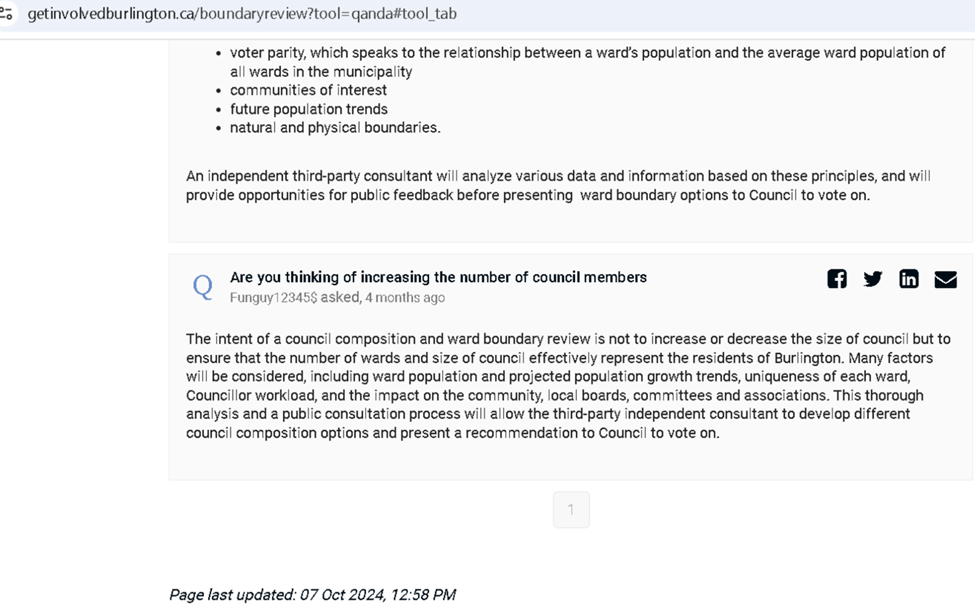
June 7, 2024 – FunGuy12345, I’m a fun guy but not this fun guy, asks a question on the City’s GetInvolved website, “Are you thinking of increasing the number of council members?”
Answer: “The intent of the ward boundary review is not to increase or decrease the size of council.”
This question was removed from the site in October (2024) after I showed it to one of the consultants on the Watson team.
In March, our council opted to spend $220,000 on consultants to look at all options. In June, as stated on the city website, the purpose of the review is not to increase or decrease the size of the council. Why did the council select option 2 at a cost of $220,000 when residents were being told that the direction is option 1 at a cost of $125,000?
October 7th, 2024 (morning) – Jim Young asked the council to increase the number of review meetings, requesting a meeting be held in Aldershot. Councillor Sharman then requested a meeting be held in his ward. The cost to taxpayers for these additional meetings is unknown.
October 7th, 2024 (evening) – My wife and I attended the review meeting held at Tansley Woods and stayed for the entire meeting. One other resident attended.
Dr. Spicer, a member of the Watson Team, explained the process.
- A series of meetings, across the city, are being held to gather input from the community.
- After reviewing the input, another series of meetings, again across the city, would be held to present to residents the available options, including expanding the size of the council.
During this initial series of meetings, Watson & Associates did not present options for change, they were only asking for input from the community. I was surprised, apparently I needed to research the provincial ward boundary system and present options to the consultants, not the other way round.
December 2, 2024 – The Watson team presented their findings to the council. The full report is available here: https://burlingtonpublishing.escribemeetings.com/filestream.ashx?DocumentId=83470
Here are some excerpts.
216 people responding to some or all questions on the GetInvolved survey:
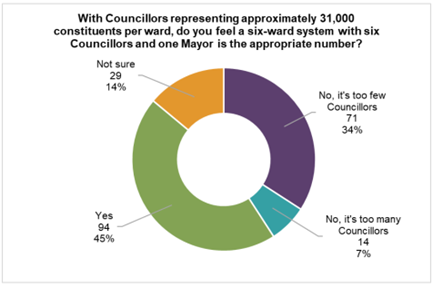
A little under half the survey respondents (45%) thought having six local and regional councillors, with one elected from each ward, was adequate for their needs.
• Of those who felt that the size of council was inappropriate, approximately 7% indicated they would prefer a smaller council and 34% of the respondents felt it was too small, and they wanted to see the size of council increased.
• Most importantly for the next phase of the project, respondents prioritized the principle of representation by population, with 31% of respondents ranking it as the most important to them. A significant percentage of respondents, however, also thought that balancing projected demographic trends should be the top priority (26%).
• Furthermore, 25% believe that respecting communities of interest is the most important principle as the study progresses. Geographic representation was prioritized by the fewest number of people (18%).
Here are the survey results on the critical question: Are there too few councillors?
December 10, 2024: During a regular meeting of the council, under the agenda item “Council Composition and Ward Boundary Review interim report (CL-27-24)”. Our elected representatives voted to “Direct the Consultant Team to investigate and recommend council composition and ward boundary options where all councillors are local and regional councillors”.
In other words, our council voted not to increase the number of councillors, leaving ward boundary realignment as the only option. Burlington can’t independently increase the number of regional councillors.
This vote was not a separate agenda item, and there was no opportunity for residents to delegate because no notice was given to residents that this decision was about to be made.
All the councillors voted in favour of the motion. No local or Burlington-only councillors. Burlington residents will continue to have roughly one councillor for every 26,000 people, compared to one for every 14,000 people in Oakville and Milton.

May 2025: Burlington has new ward boundaries.
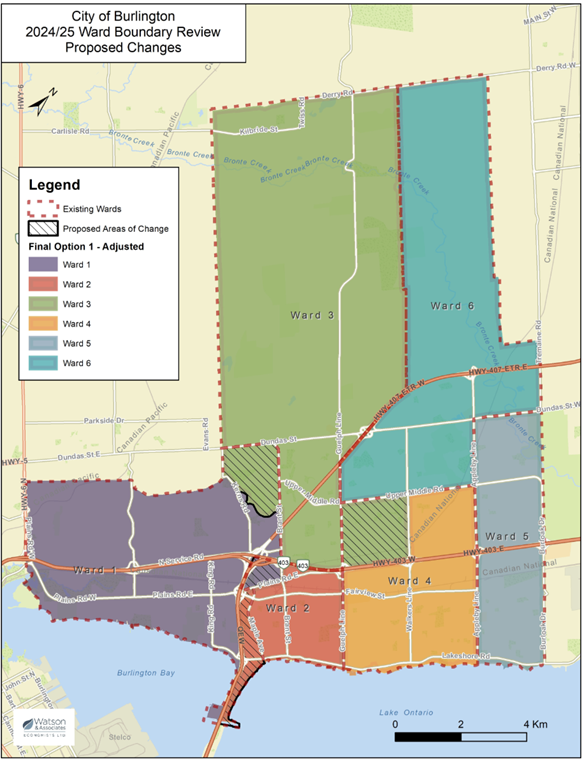
What happens next?
“Under section 222(4) of the Municipal Act 2001, S.O. c. 25, any person or agency may appeal Bylaw 30-2025 to the Ontario Land Tribunal. A notice of appeal must be filed within 45 days of when the bylaw was approved. The final day to file a notice of appeal for Bylaw 30-2025 is Friday, July 4, 2025.”
Council decisions in Burlington require a simple majority, four people.
Ward boundary reviews are right up there with watching paint dry. When I see that Oakville residents have one councillor for every 14,251 people, while Burlington has one councillor for every 26,707 people, I wonder if this subject should be of more interest to Burlington residents.
There is a short, 6 question, survey on the review process here: Focus Burlington Ward Review Survey
Discover more from Focus Burlington
Subscribe to get the latest posts sent to your email.