With 2026’s 5.8% increase to the city budget and the Burlington line on our tax bills, we were told that there were four components to the increase, as explained in this graphic from the city.
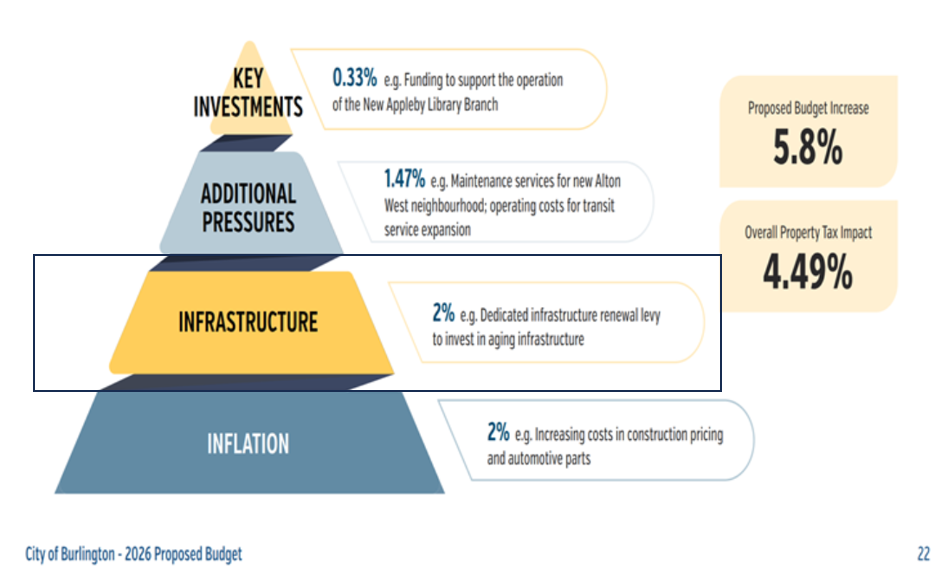
In dollar terms, 2% is about $5.2 million; in theory, $5.2 million of property tax money is going into keeping the city’s infrastructure in good repair. All you have to do is drive on a road in Hamilton to understand what bad repair means.
We saw the same increase in 2025 for the same reasion, “2% for infrastructure”.
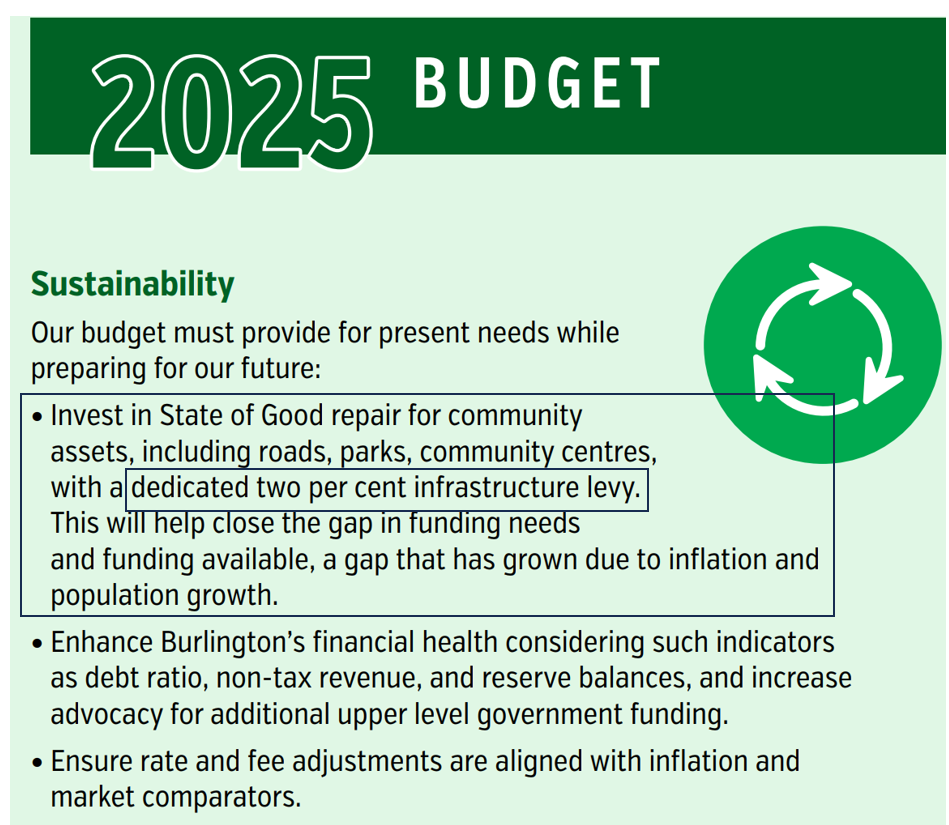
What’s driving the year-after-year 2% for infrastructure increases is something called the Asset Management Plan. Ontario requires every municipality to have an Asset Management Plan (AMP). If the city goes ahead and builds a new arena at 1200 King Rd., the day the arena opens, it will get recorded in the AMP, with the expectation that it will need to be torn down and rebuilt in 50 years.
The idea behind the AMP is simple: if you know the arena will need rebuilding in 50 years, put money away over time so that, in 50 years, the money is there in a reserve fund to pay for the rebuild. The AMP tracks almost everything in the city, from buses to trees to software. Taking a detailed look at the plan is overwhelming, so we came up with a simpler approach: Let’s compare Burlington’s plan with Oakville’s plan.
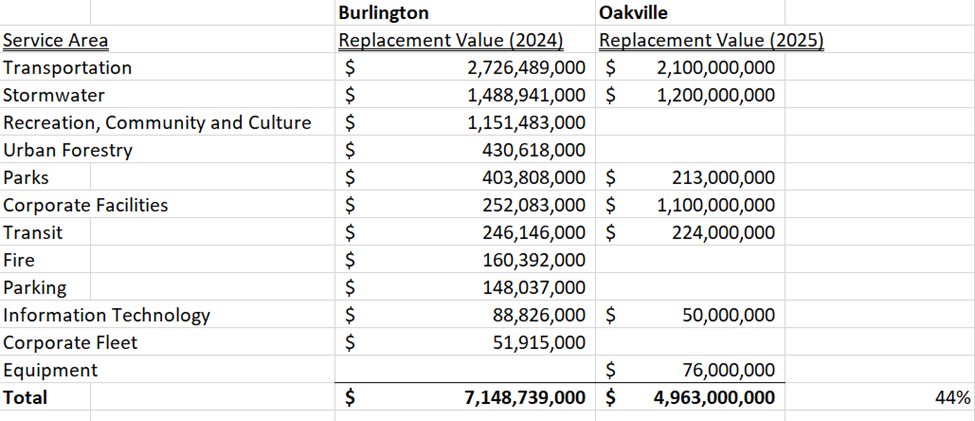
Ontario requires a plan but doesn’t define the service areas, making comparisons between municipalities difficult. We can start by just looking at the total; Burlington’s total replacement value in 2024 dollars is substantially higher than Oakville’s in 2025 dollars, about 44% higher. Before labelling Burlington’s plan as pure Burlington Speak, it’s worth looking at more of the details. But first …
Why does the AMP drive tax increases?
The asset management plan is very detailed: if a specific city truck is 10 years old and estimated to last 15 years, it needs to be replaced in 5 years; this calculation is repeated for every asset in the city. The city then, using software, adds up everything that needs replacing or rehabilitating over the next 10 years to determine how much money it will need over that period.
Based on the AMP, Burlington faces a $1.22 billion, 10-year infrastructure funding gap because it lacks sufficient reserve savings. If its total asset replacement costs matched neighbouring Oakville’s ($4.9 billion instead of $7.1 billion), that 10-year cost would drop to $833 million—significantly shrinking the gap and reducing the need for annual tax hikes.
Difference: Urban Forestry
Let’s take a look at the first obvious Burlington-to-Oakville difference. The provincial legislation has changed, and all municipalities will soon include their urban forest numbers in the AMP. Oakville was not including trees because, like wine, trees improve with age and are replaced with low-cost saplings. Burlington includes trees because if we suddenly lost all of them, there would be substantial costs associated with flooding. These what-if scenarios are difficult to manage and plan for; if all the trees in Burlington suddenly died, we might be facing other issues, including a food shortage. The reality is that the trees we have today may well be worth $430 million, but they simply can’t be replaced; the only option is to plant saplings and wait. Making the replacement cost, even after factoring in flood mitigation, substantially less than the current value.
Let’s take out the trees, figuratively.
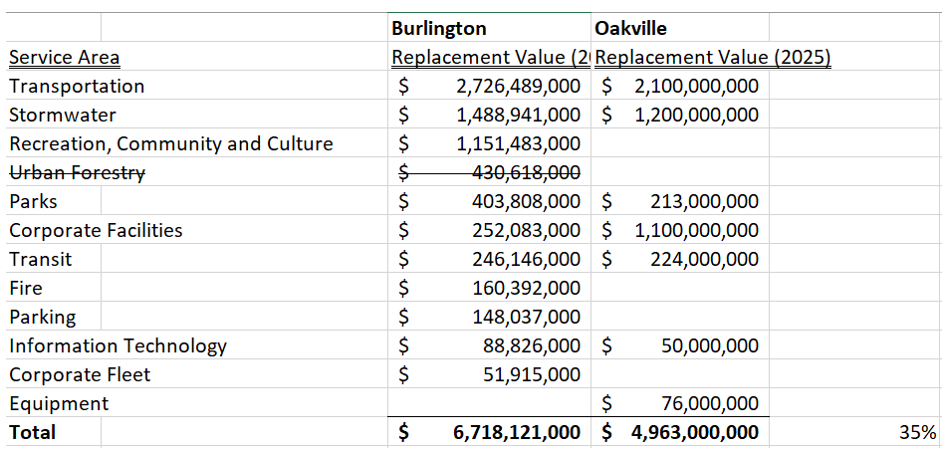
Now, the difference between Burlington’s and Oakville’s replacement asset value is 35%.
Next Up: Information Technology
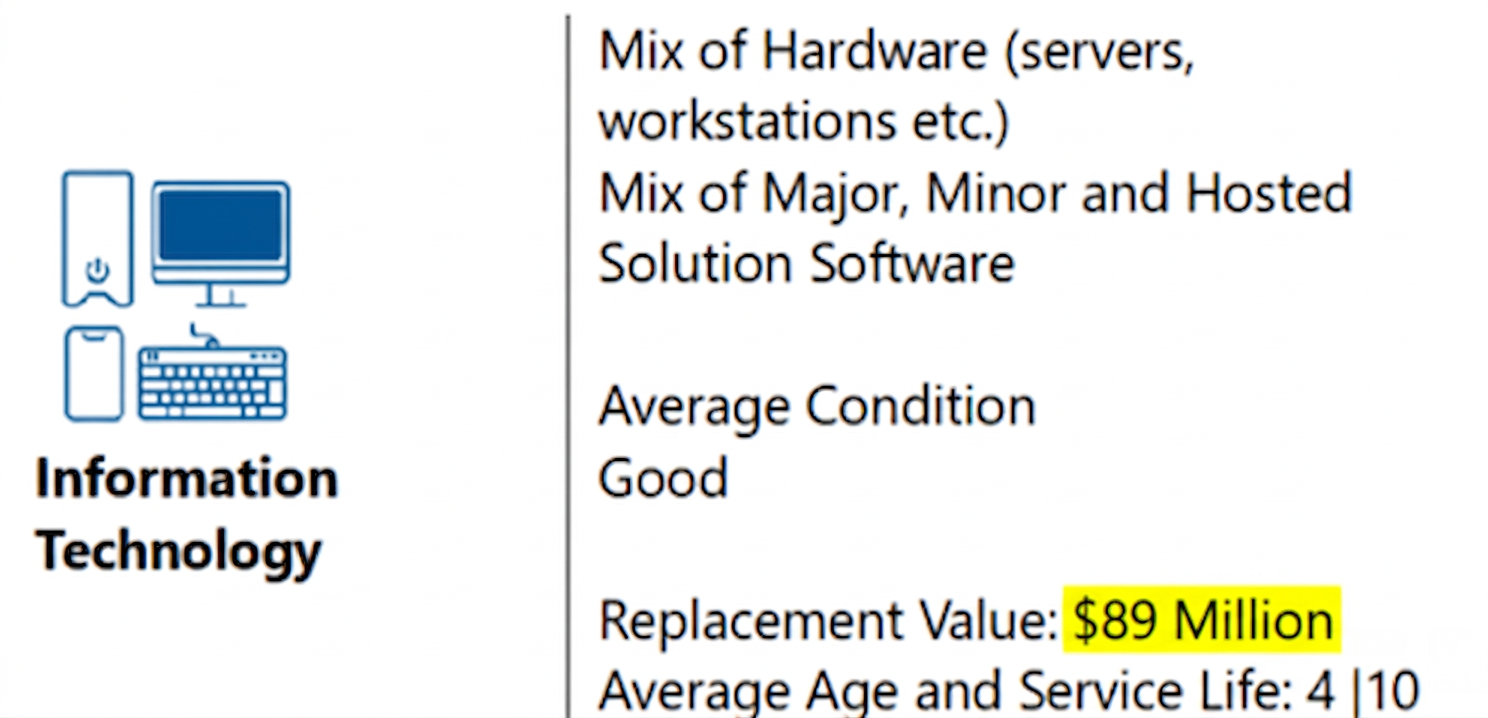
This is the Burlington overview (2025). The $89 million includes the cost of implementing the software, as well as its purchase price.
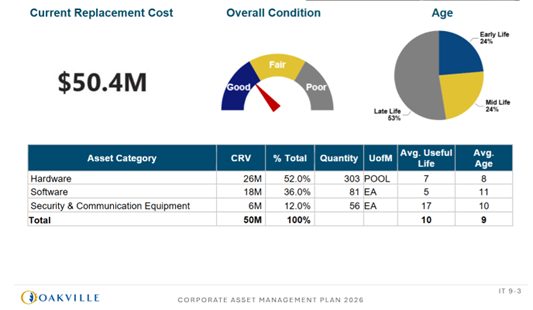
Oakville’s 2026 number of $50.4 million is explained like this.
The software industry is going through two massive changes. The first, which has been happening for years, is the movement away from large on-premises software systems to cloud-based subscription systems. Subscriptions are paid monthly or yearly and are not part of an AMP; they’re an operating expense. The second change, AI, is being used to quickly move data from one application to another, reducing implementation costs.
Oakville has a larger population than Burlington’s, and it’s part of Halton Region, but the current replacement cost of its IT infrastructure is $38.6 million dollars less than Burlington’s.
Next up: Parks
| Burlington | Oakville | Difference | |
| Parks | $403,808,000 | $213,000,000 | $190,808,000 |
Hmmm, $190 million, that’s a lot.
Oakville provides the following details:

And Burlington provides:
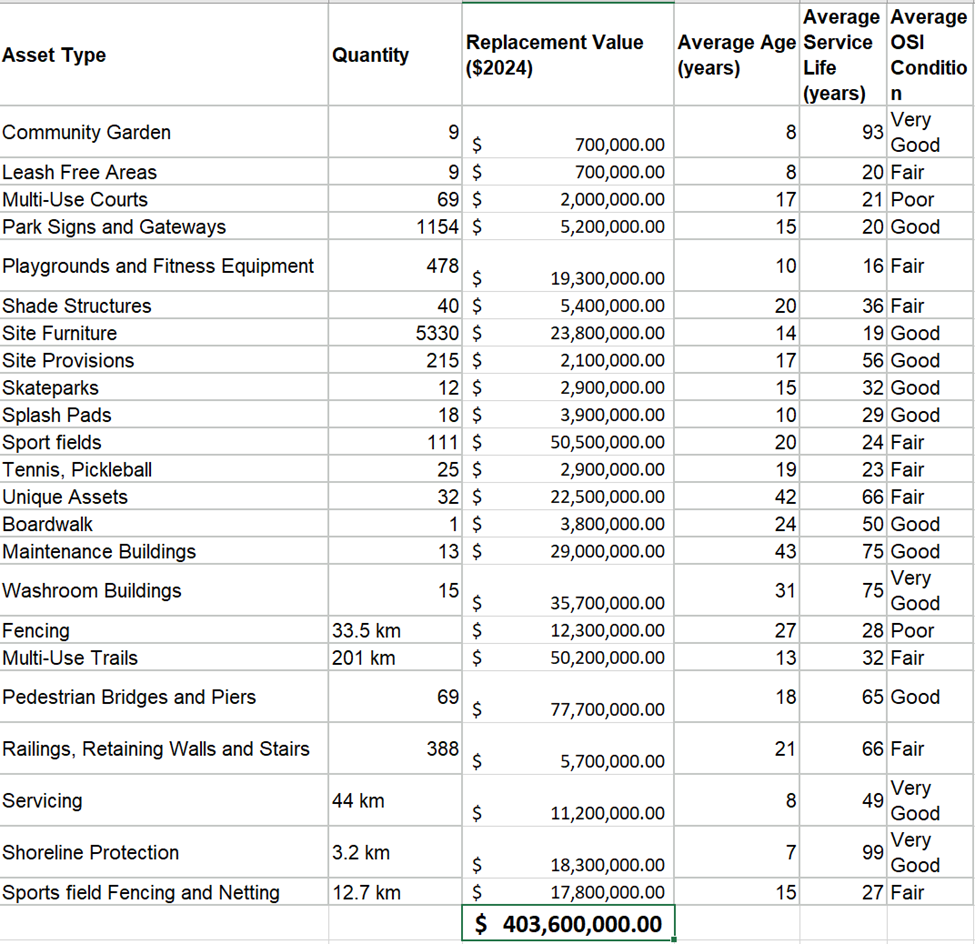
Going deeper on one item: Oakville has over 200km of trails with a replacement cost of $24 million. This compares to Burlington’s 201 km, which have a replacement cost of over $50 million.
For Burlington, that works out to almost $250,000 to replace or rehabilitate a kilometer of multi-use trail. Compare that to $120,000 in Oakville.
Assumptions on top of Assumptions
Accurately predicting costs out 50 years is a guessing game at best. The city relies on the Non-Residential Building Construction Price Index (NRBCPI), which increased rapidly during the condo construction boom. Many of the same people and similar materials go into building condos and community centres. With a slowdown in the construction industry and builders expressing concerns in Burlington council meetings about layoffs among construction workers, will the NRBCPI come down? Really, who knows. Building reserve funds and investing them wisely so they keep up with inflation might be the best strategy of all.
What’s next?
City staff prepare the asset management plan and then present it to council as justification for raising property taxes. The mayor turns to taxpayers with a rallying cry of 2% for infrastructure. Maybe it’s time for our council to turn back to city staff and request more clarity around why Burlington’s needs are so much higher than Oakville’s. After all, we elect a council to represent our interests.
Where is the “2% for infrastructure” is actually going?
Discover more from Focus Burlington
Subscribe to get the latest posts sent to your email.
There are some facts not included in this that are quite relevant.
The first is that the City of Burlington re-evaluated the total value of the assets in 2021 almost doubling it from 2.94B to 5.18B.
Then for the 2024 budget they increased in again from $5.3 B to $6.3 B. They readjusted the value despite the fact that it was 5 yrs earlier than required by law. They justified it by citing issues which were true at the time the report was commissioned almost 1.5 yrs prior but in start contrast to economic factors at the time of the 2024 budget. This is an ongoing problem. The city’s reports lag behind budgets considerably making the reports and the current economic conditions often not compatible yet council treats them as valid nonetheless. Can you imagine making decisions about the direction of your company based on data that is up to 2 yrs old?
Significant issues they used to justify changing the replacement value of the AMP for the 2024 budget were covid and interest rates. Both were ridiculous excuses and that kind of reaching and frankly questionable ethics, that wouldnt occur in private practice. Do you think a board of directors & shareholders would be cool with the CFO saying hey, I’m going to re-evaluate everything based on this event that is done and over with but I’m never going to readjust things back down again bc I want to be able to use this inflated value for my own reasons. Cool with that?
At the time they did this is was now fall 2023 and they were using a report from a year earlier that cited increased costs from 2020-2022 as justification. Costs from covid were already falling as workforces and the economy returned to normal. The report also cited high interest rates but by then we were in a technical recession and it was widely anticipated interest rates would be cut in early 2024 which they were. By June 2024 the Bank of Canada cut the overnight rate from 5% to 4.75% with them down to 3.25 by year end. Cuts continued throughout 2025 and 2026 with rates currently at 2.25%. So citing high interest rates as one of the major reasons they needed to increase the value of the assets by $1 Billion? Seriously questionable and makes me wonder how Deloitte is signing off on these financials.
It was completely inappropriate to recalculate the value of the AMP for the 2024 budget. It had just been done in 2021 and by O.Reg 588/17, the legislation that governs the AMPs of municipalities, it is only required every 5 years. The city’s finance department has now done it twice in 4 years as they further increased it to $7.15B in 2025
And do you know why? Bc if they say they need a 2% levy on 5.3B, is $106 m, on 6.3B it’s 126m and on 7.15B, its $143m. The more they jack up the value of the AMP, the more they can say they need in taxes to fund its repairs and replacement.
The city of Burlington has and continues to play fast and loose with the guidelines for calculating replacement value.
Further, in the 2021 assessment of the AMP, in conjunction with O.Reg 588/17, that report indicated that the MAJORITY of the assets owned by the city were NEW. Then 2 years later this council is fear mongering to taxpayers about how they have to have this massive levy bc the infrastructure is crumbling. That could not have been a bigger load of BS. 15% of the assets were deemed in very poor or poor condition which included a backlog of 9.9%. So the backlog is the % that has missed the date it was supposed to be replaced or repaired due to lack of funding, bad weather, it became obsolete, etc. By the city’s own words, they did not consider it significant given its $ value and relative to the total value of the city’s assets. Yet MMW and this council went to town on their annual budget presentations about the god awful state the city’s infrastructure was in.
And they continue to do so. Here’s a thought. Maybe they ought to have kept their paws out of the reserve jar