
If you are older than sixty-five, you may remember a popular song from the 1970s called “Signs”. It was recorded by a group out of Ottawa called the Five Man Electrical Band, who experienced some popular success here in Canada and, to a lesser extent, in the U.S.
The chorus to the song goes something like this:
Sign, sign
Everywhere a sign
Blockin′ out the scenery
Breakin’ my mind
Do this, don’t do that
Can′t you read the sign?
I’ve thought about this song a lot lately. It isn’t so much out of a sense of musical nostalgia, but rather, a belated recognition of the proliferation of signs in my neighbourhood.
It seems like everywhere you look, there are signs. There are the obvious and necessary stop and yield signs that one would normally expect. There are multiple signs saying “No Parking”, and ironically, they seem to appear about every thirty feet. There are signs telling drivers not to idle. There are signs saying no entrance. There are signs with lots of words, such as the one in a park near me, which tells residents not to walk their dog off a leash, pick up after their dog, don’t feed wildlife, don’t golf, etc.
All the signs seem to have the same underlying admonition, which is to refrain from certain behaviours. My favourite are the signs that start with the word “Don’t”. Not exactly inspiring or uplifting.
A few years ago, I recall in a meeting I attended, the mayor telling us that the city was fortunate in that it had its own sign maker on the payroll. Really? I can think of a lot of roles that would be more impactful and beneficial for the ongoing well-being and safety of our citizens, but an in-house sign-maker isn’t top of mind.
Just How Many Signs Are There?
I decided to do a little survey on my street, which is about six blocks long and has about 43 homes. I wanted to see how many signs were erected. Excluding stop signs, which I have no issue with, there are ten no-parking signs on the east side of my street. On average, there is one no-parking sign every thirty feet. Granted, these signs are small, but they are red, white and black in colour, and are easy to see. If one were to park their car and look up one could readily see a sign a short distance ahead. If you couldn’t, then you likely shouldn’t be driving!
Why do we need ten no-parking signs? While we’re on the topic, why do we need signs like this one, which is located in a corner of Mohawk Public School in a not highly visible area?
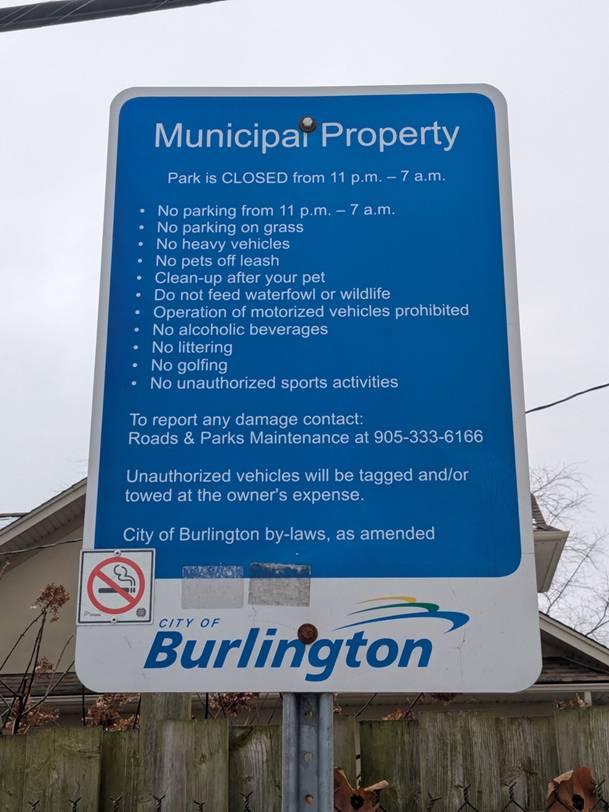
Caption Sign #1: Maybe instead of telling us what we can’t do, it might be simpler if they told us what we can do.
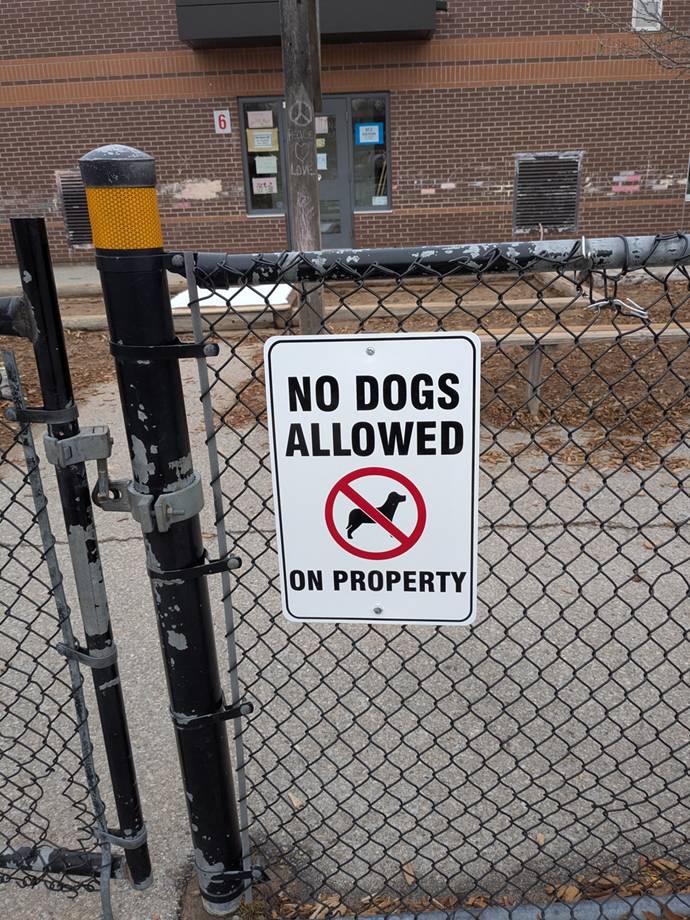
Caption Sign #2: Evidently, the City’s sign-maker believes that residents have no conception of what a dog looks like; hence, the drawing. I wonder if “On Property” means the dogs aren’t permitted in the park, or just this section of it?
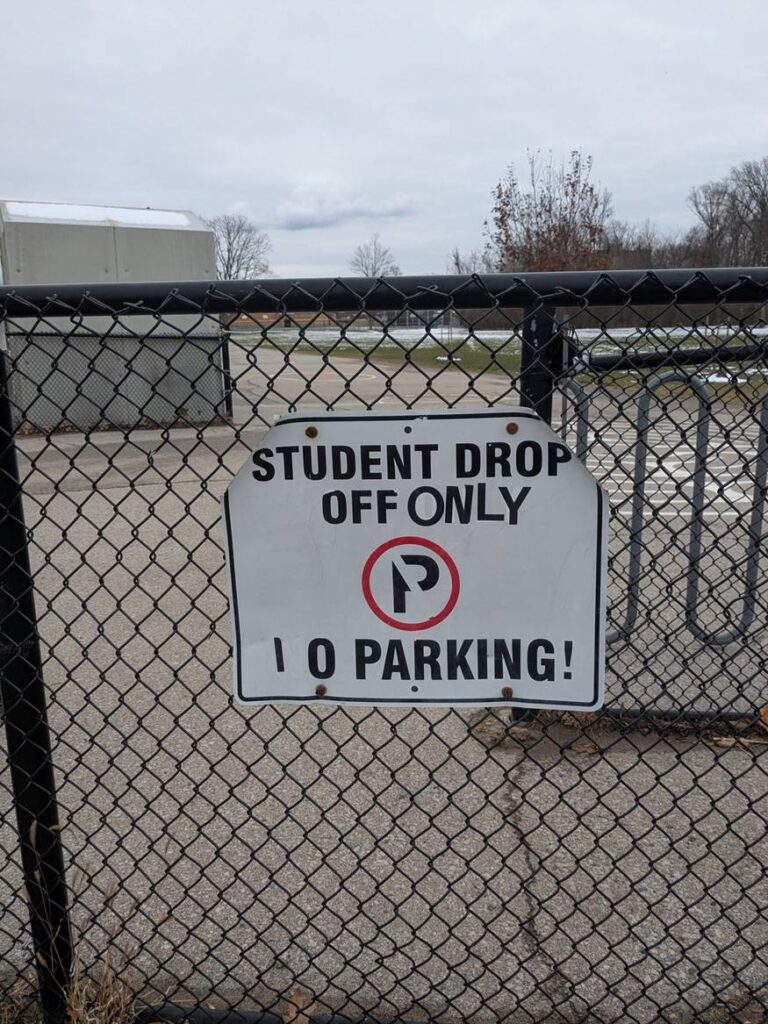
Caption Sign #3: When the letters fade, or someone alters the sign, the message conveyed can take on a whole different context. Does this mean 10 cars can park, or zero?
A Sign of the Times
There was a time when people were expected to demonstrate common sense. For instance, I am a dog owner. As an owner, I know I have certain responsibilities. One of them is to pick up after my dog. Another is not to let my dog run off-leash in a park. Another is to prevent my dog from having contact with other people unless I know them, and unless I have a reasonable assurance that they aren’t afraid of dogs.
The same is true elsewhere. Why do we need to tell people they can’t golf in a park full of children who are on recess? Why do we need to post signs every few metres telling people they can’t park on a street? At what point does sign proliferation become, in and of itself, a form of pollution? Moreover, not only is overt signage unappealing, but the visual clutter is distracting.
Signs are just the Outward Manifestation
The recourse to excessive signage is, I submit, an outward manifestation of a much deeper problem oriented around the issue of control. City officials are fixated on control. They want to constrain public behaviour from what they consider anti-social actions and behaviours. We see this in the mayor’s incessant reminders at the start of public meetings about respectful behaviour. Every Council meeting and every public gathering begins with appeals for respect and decency.
I fully acknowledge that the level of political discourse in our society has seriously degenerated in the last few years. The emergence of social media, which has become the Wild, Wild West of the media world, has created an expectation that “anything goes”, regardless of how unfounded, accusatory or disrespectful it may appear. Certainly, U.S. President Donald Trump’s endless tweets, blogs and incendiary comments have done nothing to elevate public discourse or civil discussion on public issues.
However, if respect is both the norm and the expectation, and some citizens don’t subscribe to the required standard, then deal with them directly and in private. Stop infantilizing the 99.99% of us who know how to behave, and kindly refrain from treating us like recalcitrant three-year-olds. Maybe it’s time to start showing some respect for the intelligence of Burlington residents. If someone utters a threat, call the police and lay charges. If someone engages in insulting language or behaviour, then evict them from the meeting.
About Those Signs
As mentioned, the City of Burlington likes signs. If you wonder how much they like them, have a look at the following excerpts from the city’s 2026 budget:
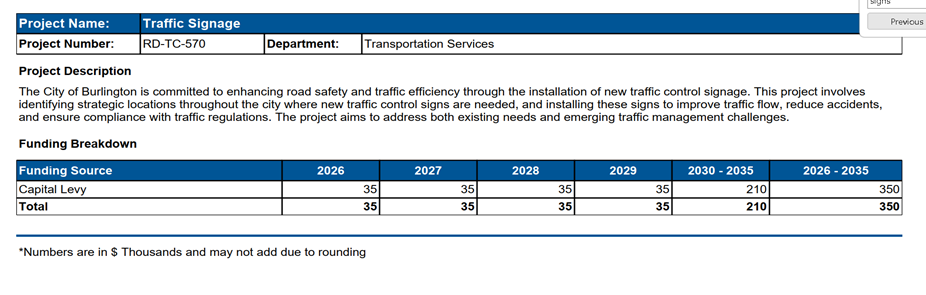
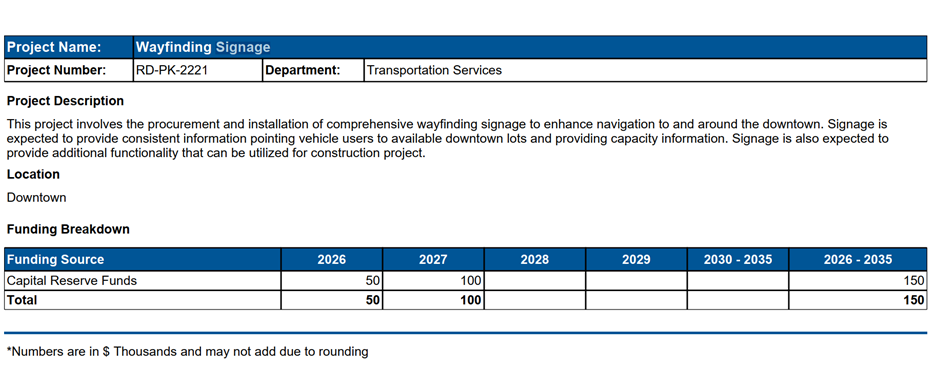
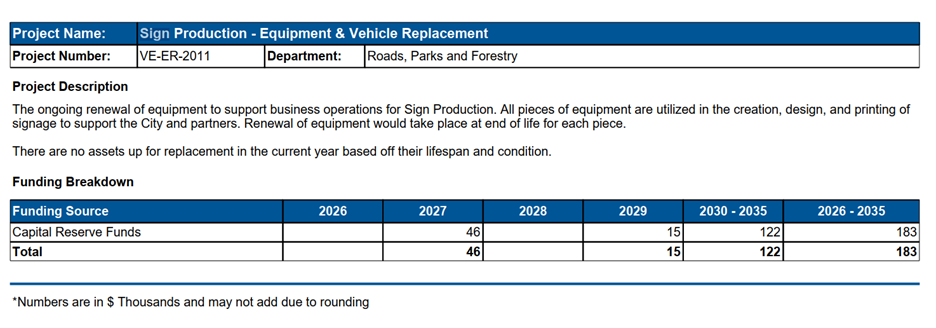
The numbers are in $ Thousands. The total 2026 spend – $85,000, total 2027 spend – $181,000, total 10-year spend – $683,000
Excluding the signs for issues of public safety, perhaps what would be more impactful is determining whether the signs being replaced or added are actually needed in the first place. Who makes that determination, and at what point do we reach a state where enough is enough?
Recently on CITY-TV, I saw a report about an initiative currently underway in the City of Toronto. It seems their Manager of Transportation Services is also concerned about sign proliferation and the fact that the messaging is often confusing. He wants to replace the multiplicity of signs with one consolidated sign with simplified messaging. I’m all for consolidation and making things simpler. However, I’d go one step further and suggest that perhaps many of these signs are simply unnecessary.
Click here to read the City-TV article.
Entrusting adults to behave like adults
Sign proliferation is not just a cost issue, but also a form of sign pollution. Too many signs detract from their meaning and significance. Sign consolidation is important, but so too is entrusting people to behave like responsible adults and allowing them to exercise good judgment. Deal with those who fail to comply as is necessary, but please allow the rest of us to go about our business without feeling like we are living in an Orwellian dystopia with Big Brother looking over our shoulder every two minutes.
We asked the city about the merits of in-house sign production.
VE-ER-2011 Sign Production – Equipment & Vehicle Replacement (Page 531)
Question:
2027 Expense of $46k. Is it time to outsource sign production? How does the cost of labour and equipment for in-house sign production compare with buying signs from a supplier like RAMUDDEN? https://ramudden.ca/products/traffic-signs.html
Response:
Outsourcing sign production is not practical for the City, as traffic signs represent only about 25% of total sign output. The in-house sign shop supports all City departments and partners, providing a full range of services that go well beyond traffic signage. The in-house shop rate is $81 an hour compared to $120 an hour in the private sector. With the ability to meet specific customer requirements and respond quickly to projects with tight deadlines, the shop plays a vital role in City operations. Maintaining in-house production offers numerous benefits, which is why continued investment in equipment is planned for 2027.
Comments: During the Burlington Green funding debate, one councillor said that it is always less expensive for the city to contract out work. This case must be different. It’s great to learn that the city is more efficient and cost-effective at sign production than the private sector.
Discover more from Focus Burlington
Subscribe to get the latest posts sent to your email.