
First, we’d like to thank the city for the responses to our questions.
What is happening in Burlington with Salaries and Wages
As one of many questions on the 2026 budget, Focus Burlington asked the city, “What is the reasoning behind the average salary increase being in the range of 5% when CPI is in the range of 2% to 3%.”.
This is the response we received:
“The Human Resources (HR) costs outlined in the budget reflect costs beyond salary adjustments. In addition to base wage increases, HR expenses include mandatory payroll taxes, pension contributions, employee benefits such as health and dental coverage, and other compensation-related costs. In recent years, benefit premiums have risen far beyond standard CPI. As a result, even modest wage increases can translate into a higher overall percentage increase in total HR costs. A breakdown of drivers behind the human resource increase can be found on page 43 of the budget book “
What does page 43 of the budget show us?
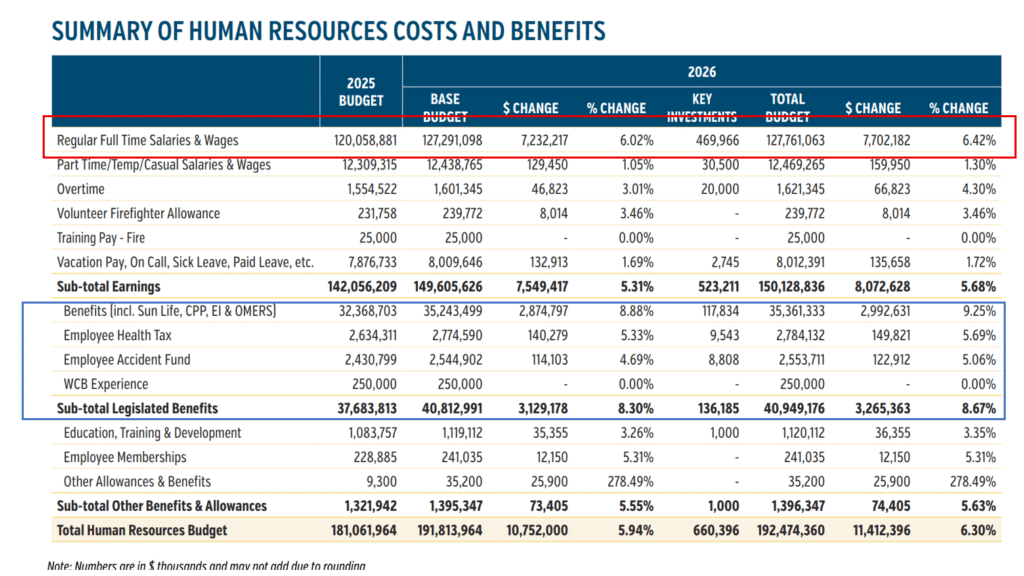
We can clearly see that the total cost for “Regular Full Time Salaries and Wages” is increasing by 6.42% before any change in benefit costs. Benefits are shown in the block outlined in blue starting at line 8. Benefit costs represent about one-fifth of the total HR budget and are increasing by 8.67%.
Page 44 shows us that in 2025, the city had 1,185 full-time employees, and that this will increase to 1,199 in 2026.
What is the average salary increase for a City of Burlington employee before benefit costs?

The city stated: “In recent years, benefit premiums have risen far beyond standard CPI. As a result, even modest wage increases can translate into a higher overall percentage increase in total HR costs”. Once again, we would like to thank the city for its prompt and respectful responses to our questions.
What is happening with the number of full-time employees working for the City of Burlington?
Using information provided by the city and conservative population growth estimates for 2025 and 2026, we can see that the number of full-time employees is growing at a rate more than twice that of the population growth.

How do City of Burlington Full-Time employees’ salaries and wages compare to inflation over time?

The 2021 approved budget book shows us that full-time employee salaries and wages cost $85,952,384 in 2021 (Page 410). If the average salary for a City of Burlington employee had kept pace with inflation, the average salary would be up 15.40% instead of the actual 25.34% increase.
What’s happening outside of Burlington?
The 2021 approved budget book shows us that full-time employee salaries and wages cost $85,952,384 in 2021 (Page 410). If the average salary for a City of Burlington employee had kept pace with inflation, the average salary would be up 15.40% instead of the actual 25.34% increase.
Mercer
As published in Mercer Dec 20 2024, ”The most recent Canada Compensation Planning Survey shows that employers are projecting average merit budgets to be the same as those delivered to employees in 2024 — 3.2% merit and 3.5% total increases.”
Normandin Beaudry
“This summer, more than 1,000 organizations across Canada participated in the 15th edition of Normandin Beaudry’s Salary Increase Survey. The detailed analysis conducted by our compensation specialists provides insights and trends that can be used to inform internal compensation decisions.”
“As Canada faces an economic slowdown compounded by ongoing tariff pressures and trade uncertainties, strategic planning relevant to salary increases is essential in retaining talent and maintaining workforce strength.“
“Organizations are expected to continue scaling back their salary increase budgets in 2026, with an average projected increase of 3.1%, excluding salary freezes, versus 3.2% in 2025.“
Projections by ownership structure- 2026 salary increase budget projections show minimal differentiation across ownership structures:
– Privately held (not listed on the stock market): 3.2%
– Not-for-profit organizations: 3.1%
– Publicly traded: 3.2%
– Government organization/Crown corporation: 3.0%
According to Canadian HR Reporter
“Canadian employers are preparing for a modest slowdown in salary growth next year, with average base salary increases projected at 3.3% for 2026, according to a new survey.”
“The total base salary budget includes merit increases, cost-of-living increases, across-the-board increases, minimum wage adjustments, market adjustments, equity adjustments, off-cycle increases, etc. Promotional increases are excluded.”
According to Eckler (pension, benefits and compensation consultants), Oct 25, 2025
“Canadian organizations are planning average base salary increases of 3.3% in 2026, according to Eckler’s latest compensation planning survey (excluding salary freezes). This is slightly below the actual increase of 3.4% in 2025, signalling a more cautious approach to budget planning amid slowing economic conditions and stabilizing inflation. While the Bank of Canada is cutting interest rates to ease borrowing costs and stimulate growth, rising unemployment and ongoing uncertainty are keeping employers conservative.”
According to Mercer 2025 survey results for 2026:
“A bit more than 500 Canadian companies participated in the 2025 Mercer QuickPulse® – Canada Compensation Planning Survey , July edition
Our data collection period was July 14 – July 25, 2025, and as of that time 90% of respondents indicated they are in the preliminary phase and have started collecting data to determine their annual increase budgets. Keeping that in mind, the national mean, including zeros for merit increases in Canada is expected to be 2.9% for 2026. For total increase budgets, which include merit, promotional, off-cycle increases, etc., the national mean is 3.2%. Both of these are just below the actual increases delivered for the 2024 performance year in the first quarter of 2025. In Canada, publicly traded companies are projecting a mean merit increase of 2.8%, while privately owned and crown corporations are projecting 3.0%. As for industries, High-tech and Insurance/Reinsurance stand out for both having their total rewards budget above the national average (3.2%) at 3.5%.”
Summary
Our calculations show that a 3.3% average salary increase for full-time employees, an increase that is in line with the private sector, would result in a savings of $3,745,837.09 and reduce the projected tax increase from 5.8% to 4.44%.
The annual turnover rate, people leaving the city to work for other organizations, is low. The city tells us that “Since 2022 the City’s annual voluntary turnover rate has reduced from 4.9% to 2.2% (2024 reporting)”.
We’ll respectfully ask a revised question:
“The first line in the table on page 43 shows that regular full-time salaries and wages are increasing by 6.42% exclusive of any other costs. What is the reasoning behind the average full-time salary increase being in the range of 5% when CPI is in the range of 2% to 3%. If the 5.17% shown above, as the average salary increase before benefit costs, is not correct, what is the average full-time employee salary increase percentage, before benefit costs, and what is the justification for that increase?”
Is the question reasonable?
There are lots of reasons employers increase average salary at a rate higher than inflation. Are too many employees quitting? Are other employers paying more? Has the cost of living in Burlington dramatically increased?
In light of the data in the budget, is the response from the city reasonable?
“In recent years, benefit premiums have risen far beyond standard CPI. As a result, even modest wage increases can translate into a higher overall percentage increase in total HR costs”
Discover more from Focus Burlington
Subscribe to get the latest posts sent to your email.