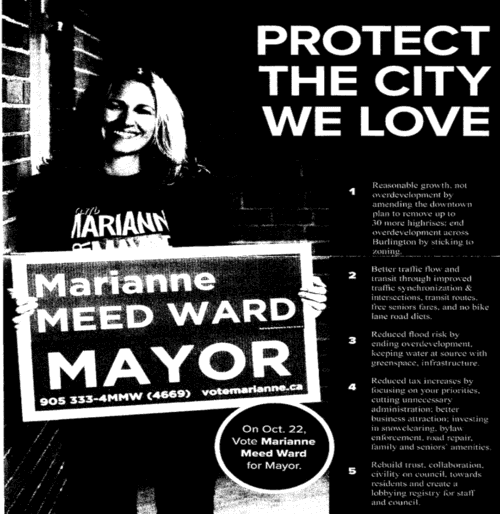
A member of the Burlington community shared this black-and-white scan of a 2018 campaign flyer with us. Take a minute to rate how things went by completing the survey at the end of this post.
Here are the five planks of the platform, as shown on the campaign flyer.
#1 – Reasonable growth, not overdevelopment, by amending the downtown plan to remove up to 30 more high-rises: end overdevelopment across Burlington by sticking to zoning.
#2 – Better traffic flow and transit through improved traffic synchronization & intersections, transit routes, free seniors fares, and no bike lane road diets.
#3 – Reduced flood risk by ending overdevelopment, keeping water at source with greenspace, infrastructure.
#4 – Reduced tax increases by focusing on your priorities, cutting unnecessary administration; better business attraction; investing in snowclearing, bylaw enforcement, road repair, family and seniors’ amenities.
#5 Rebuild trust, collaboration, civility on council, towards residents and create a lobbying registry for staff and council.
#1 – Reasonable growth, not overdevelopment, by amending the downtown plan to remove up to 30 more high-rises: end overdevelopment across Burlington by sticking to zoning.
Let’s take a step back from the development question and look holistically at transit.
The downtown bus terminal first opened in 1987.
In 2017, under Ontario’s provincial planning framework (specifically the Growth Plan for the Greater Golden Horseshoe), municipalities were required to identify Major Transit Station Areas (MTSA) and the tiny bus terminal on John St. did the trick. Downtown was an MTSA.
After appeals from the city and region, sanity prevailed, and in November of 2021, the province issued a decision, ROPA 48, removing the MTSA designation from downtown Burlington.
Developers had submitted zoning requests before November 2021 and argued those should be honoured. Worse, the bus terminal remained. In the case of 535-551 Brant St, the 2023 OLT report states, “The Subject Property is well serviced with public transit and is approximately 450m (five-minute walk) to the Downtown John Street Bus Terminal.” – allowing approval of a condo tower with less than one parking spot per housing unit.
In March of 2025, the bus terminal was moved to the Burlington GO Station. The Burlington GO Station is a major transit hub, moving thousands of people in and out of the city daily and would have been a logical place for a bus terminal as far back as 1987 or even 1967.
Was ending development downtown as easy as moving the bus terminal in 2019? Now, city staff and downtown businesses are complaining about a lack of parking. How long will a new council delay building a $50 million parking garage?
Heading into this election, times have changed. The country’s population has grown, and we need more homes. That was not the case in 2018.
#2 – Better traffic flow and transit through improved traffic synchronization & intersections, transit routes, free seniors fares, and no bike lane road diets.
Traffic Synchronization
The 2026 budget includes $2 million over 2 years for Transit Signal Priority (TSP) and renewal of the Fire Department’s Emergency Vehicle Preemption (EVP) system. Between 2018 and 2026, Halton Region timed traffic lights on the regional roads (Appleby north of Fairview, Brant North of Fairview, Upper Middle, etc.).
Between 2018 and 2026, Burlington didn’t synchronize traffic lights, and research shows that TSP, without real-time monitoring software, worsens traffic congestion. When asked about traffic management software in reference to the 2026 budget, the city responded, “The city will use existing tools such as travel time systems, traffic signal reporting, and traffic counting equipment to monitor TSP performance and its impact on general traffic.”
Sharman’s claims during the Ward 5 debate that the city is installing AI software to time traffic lights may be just another campaign promise. The 2026 budget didn’t allocate money for software to time traffic lights.
I remember a story in the Burlington Post in the mid-90s about the city’s traffic light timing computer being taken offline because vacuum tubes were no longer being manufactured.
Do we need to elect a new council to prioritize synchronizing traffic lights?
Free Seniors Fares
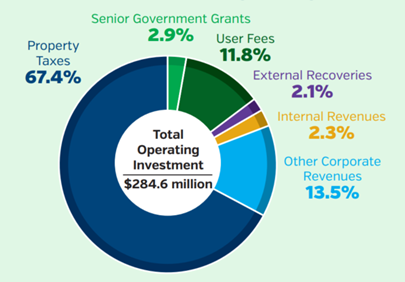
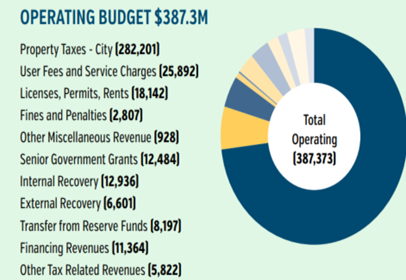
The city has implemented free fares for seniors, children, and youth during specific times. Taxpayers fund the “free” fare program. In 2022, user fees accounted for 11.8% of city revenue, in dollar terms, that’s $33.5 million. In 2026, user fees and service charges accounted for $25.8 million.
Burlington offers a program that provides free transit to people who need help for financial reasons (Halton Split).
Does it make sense for all taxpayers to provide free transit to all seniors, even those who might own their homes and don’t need the help?
Fast forward to 2026
The “free” fare program is intended to get us onto buses and off the roads; is saving $2.85 in bus fare enough of an incentive for that to happen?
No bike lane road diets.
The term road diet refers to the bike lane experiment on New St., where the bike lanes were ultimately removed. We’ve all seen the bike lanes on Prospect and Plains Road. Prospect definitely went on a road diet. Beyond the cost of building protected bike lanes, they are expensive to maintain: special snowplows, special street cleaners, etc. Three things work against bike lanes in Burlington: climate, demographics, and the fact that many people have cars.
#3 – Reduced flood risk by ending overdevelopment, keeping water at source with greenspace, infrastructure.
The July 15-16, 2024 rainfall did force the city into action. A lot of money has been spent and, at least so far, the most recent 100-year storms have not resulted in flooding. Millcroft residents might have something to say about “keeping water at the source with greenspace”.
#4 – Reduced tax increases by focusing on your priorities, cutting unnecessary administration; better business attraction; investing in snowclearing, bylaw enforcement, road repair, family and seniors’ amenities.
Over the last four years, Burlington’s property taxes have risen sharply. The region has kept increases near inflation; education taxes have not increased, but the total tax bill is up almost 27%. The Burlington portion, the M-Municipal box on our bill, is up 44.9%. Our city council is solely responsible for increases in the M-Municipal box. You’ll hear the city say it’s only up 42.6%; the difference is in how the hospital levy was managed. Is 42.6% acceptable and 44.9% not?
“cutting unnecessary administration” – Over the last four years, we’ve seen a 15% increase in full-time employees at City Hall.
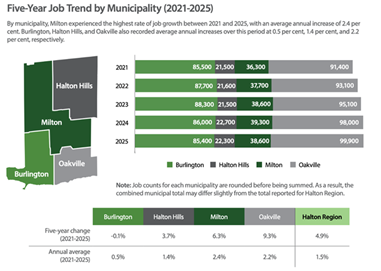
“better business attraction” – Halton estimates that Burlington has lost jobs over the last 5 years.
“road repair” – In my opinion, many of our roads need work. In this election year, we are seeing a lot of activity. Are the roads better now than in 2018?
Family and senior amenities are better, especially in Ward 5 South of the QEW. Bateman is an interesting satellite campus for Brock University. What Brock pays in rent is “confidential” information. Skyway is a beautiful facility.
What we don’t hear is that these community centers were funded with debt. Debt has increased to $151.5 million. Servicing this debt is now costing taxpayers over $13 million a year. Blaming our parents for not paying enough taxes in the 90s, then borrowing money that our children will have to pay back, doesn’t feel like a good strategy.
#5 Rebuild trust, collaboration, civility on council, towards residents and create a lobbying registry for staff and council.
Focus Burlington has written about the delegation process. Community engagement has never been higher, the impact of that engagement in terms of influencing decisions has never been lower. The city can’t even be forthright in how it presents the tax increases.
Councillor Kearns championed the creation of an official (required) lobbyist registry in 2024.
Regarding rebuilding trust and collaboration, and in reference to the Bateman project, Councillor Shawna Stolte was sanctioned for saying in late 2021, “The reality is that the final cost will be well above $50M.” Councillor Stolte lost a week’s pay; she did break the rules, but she was also being honest with the public. This is what Meed Ward said about the incident.
What’s your opinion?
After 8 years as Ward 2 Councillor and 8 years as mayor, we have a solid basis for what to expect if Meed Ward is re-elected.
Have the goals set out in 2018 been achieved over the last eight years.
Discover more from Focus Burlington
Subscribe to get the latest posts sent to your email.