
There are few public agencies that have attracted as much scrutiny, criticism, and outright ridicule in recent months as Metrolinx. Created in 2006, Metrolinx is the provincial agency responsible for improving, integrating, and operating transportation across the Greater Toronto and Hamilton Area. Its responsibilities are vast: GO Transit, UP Express, the PRESTO fare system, and the construction and management of multiple light rail and subway projects.
Yet despite its mandate and resources, Metrolinx’s recent performance suggests an organization struggling to deliver even basic reliability.
As reported by the Trillium / Toronto Life on March 17th, 2026 – “The GTA’s GO trains are falling apart faster than Metrolinx can fix them”.
https://torontolife.com/city/the-go-trains-are-falling-apart-a-leaked-report-says
A Pattern of Failure, Not Isolated Incidents
January and February have been particularly damaging for Metrolinx’s credibility. The Finch West LRT, which opened with much fanfare in December, has already been plagued by frozen and melting infrastructure. The Eglinton Crosstown (Line 5), originally slated to open in 2020, has finally opened after years of delays and more than 260 documented quality control issues, including improperly laid track, water damage, and emergency braking failures.
Most recently, a GO Transit derailment caused widespread service disruptions, leaving passengers stranded for hours with little meaningful information. At some point, it becomes impossible to dismiss these incidents as isolated problems. They point instead to systemic dysfunction.
When Representation Displaces Expertise
Metrolinx was designed to centralize expertise, improve coordination, and achieve economies of scale in delivering regional transportation projects. In theory, that makes sense. In practice, the results suggest otherwise.
The agency is led by President and CEO Michael Lindsay and governed by a provincially appointed Board of Directors reporting to the Minister of Transportation. While the Board can have up to 15 members, its current composition raises serious concerns. A review of board profiles reveals finance professionals, lawyers, and entrepreneurs—but only one director (i.e. Tony Marquis) with a clear background in transportation systems.
https://www.metrolinx.com/en/about-us/the-board
For an organization tasked with designing, building, and operating complex transit networks, the lack of technical and operational expertise at the board level is striking. Governance without subject-matter knowledge is not oversight; it is delegation without accountability.
A Communication Breakdown
Construction delays and technical failures are frustrating enough, but Metrolinx’s inability to communicate effectively with riders has compounded public anger. During recent GO Transit disruptions, riders reported delays of two to three hours and received little accurate or timely information.
This is not a new criticism. CBC reporting has documented repeated communication failures on major projects, including the Crosstown. Riders are not demanding perfection—but they reasonably expect transparency, clarity, and timely updates. Metrolinx has consistently failed to meet even that basic standard.
https://www.cbc.ca/news/canada/toronto/eglinton-crosstown-communications-mistakes-9.7074251
A Top-Heavy Organization
Metrolinx employs over 7,200 full-time equivalent staff across more than 100 locations. According to its 2024–25 Annual Report, the organization includes 124 executives and over 2,200 managers—meaning nearly one-third of its workforce occupies managerial roles (see page 36 of the annual report linked below).
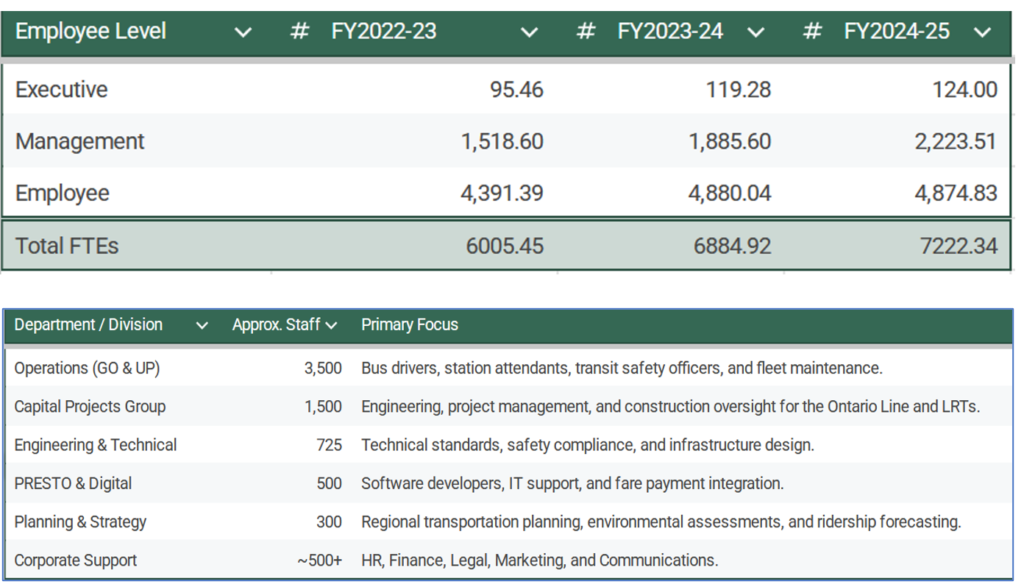
This structure raises obvious questions. Is this an organization optimized for delivery, or one burdened by layers of administration? Size alone does not guarantee competence, and Metrolinx increasingly appears more bureaucratic than effective.
While the agency highlights improving customer satisfaction scores—86% for GO Transit, 88% for UP Express, and 83% for PRESTO—these numbers would be considered mediocre in the private sector. More concerning is what is not disclosed: the total number of complaints received. Reporting response times without revealing complaint volumes obscures the true scale of customer dissatisfaction (see pages 81 – 83).
The Real Issue: Runaway Costs
More troubling than delays or poor communication are the staggering cost overruns across nearly every Metrolinx construction project:
- Eglinton Crosstown (Line 5): Costs have ballooned from roughly $5.3 billion to over $13 billion.
- Ontario Line: Originally estimated at $10.9 billion, projected costs now exceed $27 billion.
- Hazel McCallion Line (Hurontario LRT): Escalated from $1.4 billion to approximately $5.6 billion.
- Hamilton LRT: Increased from $1 billion to roughly $3.4 billion.
- Yonge North Subway Extension: Grew from $1.4 billion to over $3.5 billion.
- Burloak Drive Underpass: Rose from $60 million to $177 million.
These are not marginal overruns; they are multiples of original estimates. Unsurprisingly, calls are growing for a formal provincial inquiry, including demands for a value-for-money audit from elected officials at Queen’s Park.
Accountability Is Long Overdue
By any reasonable standard, Metrolinx is failing. Persistent cost overruns, operational breakdowns, weak governance, and chronic communication failures all point to an organization that has grown too large, too insulated, and too unaccountable.
This is no longer just a Toronto issue. Municipal partners and taxpayers across the region are footing the bill. It is time for Burlington City Council—and the mayor—to join those demanding transparency, independent review, and real accountability. Without it, Metrolinx will continue to lurch from one fiasco to the next, at enormous public expense.
Discover more from Focus Burlington
Subscribe to get the latest posts sent to your email.
I’ve read the background material from the Trillium published by BurlingtonToday several days ago and I’ve seen the root causes analyzed through other sources. This issue does not reduce to simply ones of unnecessary expenditures and loose project controls. Nor does it involve egregious knowing disrespect of public oversight. In large part, it is an extremely complex aggregation of causes and influences, not the least of which is the perceived superiority of private sector delivery models when applied to provincial services. Let us not forget that the main service providers for Metrolinx and GO Transit are private sector companies that failed quite spectacularly in delivering on their contractual obligations.