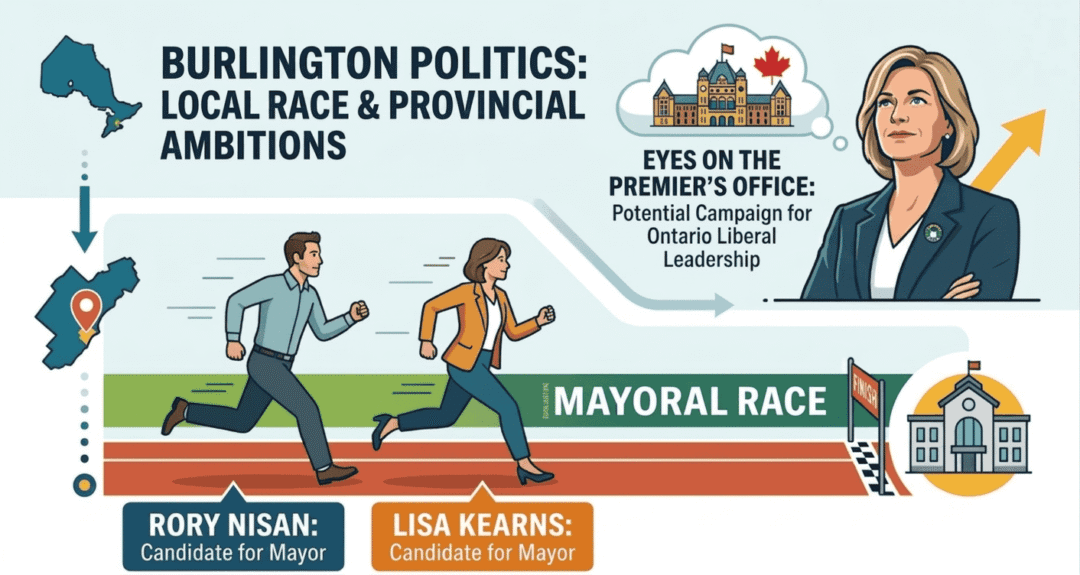
The political landscape in Burlington has shifted. The 2026 mayoral race, has been a field of speculation, suddenly ignited by the entry of Ward 3 Councillor Rory Nisan. Ward 2 Councillor Lisa Kearns announced earlier that she was running. The race is now no longer just about the incumbent; it is a battle over economic philosophy and the practical application of power.
For the average voter, this election provides a rare opportunity to demand specific answers on affordability and governance. As these candidates vie for your vote, here is how you should be framing your questions at the doorstep.
The Affordability Test: Track Records vs. Campaign Promises
Lisa Kearns entered the race early with a pledge to be more sensitive to the economic pressures facing residents.
She carries a significant piece of political capital: a track record of voting against both the 2025 and 2026 budgets. Meanwhile, Rory Nisan’s campaign messaging leans heavily on “discipline,” comparing the city’s financial responsibilities to the stretched budgets of families dealing with rising mortgage, grocery, and gas costs.
Voter Instruction: Ask the candidates to reconcile their rhetoric with their past actions. Specifically, ask them: “If you promise fiscal discipline now, why was it acceptable to approve $160,000 for the FIFA Caravan – an unbudgeted ‘nice to have’ event – while residents were already feeling the pinch?”
The Strong Mayor Powers Irony
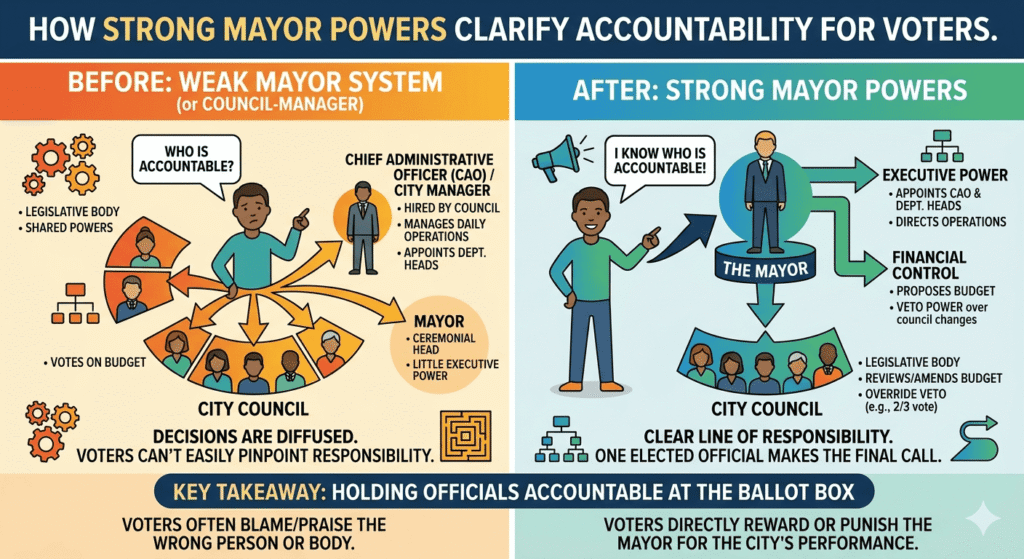
Perhaps the most intriguing subplot of this election is the stance on Strong Mayor Powers (SMP). Both Kearns and Nisan were vocal critics of Mayor Marianne Meed Ward regarding the use of these powers. Yet, if either is elected, they will inherit those same tools.
Once elected they could meet their promises by making in-year changes to the 2026 budget using Strong Mayor Powers. This creates a “walk the talk” moment. As an example, Richmond Hill, Mayor David West utilized his mayoral budget direction to explicitly address tariffs and the cost-of-living crisis, while mandating a constant review of spending to find efficiencies.
David West didn’t leave it vague. He put expectations into his mayoral direction:
“The City of Richmond Hill’s 2026 budgets must address the economic challenges residents are facing, particularly the threats of tariffs, rising cost of living and ongoing affordability crisis. This should be accomplished by balancing financial pressures on the City including the need to build and maintain growth related infrastructure and continuing to deliver important services that make our City a premium community in which to live.”
And then he added:
“To constantly review spending and find efficiencies to ensure financial prudence and sustainability.”
That’s what voters should be looking for here: specific, written direction that ties spending decisions to economic reality.
Voter Instruction: Do not let candidates offer vague critiques of Strong Mayor Powers. Ask them: “What is your specific, step-by-step plan to use Strong Mayor Powers differently than the incumbent? Will you commit to a budget direction with a ‘tight ceiling’ and a mandate for spending reviews similar to the Richmond Hill approach?”
The MMW Factor and the Provincial Pivot
While the challengers sharpen their knives, incumbent Mayor Marianne Meed Ward has yet to announce her intentions. The timing is interesting if not notable. A recent poll suggests that the leaderless Ontario Liberal Party is currently leading Doug Ford’s Conservatives. This creates a potential opening for Meed Ward to “upset the apple cart” by seeking the provincial Liberal leadership.
If Meed Ward chooses this route, the local impact is massive. Not only would Burlington have a new Mayor, but Wards 2 and 3 would be left without their incumbents, leading to two new councillors and a total overhaul of the city’s leadership.
Voter Instruction: Until her intentions are clear, the question for the incumbent remains: “How much of the current 2026 strategy is built for Burlington’s long-term future, and how much is a platform for provincial ambition?”
Looking Ahead
Burlington is at a crossroads. We have candidates promising discipline while having previously supported unbudgeted expenditures. We have critics of executive power who may soon be wielding it. And we have an incumbent who may be looking toward Queen’s Park.
This is the election to watch. Stay tuned as we continue to track how these candidates respond to the “Richmond Hill” standard of fiscal transparency. The power in this election rests not with the candidates’ announcements, but with the voters’ willingness to demand consistency.
Read more about Strong Mayor Powers here:
Discover more from Focus Burlington
Subscribe to get the latest posts sent to your email.
Before people can ask the important questions you have suggested they have to know what ward they live in.
It is shocking that many residents have no idea what ward they live in let alone who their current councillor is.
Unless an issue like over intensification or the increase in property taxes affects them most residents have no desire to look deeply into the actions of the present council.
In my opinion, this is indeed a sad state of affairs.