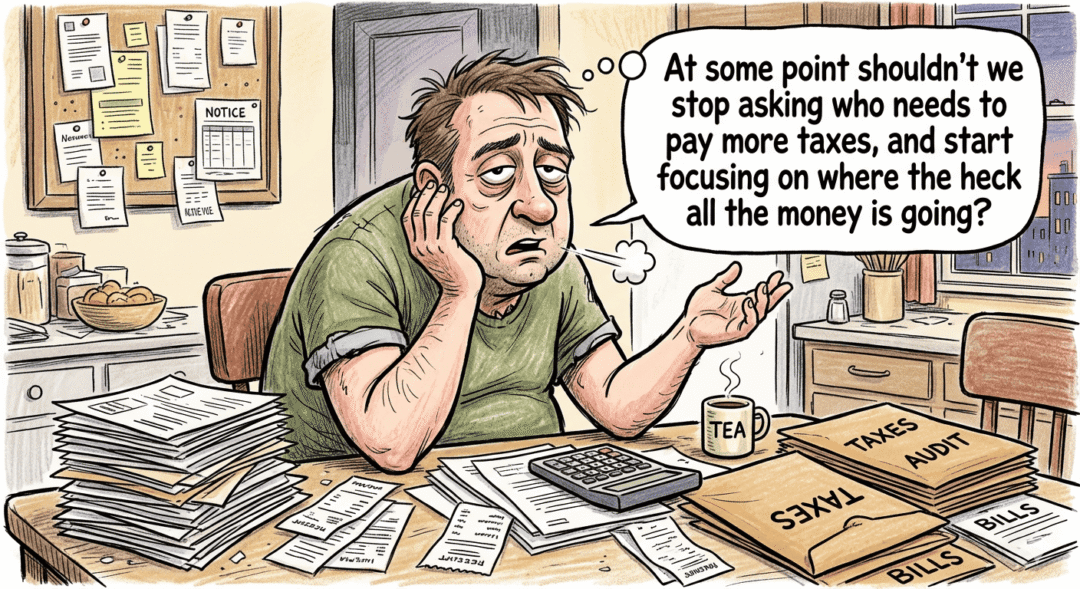
April showers bring May flowers, but June brings something less pleasant to Burlington mailboxes: the first property tax bill of 2026. Whether you own a home, rent an apartment, or simply shop at local businesses, you are paying property taxes. They are baked into our rent, our groceries, and the price of our morning coffee.
During the budget debates last autumn, a flurry of numbers was thrown around—2.98%, 5.8%, 4.49%. If you’re confused, you’re not alone. Our overall bill has increased by 4.49%. On a $10,000 property tax bill, that means an extra $449 out of your pocket.
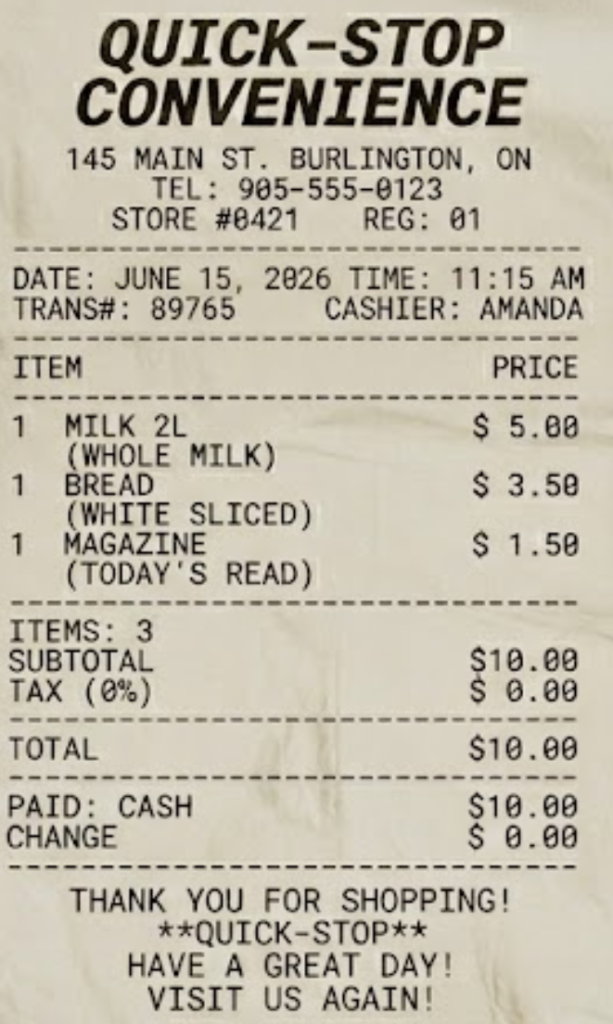
Where does the 2.98% number come from? To understand what we’re being told, we need to pull apart the property tax bill. Think of your tax bill like a convenience store receipt for three items bundled together for simplicity: “Milk” (The City of Burlington): Managed by the mayor under strong-mayor powers. “Bread” (Halton Region): Managed by 23 Councillors and a Regional Chair. A “Magazine” (Education): Managed by the Provincial government. Even though you receive one bill, the money goes to three different “suppliers”, with the price of each item being set by a different entity.
If we look back four years—the term of our current council—the price of these items has changed dramatically. While cumulative inflation over that period was about 10.29%, our “convenience store bill” didn’t follow suit: Burlington’s item (Milk) increased by over 44%. Halton’s item (Bread) increased by 20.9%. Education (Magazine) stayed flat at 0%.
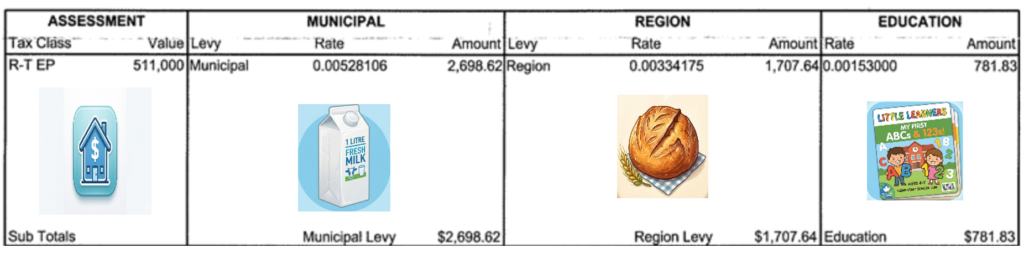
Overall, the total bill rose by nearly 27%, more than double the rate of inflation. Most notably, the cost of “milk” (Burlington’s item) rose at a rate 4 times the inflation rate.
Looking at this from a different angle, if our mayor had increased Burlington taxes by the same percentage as Halton’s increase, without the police increase, the overall tax bill would only be up 11.8%, slightly more than inflation over the four-year period. Is provincial downloading the cause? Halton is responsible for social housing, child care, and paramedic services, all of which are impacted by the homeless crisis. New roads? Halton is widening Dundas St., but Burlington doesn’t widen roads.
Here is where things get murky. For 2026, the City’s official documents claim “Burlington’s share of the total tax increase” is only 2.98%.
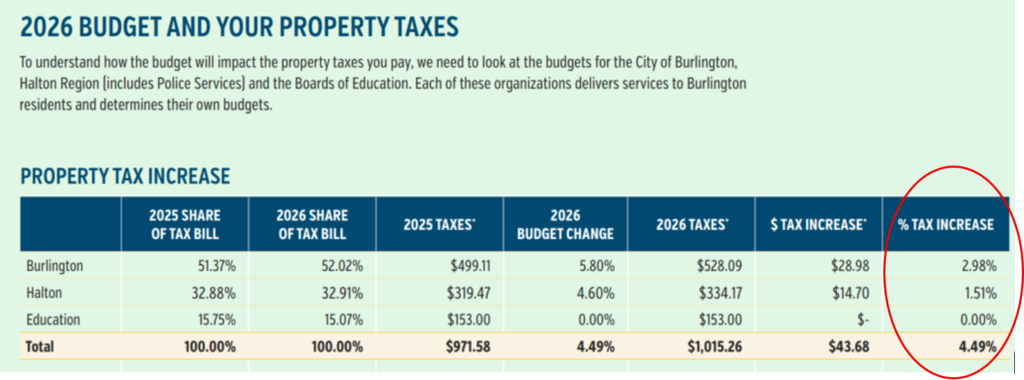
In the real world, a percentage is simple math: you take the new amount, subtract the old amount, and divide by the old amount. If the City’s portion of your bill went from $1,000 to $1,058, that is a 5.8% increase. So, how does the City get 2.98%? They take their price increase but divide it by the total bill (including the Region and Education portions). It’s like a milk producer claiming their price only went up by 1% because they’re calculating it against your entire $400 grocery bill.
We know what a percent sign means. The 2.98% increase shown on the Burlington line is not mathematically correct. It’s marketing (or worse). The 5.8% shown in the middle of the chart is the increase in Burlington’s portion of the property tax bill.
It’s technically a calculation, but is it honest communication? If you check your own bill on the new online portal and look at the “Municipal” block, you’ll see the real number for this year is actually 5.8%.
Whether the City actually needs this money for services is a valid debate. Whether taxpayers should accept “clever” wording that masks the true increase is another matter entirely.
On October 26th, 2026, we have the opportunity to express our opinion at the ballot box. Voting has consequences, and transparency should be at the top of the agenda. Do your own research, look at the “Municipal” block on your bill, and check which mayoral candidates are committed to clear and honest communication with taxpayers.
Are statements like this: “with the City of Burlington share of taxes being less than 3 per cent” from our mayor acceptable?
On page 3 of the 2026 Budget the mayor states in her “Message from the Mayor”
“At the Regular Meeting of City Council on July 15, 2025, Council endorsed my Mayoral Direction in which I asked City staff to prepare a 2026 Budget that results in a total tax increase (including the City, Halton Region, and Boards of Education)in the order of 4.5 per cent, with the City of Burlington share of taxes being less than 3 per cent. City staff have delivered a proposed budget that meets these targets.”
Discover more from Focus Burlington
Subscribe to get the latest posts sent to your email.
How many days are there until October 26?