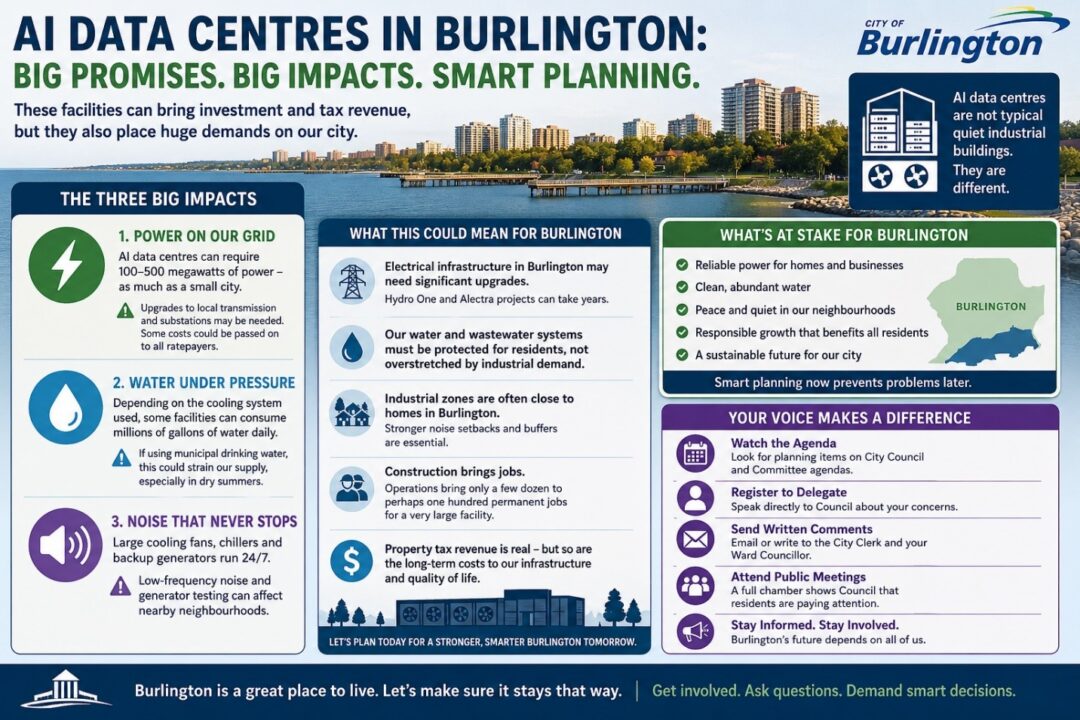
Across Ontario, municipal councils are increasingly finding themselves on the front lines of the artificial intelligence boom. Hamilton City Council recently voted overwhelmingly to prepare an Interim Control By-law that would temporarily pause approvals for new data centres while staff study their long-term impacts. At the same time, Toronto is working to develop a planning framework to better manage future proposals. And right now, Burlington also appears to be faced with what to do.
AI data centres are fundamentally different from traditional industrial developments and require thoughtful planning before approvals are granted.
These facilities can bring significant investment, construction activity, and property tax revenue. However, they can also place unprecedented demands on local electricity, water infrastructure, and surrounding communities.
Understanding the New vs Older Data Centres
Traditional data centres primarily stored information and hosted websites or business applications. Today’s AI data centres perform complex machine-learning computations using thousands of high-performance graphics processing units (GPUs) operating around the clock.
1. Electricity: A New Level of Demand
Large AI Data Centres can require between 400 to 500 megawatts (MW) of electricity, with the largest proposed facilities exceeding those levels. A hyperscale data center may have at least 5,000 servers, 10,000 sq ft of floor space, and 40 MW of power, enough to power a city of appx 80,000 inhabitants.
New transmission lines, substations, transformers, or other electrical infrastructure may be required to serve these facilities. Depending on how those projects are financed and regulated, some infrastructure costs are borne directly by the developer, (who may not operate the centre) while others may ultimately become part of broader utility investments recovered through electricity rates.
2. Water Use Differs by Centre and Can be a Concern
Cooling thousands of AI processors generates enormous amounts of heat
Some centres rely on evaporative cooling systems that consume very large volumes of fresh water. These systems can lose millions of gallons annually through tower operations. Others use closed-loop liquid cooling or air-cooled systems that require significantly less municipal water.
The amount of water required depends heavily on the technology selected by the operator
Where municipal water is proposed as the primary cooling source, communities should understand the potential impact on local treatment capacity, water supplies, and future growth, particularly during periods of drought or peak summer demand.
3. Noise That Doesn’t Shut Off
Unlike many industrial operations, data centres operate continuously
Large cooling fans, chillers, transformers, and periodic testing of emergency diesel generators can produce a constant low-frequency hum that travels farther than many residents expect.
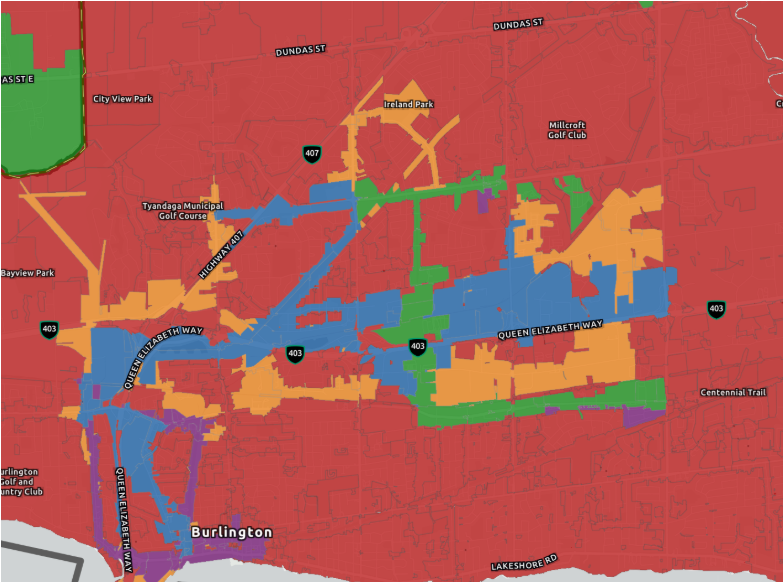
Because many municipal zoning bylaws were written long before AI data centres existed, these centres may be permitted within existing industrial zones that are located relatively close to residential neighbourhoods.
Supporters often describe data centres as major job creators
Construction of a large facility can generate hundreds of well-paying skilled trades jobs over several years. Once operational, however, these highly automated facilities generally employ only a few dozen to perhaps one hundred permanent staff, depending on their size and operating model. As an example, a 40MW centre could require as few as 45 fulltime employees.
That does not mean they lack value. Property tax revenue, investment, and improved digital infrastructure can benefit municipalities. However, councils should carefully weigh those benefits against long-term demands on local infrastructure and municipal services.
Why Municipal Planning Matters
One of the biggest challenges facing municipalities is that AI data centres do not fit neatly into traditional planning categories.
Questions that deserve careful examination include:
Is sufficient electrical capacity available? ;
Can existing water and wastewater systems support the project? ;
Are noise impacts adequately addressed? ;
Should minimum setbacks from residential areas be increased? ;
Are emergency backup systems appropriately regulated? ; and
Does the municipality have the expertise to evaluate proposals of this scale?
How You Can Participate
Major planning decisions are made through public meetings, planning committees, and council votes.
If you who wish to participate you can do so in different ways
1 Follow council agendas. Watch for zoning by-law amendments, official plan amendments, site plan applications, or planning reports involving large industrial properties.
2 Register as a delegation. Speaking directly to council allows residents to raise evidence-based concerns about infrastructure, servicing, traffic, noise, or environmental impacts.
3 Submit written comments. Letters to the City Clerk and local councillors become part of the public record and help decision-makers understand community concerns.
4 Attend public meetings. A full council chamber demonstrates that residents are paying attention. Public participation often encourages more thorough discussion and more transparent decision-making.
5 Vote. Only 27.6% of eligible voters bothered to vote in 2022. Look up your mayoral and ward candidates. Understand their position on this issue and vote for the candidate that represents you.
Looking Ahead
Artificial intelligence (AI) is transforming the global economy, and data centres will play an essential role in that future. The question facing municipalities is not whether these facilities should exist, but where they should be located and under what conditions.
Communities should welcome innovation while ensuring that growth occurs responsibly, transparently, and with a full understanding of its long-term implications.
Careful planning today will help ensure that tomorrow’s technological progress strengthens our communities rather than placing unexpected burdens upon them.
More information on the Burlington Data Centre proposal is avaialble here:
https://www.burlington.ca/en/news/current-development-projects/3110_South_Service_Rd.aspx
Discover more from Focus Burlington
Subscribe to get the latest posts sent to your email.
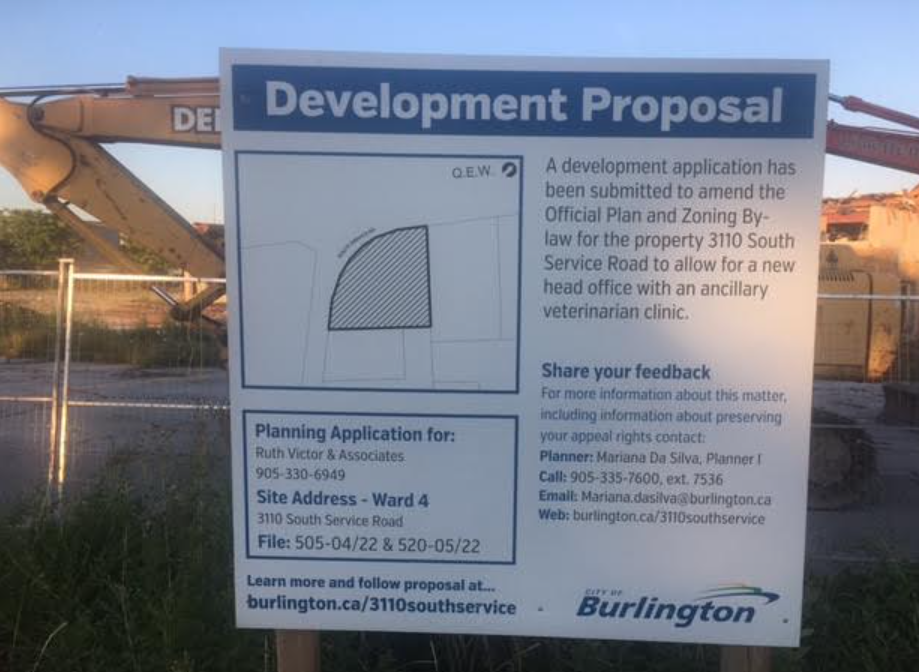
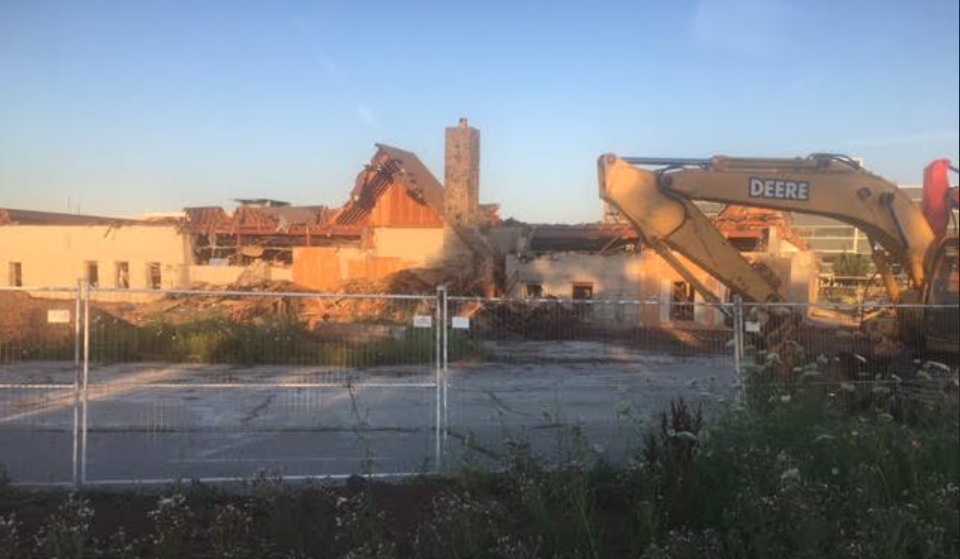
The Development sign on the property, in the picture, is truly misleading. It states the building purpose is a “Head Office” and a veterinary clinic! Really??
The pictures were taken this week. The signs have been up for a while. The proposal for a data centre might be going to council on Tuesday. The city hasn’t shared the agenda for Tuesday’s (July 21) council meeting with us yet so there is no way to know.