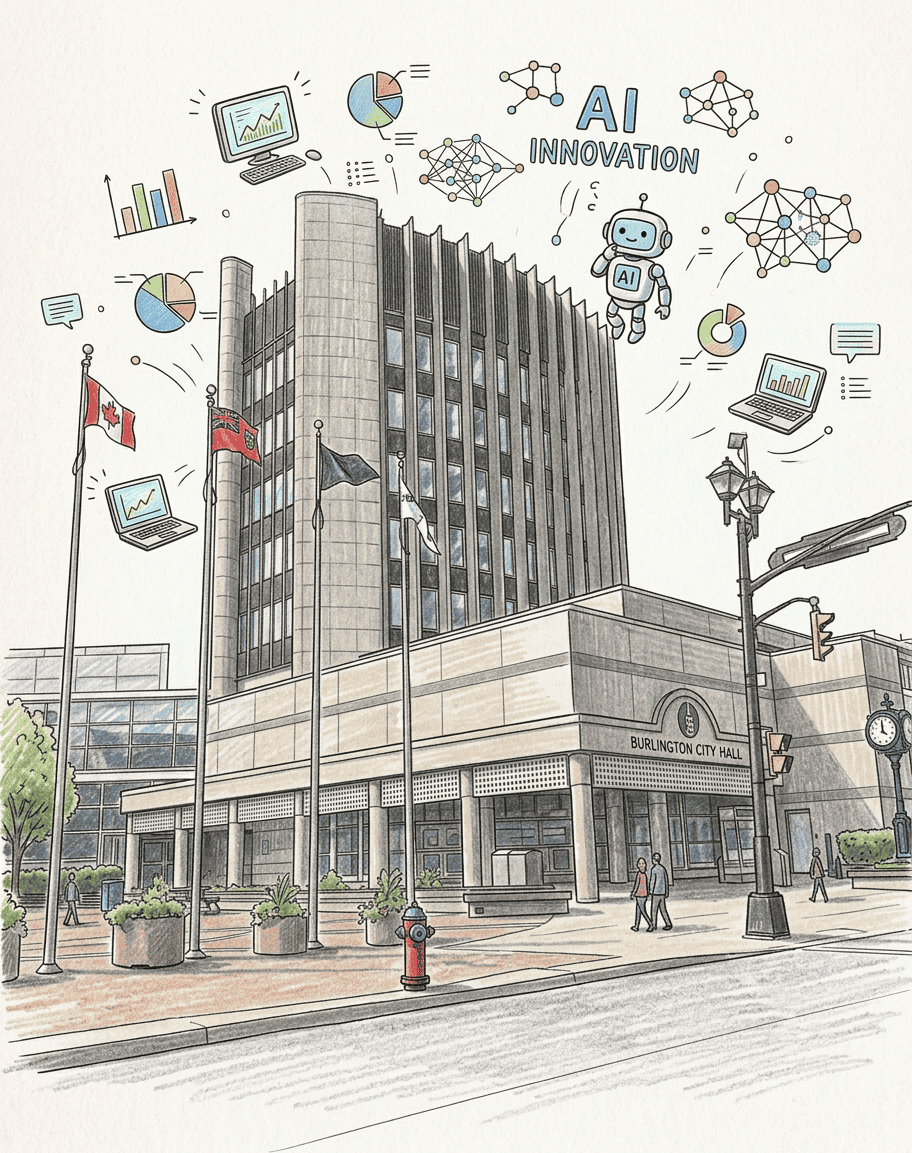
Where we are today.
Since 2015, public sector employment in this country has grown significantly. While most of the attention has been focused on the explosion in government jobs in the federal sector, there has also been a sizable increase at the municipal level.
According to the 2026 budget document, the City of Burlington employs 1198 full-time and 227.9 part-time staff. The 2025 staff turnover rate was 7%, including retirements. Excluding retirements, the turnover rate is close to 2%.
Human resources, as a percentage of the overall gross operating budget, equates to 49.8%. An examination of the breakdown of employment by department reveals that most employees are concentrated in two areas: Development & Growth Management (i.e. Building; By-Law Compliance; Community Planning), and Community Services (i.e. Fire, Transit, Recreation, Culture). (see page 14).
Between 2025 and 2026, human resources expenditures increased by $11,516,000, or roughly 6.37%. Much of this, according to the city, was due to increased wages to attract and retain qualified personnel.
An Option Forward
With costs escalating and competition for resources increasing, what does this portend for the future? Are taxpayers on the hook for the kind of tax increases we have seen over the past four years? Are we all just expected to keep paying and paying? In a heavily unionized workforce, wage rates are already higher than for many comparable roles in the private sector. Add to this the existence of generous benefit programs and defined benefit pension plans, and you have a workforce that is not only well-compensated, but one where the expectation is that things will continue ad infinitum.
That leads some observers to ask an intriguing question: can Artificial Intelligence (“AI”) be leveraged not only to improve operating efficiencies, but also to reduce costs?
The Toronto Metropolitan University recently published a fascinating paper in August 2025 entitled “Adoption Ready? The AI Exposure of Jobs and Skills in Canada’s Public Sector Workforce”.
According to the researchers, “Canada’s public sector is uniquely positioned to lead in AI adoption, with greater exposure than the broader workforce. This creates a powerful opportunity to enhance public services, improve efficiency, and reduce costs. With thoughtful strategy, responsible practices and strong workforce support, AI can enable a more innovative, efficient, and responsive government in a rapidly shifting digital world.”
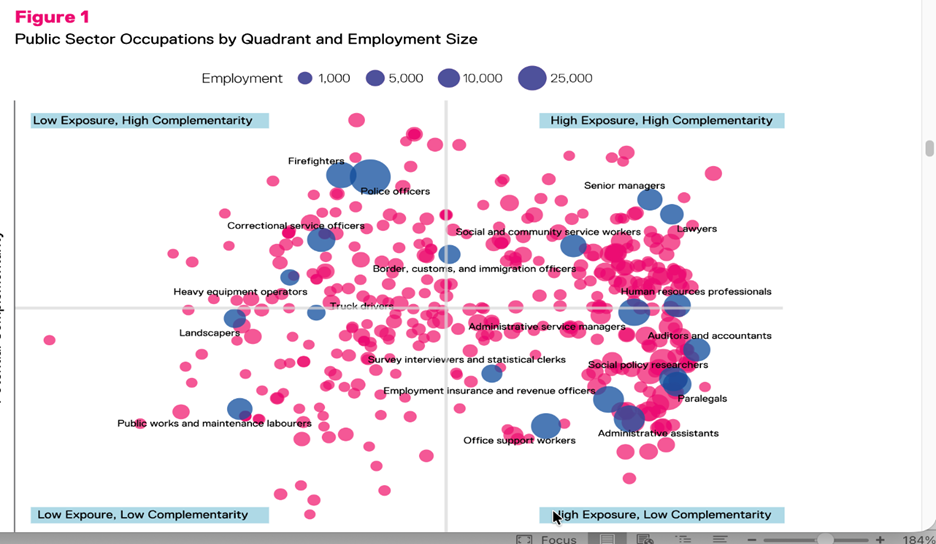
The researchers did an in-depth analysis of occupational classifications at the federal, provincial and municipal level. They found that AI has the potential to significantly impact jobs at the federal and provincial levels, particularly those in business, administrative, and financial roles. However, at the municipal level, the impact is expected to be much less. The reasons for this are that local government has a higher percentage of workers concentrated in front-line, customer service occupations such as firefighters, police, landscapers, etc. At the federal and provincial levels, the researchers found that roughly 28-31% of workers fell into the category labelled “High Exposure/High Complementarity”; meaning that workers will have a greater likelihood of encountering AI in their daily routines with tasks augmented or assisted by its use. At the municipal level, this percentage falls to 20%.
One intriguing metric contained in this study was a graph entitled “Public Sector Occupations by Quadrant and Employment Size”. The upper right corner of this graph highlights those employment occupations which fit into the HE/HC category. While the authors appear to go to great pains to imply that AI will merely “augment” or “assist” work, one may also assume that these groups are, potentially, ones that could be displaced by AI.
Who is Impacted?
The study cited a number of cases where AI could be deployed to enhance the quality of work. From parsing and summarizing documents to performing calculations and distilling reports, AI has the potential to dramatically increase speed and reduce turnaround time. Similarly, the ability to create models and highlight patterns implies both better predictive capacities in less time and with far fewer resources.
Never Miss an Opportunity
Clearly, AI has the potential to significantly improve operating efficiencies, turnaround time and the overall quality of work. However, it will also likely have a disruptive impact upon employment. Indeed, multiple writers have opined about the impact of AI on employment. Their estimates range from moderate to significant.
Should AI be deployed in the public sector? I think the answer is a resounding “yes”, and there is clear evidence it is already being used. However, I’m not advocating for its wholesale adoption simply as a means of slashing public sector employment. Like any new technology, its deployment must make sense, enhance service delivery, and provide tangible benefits. If the technology has the potential to reduce or eliminate routine administrative tasks that have become redundant due to AI, then there is an inherent cost and labour-saving benefit that will accrue.
But here’s the sobering reality. 65% of the city’s revenue comes from taxes, the largest portion of which is derived from residential property taxes. Not only have costs escalated, but they have increased far in excess of inflation. Unlike other jurisdictions (e.g. Windsor, Toronto, Hamilton, Sault Ste. Marie), Burlington has declined to consider revenue measures such as a vacant home tax. Our industrial and commercial base is essentially stagnant, and Burlington prioritizes supporting high-tech start-ups that will likely take years to reach fruition. Finally, the city continues to subsidize a myriad of programs which Focus Burlington, and others, have frequently described as either wasteful or of dubious value (e.g. Food for Feedback; Love Your Neighbourhood), while other municipalities actively court businesses and manufacturers seeking to open new facilities,
We Need a Thoughtful and Strategic Approach
So, how is Burlington leveraging AI? Here are a couple of examples I came across:
https://www.archistar.ai/blog/city-of-burlington
This is great news. However, one gets the impression that the adoption of this technology is being rolled out as needed, department-by-department, when what is really required is a comprehensive strategy that balances efficiencies with cost-savings. At a minimum, here are some ideas.
- Workforce Impact Assessment
Establish a task force (management and unions) to identify roles most affected by AI—particularly in Planning, Finance, Procurement, Clerks, Legal, and Customer Service. - Targeted Hiring Restraint
Limit or pause permanent hiring in high-risk roles. Use temporary or contract staffing where necessary to avoid future redundancies. - Retraining and Redeployment
Invest in reskilling existing employees for higher-value roles. This protects institutional knowledge while preparing the workforce for transition. - Restrict External Hiring
Prioritize internal redeployment over external recruitment, except for specialized skills.
Conclusion
AI presents both risk and opportunity. How Burlington responds will reflect its leadership.
With nearly half the budget tied to personnel, limited revenue flexibility, and taxpayers already under strain, maintaining the status quo is unsustainable.
The real question then is whether council is willing to embrace AI-driven efficiency—even if it challenges traditional workforce growth—or defer the issue and push costs further into the future.
Discover more from Focus Burlington
Subscribe to get the latest posts sent to your email.
What about eliminating the Region Level…what does Burlington pay each Councillor to sit on both City Council and Region Council?