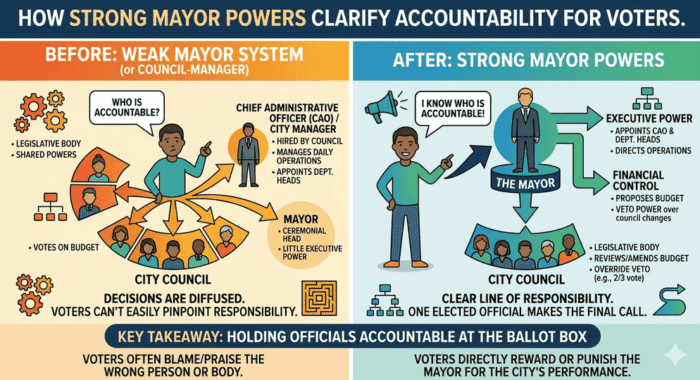
The Burlington Gazette article, “Candidates for the Office of Mayor talk about what they would do during their first 100 days if they were elected,” also posed a question: “Did you get the answer you expected? Did the answers address the issue?” While there was an interesting exchange about the “powers” and the municipal budget, the exchange left me wondering whether the candidates were having the right conversation. More importantly, voters should know how their mayor will choose to use those powers.
Understanding that there is a choice appears to have been lost in some of the recent budget discussions. At the event, mayoral candidate Rory Nisan stated, “I’ll never use strong mayor powers ever,” even though the legislation does not give a mayor the option to simply opt out of the Strong Mayor framework. Lisa Kearns took a different view, stating, “No matter how you slice it, it is a strong mayor’s budget,” which is correct in the sense that municipal budgets are now developed within the Strong Mayor legislative framework. Incumbent Mayor Marianne Meed Ward, however, said, “I don’t know what a strong mayor’s budget means,” before explaining that the new mayor will be required to either bring forward a budget or direct staff to prepare one. That statement is correct as far as it goes, but it does not tell the whole story. The important distinction is that the legislation provides a mayor with choices about how to exercise the powers available to them in developing and presenting the budget; the Strong Mayor framework itself is not optional.
What Strong Mayor Powers Actually Mean
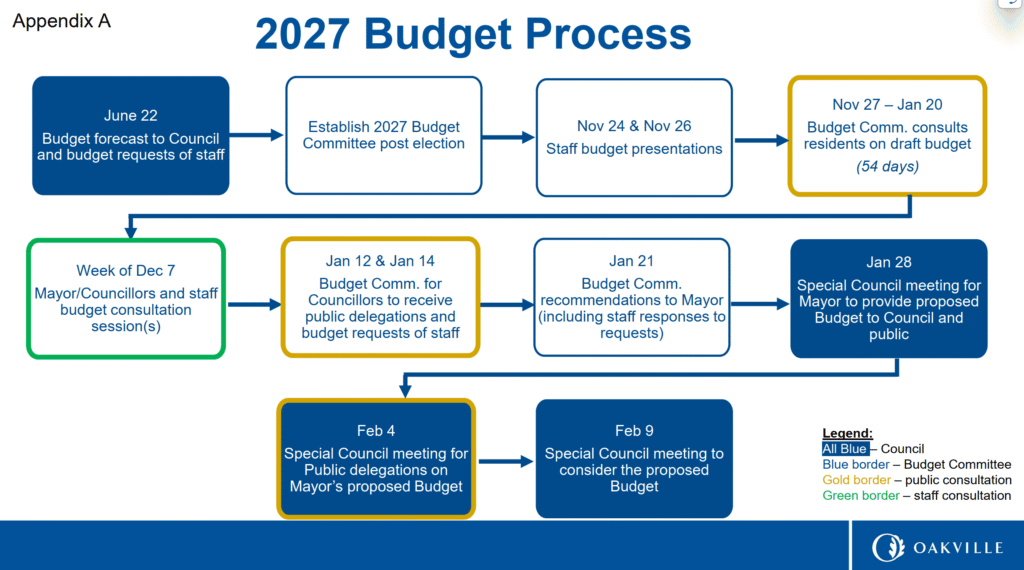
Under the Municipal Act, the powers and duties concerning proposing and adopting a municipal budget are assigned to the head of council. The mayor must prepare and provide a proposed budget to council, and the regulation requires that this happens by February 1, subject to a special rule for the year following a regular municipal election.
But nowhere does the legislation say that the mayor has to develop that budget in isolation. That is where I think voters need to pay attention. A strong mayor could say: “This is my budget. I have decided what I want. Staff will build it.” That is one approach.
Another approach would be for the mayor to say: “Before I establish the direction for the budget, I want to hear from Council, residents, businesses and the people who actually use the services we are considering changing.” The difference is not whether the mayor complies with the Strong Mayor legislation. Both approaches can comply with the law. The difference is how the mayor chooses to exercise the authority given to the office.
Nothing Prevents Pre-Consultation
The legislation gives the mayor the responsibility for preparing the proposed budget. It also gives the mayor the ability to direct municipal employees in writing on matters connected with the mayor’s Strong Mayor responsibilities. Those directions must be documented and provided to the Clerk and CAO as required. But that doesn’t mean the first step has to be a unilateral direction to staff.
A mayor could begin with a public conversation, asking residents:
· What services are most important to you?
· What would you be prepared to see reduced?
· Where do you believe the city is spending too much?
· What should be protected?
· What should be eliminated?
More on the Process
Upon the mayor’s proposed budget reaching Council, Council still has the ability to amend it. The mayor still holds veto powers over Council’s amendments, but that power is discretionary. Council can still override a mayoral veto with the required two-thirds vote.
The Strong Mayor system did not eliminate Council’s role in the budget; it changed the starting point. Instead of Council collectively originating and adopting the budget in the traditional manner, the head of council has the statutory responsibility to bring forward the proposed budget. That doesn’t mean the mayor has to treat Council as an afterthought.
The 2027 Budget Timeline Is Different
There is another important change for the mayor elected in October. A June 2026 amendment to Ontario Regulation 530/22 now says that following a regular municipal election, the head of council may propose the budget for the following year only in the year to which that budget applies. In plain English, the outgoing mayor cannot propose Burlington’s 2027 budget in 2026. The new mayor will deal with the 2027 budget in 2027.
That makes some of the current debate about inheriting or “resetting” a 2027 mayor’s budget somewhat misplaced. The incoming mayor will have an opportunity to establish the process. The question is what that process will look like.
Questions for Mayoral Candidates
· Will you consult residents before establishing the budget direction?
· Will you ask Council members for their priorities before instructing staff?
· Will you hold public meetings before difficult choices are made?
· Will you publish the assumptions being given to staff?
· Will you explain what can be cut, what cannot be cut and why?
· Will you use the mayoral veto when Council disagrees with you, or will you respect Council’s decision?
Conclusion
The answers to those questions are not simple. Municipal budgets are complicated. Contracts have to be honoured. Collective agreements have to be respected. Infrastructure has to be maintained. And residents understandably want services without endlessly increasing taxes. But that is why the conversation needs to be bigger than whether someone says they will “never use” Strong Mayor Powers.
The powers exist and are not going away. A mayor cannot wish them away. But a mayor can decide how they will use them.
Ask the people. Ask Council. Listen. Then give staff the direction.
It would still be a Strong Mayor budget. But it would be a budget built with community and Council input.
Discover more from Focus Burlington
Subscribe to get the latest posts sent to your email.