With 2026’s 5.8% increase to the city budget and the Burlington line on our tax bills, we were told that there were four components to the increase, as explained in this graphic from the city.
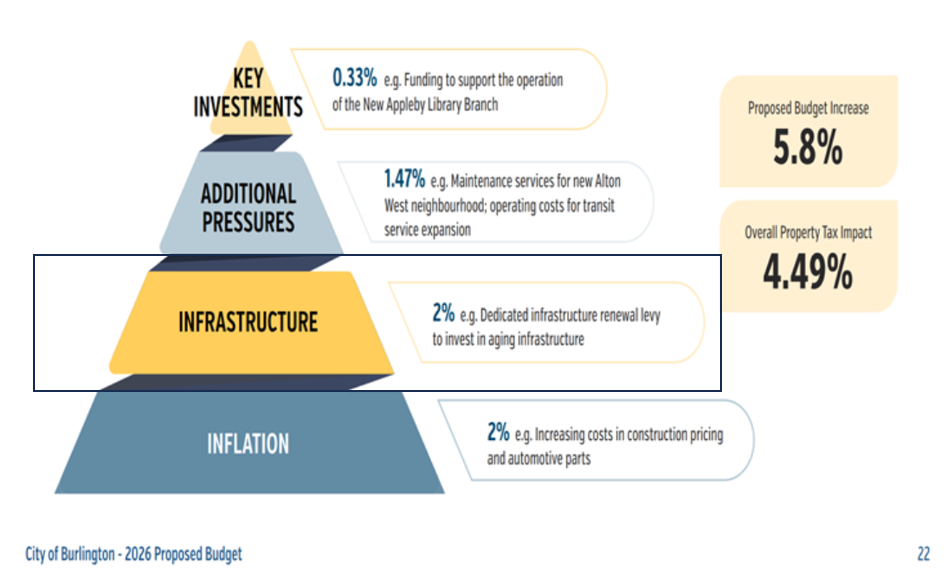
In dollar terms, 2% is about $5.2 million; in theory, $5.2 million of property tax money is going into keeping the city’s infrastructure in good repair. All you have to do is drive on a road in Hamilton to understand what bad repair means.
We saw the same increase in 2025 for the same reasion, “2% for infrastructure”.
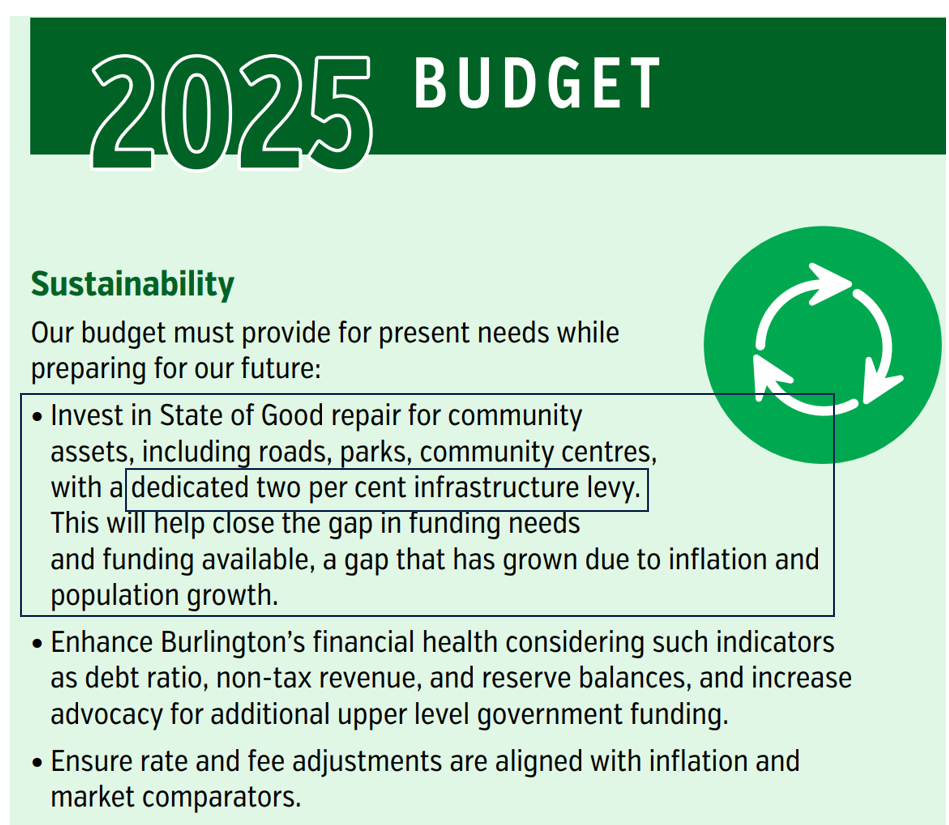
What’s driving the year-after-year 2% for infrastructure increases is something called the Asset Management Plan. Ontario requires every municipality to have an Asset Management Plan (AMP). If the city goes ahead and builds a new arena at 1200 King Rd., the day the arena opens, it will get recorded in the AMP, with the expectation that it will need to be torn down and rebuilt in 50 years.
The idea behind the AMP is simple: if you know the arena will need rebuilding in 50 years, put money away over time so that, in 50 years, the money is there in a reserve fund to pay for the rebuild. The AMP tracks almost everything in the city, from buses to trees to software. Taking a detailed look at the plan is overwhelming, so we came up with a simpler approach: Let’s compare Burlington’s plan with Oakville’s plan.
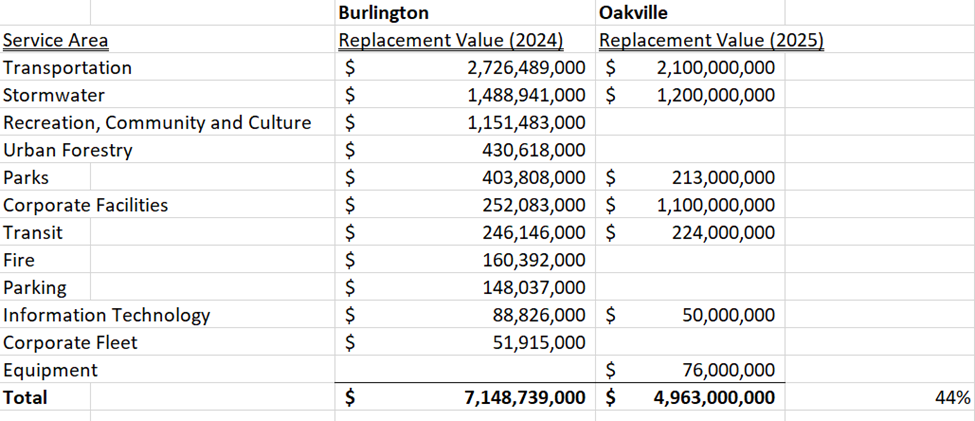
Ontario requires a plan but doesn’t define the service areas, making comparisons between municipalities difficult. We can start by just looking at the total; Burlington’s total replacement value in 2024 dollars is substantially higher than Oakville’s in 2025 dollars, about 44% higher. Before labelling Burlington’s plan as pure Burlington Speak, it’s worth looking at more of the details. But first …
Why does the AMP drive tax increases?
The asset management plan is very detailed: if a specific city truck is 10 years old and estimated to last 15 years, it needs to be replaced in 5 years; this calculation is repeated for every asset in the city. The city then, using software, adds up everything that needs replacing or rehabilitating over the next 10 years to determine how much money it will need over that period.
Based on the AMP, Burlington faces a $1.22 billion, 10-year infrastructure funding gap because it lacks sufficient reserve savings. If its total asset replacement costs matched neighbouring Oakville’s ($4.9 billion instead of $7.1 billion), that 10-year cost would drop to $833 million—significantly shrinking the gap and reducing the need for annual tax hikes.
Difference: Urban Forestry
Let’s take a look at the first obvious Burlington-to-Oakville difference. The provincial legislation has changed, and all municipalities will soon include their urban forest numbers in the AMP. Oakville was not including trees because, like wine, trees improve with age and are replaced with low-cost saplings. Burlington includes trees because if we suddenly lost all of them, there would be substantial costs associated with flooding. These what-if scenarios are difficult to manage and plan for; if all the trees in Burlington suddenly died, we might be facing other issues, including a food shortage. The reality is that the trees we have today may well be worth $430 million, but they simply can’t be replaced; the only option is to plant saplings and wait. Making the replacement cost, even after factoring in flood mitigation, substantially less than the current value.
Let’s take out the trees, figuratively.
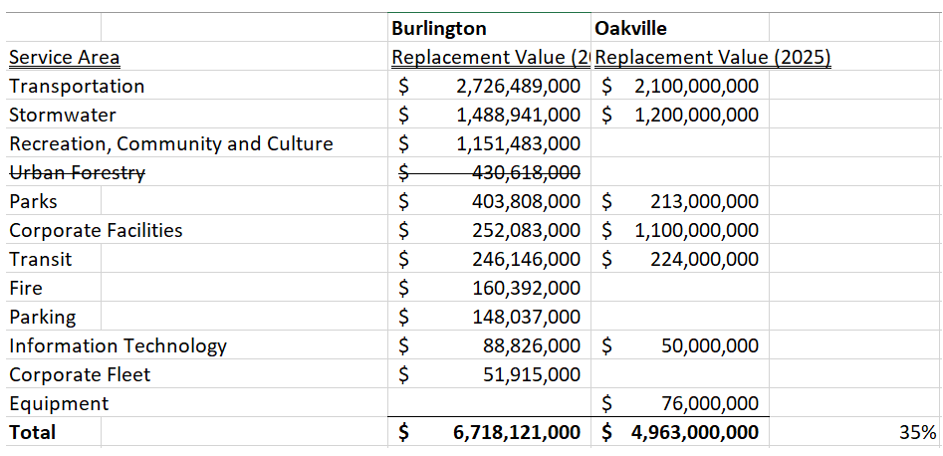
Now, the difference between Burlington’s and Oakville’s replacement asset value is 35%.
Next Up: Information Technology
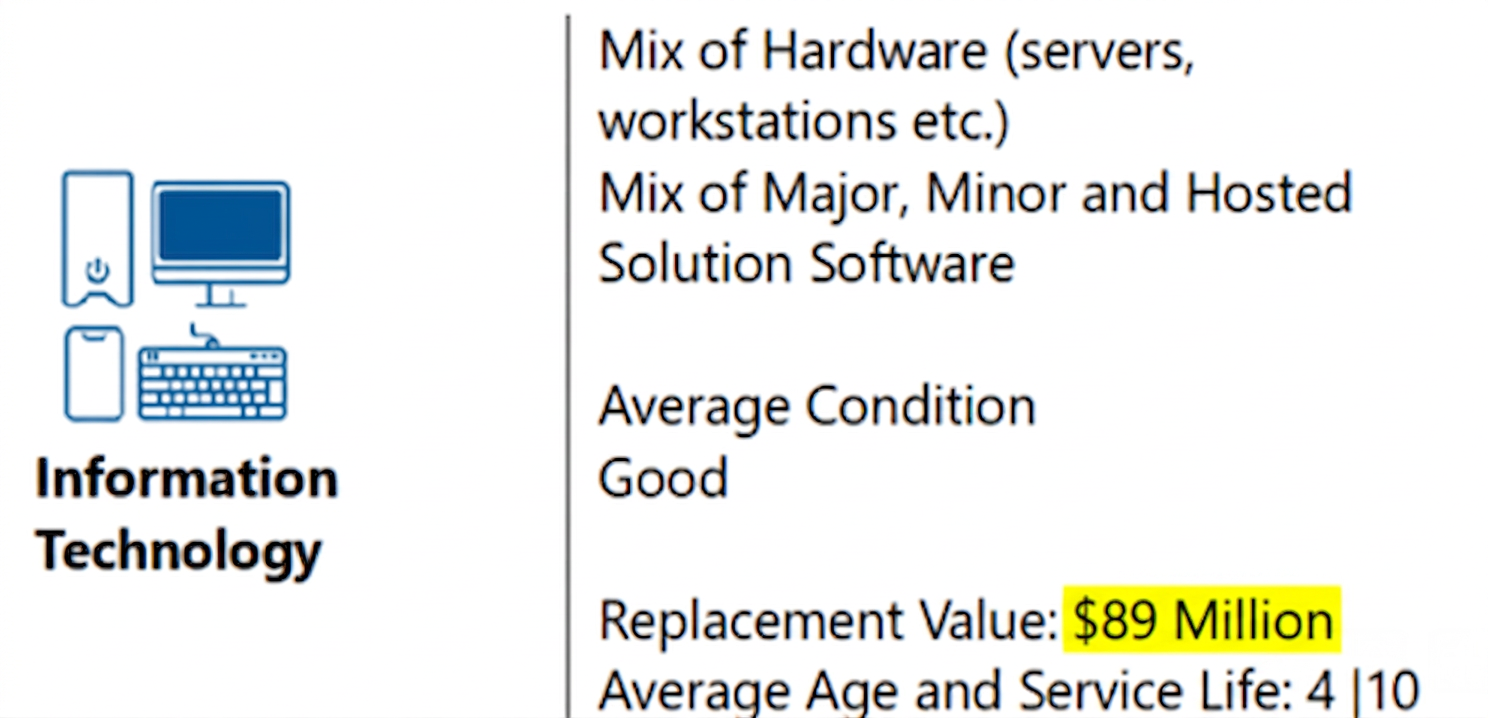
This is the Burlington overview (2025). The $89 million includes the cost of implementing the software, as well as its purchase price.
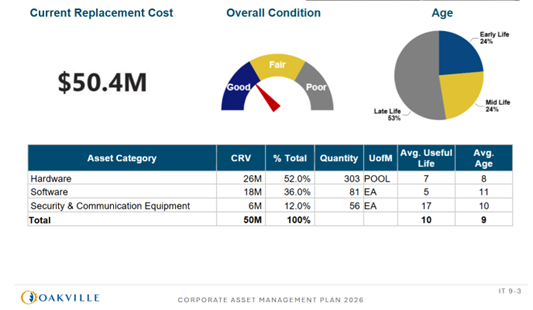
Oakville’s 2026 number of $50.4 million is explained like this.
The software industry is going through two massive changes. The first, which has been happening for years, is the movement away from large on-premises software systems to cloud-based subscription systems. Subscriptions are paid monthly or yearly and are not part of an AMP; they’re an operating expense. The second change, AI, is being used to quickly move data from one application to another, reducing implementation costs.
Oakville has a larger population than Burlington’s, and it’s part of Halton Region, but the current replacement cost of its IT infrastructure is $38.6 million dollars less than Burlington’s.
Next up: Parks
| Burlington | Oakville | Difference | |
| Parks | $403,808,000 | $213,000,000 | $190,808,000 |
Hmmm, $190 million, that’s a lot.
Oakville provides the following details:

And Burlington provides:
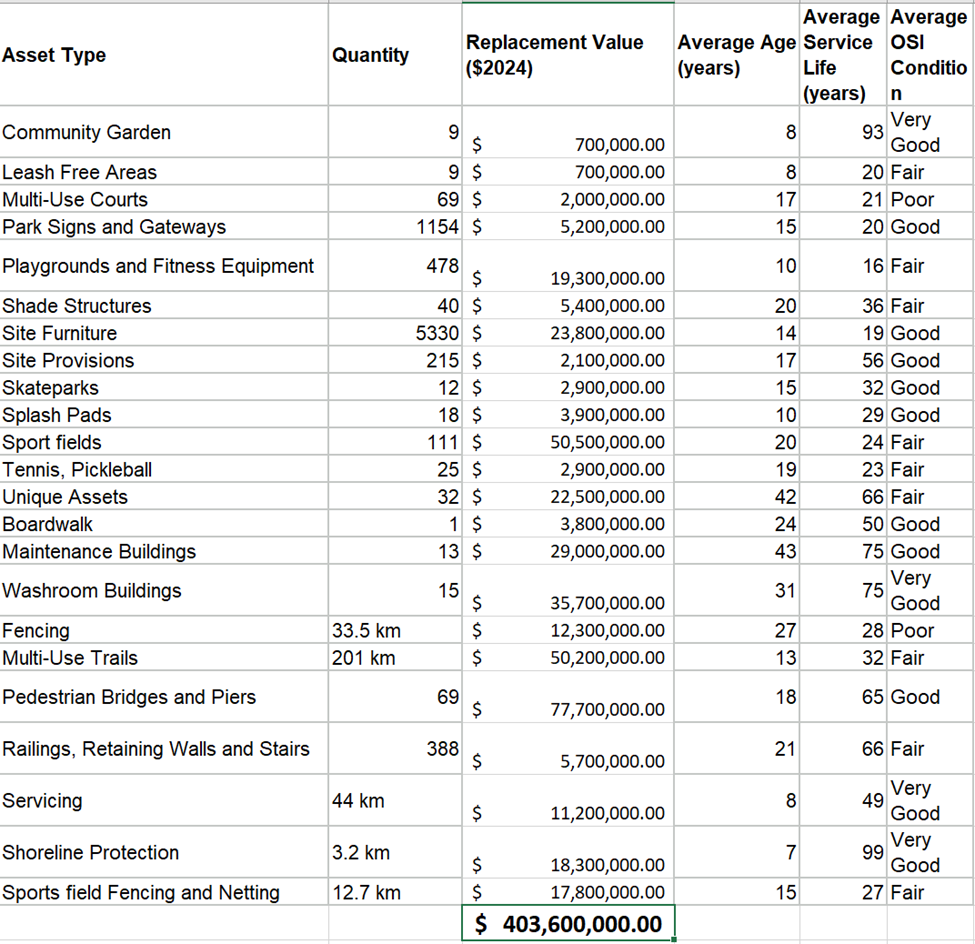
Going deeper on one item: Oakville has over 200km of trails with a replacement cost of $24 million. This compares to Burlington’s 201 km, which have a replacement cost of over $50 million.
For Burlington, that works out to almost $250,000 to replace or rehabilitate a kilometer of multi-use trail. Compare that to $120,000 in Oakville.
Assumptions on top of Assumptions
Accurately predicting costs out 50 years is a guessing game at best. The city relies on the Non-Residential Building Construction Price Index (NRBCPI), which increased rapidly during the condo construction boom. Many of the same people and similar materials go into building condos and community centres. With a slowdown in the construction industry and builders expressing concerns in Burlington council meetings about layoffs among construction workers, will the NRBCPI come down? Really, who knows. Building reserve funds and investing them wisely so they keep up with inflation might be the best strategy of all.
What’s next?
City staff prepare the asset management plan and then present it to council as justification for raising property taxes. The mayor turns to taxpayers with a rallying cry of 2% for infrastructure. Maybe it’s time for our council to turn back to city staff and request more clarity around why Burlington’s needs are so much higher than Oakville’s. After all, we elect a council to represent our interests.
Where is the “2% for infrastructure” is actually going?
Discover more from Focus Burlington
Subscribe to get the latest posts sent to your email.