Most of us are critical of politicians. At times, they say and do things that seem illogical, irresponsible, or even downright stupid. Every so often, however, they get it right—particularly when they stand up for important principles.
That’s why it was refreshing to learn of Andrea Grebenc’s recent decision not to apply for the role of Chair of Halton Region.
Hidden Agendas and Disguised Motives
Ms. Grebenc formerly served as Chair of the Halton District School Board. In 2022, she ran for Halton Regional Chair against incumbent Gary Carr. Former Burlington MPP Jane McKenna also entered the race, making it a three-way contest. Carr was re-elected with about 48% of the vote, McKenna received just over 33%, and Grebenc secured 18.7%.
In 2025, Ms. Grebenc won the provincial Liberal nomination and mounted an impressive campaign against PC incumbent Natalie Pierre, arguably one of the lowest-profile and least effective MPPs in Doug Ford’s government. Grebenc ultimately lost by about 40 votes in one of the province’s closest races.
Andrea Grebenc has an established public profile and political track record. Whether she would have been appointed Regional Chair is anyone’s guess. Given Doug Ford’s penchant for gaffes, poor judgment, partisanship, and political missteps, I suspect she would not have secured the appointment. What impressed me, however, was her willingness to identify what is really behind the Ford government’s latest assault on municipal democracy.
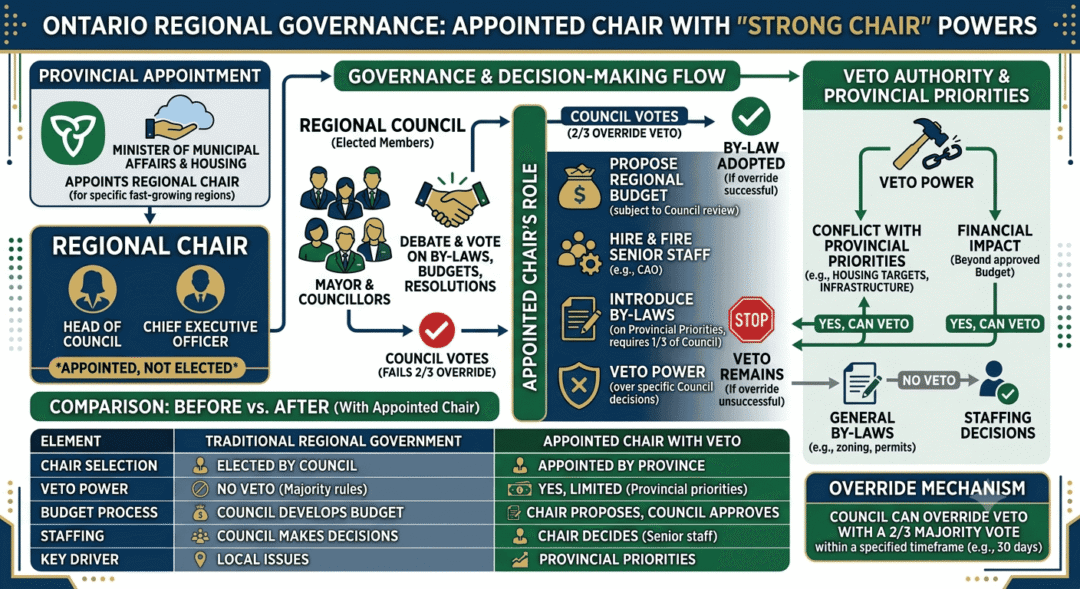
In her letter, Ms. Grebenc condemned the Ford government’s decision to replace an elected Regional Chair with a provincial appointee as fundamentally undemocratic. Like others, she pointed to what is likely the real objective behind this decision—and many previous initiatives, particularly the imposition of Strong Mayor Powers:
“Finally, I suspect that land-use planning will return to the regional level under this new leadership structure and its expanded powers, allowing for closer provincial control and less local voice over the extremely valuable land here in Halton”.
https://burlingtongazette.ca/?s=Andrea+Grebenc
Reckless and Irresponsible
To say Doug Ford has a fixation with local government would be an understatement. That animus was forged during his years as a Toronto city councillor. When his brother Rob was elected mayor in 2010, Doug won the Ward 2 seat Rob had vacated. Over the next four years, he became the staunchest defender of his brother’s agenda on a city council whose political centre of gravity leaned decidedly left. After losing the 2014 mayoral race, Ford’s political resurrection came in 2018 when he won the Progressive Conservative leadership and was subsequently elected Premier.
Like Ford, several previous Progressive Conservative premiers began their political careers in municipal government. George Drew served as an alderman and later Mayor of Guelph. Tom Kennedy was a school trustee and reeve of Toronto Township. John Robarts served on London City Council. Frank Miller sat on Bracebridge council before entering provincial politics. Even Mike Harris served as a school trustee in North Bay during the mid-1970s.
What distinguished these leaders from Ford is that municipal politics gave them an appreciation for public service and the important role local government plays in people’s lives. While they occasionally enacted legislation affecting municipalities, none pursued policies as overtly manipulative, centralized, or dismissive of local democracy as Doug Ford has. In short, they were not pursuing a personal vendetta.
One of Ford’s first acts as Premier was legislation reducing the size of Toronto City Council. Even after the courts ruled against the move, he pressed ahead and threatened to invoke Section 33 of the Canadian Charter of Rights and Freedoms—the notwithstanding clause. In September 2022, his government enacted the Strong Mayors, Building Homes Act, granting extraordinary powers to the mayors of Toronto and Ottawa to control budgets, dismiss senior officials, and effectively override their councils. Following criticism, these powers were later extended to roughly half of Ontario’s municipalities.
His government also attempted to open large portions of the Greenbelt to development, a move halted by public opposition and legal challenges. Ford has sought to eliminate bicycle lanes in Toronto and, more recently, has intervened to restrict municipalities’ use of automated speed enforcement.
Ford’s actions are driven largely by an overriding concern with cost containment and efficiency. Yet the measures he has chosen are not merely heavy-handed—they strike at the heart of local democracy. Like the current American president, whose style he claims to dislike but increasingly seems to emulate, Ford has little tolerance for opposition, views dissent as obstruction, and shows scant respect for those with different mandates or priorities.
For former Progressive Conservative supporters like me, Doug Ford is neither progressive nor conservative. He is erratic, undisciplined, impulsive, and deeply dismissive of those who believe local democracy matters—and that government should not become the preserve of political elites, developers, and backroom “subject matter experts” who presume to know better than the electorate.
In her letter to Burlington Today, Andrea Grebenc summed it up well:
“To change a democratically elected position into an appointed one, empowered to veto 23 duly elected councillors and mayors, push through provincial priorities rather than the priorities of local voters, and limit public consultation and debate at council is a travesty.”
Right you are, Andrea!
Discover more from Focus Burlington
Subscribe to get the latest posts sent to your email.
I agree on most of your points. Having said that, kill me now because I have no time for the Liberals and definitely no time for the NDP. I’m old enough to have lived through all of those poo shows.