The Fourth and Final Instalment of the Series
It Started with the Housing Pledge:
On March 21, 2023, Burlington signed the province’s housing pledge, committing to facilitate the construction of 29,000 new homes by 2031. That target would require the city to average 3,625 housing units per year over eight years.
At the time, Burlington reported that approximately 23,000 housing units were already under review in its development pipeline. Within weeks, city officials stated that the pipeline had reached 29,000 units, and by August 2023 the figure had reportedly grown to 38,000 units.
On paper, this suggested Burlington had the potential to build more than 4,700 homes per year, well above the pace required to meet provincial targets.
The Carrot – Building More Homes Faster for Dollars:
Burlington’s performance under Ontario’s “Building Homes Faster” program highlights the gap between ambitious targets and actual results. Despite ambitious provincial goals, the city fell well short of its housing targets in both 2023 and 2024. As a result, Burlington missed the 80 percent threshold needed to access roughly $12 million from the province’s “building faster” fund – a $400-million program intended to reward municipalities that hit their housing targets and help pay for the infrastructure needed to support growth. While the province has yet to release the 2025 results, it is likely Burlington will again fall short of both the target and the funding.
Mayoral Directions and Decisions – Transparency:
Mayoral directions – which should not be confused with decisions – were introduced under Ontario’s strong mayor framework to advance “provincial priorities.” Under this system, the mayor, acting in the statutory role of Head of Council, was granted the authority to issue written directions to municipal employees through the Chief Administrative Officer and specified department heads. These directions may require staff to undertake research, provide advice, or carry out actions necessary to implement the powers and responsibilities of the Head of Council.
The distinction matters. A direction is an instruction to staff to undertake work related to the exercise of the Head of Council’s powers. A decision, by contrast, is the exercise of a separate statutory authority that determines an outcome or resolves a matter.
The legislation is explicit that mayoral directions and decisions must be in writing, and must be made available to the public, ensuring transparency.
Between 2023 and 2026, the mayor of Burlington issued sixty-five mayoral decisions. Of which seven were for directions, three for budgeting, one each for HR, Municipal Freedom of Information and Protection of Privacy Act (MFIPPA), Tariffs, and Development Charges.
Forty-eight of the decisions were for by-laws, the balance for other matters.
Budget Direction:
Starting in 2024, mayoral directions showed an increase in the use of authority under the strong mayor framework. While the 2024 direction was largely procedural, the 2025 and 2026 directions introduced four broad guiding principles: Affordability, Livability, Sustainability and Transparency. Worthwhile goals, that read more like policy aspirations than measurable housing outcomes.
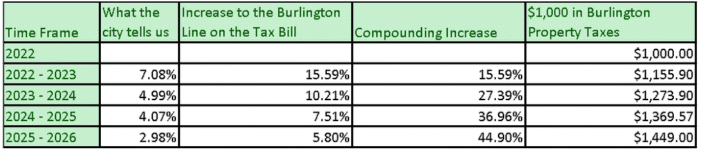
This matters because taxpayers are funding the system. Between 2022 and 2026, Burlington increased its property tax levy by roughly 44 percent, yet housing construction has not accelerated at a pace needed to meet provincial targets.
What is striking, however, is what they do not say. None explicitly referenced the provincial priorities used to justify these powers.
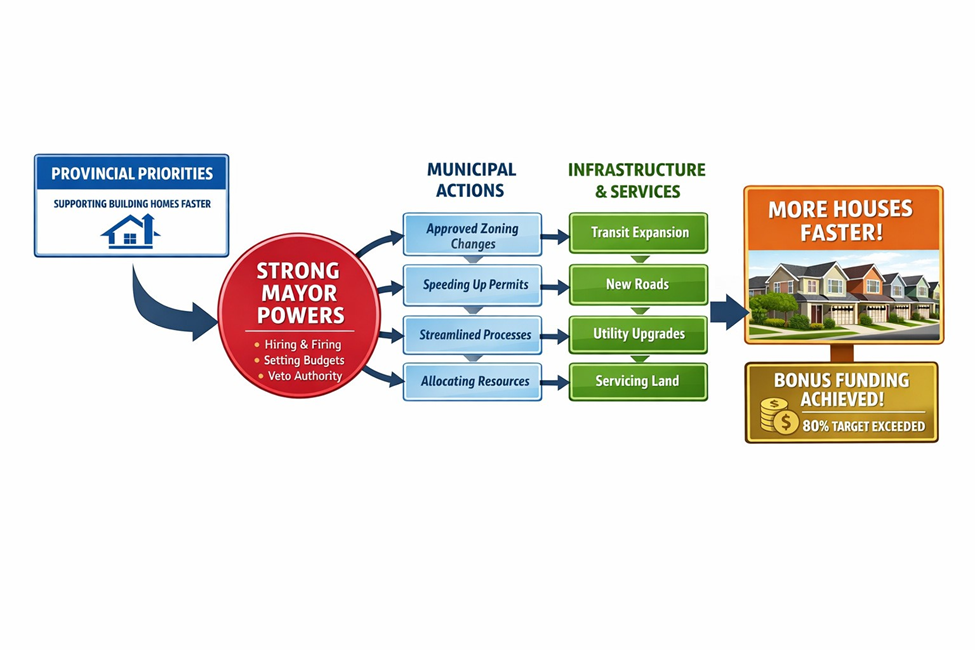
For residents paying the tax bill, the question becomes – if strong mayor powers were meant to speed up housing, where are the results?
Development Charges – Direction:
On February 11, 2026 the mayor directed staff to investigate the temporary elimination of Development
Charges (DCs). The agenda item was to be discussed at the regular council meeting scheduled for February 17. As of 4 p.m. on the preceding Friday, the council agenda had not been posted on the city’s website. In practical terms, this meant there would be limited time for the public to weigh in on a decision that could materially affect them as taxpayers, municipal finances, and the funding of infrastructure for future growth.
Substantively, the mayoral direction itself was a highly structured document, requiring considerable prior preparation, detailed financial modelling, historical trend analysis, and alternative policy options. The stakes were significant: the direction identified potential DC revenue exposure ranging from $16 million to $42 million if the charges were eliminated.
In the end – was this an attempt to stimulate stalled housing construction, or a policy shift prompted by missed growth targets? More importantly, this episode illustrates how the expanded authorities created under the strong mayor powers can be used to rapidly shape policy direction and council debate on major financial matters, and in this case on a timeline that left little room for public scrutiny.
By-laws – Council Size – Veto Implications:
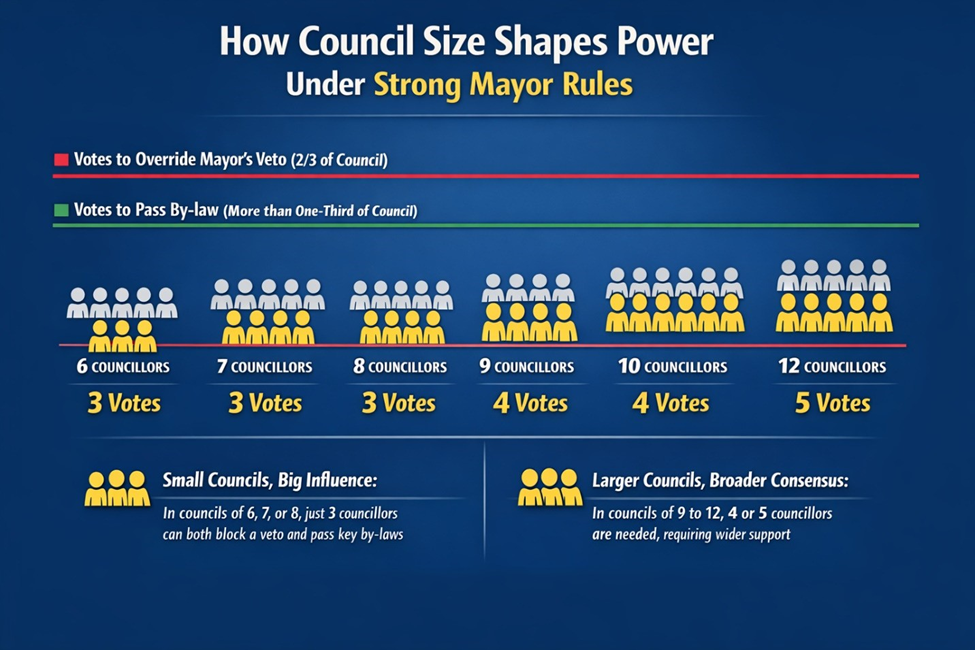
Given forty-eight of the mayoral decisions were bylaw related, a closer and comparative look is worthwhile and here is why. Burlington council is made up of the mayor and six councillors. Under the rules introduced in the Better Municipal Governance Act, 2022 (Bill 39), overriding a mayoral veto requires a two-thirds council vote, or five councillors. That means three councillors are enough to sustain the veto, preventing council from overturning the mayor’s decision.
At the same time, the legislation allows certain by-laws aligned with provincial priorities to pass with more than one-third support, which in a seven-member council is also three councillors. Meaning the same small bloc of councillors that can shield a mayoral veto can also help advance mayor-aligned legislation.
In practical terms, this makes each individual councillor’s alignment particularly consequential in a council of Burlington’s size.
In May 2025, City Council passed By-law 30-2025, making minor adjustments to the ward structure. Had they increased size of council from seven to twelve, note the shift in the number required to sustain a veto, e.g. a twelve-member council means five councillors would be required to sustain a veto.
Post Mortem on Strong Mayor Powers:
Ontario’s strong mayor experiment was meant to accelerate housing construction. So far, it has not delivered the breakthrough promised. Housing targets remain unmet, funding under the “building faster” fund flows only after municipalities succeed rather than helping them get there, and the province has yet to publish complete 2025 housing data.
The model assumed municipal governments can operate like corporations, by concentrating authority in one office. Unlike corporations’ voters have to wait four years to cast their verdict on Fords’ strong mayor powers and the lack of performance at the municipal level. Worthy of mention is the Act makes no mention of the word mayor, except in the title, a vote for a mayor, is a vote for the head of council.
Article 1. Strong Mayor Powers – The Back Story
Article 2. Strong Mayor Powers – How They Actually Work
Discover more from Focus Burlington
Subscribe to get the latest posts sent to your email.