
Burlington’s 2026 Budget includes $4.2 million for three new 40-foot buses, $95,000 a year, every year, for bus stop improvements and a one-time expense of $299,000 for technology improvements. The technology improvements are for buses with Automatic Vehicle Location (AVL) systems. There are also major improvements planned for specialized (accessible) transit.
As Burlington moves towards free transit for more and more groups of people, what are the factors that dissuade people from using transit? The most obvious is overall travel time. Other factors include personal safety and wait times. Last year, Burlington spent heavily on bus stop improvements. Burlington defines a complete bus stop as having a shelter, a bench, and a trash can. In 2024 and 2025, Burlington spent $412,325 to upgrade 41 bus stops with new concrete pads. Keeping the math simple, that works out to $10,000 a stop.
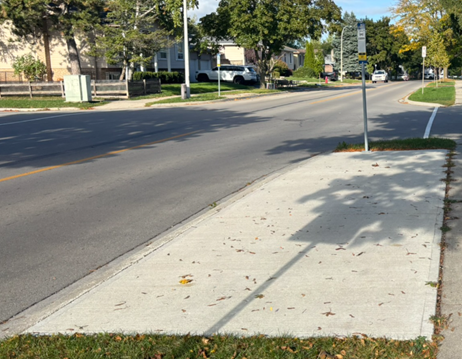
Burlington has around 789 bus stops, at a cost of $10,000 per stop; the total cost to upgrade all the stops is close to $8 million. Some of the $8 million has already been spent. Adding benches, heaters, shelters, and garbage cans will cost considerably more.
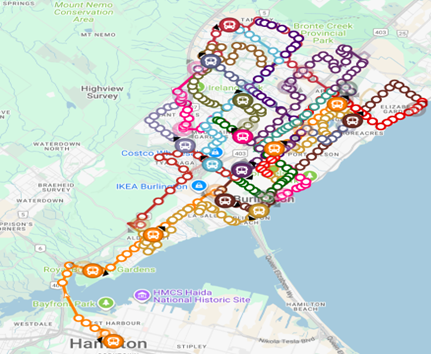
Are complete bus stops important, or is minimizing wait times at the bus stop what really matters?
In a perfect world, using an app on my phone, I’d see when the bus is arriving at the nearest stop, I’d walk to that stop, and board the bus.
How does Burlington Transit compare to my perfect world? I did a quick search in the Apple App Store for the Burlington Transit App and installed the obvious choice, the app named BurlingtonTransit.
This is what I saw when I opened the app.
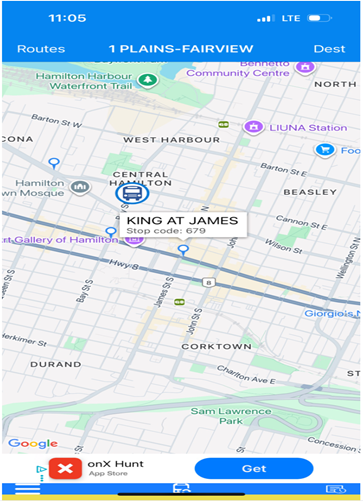
The BurlingtonTransit app didn’t show information based on my current location. I couldn’t find a way to enter a destination. I quickly gave up. There are steps the city can take to have the BurlingtonTransit application renamed in the app store.
I took a look at the Burlington Transit website and learned that the “BurlingtonTransit” app was not the correct application to install. There are steps
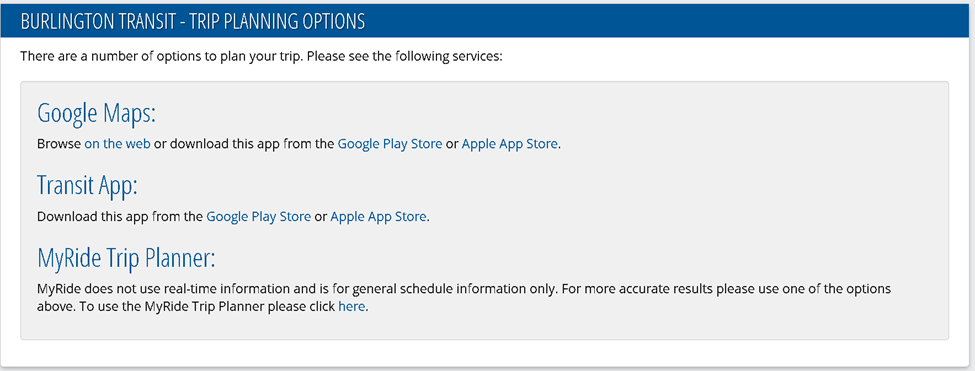
I tried the second option – the “Transit App”, this app works and is easy to use. Curiously, the transit app offers UBER as a choice and has an optional $25 annual fee.
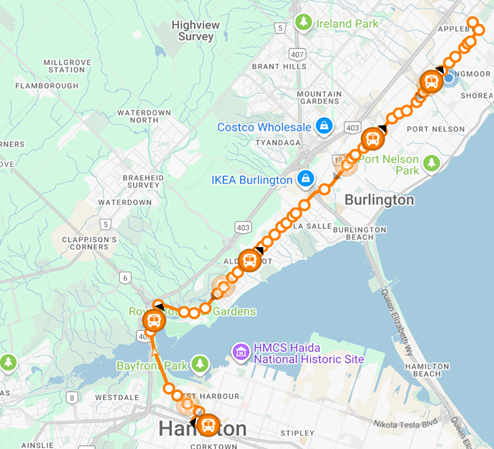
Ok, but what does this have to do with bus shelters?
Bus shelters are important because they protect us from the elements, keeping us comfortable and safe while we wait for a bus. But waiting is one of the reasons people don’t like public transit. I want to wait at home, work, school, or a restaurant, and leave in time to get to the bus stop with a few minutes to spare.
Bus shelters at transfer points make sense, but making every stop a “complete” stop with a shelter, a bench, and a trash receptacle may not be the answer.
Instead of spending millions on adding bus shelters, should Burlington concentrate on one app and minimize the time people spend at bus stops in the first place? After all, is anyone ever really comfortable on a bench in a bus shelter?
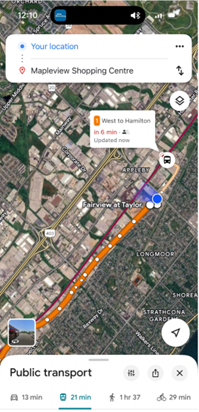
How well is the real-time transit information in Burlington working?
These comments are from a recent social media posts on Reddit.
“Buses disappear with no explanation, and I don’t even know why they have a schedule/app when the time fluctuates wildly at a moment’s notice.”
“I flat out refuse to use Burlington Transit’s app because it’s essentially a wish list of when the bus should arrive. I use an app called Transit instead because it essentially crowd-sources the data, so you have more accurate arrival times, and it also works across multiple transit companies.”
“I check my ride app. “Next bus in 11 minutes” – 11 minutes comes and goes, no bus. I wait 4 more minutes, no bus and now the app is saying next bus in 28 minutes. Another ghost bus. So I start walking home on bad knees. 10 minutes later the 2 south to downtown races past me as I walk. I check the app which still tells me it is 20 minutes away.”
Bus Shelters and Unintended Consequences.
There are reports on Reddit of bus shelters near the Burlington Go Station being used as overnight shelters by people who are underhoused.
What did we learn about transit upgrades in the 2026 Budget?
AVL means Automatic Vehicle Location.
We asked the city:
“Does the improvement in accessible transit, combined with accurate AVL information, eliminate the need to improve bus stops?“
This is what we learned:
“Transit riders must wait for buses in all weather conditions and not all routes are 15 minutes, nor does everyone have a cell phone to access real time bus information. Therefore amenities at the stop provide comfort for riders.”
We asked the city:
“Should the city wait for the AVL implementation to be completed and re-evaluate the need for bus stop improvements?”
This is what we learned:
“No. VE-ER-2176 – Transit Mobile Data Terminal Replacement updates aging onboard hardware. Bus stop upgrades (RD-TR-270) are a separate program and continue to move forward to meet accessibility requirements, remove identified barriers, and support a state of good repair.”
We asked the city:
“The comments on social media and in the press indicate that the current AVL system doesn’t work. Will the new system be more accurate?”
“Capital project (VE-ER-2176 – Transit Mobile Data Terminal Replacement) upgrades the on-board Mobile Data Terminals (MDTs). These terminals contain the GPS receiver that provides the real-time location data used by Burlington Transit’s Automatic Vehicle Location (AVL).
In addition, Burlington Transit provides real-time data for fixed-route service through GTFS-RT. Rider experience can vary depending on the platform they are using and how the information is being viewed. Some tools default to scheduled (predictive) information, and real-time bus locations require selecting different features to access the full functionality. For example:
• MyRide Trip Planner is schedule-based and predictive, not real–time.
• My Ride Route Map must be selected to see the bus location in real time by selecting route(s).”
If riders are experiencing issues, they are encouraged to email contactbt@burlington.ca with the specifics of their circumstances so we can provide assistance, if possible.”
Regardless of what the city is saying, concentrating on a single smartphone application with a goal to provide accurate real-time bus location information may do more to improve ridership than any other investment. If the ARGO pilot in Brampton is successful, bus stops will be a thing of the past.
What is state-of-the-art transit? ARGO, an Ontario company, has this vision: “A future where public transit is faster than driving a car but as affordable as taking the bus.”.
Discover more from Focus Burlington
Subscribe to get the latest posts sent to your email.
This is very well done! Make sure Burlington Transit gets a copy.
Thanks for the research and the well informed opinion and timely questions,