The unofficial results are in, and Burlington’s 2026 mayoral election offers a clear look at a fundamental reality of local politics: in low-turnout municipal races, city-wide name recognition and a stable voter floor matter more than assembling a broad majority coalition.
Mayor Marianne Meed Ward secured a third term with 25,025 votes, while challengers Lisa Kearns and Rory Nisan captured 17,070 and 12,650 votes, respectively. Minor candidates Keith Demoe (1,474) and Yugalkeesor Ramdhonee (273) rounded out the ballot.
While headlines will frame this as a victory for the incumbent, the raw numbers reveal a different story—one defined by incumbent brand resilience and a deeply fragmented opposition.
The 15% Support Reality
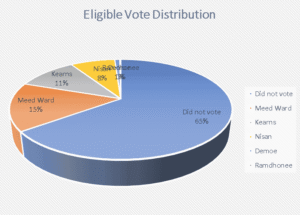
Out of the approximately 160,089 eligible voters in Burlington, turnout sat at roughly 35.5% with 56,492 total ballots cast.
Expressed relative to the entire city electorate, Mayor Meed Ward was re-elected with the support of roughly 15.6% of registered voters.
Under Ontario’s First-Past-The-Post system, this 15.6% tally translates into a 100% executive authority and a strong mayor mandate. In non-partisan municipal elections—where voters lack party labels to guide them—incumbent brand recognition functions as a candidate’s insurance policy.
Meed Ward’s 25,025 votes mirror her 2018 victory tally (23,360). This ~25,000-vote block represents a solid, dependable floor: built on eight years as mayor, eight years as a ward councillor, and a decade of high-profile civic exposure. To win, the incumbent did not need to persuade the majority of Burlington residents—she simply needed her established base to vote.
The City-Wide Recognition Gap
The challenge for the opposition was not a lack of voter dissatisfaction, but a recognition gap.
Both Lisa Kearns and Rory Nisan were sitting city councillors with high profiles in Ward 2 and Ward 3, respectively. Matching Meed Wards profile and the multi-term mayor’s city-wide brand, is a steep hill to climb.
Combined, Kearns and Nisan captured 29,720 votes (52.6% of all ballots cast). A majority of voters actively chose a non-incumbent candidate. However, because two distinct, well-known candidates split any appetite for change, neither came close to clearing the mayor’s 25,000-vote threshold on their own.
2026 Burlington Mayoral Vote Distribution
| Candidate | Votes | Percentage |
|---|---|---|
| Marianne Meed Ward (Incumbent) | 25,025 | 44.3% |
| Lisa Kearns (Challenger) | 17,070 | 30.2% |
| Rory Nisan (Challenger) | 12,650 | 22.4% |
| Keith Demoe (Challenger) | 1,474 | 2.6% |
| Yugalkeesor Ramdhonee | 273 | 0.5% |
Total Non-Incumbent Opposition: 31,467 votes (55.7%)
Total Registered Electorate Support for Mayor: 15.6%
The Moral for the Disillusioned Majority
For the close to two-thirds of eligible voters who stayed home, the lesson of 2026 is: frustration without mobilization guarantees you four more years of the status quo.
A wide swath of door-to-door conversations revealed a high level of electorate frustration and anger over key local governance issues such as:
- Tax Increases: Cumulative tax hikes over successive municipal budgets that squeezed household finances during a cost-of-living crisis.
- Accessibility & Governance: Daytime council meeting schedules that made live civic participation difficult for working residents.
- Capital Expenditures: Lingering questions surrounding the total lifecycle costs and long-term financial commitments of major municipal acquisitions, such as the former Robert Bateman High School site.
- Infrastructure Experiments: Localized traffic-calming and active transportation reconfigurations—such as the Prospect Street lane-reduction project—that sparked intense neighborhood debates over municipal priorities.
Feeling aggrieved by property 44% tax rates, daytime governance, or controversial capital projects achieves nothing if that frustration stays at home. By choosing not to vote, or by allowing opposition support to split evenly between two candidates, these residents effectively parked their vote. Under municipal terms, those who didn’t vote now have to wait until 2030 for another say at the ballot box.
Echoes of 2018
Burlington witnessed a similar dynamic in 2018. In that race, former mayor Rick Goldring saw his support collapse to 33.1%, while Meed Ward won the mayoralty with 46.0% (23,360 votes) against a field that included former MP Mike Wallace (18.9%).
The lesson from 2018—reaffirmed in 2026—is that when voters want change, the distribution of that vote across name-recognized challengers matters just as much as the overall desire for a new direction. Without a single, unified challenger who commands city-wide brand equity early in the cycle, the incumbent’s voting floor remains almost impossible to break.
The Mandate Question
Mayor Meed Ward achieved a legally sound, plurality victory. However, claiming a broad, unanimous mandate from the electorate oversimplifies the reality of the math.
In an election where 64.5% of eligible voters stayed home and 55.7% of participating voters cast ballots for someone else, the election was not a ringing endorsement of every policy decision or exercise of strong mayor authority. Rather, it was a textbook demonstration of first-past-the-post mechanics: a system that rewards established name recognition and a firm voting floor over a broad electoral majority.
Discover more from Focus Burlington
Subscribe to get the latest posts sent to your email.