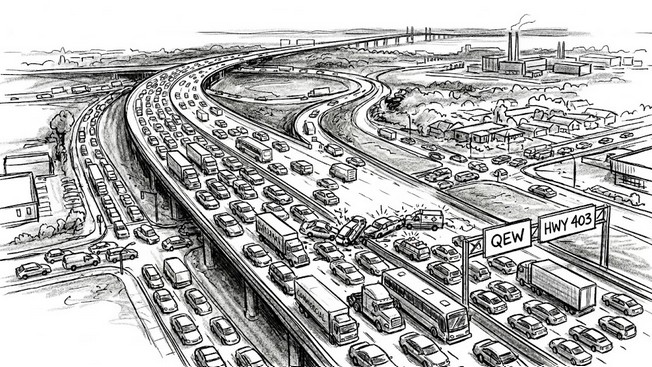
I recently attended the Transportation Open House hosted by Councillors Lisa Kearns and Paul Sharman. Normally, I welcome public meetings because they offer a chance to hear directly from officials about plans and new initiatives. But when it comes to transportation, I’m usually skeptical. Too often, these discussions focus on public transit and bike lanes, while offering little that meaningfully addresses Burlington’s worsening vehicular traffic congestion.
A Meeting with No Clear Focus
The meeting was scheduled to begin at 6:30 p.m., and attendees were asked to pre-register. Why registration was necessary is unclear, especially since there were no refreshments and water was the only offering. Before the meeting began, Councillor Kearns announced a delay until 7:00 p.m. so attendees could go outside and view a new microbus sponsored by the ARGO Transit System. Why the bus wasn’t already in place when people arrived is Mystery #2.
Several transportation-related organizations had displays at the back of the room, including city committees promoting their work. Many were handing out bicycle bells and lights. Presumably, taxpayers paid for these items, along with the upkeep of the many agencies, boards, and commissions that seem to perpetuate themselves.
We then heard from staff in the Transportation Department and from Halton Regional Police Services. Some spoke about bike lanes, others about public transit, and the police covered crime prevention, collision statistics, and impaired driving. Interesting, perhaps, but not the kind of practical discussion I had hoped for.
The best part of the evening was the question period, which finally began around 8:25 p.m.
Great Questions, But Few Good Answers
Residents asked about traffic being diverted onto downtown Burlington streets when there is an accident on the QEW. Others asked about public transit, ARGO buses for seniors, and the growing use of e-scooters. One story involved a 15-year-old riding an $8,000 bike without a helmet or protective gear. The police said they could not charge the rider because of his age, though many in the room wondered why the parents were not held accountable. Mystery #3.

The questions were excellent. The answers, less so. What I did not hear from councillors, staff, or police was a real plan to deal with Burlington’s traffic congestion.
I heard about data collection and efforts to encourage lower-carbon travel, but not about concrete measures to improve the city’s transportation network.
I am not saying Burlington needs more roads. I would settle for proper maintenance of the roads we already have. What I am looking for are practical tools to move people, goods, and materials safely and efficiently. Instead, I heard nothing about traffic light synchronization, longer advance greens, more bus lay-bys, or additional right-turn lanes. Mystery #4.
Time For A Reality Check
One comment suggested that if we expand roads, traffic will eventually increase to fill them. That may be true, but how else do we deal with a growing population and the province’s mandated housing and population targets? City officials still seem to believe that if they build enough bike lanes and expand transit, people will simply abandon cars. In a recent article, my Focus Burlington colleague, Eric Stern, wrote about this in what he called “Gridlock by Design”:
In a perfectly planned city where everyone travels between the same few destinations public transit and bike lanes make perfect sense. Unfortunately, Burlington does not fit this paradigm. Most people make multiple stops in a day. A family might go from school to hockey, then to dinner, then to a grocery store or hardware store. Public transit is not well suited to that kind of travel.
My own routine is typical of many residents. My dentist is on Guelph Line, my bank is in Millcroft, I play tennis in Aldershot, my dry cleaner is on Brant Street, my vet is in Bronte, and I shop in Oakville, where my church is also located. That is how many people live. Public transit may suit some residents, but it does not reflect the reality for everyone else.
According to the 2021 Census, only 4.5% of Burlington residents used walking or cycling for their daily commute. Even if that number rose to 10%, the vast majority would still rely on vehicles. Those vehicles may become electric, but they will still be cars. The real question is: what is being done to make vehicle traffic move better in Burlington? Based on what I heard at this meeting, not much. Mystery #5.
Coordinate, Cooperate, Engage
Public meetings in Burlington are replete with the same buzz words from our civic officials: coordinate, cooperate, and engage. Those phrases sound good, but they do not solve problems.
Too often, the city’s policy focus is on structure rather than results. We see PowerPoints, charts, formulas, and committees, but not enough evidence that these efforts improve traffic flow. I heard statistics about impaired drivers, car thefts, and bus ridership, but very little about how long it takes Burlington drivers to get across the city.
What matters in the real world is performance. I do not need a lecture on process. I expect city officials to do their jobs. Most are being paid well for their service….some might even argue, far too much. What I want to know is whether the problem is being addressed, and the degree of measurable performance improvements. After two and a half hours, I left without any clear sense that city hall truly understands the challenges Burlington motorists face.
Reflections from the Past
The evening’s most telling moment came near the end, when a gentleman held up a book and said it was a report written in 1976 by two former Burlington councillors, including Joan Little, formerly Joan Allingham, who recently passed away. The report referred to Burlington’s traffic congestion and called for action from all levels of government.
Fifty years later, the problem remains. Sadly, some things never seem to change.
Discover more from Focus Burlington
Subscribe to get the latest posts sent to your email.
This is an excellent description of what happened. There wan no meaningful solutions presented by staff and council to solving the gridlock problems.
One solution is to revive the Mid-Peninsula Hwy planned by thr Harris government in the 1990,s and killed by the Liberals supported by Burlington and Halton.We now pay the price for stupidity.