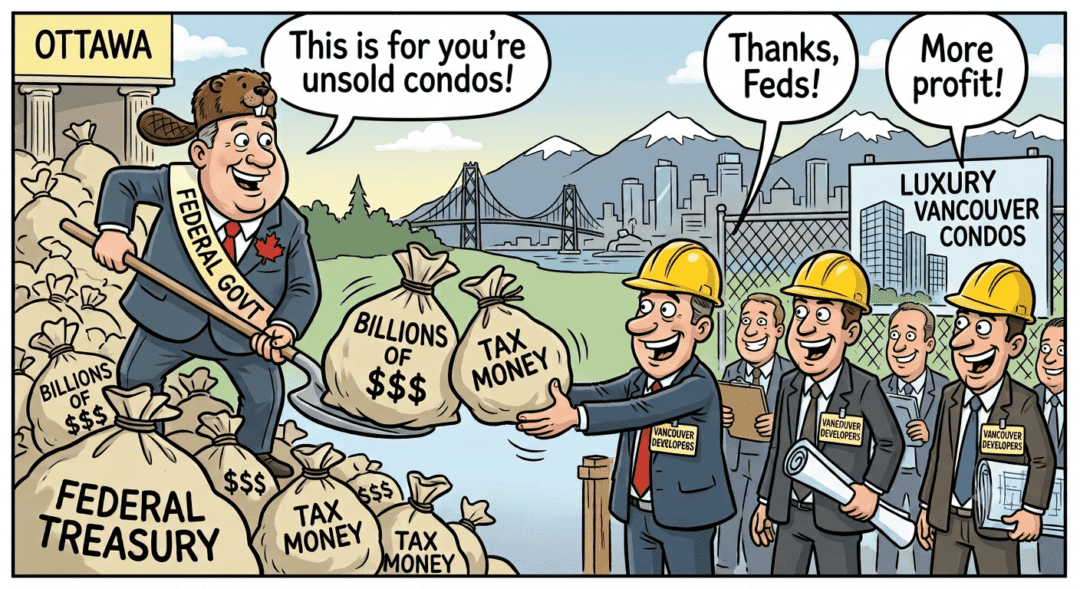
For an industry that began the year in a financial funk, real estate developers should be ecstatic after some of the support measures announced by the federal government. Christmas has come early!
First came the March 2026 GST rebate for first-time homebuyers, intended to spur an industry struggling with weak consumer demand. Then came the Canada-Ontario Partnership to Build program, which provided incentives for municipalities to eliminate development charges. Now, the federal government is stepping in with plans to purchase hundreds of unsold condos in Vancouver and convert them into rental housing.
Thank you, Prime Minister Carney. Who says there is no Santa Claus?
This latest example of government largesse has sparked renewed criticism. One respected industry observer, Ron Butler, has called the plan “crazy”:
The Return of Corporate Welfare
Under the federal initiative, an estimated 2,200 vacant Vancouver condos will be purchased from developers and converted into rental housing at a cost of $3.2 billion. Rents will be set below market rates and classified as “social housing.” Most of these units would normally sell for more than $1 million.
The moderator on the Butler podcast described the measure as “perverse” because it prevents market forces from operating. National Post columnist John Ivison, in an article entitled “Carney’s condo developer bailout is a hazardous look”, writes:
“…incentivizing developers to build more by creating certainty on the development-charge front is quite different from bailing them out when they can’t sell their homes”.
https://nationalpost.com/opinion/john-ivison-carneys-condo-developer-bailout-is-a-hazardous-look
While B.C. reportedly has a thirty-year supply of unsold condos, clearly a disincentive for new construction, the industry bears responsibility for much of its current predicament. Had developers pivoted toward the types of housing consumers increasingly want—low- and medium-density homes, duplexes, triplexes, and fourplexes—the situation might not be as severe.
As federal Conservative leader Pierre Poilievre has argued, developers took risks, the bubble burst, the condos remain empty, and instead of allowing prices to adjust, the federal government is stepping in with yet another bailout.
Under Carney’s plan, the normal forces of free-market capitalism—excess supply leading to lower prices—are constrained. If market forces were allowed to operate, many of these units would likely be sold at lower prices, enabling more purchasers to become homeowners rather than renters. If affordability is the problem, would that not make homeownership more attainable?
Free Market Realities
Back in March, when Burlington Council was considering reductions to development charges, councillors heard repeated warnings from industry representatives about the consequences of inaction. Layoffs and bankruptcies were among the outcomes cited.
But here is the blunt truth: bankruptcies, downsizings and restructurings are a fact of life. Businesses come and go. Success is never guaranteed.
Real estate development carries significant risks, but it also offers substantial rewards when conditions are favourable. Those expensive BMWs and Mercedes-Benz vehicles, lavish homes, and opulent offices often associated with many developers’ lifestyles are reminders of those prosperous years. Now, as the housing market undergoes a major correction, already overburdened taxpayers are expected to subsidize an industry that many view as both excessively profit-driven and slow to adapt to changing market realities. The new emerging public-policy model appears to be simple: privatize profits but socialize risk.
In the GTHA alone, there are an estimated 30,000 unsold condominium units. Will Ontario follow British Columbia’s lead? Will Premier Ford, who has shown a repeated tendency to intervene in economic matters, work with Prime Minister Carney to extend this program to Ontario? Or will they show restraint and allow market forces to prevail?
Time will tell.
Sobering Reminders From the Past
During the 1972 federal election, the late NDP leader David Lewis coined the phrase “Corporate Welfare Bums” to describe large corporations that sought and received generous government assistance.
His targets included Michelin Tire, Shell Canada, and Bell Canada—companies that benefited from substantial grants and subsidies while avoiding what many Canadians believed was their fair share of taxes. The message resonated strongly with voters, and helped propel the NDP to election gains that gave the party the balance of power in Parliament.
Fast forward to 2026. The players may have changed, and today’s bailouts may be more sophisticated and nuanced. But the bottom-line result remains the same: taxpayers bear the cost.
If the negative optics and growing criticism surrounding the Vancouver plan are any indication, governments should think carefully before extending generous entitlements. Beyond the terrible optics, such interventions risk creating a dangerous precedent with significant long-term economic and financial consequences.
Discover more from Focus Burlington
Subscribe to get the latest posts sent to your email.
Whether its a bailout or not depends on the price the government pays for the units. It would not be a bailout if the price forces the developer to take as much of a loss as selling into the free market. We know the government is going to acquire/pay for social housing and if it can be bought at less than cost price then it is good deal for taxpayers not a bailout for developers. Only when the sale price is known will we know if the program is a bailout or not.
If we want the next generation to have condos to buy (someone must build them), or even the present generation of new condo buyers to afford them, please suggest a plan. Don’t come dragging with this right-wing hit piece!! The irony here is that you are breaking Your Own Values “The Focus Burlington is deeply committed to actively promoting certain policy initiatives that align with our overall goal of promoting a safe, secure and sustainable future for all residents.”