
Take a look at the forecasted Burlington property tax increases for the next five years and consider voting in the October 26th, 2026, election. Voter turnout is always low, and people should be voting for or against these increases. Voting lets our elected representatives know whether they’re on the right track. The Burlington item on our property tax bill has increased by 44.7% over the last four years.

Every year, the civil servants at city hall put together a forecast predicting how much more money they’ll need in 2027. This is done to prepare for the 2027 budget discussions. The Financial Forecast, Report FIN-11-26, was presented to the Committee of the Whole on June 8, 2026.
The Big Picture: What the Numbers Tell Us
According to current staff projections, the preliminary 2027 city budget increase is expected to range from 5.0% to 7.3%.
To be perfectly clear, this means the Burlington item on our property tax bill will increase by between 5 and 7.3%. The city uses an invalid mathematical calculation to understate the percentage tax increase by at least half, referring to it as the “City Share of the Overall Property Tax Bill Impact”. There is no mathematical basis for the 2.60% or 3.80% shown in the chart below.
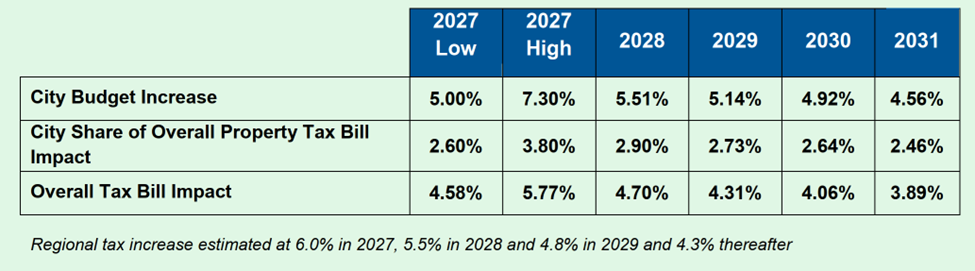
We understand percentage increases. Burlington likes to talk about “Tax Bill Impact” that understates the increase by over 50%.
This report states one of the principles for budget development is “Transparency – A simpler, easier to track and understand presentation of the budget, to foster better community engagement.” Is it time for the city to use the mathematical definition of a percentage increase, rather than a made-up calculation masquerading as a percentage?
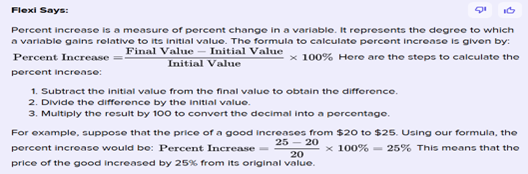
| How to calculate a percentage is high school math. https://www.ck12.org/flexi/cbse-math/percentage/how-to-determine-the-percent-increase/ The city doesn’t follow this formula and shouldn’t show 2.60 or 3.80 with a percent sign. I don’t know what 2.60 and 3.80 represent, and the city should explain them to us in the spirit of transparency. |
What does this mean in terms of a tax bill?
The next two tables show amounts from a sample 2026 tax bill and the effect of the increase on each item.
Using the “low” 5% Burlington property tax increase and a sample tax bill:
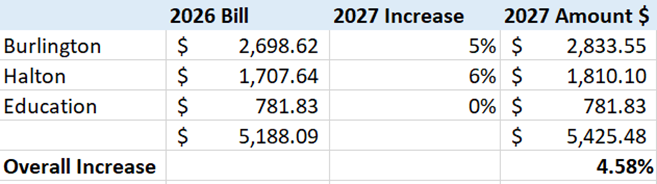
The total bill will increase by 4.58%.
Using the “High” 7.3% Burlington property tax increase and a sample tax bill:
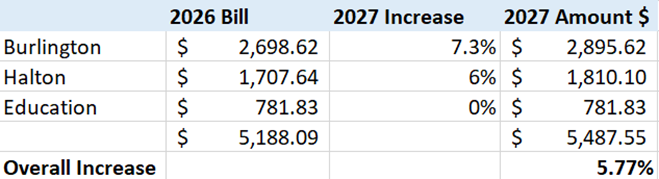
The total bill will increase by 5.77%.
These are forecasts. We won’t know how much our total tax bill will go up until Halton Region, the police, and the Ministry of Education have finalized their budgets.
What will increase by the 2.60% or 3.80% shown in the city’s table above?
Absolutely nothing.
What does this mean in terms of dollars?
A 5% to 7.3% increase in the city’s box/line on our tax bill translates to the city collecting, in total, between $297 million and $302 million in property taxes (excluding taxes for Halton and Education), which is about $17 million more than it collected in 2026.

The report to council highlights that Burlington remains below the group average when comparing the tax burdens of similar properties across surrounding municipalities in the Greater Toronto and Hamilton Area (GTHA), according to the 2025 BMA annual study. The report does not include a reference to the BMA study or a summary of the data used to justify this statement.
A quick comparison of two bungalows shows:
265 Snowden Road, Oakville – 1303 sq. ft above grade – brick exterior
– annual property taxes (Oakville, Halton, Education) – $5,792.
https://www.realtor.ca/real-estate/29775282/265-snowden-road-oakville
291 STRATHCONA Drive, Burlington – 1335 sq. ft above grade – brick exterior
– annual property taxes (Burlington, Halton, Education) – $6,160.
https://www.realtor.ca/real-estate/29788215/291-strathcona-drive-burlington
The BMA study, available courtesy of the City of Guelph, does show the municipal tax burden as a % of household income. Essentially, a measure of affordability, with Burlington coming in on top, in the region, taking 4.2% of household income.
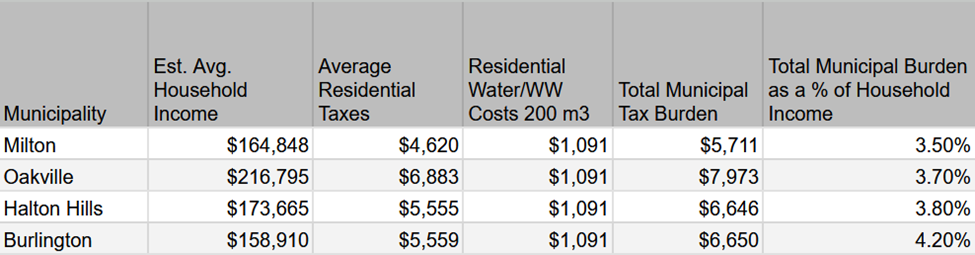
Page 474 https://guelph.ca/wp-content/uploads/2025-BMA-Municipal-Study.pdf
Why the tax increase range?
The upper end of the 2027 forecast (7.3%) specifically accounts for an increased contribution to capital reserves. This intentional investment is designed to address a projected $350 million infrastructure deficit over the next 10 years, as identified in the city’s 2025 Asset Management Plan update.
The report makes no mention of the $150 to $200 Million that staff estimates will be required for community facilities at 1200 King Road, or how much this project will add to the infrastructure deficit going forward. Discussions include a hockey arena, a new 50-meter competition pool, and a new 25-meter community pool.
There is also no mention of a slowdown in the construction industry. Mike Collins-Williams spoke at City Hall earlier in 2026 and said that the slowdown in the industry is lowering construction costs.
There is also no mention of the infrastructure levy funds added to the annual property tax in 2025, and again in 2026. In 2026, the mayor repeatedly stated that 2% of the increase (meaning 1/3 of the 5.8% 2026 increase) was for infrastructure. The 2026 budget showed that fully 2/3rds of the 5.8% increase went to increases in salaries, wages, benefits, and consulting. We’ve been told for the last two years that the tax increase is to support infrastructure, and we’re being told the same thing this year, despite the 2026 budget not supporting these claims.
The Financial Forecast makes no mention of the average salary increase for 2027. The average increase in 2026 was 5%.
This is an election year, and the Proposed Budget for 2027 is expected to be released in January 2027, with final budget adoption in February.
The full report is available here: https://burlingtonpublishing.escribemeetings.com/filestream.ashx?DocumentId=97097
Vote, to be heard, on October 26th, 2026.
A follow-up posting will deal with how our councillors received this report. During our current mayor’s time in office, no limits have been placed on staff. Staff have been asked to present the best budget possible. This has resulted in increased borrowing and a 44.7% increase (over the last 4 years) in the Burlington item on our tax bill. The best budget possible may mean the best budget for staff and not residents.
Discover more from Focus Burlington
Subscribe to get the latest posts sent to your email.